















How to Choose the Right Fintech Web Development Company for Your Business



Fintech websites have a much bigger job than most B2B websites. They need to educate buyers, support onboarding, communicate security and compliance, and earn enough trust for someone to share sensitive financial information. There's very little room for error.
That's what makes choosing a fintech web development company so important. A project can look like it's going well. The designs get approved. Development stays on schedule. The website launches. Then buyers struggle to navigate the product, compliance reviews expose gaps, or the experience simply doesn't build enough trust to convert. By then, you've already invested $15,000-$75,000, and fixing those problems often means bringing in another agency.
The difficult part is that most companies offering fintech web development services look qualified. Every portfolio has polished visuals and recognizable client logos. Much harder to judge is whether an agency understands complex buyer journeys, regulatory requirements, and the product decisions that shape successful fintech websites.
The six questions below will help you evaluate any fintech web development company beyond its portfolio, identify genuine fintech expertise, and avoid an expensive decision you'll have to reverse later.
TL;DR
- Look for category-specific fintech experience (payments, lending, regtech), not generic B2B portfolios
- Prioritize agencies that lead with research and business outcomes over visual design
- Compliance and post-launch support should be built into the process from day one, not bolted on at the end
What Makes Fintech Web Development Different?
Web development for fintech is more complex than traditional B2B web development because every website has to balance regulatory compliance, explain complex financial products, and support long-term scalability.
Here are the three factors that make fintech web development different.
1. Every compliance requirement shapes the user experience
Compliance isn't something a fintech website adds before launch. It influences how customers discover the product, sign up, verify their identity, and complete key actions.
Take KYC onboarding as an example. It determines what information users need to provide, when they provide it, and what they can access next. The same applies to mandatory disclosures, consent flows, and authentication. They're regulatory requirements, but they also shape the user journey.
Research shows that 4 to 7 out of every 10 prospects abandon financial onboarding before completing it, showing how quickly compliance-related friction can become a business problem. Look for a fintech web development company that can balance regulatory requirements with a smooth user experience.
2. Complex financial products need to be easy to understand
Fintech websites need to do more than describe features. Product walkthroughs, calculators, interactive visuals, and educational content help buyers understand how the product works, why it matters, and whether it's the right fit for their needs.
When choosing a fintech web development company, look for experience simplifying complex financial products through website design. The best partners know how to turn technical products into intuitive buying experiences that build confidence and trust.
3. Only the right technical foundation supports long-term growth
Three technical decisions shape how well your fintech website holds up long-term:
- CMS choice: Your CMS determines how quickly your team can publish new pages, update disclosures, and launch products without relying on developers.
- Compliance integrations: Fintech websites often connect with KYC providers, payment gateways, CRMs, and analytics platforms. These integrations need to be reliable, secure, and easy to maintain.
- Security architecture: Security needs to be built into the website from the start through encrypted data handling, secure authentication, and protection against common vulnerabilities.
The right fintech web development company helps you make these decisions early instead of fixing expensive problems later.
4. Performance has to be built in
A two-second lag during KYC verification is enough to make a buyer question whether the website can be trusted with their money. Slow load times don't just hurt rankings. In fintech, they read as a warning sign that something's off with the site itself.
But speed can't come at the cost of compliance. Cutting security checks or KYC steps to shave off load time just trades one risk for another. Look for a fintech web development company that builds fast websites without cutting corners on what they're required to verify.
How to Find the Right Fintech Web Development Company: 6 Questions to Ask
Here are six questions to evaluate whether an agency is the right fit for your fintech brand.
1. Do You Have Experience Working With Fintech Companies Similar to Ours?
A payments company doesn't need the same website as a lending platform. Each serves different buyers, navigates different compliance requirements, and guides users through different conversion journeys. The same is true for a startup launching its first website versus an established fintech looking to improve conversions.
The closer a fintech web development agency's experience is to your category and stage, the faster they'll understand your buyers, regulatory environment, technical constraints, competitive landscape, and business goals. That context influences everything from the user experience and messaging to the technical decisions behind the website.
What a good answer looks like
A strong agency should be able to:
- Share case studies from fintech companies in your category or adjacent verticals
- Explain how their approach changed based on the product, buyer, compliance requirements, and technical constraints
- Explain their experience with the CMS platforms and compliance-heavy integrations your website requires
- Connect their design and development decisions to measurable business outcomes
- Be upfront about whether development is handled in-house or outsourced
- Demonstrate experience across multiple fintech verticals and growth stages
What this looks like in practice
While both our clients, Zenda and Refo, operate in fintech, the problems their websites needed to solve were completely different.
Zenda helps schools and parents manage fee payments, so the website needed to feel simple, approachable, and easy to navigate for people who aren't financial experts.
Refo is an open banking and lending automation platform. The challenge was helping buyers quickly understand a complex platform, connect multiple products and workflows, and feel confident enough to book a demo.
That level of understanding usually comes from working across different fintech verticals and growth stages, not simply having a few fintech logos on a portfolio page.
Potential red flags
- No fintech experience within your specific category
- Generic B2B examples instead of fintech case studies
- No measurable outcomes tied to the work
- Can't explain how their approach changes across fintech segments
2. What Results Have You Helped Fintech Clients Achieve?
Business outcomes matter, but they're only part of the picture. The more revealing question is why the website was built the way it was. The answer gives you a glimpse into how the agency thinks.
Strong fintech web design and development agencies don't just tell you what changed after launch. They explain why they made specific strategy, design, and development decisions.
Maybe they reorganized the navigation because buyers couldn't distinguish between similar products, restructured product pages to make a complex platform easier to understand, or surfaced trust signals earlier because visitors needed reassurance before sharing sensitive information.
Those decisions reveal far more about an agency's expertise than simply saying they increased conversions or built a modern website.
What a good answer looks like
A strong agency should be able to:
- Explain the business problem the site needed to solve, before jumping to the solution.
- Walk through their key decisions and why: navigation, page structure, trust signals, whatever it was.
- Tie those decisions to something specific about that client's product, buyers, or market.
- Connect those decisions to meaningful business outcomes, even when exact metrics are confidential.
What this looks like in practice
Take our client, Zamp, a fully managed sales tax compliance platform. Zamp operates in a crowded category alongside players like Avalara and TaxJar, where many competitors offer similar features and make similar promises.
The challenge wasn't explaining what Zamp does. It was helping CFOs and finance leaders quickly understand why they should choose Zamp over the alternatives. That insight shaped how the website was structured, how information was prioritized, and how buyers moved through the site.
Instead of leading with features, the website was organized around the questions buyers needed answered before trusting a sales tax compliance platform. Every strategy, design, and development decision supported that goal. The website wasn't measured by how modern it looked. It was measured by how effectively it helped buyers understand Zamp's value and take the next step.
Potential red flags
- They jump straight to the solution without explaining the business problem.
- Every project follows the same approach, regardless of the product or buyer.
- They describe what they built, but not why they built it that way.
- Success is measured by how the website looks rather than how it performs for the business.
3. How Do You Approach a Fintech Website Project?
As one fintech buyer put it on Reddit, choosing a development partner was "the highest-stakes decision" of their project because the wrong choice could have legal and reputational consequences. That's why evaluating an agency's process matters just as much as evaluating its portfolio.
For example, deciding where compliance information appears or how a customer onboarding flow works can directly influence whether visitors trust your business enough to take the next step. Without that foundation, it's easy to build a polished website that fails to solve the right business problem.
What a good answer looks like
A strong agency should be able to:
- Explain how they evaluate your existing website before making recommendations.
- Show how buyer research, competitive analysis, and compliance requirements shape the project.
- Explain how those insights influence the website structure, content architecture, user journeys, and development decisions.
- Walk you through how strategy translates into implementation, testing, and launch.
- Explain how integrations across your CMS, CRM, analytics, and marketing stack are planned from the start.
What this looks like in practice
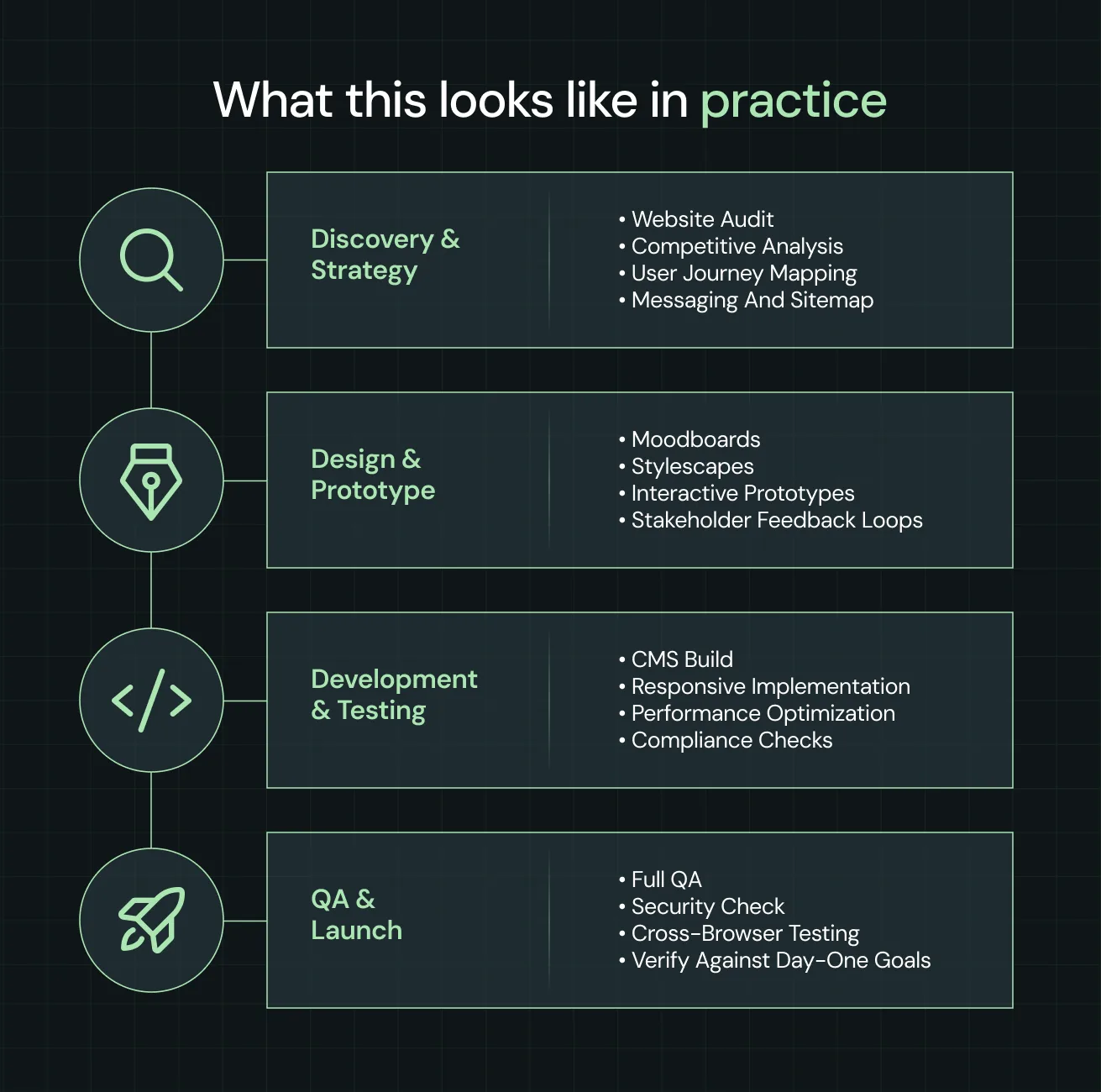
At ThunderClap, every fintech project begins with discovery. We audit the existing website, map user journeys, analyze competitors, and identify conversion gaps before recommending any changes.
Those findings shape the website strategy, including the information architecture, messaging, and user flows. Once the direction is validated, we move into design and prototyping to test ideas before development begins.
From there, the website is built, tested, and optimized for performance, accessibility, and compliance before launch. Every stage is measured against the business goals defined during discovery to make sure the final website doesn't just look good, but performs the way it should.
Potential red flags
- They jump into design before understanding your business.
- Discovery is limited to a kickoff questionnaire.
- They can't explain why key website decisions were made.
- Their process changes depending on who's pitching.
4. How Do You Handle Compliance and Security on a Fintech Website?
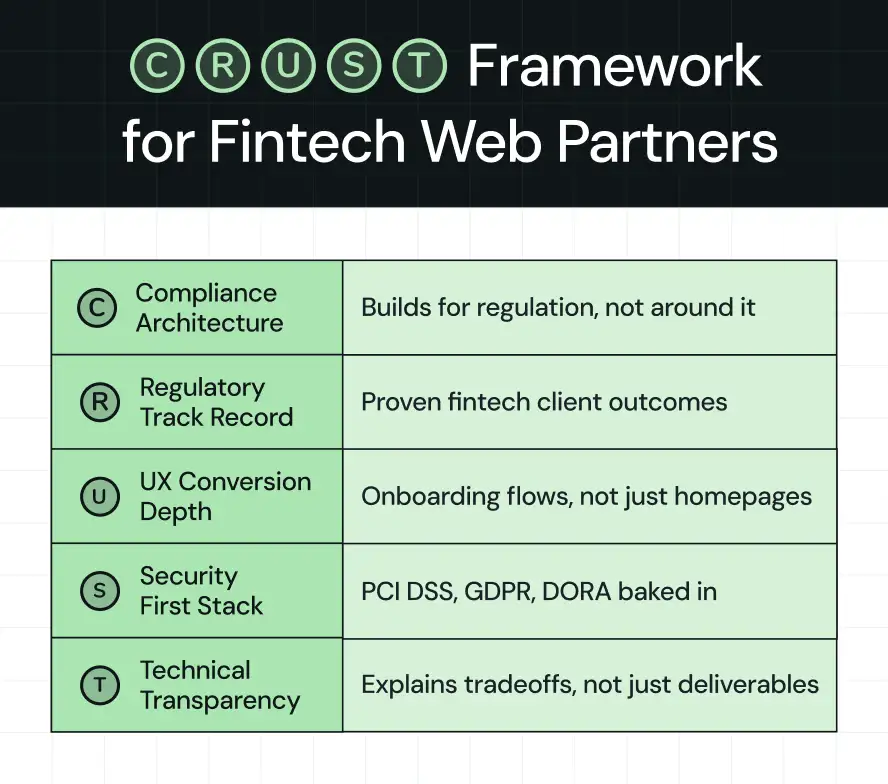
The answer to this question often separates agencies with genuine fintech experience from those applying a generic B2B website process. One way to evaluate their response is through ThunderClap’s CRUST Framework, which highlights the five capabilities every fintech web development agency should have.
What a good answer looks like
A strong agency should be able to:
- Build compliance into the website from the beginning, allowing regulatory requirements to shape website structure, user journeys, and trust signals instead of treating them as a final review.
- Demonstrate experience building websites for regulated fintech businesses, backed by relevant case studies and an understanding of industry-specific compliance requirements.
- Design buyer journeys that balance trust, onboarding, disclosures, and conversion without creating unnecessary friction or overwhelming users.
- Explain how security influences development decisions, from handling sensitive information and integrations to communicating security throughout the website.
- Clearly explain development decisions, trade-offs, and recommendations so you understand why specific approaches were chosen.
What this looks like in practice
Take our client Rezolv, an AI-powered debt collection platform operating in one of fintech's most heavily regulated categories.
Compliance wasn't something we added at the end. It shaped how the website was structured. Data Privacy & Security sits in the main navigation, not in the footer. Certifications don't just display logos; they show validation frequency so visitors know the credentials are current. Even the data ownership section is written for buyers handing over sensitive information, not auditors reviewing a checklist.
They're small decisions, but for someone evaluating risk, they're often the difference between doubt and trust.
Potential red flags
- Compliance is treated as a final review step.
- The agency has little or no experience building websites for regulated fintech businesses.
- User journeys follow generic B2B best practices instead of addressing fintech-specific trust and compliance requirements.
- Security information is difficult to find or treated as an afterthought.
- The agency can't clearly explain the reasoning behind its development decisions.
5. How Do You Measure Success After Launch?
A successful launch doesn't guarantee a successful website. This question reveals whether an agency treats launch as the finish line or the start of continuous optimization. Post-launch optimization determines whether your website continues to improve or gradually loses momentum.
What a good answer looks like
A strong agency should be able to:
- Define success metrics before launch and align them with your business goals.
- Explain how they monitor website performance after launch and how those insights translate into ongoing improvements.
- Show how post-launch support includes landing page conversion optimization, not just bug fixes
What this looks like in practice
At ThunderClap, post-launch support runs for 30 days. During that time, we track Google Analytics and Search Console data to see whether the site is performing the way it should. If the numbers aren't moving, we tell you why and what to change. If they are, we tell you that too.
As Ankita Deb, Accounts Director at ThunderClap, puts it:
"We measure success through a mix of quantitative and qualitative metrics. Quantitative indicators include improvements in conversions, lead quality, organic traffic, and bounce rates. Qualitative metrics include brand perception, messaging clarity, and how easy the new CMS is for internal teams."
Potential red flags
- Success is measured by traffic alone, not pipeline or conversions
- No one is monitoring Google Analytics or Search Console after handover
- Post-launch support requires a new contract
6. How Do You Handle Website Maintenance After Launch?
Fintech regulations don't stay still. When the Digital Operational Resilience Act (DORA) came into effect in 2025, fintech companies had new compliance requirements to communicate on their websites. Some teams updated their pages and moved on. Others found themselves raising tickets, waiting on developers, and turning a simple update into a project.
That's the reality of fintech. A website redesign isn't the end of the journey. Regulations change. Products evolve. New certifications need to be added. New markets need new pages. Maintaining a fintech website goes beyond updating content. It also means keeping the website technically secure, reliable, and compliant as your CMS, plugins, integrations, and third-party tools evolve.
Most agencies focus on keeping the website running. The best partners combine routine technical maintenance with proactive monitoring and optimization, helping you catch security vulnerabilities, broken experiences, and performance issues before they affect your buyers.
What a good answer looks like
A strong agency should be able to:
- Explain what they do between active projects, not just when tickets are raised
- Describe how they handle ongoing technical maintenance, including CMS updates, security patches, plugin and dependency updates, and integration health.
- Show how they monitor performance proactively using CRO tools like Google Analytics, Search Console, and behavior tracking
- Walk you through their handover process so your team can manage content updates, compliance pages, and certifications without raising a ticket every time
- Be clear about turnaround times for standard and urgent requests
What this looks like in practice
At ThunderClap, website maintenance isn't just about fixing what breaks. Between projects, we track analytics and Search Console data, run behavioral checks using tools like Microsoft Clarity, and flag issues before they become problems. A broken form, a slow page, a compliance page that needs updating—we catch it before you do.
Potential red flags
- Goes quiet between active projects.
- Maintenance is limited to reactive bug fixes instead of ongoing technical maintenance.
- No proactive monitoring using analytics or user behavior data.
- No structured handover process after launch.
- Vague about turnaround times for standard and urgent requests.
What to Look for in a Fintech Web Development Company: At a Glance
To find the best fintech web development company, look for proven fintech experience, a research-led process, a strong understanding of compliance and trust, clear post-launch support, and a maintenance approach that can adapt as your business grows.
{{specficService}}
Which Fintech Web Development Agencies Should You Shortlist?
Knowing what to look for is one thing. Finding agencies that actually meet those standards is another. Based on the criteria we've covered, here are three fintech web development agencies worth considering.
{{specficBlog}}
Why Fintech Companies Choose ThunderClap
The questions in this guide reflect the same challenges we've helped fintech clients solve across payments, lending, tax compliance, debt collection, and financial infrastructure. We've worked with companies like Razorpay, Refo, Rezolv, Zamp, and Zenda, each with different products, buyers, and growth goals.
If you're wondering why these fintech companies chose ThunderClap, here are a few reasons:
- Fintech expertise: From payments (Razorpay and Zenda) to lending (Refo), tax compliance (Zamp), and debt collection (Rezolv), we've helped fintech companies tackle very different trust, positioning, and conversion challenges.
- Strategy before design: Every project starts with a website audit, research, positioning, messaging, and user journey mapping so the website solves the right business problem, not just the design problem.
- Proven B2B experience: Our work across fintech, SaaS, AI, HR tech, and venture capital helps us apply proven conversion and messaging principles to complex fintech products.
- End-to-end execution: Strategy, website copy, design, development, and CRO under one roof means fewer handoffs, faster execution, and a more consistent customer experience.
- Post-launch support: We continue tracking performance and supporting improvements after launch so the website keeps delivering results long after go-live.
- Built to scale: Whether you're launching new products, entering new markets, or updating compliance information, your website can evolve without needing a complete rebuild.
{{ctaBlock}}
Frequently Asked Questions on Fintech Web Development
1. Why is security important in fintech web development?
Security is critical in fintech websites because they handle sensitive financial and personal data. Users expect strong security practices to protect their information, support compliance requirements, reduce fraud risks, and build trust in the company.
2. How much does fintech web development cost?
The cost of web development for fintech depends on the scope of the project, integrations, functionality, compliance requirements, and content needs. For a mid-market agency, fintech website projects typically start at around $15,000, with larger, more complex projects costing significantly more.
3. How long does it take to develop a fintech website or platform?
Most fintech and banking web development projects focused on websites take between 8–12 weeks to design and develop. Timelines depend on the number of pages, content requirements, integrations, and stakeholder feedback cycles. Fintech platforms and products typically take several months or longer, depending on the complexity of the functionality, security requirements, integrations, and overall development scope.
4. Do I need a fintech-specific web development company?
A fintech-specific web development company isn't always necessary. However, your agency should understand fintech buyer journeys, trust signals, compliance requirements, and security considerations. That expertise usually leads to a smoother project and a website that better serves fintech buyers.
5. How do you explain a complex fintech product on a website?
To explain a complex fintech product on a website, use clear messaging, real-world examples, product visuals, videos, and trust signals. The goal is to help visitors quickly understand what the product does, who it's for, and why it matters.
6. Will we be able to update the website ourselves after launch?
Yes, you will be able to update the website yourself after launch. Most fintech websites are built on CMS platforms like Webflow, allowing marketing teams to update content and create pages without developers. If you need ongoing support, you can also opt for website maintenance plans offered by web design and development agencies.



.webp)
Browse Similar Articles




Leading 5 SaaS Branding Agencies in Florida (That Actually Understand SaaS Growth)

.svg)

How to Turn Your B2B Website into a Self-Serve Growth Engine? (PLG Ready in 2026)


9-Step Website Copy Audit Checklist to Improve Conversions (Examples from Top B2B Brands)

.webp)

Top B2B Website Design Principles That Turn Visitors into Qualified Leads

%20Audit%20That%20Actually%20Improves%20Revenue.webp)
How to Do a Conversion Rate Optimization (CRO) Audit That Actually Improves Revenue
Web Design Agency vs. Freelancer vs. In-House: What Actually Works in 2026
5 CRO Agencies in London and How to Choose the Best CRO Agency for Your Business

The Ultimate Fintech B2B Positioning Guide for 2026 (That Actually Drives Conversions)
Mapping the B2B Buyer Journey to Improve Conversions Across Every Touchpoint
.webp)
7 Best Website Maintenance Companies in India for Growth-Led B2B Teams (2026)

.webp)


8 Best Healthcare Website Design Agencies for HIPAA-Compliant Sites in 2026



How to Find the Best Web Design Company in Houston, Texas for B2B Brands (6 Best Picks)

Positioning That Wins: How to Make Complex B2B Products Clear and Compelling
The Step-by-Step Website Redesign Process B2B Teams Use to Increase Conversions (Without Killing SEO and Pipeline)
7 Best Video Production Agencies for SaaS Product Walkthroughs and Feature Videos

How to Choose the Best B2B Website Maintenance Company: 9 Questions to Ask Before You Hire One




How to Choose a Web Design Company in San Francisco in 2026 (with Examples)

10 Best Web Design Companies in Florida in 2026 and How to Choose the Right One

How to Use Brand Storytelling on Your Website to Close More B2B Deals and Build Buyer Trust

SaaS CRO Best Practices: What High-Growth Brands Do Differently to Win Conversions


How a Rebranding Agency Can Redefine Your B2B SaaS Identity and Boost Pipeline


B2B Marketing Trends in 2026 That Directly Influence Pipeline and Revenue

Top 7 Video Marketing Agencies Driving B2B SaaS Brand Awareness in 2026

Why Partnering with a B2B Brand Positioning Agency Accelerates Market Differentiation

The Complete Website Redesign Checklist for B2B SaaS Teams Ready to Scale

.avif)
10 Best Webflow Development Agencies in India for 2026 (In-Depth Review)

10 Product Marketing Companies Powering the Fastest-Growing SaaS Brands in 2026
Website Copywriting Services vs In-House: What's Right for Your Business?


How to Choose a Marketing Agency That Understands B2B SaaS Growth Metrics


How to Choose a Video Marketing Agency That Understands B2B Storytelling

Outsourcing Web Design: Cost-Benefit Analysis for Mid-Market & Enterprise Brands

From Leads to Lifetime Value: How Growth Marketing Agencies Scale SaaS Revenue
Build a B2B Website Strategy That Aligns with Sales and Marketing Goals
Webflow vs WordPress: Which Platform Is Better for Your Business Website in 2026?
Fintech Web Design That Builds Trust: 8 UX Principles Every Fintech Site Needs

Optimizing for Intent: How B2B Website Messaging and UX Changes Help Capture Top-Funnel Buyers



12 Best B2B Web Development Agencies in the US to Build Scalable Websites

From Audit to Action: 8-Step Process to Optimize Your B2B Website Strategy for 2026 Buyers

How to Design a High-Converting Landing Page from Scratch (2026 Edition)

From Click to Customer: Proven Landing Page Conversion Optimization Techniques

How to Write Website Copy That Converts: A Step-by-Step Guide for 2026


How to Optimize a Landing Page for Maximum ROI: A Step-by-Step Breakdown


AI Landing Pages That Convert: 7 Design Principles Every AI Platform Should Follow
From Traffic to Pipeline: B2B Website Growth Strategy for Scaling Teams


B2B Website Optimization Strategy: Speed, UX, SEO, and CRO in One Playbook




Interested in seeing what we can do for your website?



.webp)
