















Mapping the B2B Buyer Journey to Improve Conversions Across Every Touchpoint


TL;DR
- B2B buyers complete 61–70% of their purchase journey before ever speaking to a sales rep, meaning marketing owns far more of the conversion process than most teams realize.
- The average B2B purchase involves 13 internal stakeholders across multiple departments. Deals are more likely to slow down due to internal misalignment than due to competitive loss.
- Buyer journeys are non-linear. Prospects loop back, enter mid-funnel, and build shortlists before vendors are even aware of them.
- High-intent touchpoints, including pricing pages, case studies, and demo requests, signal decision readiness and warrant more investment than top-of-funnel traffic metrics.
- 86% of B2B purchases slow down during the buying process. Most of these slowdowns occur between the demo stage and internal buy-in, not at the top of the funnel.
- Effective journey mapping starts with closed-won deal analysis rather than buyer personas. It must also connect to live metrics to enable meaningful optimization.
Why did that deal slow down?
How can we close faster?
Where did the buyer lose interest?
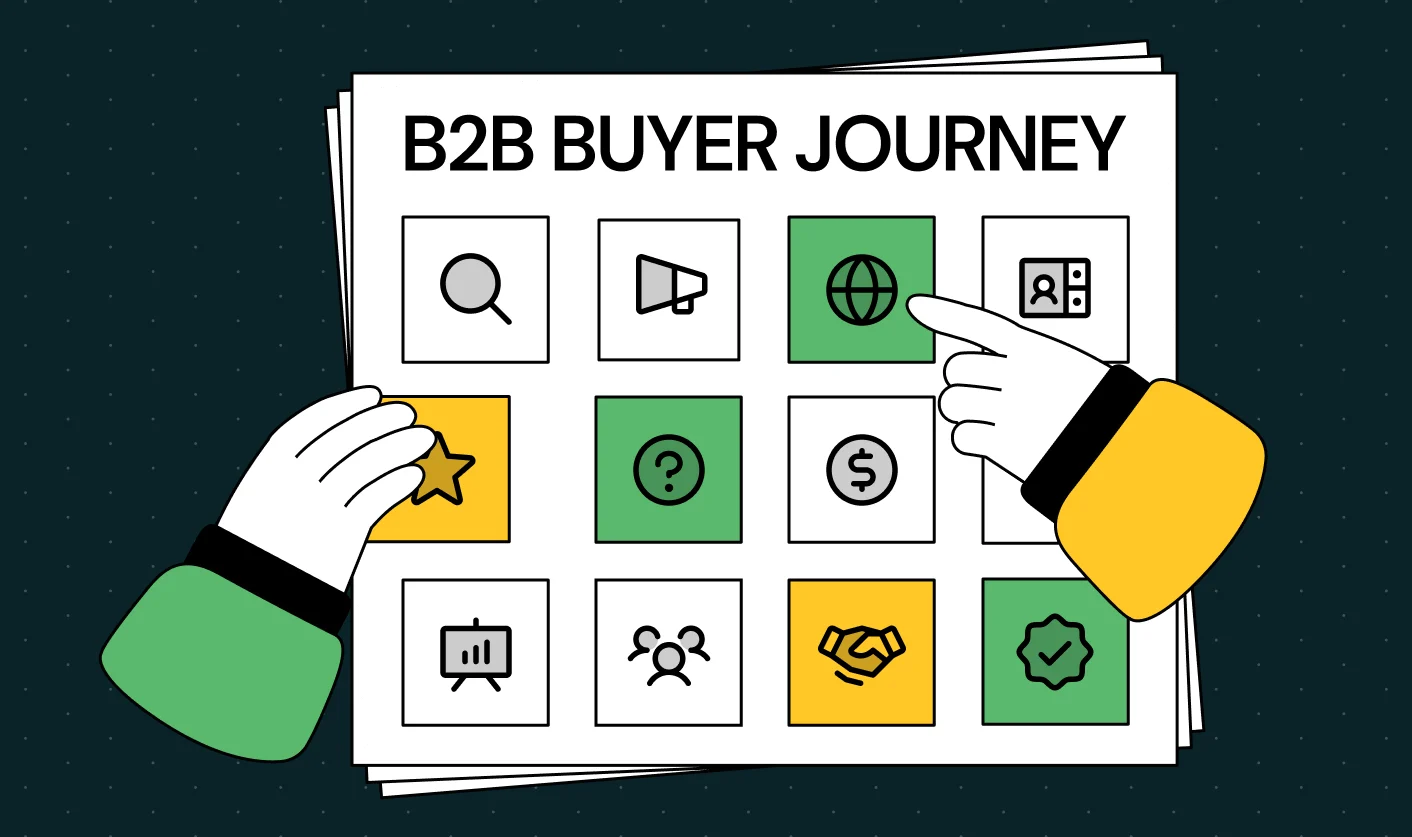
If you're a B2B marketer, salesperson, or revenue leader, these questions come up often and rarely have clear answers. Modern B2B buying is complex, involving multiple stakeholders, shifting priorities, and unpredictable paths to purchase. Buyers no longer move neatly from awareness to decision. They research independently, revisit earlier stages, and engage only when they feel ready.
This makes it difficult to pinpoint what is actually driving conversions or causing delays. Without a clear view of the buyer journey, teams rely on assumptions instead of evidence, leading to missed opportunities and inefficient efforts.
Mapping the B2B buyer journey changes that. It helps you understand how real buyers move across touchpoints, where momentum builds or drops, and how marketing and sales can work together to guide decisions more effectively.
The Real Problem: Most Buyer Journeys Don't Reflect How B2B Buying Actually Happens
You’ve probably stared at a “perfect” funnel report while a real deal quietly unraveled in your pipeline. The uncomfortable truth is that most buyer journey models were never built to explain what you’re actually seeing.
The myth of linear stages (Awareness → Consideration → Decision)
The classic funnel model, consisting of Awareness, Consideration and Decision, was built for a world where vendors controlled information.
In SaaS, especially, this model collapses almost immediately. Buyers don't start at awareness and move tidily down to decision. They enter from review sites, peer recommendations, LinkedIn threads, and analyst reports, often with a shortlist already formed.
According to 6sense's 2025 B2B Buyer Experience Report, 95% of the time, the winning vendor is already on the buyer's Day One shortlist. The funnel assumes you have a chance to earn consideration. In reality, you either made the shortlist before contact, or you didn't.
More telling, buyers don't contact sales until they're 61% through their journey on average, down from 69% in 2024, but still representing nearly two-thirds of the evaluation process happening without you in the room.
What today's B2B buyer journey actually looks like
Today's buyer journey is self-directed, multi-stakeholder, and deeply fragmented. Buyers start with independent research, often using AI tools to compare vendors before visiting a single company website. According to recent studies, buyers consume 27 pieces of content before making a purchase decision, and most of that content lives outside any vendor's direct control.
The buying motion looks less like a funnel and more like a network. For example:
- A user discovers a tool.
- They mention it to a manager.
- The manager loops in IT.
- IT flags a security concern.
- Finance wants to see ROI data.
- A VP already has a competing vendor in mind from a conference six months ago.
These stakeholders are entering at different points with different questions, and your content, social proof, and positioning need to work for all of them simultaneously.
What holds the journey together is a mix of content, product experience, and third-party proof. Case studies, peer reviews, demo environments, and pricing transparency all help buyers build their own understanding of your value long before a sales rep enters the scene.
Where conversions actually drop (and teams don't notice)
Most conversion drop-offs don't happen at the top of the funnel. They occur in three areas where teams rarely perform well.
- The first is the gap between content and demo. A buyer reads your content, visits your site, maybe even downloads something, and then nothing. There's no clear bridge from "I'm curious" to "I want to see this in action," and the buyer drifts away.
- The second is the gap between demo and internal buy-in. The person who engaged with your demo is convinced. However, they now have to sell it to finance, legal, IT, and a skeptical VP without your support.
- Most teams provide no real support for that internal selling process. The third is what appears to be ghosting. A deal goes quiet, and the instinct is to assume the buyer lost interest.
In reality, Forrester's 2024 State of Business Buying report found that 86% of B2B purchases slow down during the buying process, typically due to internal issues rather than competitive loss.
What "Mapping the Buyer Journey" Really Means (Beyond Miro Diagrams)
If your last journey map looked clean, structured, and completely disconnected from how deals actually progressed, you’re not alone.
The problem is not a lack of mapping. It is that most maps are built for presentation, not for how buyers truly make decisions.
It's not stages; it's decisions buyers are trying to make
A buyer journey map is only useful if it reflects what buyers are actually doing, asking questions, and making decisions. Not moving through stages.
At every point in the journey, buyers are working through three fundamental questions.
- The first is relevance → "Is this even the right category of solution for us?"
- The second is trust → "Can I trust this vendor to deliver?"
- The third is switching cost → "Is what we'd gain worth what it'll take to change?"
These three questions don't resolve in sequence. A buyer can be deep in evaluation and suddenly cycle back to the relevance question when a new stakeholder joins the conversation. Your journey map needs to account for that, and your content and sales motion need to address all three, not just the ones that feel most like "closing" activity.
Touchpoints are not channels; they're moments of intent
This is where most journey maps fail. Teams track channels, including email opens, webinar registrations, and social clicks, and assume they're tracking the journey.
They're not.
A website visit is not an intent to buy. A visit to the pricing page, combined with a case study download and a return visit three days later, is the intent. A demo request after a competitor comparison page? High intent.
McKinsey's survey found that buyers now use an average of ten interaction channels throughout their journey, and the best-performing companies treat those interactions as signals, not just traffic.
Where you focus determines where your resources go. If you're optimizing for page views, you'll pour budget into top-of-funnel content. If you're tracking intent signals, you'll pay close attention to what happens on your pricing page, your integration docs, and your customer case studies, and that's where the conversion leverage actually lives.
ThunderClap focuses on identifying these high-intent moments across fragmented touchpoints, not just page views.
Case in Point: Twilio
Twilio is a brand that understands this. They recognize that someone exploring messaging APIs, email delivery, or customer data platforms is not just browsing features, but actively trying to build customer experiences.
Instead of treating visitors as generic traffic, Twilio channels intent into product-specific pathways across communications, messaging, voice, authentication, and customer data tools.
On these product pathways, users see:
- A clear entry point to start building or exploring use cases like Messaging, Email, Voice, and Customer Data Platform
- A product-led structure that maps directly to intent (send messages, make calls, verify users, manage data)
- Real-world applications and developer-first guidance showing how each tool fits into a build workflow
Why it works
- Intent-to-use-case mapping: Twilio captures high-intent developer and builder queries and routes them directly into relevant product experiences rather than generic content.
- Positions the platform as infrastructure, not information: Instead of educating in isolation, Twilio immediately connects intent to actionable building tools across its API ecosystem.


The goal: Reduce friction, not increase touchpoints
More touchpoints don't produce higher conversion. Better touchpoints do.
HockeyStack's 2024 research found that for $100K+ ACV deals, buyers experience roughly 417 touchpoints before close, but top-performing teams aren't winning because they've engineered more of them. They're winning because they've made the critical ones clearer and faster.
The goal of journey mapping isn't to add more to the buyer's path. It's to remove what's slowing them down, which includes unanswered questions, missing proof points, confusing messaging, and unclear next steps.
Clarity and confidence are what move buyers forward. More touchpoints, without those, just create unnecessary chaos.
The Modern B2B Buyer Journey (and What's Changed)
If your pipeline looks unpredictable even when your messaging and targeting are “working,” it is usually not a performance issue.
It is a visibility issue into how buying actually happens across people, channels, and time.
Buyers complete most of the journey before talking to sales
Gartner's data shows that B2B buyers spend only 17% of their total buying time in direct contact with potential vendors. If a buyer is evaluating three vendors, each one gets roughly 5–6% of the calendar. That means your website, your reviews, your case studies, your community presence, and your peers' word-of-mouth are doing the vast majority of the persuasion work.
Marketing now owns a significantly larger share of the conversion process than most org charts reflect, because the persuasion is largely done before a rep ever enters the picture.
The teams winning today have restructured accordingly, building content that answers the questions buyers bring before they engage sales, and creating proof points that work without a rep in the room.
The rise of the "dark funnel"
Forrester estimates that 70–80% of the B2B evaluation process occurs in what's commonly called the dark funnel, encompassing channels and interactions that no analytics platform can track.
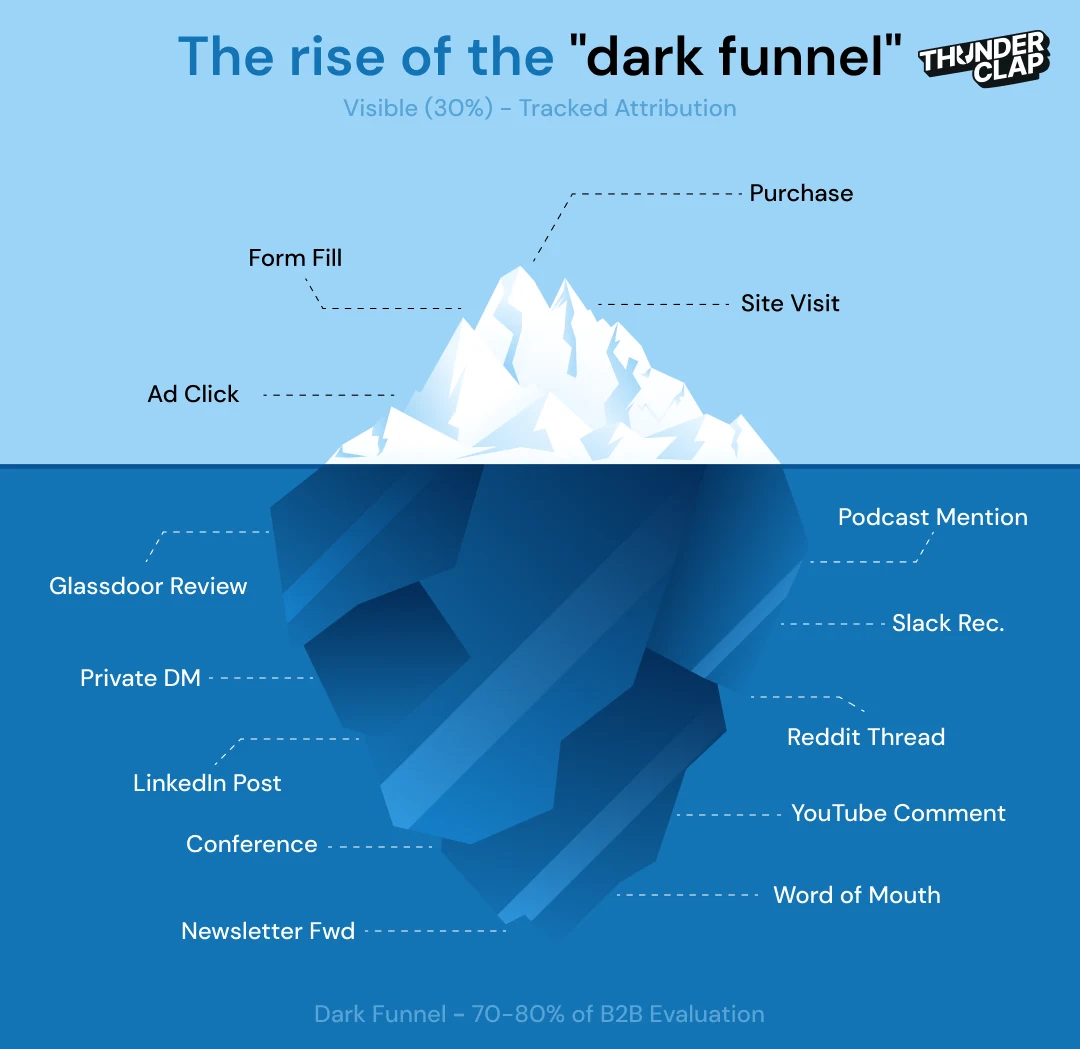
Let’s say a colleague recommends your product in a Slack channel. A buyer asks ChatGPT to compare your tool against two competitors. A VP mentions your name at a strategy offsite because they saw a LinkedIn post three months ago. None of that shows up in your CRM.
This is why traditional attribution breaks. Last click models over-credit the final interaction while ignoring the peer conversations, private research, and external validation that actually shape the decision.
The reality is that buyers do not move through a trackable sequence of touchpoints. They move through fragmented, self-directed research across tools, people, and contexts that sit outside your visibility.
In practice, a large part of this influence is created by people rather than campaigns. Founders and operators who consistently share revenue insights, product lessons, and go-to-market thinking on platforms like LinkedIn end up shaping perception long before a buyer ever enters a pipeline.
Adam Robinson, for example, built RB2B into a $25M bootstrapped SaaS company by growing his LinkedIn following to 132K, sharing transparent growth and revenue insights that turned operator-led content into a distribution channel.

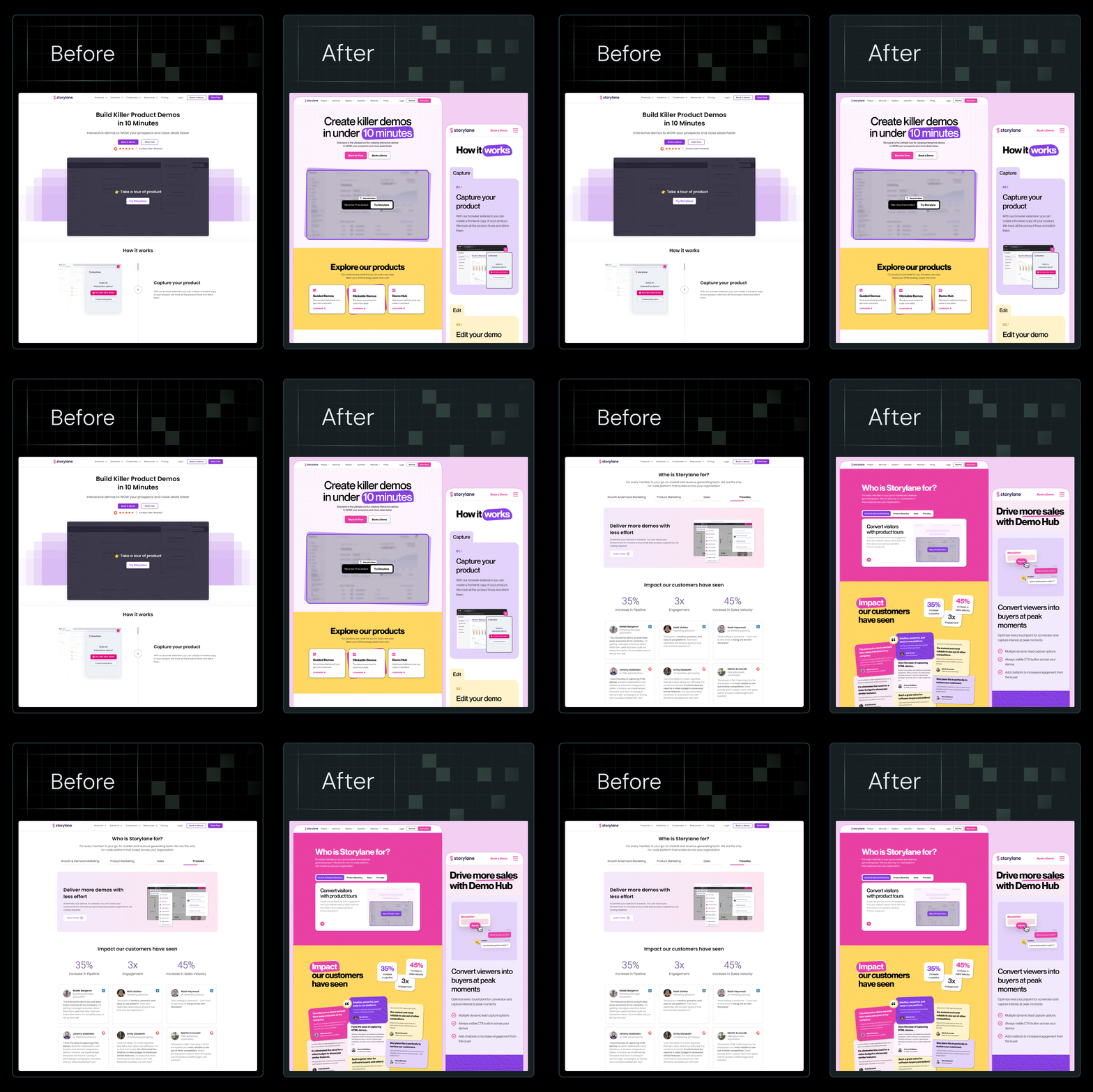
The same pattern shows up at the company level. Teams like Storylane amplify product updates, customer wins, and industry insights by consistently sharing employee voices on LinkedIn.
Instead of relying only on official marketing assets, they create a network of authentic touchpoints that reinforce trust and familiarity across multiple buyer roles over time.
The implication isn't that attribution is impossible. It's that teams need to stop trying to track every touchpoint and start reconstructing the journey from signals, such as behavioral patterns, account-level engagement, and changes in deal velocity, rather than individual click paths. ThunderClap helps connect these scattered signals into a usable journey view.
Consensus buying is now the biggest bottleneck
Deals don't fail at the top of the funnel. They slump in the middle when buying groups can't align internally.
Forrester's 2024 research puts the average B2B buying group at 13 people, with 89% of purchases involving two or more departments. Gartner reported in 2025 that 74% of buying teams experience unhealthy internal conflict during the purchase process.
When committees do reach consensus, they're 2.5 times more likely to report a high-quality decision outcome. That means the job isn't just to convince your champion. It's to give your primary contact the tools to build internal consensus on your behalf.
A Practical Framework to Map Your B2B Buyer Journey
If your current funnel feels like it describes activity but not outcomes, the issue is rarely effort. It is that most teams are still mapping assumptions instead of actual buying behavior.
This framework fixes that by starting from evidence, not theory.
Step 1: Start with closed-won deals (not personas)
Buyer personas are hypotheses. Closed-won deals are evidence.
For journey maps that don't rely on assumptions about real buying behavior, start by pulling your last 20 to 30 closed-won deals and reverse-engineering the buying trigger.
- What changed internally that made the prospect start looking?
- What content did they consume before they reached out?
- Which stakeholders were involved at each stage, and what concerns did each one raise?
This analysis reveals patterns no persona workshop can reach, the actual sequence of events that led a real buyer to say yes, and that becomes the foundation of your journey map.
Step 2: Identify high-intent touchpoints
Not all touchpoints are created equal. Demo requests, pricing page visits, deep engagement with case studies, repeated visits to integration or security documentation are signals that a buyer is actively evaluating
Map them specifically and track which combinations tend to come before a conversion event. These are the signals your systems should detect.
A buyer who visits your pricing page twice, downloads a case study, and then reads your integration docs is clearly showing where they are in the journey and what they need next.
Step 3: Map friction at each step
For each major stage in your mapped journey, ask two questions:
- What questions does a buyer still have at this point?
- And what is slowing down their decision?
Friction isn't always obvious. Sometimes, it's a pricing page that avoids the question buyers actually came to answer, a demo that shows features instead of value, or a sales process that takes three calls to produce a proposal.
Find it before it becomes a problem.
Step 4: Layer stakeholders into the journey
Your journey map needs a stakeholder layer. A user evaluating your product has completely different concerns than the finance lead approving the budget or the IT team reviewing your security posture.
If your content and sales motion treat all of them the same way, you'll lose the ones who have the most sway in the final decision.
To avoid it, here’s what you need to do:
- Map which stakeholders typically enter at which stage, what questions they bring, and what proof they need to feel confident.
- Then, build the materials, such as ROI models, security documentation and implementation guides, that address each one without requiring your primary contact to translate everything manually.
This becomes critical in enterprise buying, where perception gaps often slow down decisions even when the product is strong. For example, Zamp, a managed sales tax solution for mid- to large-sized enterprises, had strong core capabilities, including automated filings, nexus monitoring, and high accuracy.
However, the brand did not reflect that strength for CFOs and Controllers evaluating risk and reliability.
That is when they reached out to us. Here is how we helped them:
- Repositioned around owned data, accuracy, and tax expertise
- Sharpened differentiation against competitors like Avalara and TaxJar
- Simplified messaging to align with CFO-level decision-making
- Rebuilt navigation into persona-driven paths leading to demos
- Designed a cleaner, more premium visual system
- Reinforced transparency and fully managed delivery model
The result is a sharper, more differentiated brand that reflects Zamp’s premium service, backed by 99.9%+ filing accuracy, under-2-hour onboarding, sub-hour response times, and recognition from G2. With $30M+ raised and enterprise-grade credibility, Zamp now looks and sounds like the category leader it already is.
Step 5: Connect journey to metrics
A journey map without metrics is just a diagram. Connect each stage of your mapped journey to a measurable outcome:
- Drop-off rates
- Time-to-close
- Conversion rates between key steps
The average B2B win rate stands at roughly 21%, according to HubSpot. However, the range is wide.
What separates the top performers is usually their ability to identify exactly where deals are slowing down and intervene before the stall becomes permanent.
Step 6: Use systems that connect fragmented touchpoints
Manual mapping works for understanding. It breaks at scale.
Static diagrams and spreadsheets can capture what you know. They can't surface what you're missing, including the following:
- The behavioral patterns across accounts
- The touchpoint combinations that predict conversion
- The stages where deals consistently hold back
ThunderClap is designed to unify fragmented touchpoints, identify drop-off patterns, and give teams something they can actively optimize, not just visualize.
Key Touchpoints That Actually Move B2B Buyers (and Why)
Most B2B journeys do not fall apart because of a lack of interest. They break when buyers lack clarity, proof, or confidence at the exact moments they are making decisions.
Understanding which touchpoints actually reduce uncertainty is what separates predictable pipelines from inconsistent ones.
Case studies (When they're specific enough)
Generic case studies, such as "Company X improved efficiency by 20%," don't move B2B buyers. What moves them is role-based relevance. For example, a story told from the perspective of someone who had the same job, the same constraints, and the same concerns your buyer has right now.
A strong example of this is Rezolv. When their founders approached ThunderClap, they had deep technical expertise but no brand, no website, and no clear way to communicate their product.
We partnered with their team to:
- Create a new logo that captured the product’s power and personality
- Build a distinct brand voice and visual identity that inspires trust and authority
- Develop a messaging framework that communicates product value clearly
- Simplify complex use cases into clear, relatable narratives
After launch, Rezolv saw 39% more engagement from prospects and faster adoption among target customers.
As Karan Mehta, Founder at Rezolv, noted:
“As an early-stage company, we needed a clear brand identity and messaging before launching. ThunderClap delivered exactly that. Concise, impactful copy and branding that feels right.”
Kiran Kulkarni, Partner and Head of Growth at ThunderClap, sees this as a recurring pattern in early-stage fintech, where simplifying complex products into clear, trust-building narratives is what turns attention into adoption.
Read her LinkedIn post to understand more!
When a case study speaks directly to a specific stakeholder's concern (including the CFO's ROI question, the IT lead's integration worry, the end user's workflow concern), it does the work that no sales conversation can fully replicate.
It's credible, it's on-demand, and it's effective even when your rep isn't in the room.
Product-led touchpoints (Demos, trials, walkthroughs)
49% of B2B buyers report that the live demo adds more value to their evaluation than any other single touchpoint, more than interactive demos, reviews, or the marketing website. Buyers want to experience value before they commit, not be told about it.
A strong example of this is Factors.ai. Despite having a product that supported complex, data-heavy workflows, their digital experience did not initially translate that complexity into clarity for marketers.
.webp)
To fix this, the entire brand experience was anchored around a “Marketing Compass” concept, positioning the platform as a guide through the buyer journey rather than just another analytics tool.
They proved this positioning through key design decisions:
- Reducing cognitive load through hand-drawn illustrations and a distinct orange palette
- Building a functional hierarchy so the product story became instantly scannable
- Reinforcing a guide persona through contextual interaction patterns
This transformed the experience into a clearer product narrative, improving understanding before users even entered the product.
As Ayush Barnwal, Partner at ThunderClap, noted, the redesign helped Factors.ai establish a premium, globally ready brand.
“ThunderClap delivered our website revamp on extremely tight deadlines without compromising on quality. The team was always responsive, quick to act, and highly collaborative. The final output exceeded our expectations - modern, clean, and exactly what we envisioned.” - Tanvi, Product Marketing Lead at Factors.ai
A structured demo works the same way. A demo that walks through features is a product tour. A demo that maps directly to the buyer's stated problem and involves the right stakeholders from the start is a conversion tool.
Pricing and packaging pages
Your pricing page is the moment where abstract interest becomes concrete evaluation. Buyers visit it when they're ready to seriously consider whether a purchase makes sense.
If what they find there is vague, confusing, or requires a sales conversation to decode, many of them will leave and not come back.
A strong example of fixing this is WizCommerce. The company processes $100M+ in GMV, powers 700+ sales reps, and serves 300K buyers through AI-powered sales tools, B2B storefronts, and ERP integrations for wholesale businesses.
During discovery, we worked with their leadership, marketing, and product teams to identify friction points, such as fragmented systems, misaligned messaging, and outdated tools, that were slowing both reps and buyers.
We translated these insights into a scalable digital experience that clearly communicated value across audiences. The platform highlighted AI sales assistants, storefront capabilities, and ERP integrations while positioning Wizcommerce as enterprise-ready, with a structure built for both conversion and long-term scale.
As highlighted by Kiran in her LinkedIn post, the revamp focused on aligning the website with the scale and maturity of Wizcommerce’s product.
Clarity on pricing doesn't mean revealing every number. It means answering the questions buyers bring to that page:
- Is this in our budget range?
- What are we actually getting?
- What would change if we upgraded?
{{specficBlog}}
Peer validation touchpoints
Over three-quarters of B2B buyers consult user reviews during their purchasing journey, according to Sopro's 2025 B2B buyer statistics. Peer validation, such as reviews, referrals and community recommendations, carries a weight that no vendor-produced content can match, because buyers trust people who have no incentive to oversell.
FillHQ demonstrates how this trust layer works in regulated environments. As a HIPAA-compliant eSignature platform serving healthcare, finance, and legal industries, it needed to communicate security, compliance, and workflow automation in a way that converts high-friction buyers.

We rebuilt the experience around decision-critical elements, including automated workflows, audit trails, AI-assisted document generation, and secure data intake. The positioning emphasized compliance standards, including HIPAA, SOC 2, and GDPR, and was supported by educational content and case studies to build trust among stakeholders.
This is a touchpoint most teams underinvest in because it happens outside their owned channels. That's exactly why it carries so much weight.
Sales conversations (Still critical, just later)
Sales isn't disappearing from the B2B buyer journey, but shifting its role. The sales rep who positions as the educator at the top of the funnel is playing a role that buyers no longer need.
The rep who enters the journey as a decision enabler, helping buyers build internal consensus, navigate procurement, and structure a proposal that speaks to every stakeholder, is irreplaceable.
Gartner's 2025 survey found that while 67% of B2B buyers prefer a rep-free experience for the research phase, fully digital journeys often lead to purchase regret. The human element still matters. It just matters at a different point.
Where Most Teams Lose Conversions Across the Journey
Most teams do not lose deals because they lack demand. They lose them because the journey feels fragmented to the buyer, even though it appears optimized internally.
The gaps are rarely obvious in dashboards, but they are very visible to the people trying to make a decision.
- Over-investing in top-of-funnel: Many teams prioritize awareness traffic over conversion intent. This drives visitors who aren’t ready to buy, while underfunding high-impact assets like case studies, pricing clarity, and strong demos. Lower traffic with higher conversion often outperforms high traffic with weak intent.
- Treating all buyers the same: First-time buyers, switchers, and scaling customers have very different needs. Segmenting by buying situation significantly improves relevance. A message that works for one group can confuse or alienate another.
- Ignoring the post-demo experience: The 48–72 hours after a demo often decide the deal. Many teams lack a structured follow-up process, leaving buyers to reconstruct value internally without strong supporting materials, slowing deals.
- Misalignment between marketing and sales: When messaging shifts across marketing, sales, and proposals, buyers experience inconsistency, which breaks trust and slows decision-making.
Most of these issues don’t appear in standard analytics. That’s why teams increasingly use systems like ThunderClap to surface where journeys break, and messaging diverges from buyer reality.
How Optimizing the Buyer Journey Improves Conversion (in Real Terms)
Most teams focus on increasing conversion rates at individual touchpoints, but the real gains come from improving how smoothly buyers move across the entire journey.
Faster deal cycles
The average B2B sales cycle dropped from 11.3 months in 2024 to 10.1 months in 2025. That improvement happened because buyers are better informed earlier, and because more teams are building journeys that reduce the back-and-forth that traditionally adds weeks to every evaluation.
When buyers arrive at a sales conversation already understanding your value and with their key questions pre-answered, the conversation moves faster. That's a journey design outcome, not a sales skill.
For example, NativeMSG, an enterprise messaging platform, had strong capabilities but lacked a website that clearly communicated what RCS could do. The goal was to make the product instantly understandable and category-defining.
Here is what was done:
- Built 40+ visual mockups showing real RCS message experiences to make the product immediately understandable
- Structured the site around outcomes such as engagement, ROI, and conversions instead of feature lists
- Created a layered visual system to communicate structure, security, and enterprise reliability
- Designed dedicated pages for Creator, Cloud, and Connect to clarify product architecture at a glance
- Used experience-first storytelling to reduce explanation time and improve comprehension speed
The result was a product experience that helped prospects understand value in minutes rather than through extended explanation cycles, directly improving evaluation speed and deal progression.
As Ayush explained:
“They did not want to be another messaging vendor. They wanted to own RCS entirely. Our visual-first approach helped people understand the product in minutes.”
See how NativeMSG’s redesign turned a complex technology into a clear, visually compelling, and authoritative RCS brand.
Higher win rates
Better-informed buyers make faster decisions with less regret.
When your journey consistently delivers the right information to the right stakeholder at the right moment, you win a higher share of the evaluations you're part of. You also get onto more Day One shortlists before evaluations formally begin.
Better-quality pipeline
One of the most undervalued benefits of journey optimization is what it filters out: low-intent, poor-fit buyers who would have consumed sales resources and stalled in the pipeline.
A well-structured journey, with clear messaging, honest pricing, and specific proof, filters for buyers who are genuinely ready and a good fit. This is because those who aren't will opt out before they reach your pipeline.
Stronger expansion and retention
The buyer journey doesn't end at close. Buyers who have a clear, well-supported evaluation process start their post-purchase relationship with higher confidence and more realistic expectations.
This translates directly into faster time-to-value, lower churn, and higher expansion rates.
A Simple Way to Audit Your Current Buyer Journey
Use this checklist to quickly assess whether your buyer journey is actually working or just well-documented.

If you can't answer these clearly, the problem lies in visibility. This is precisely what journey intelligence platforms like ThunderClap are designed to solve.
The Teams Winning Today Aren't Mapping Journeys. They're Instrumenting Them.
Mapping is static. Real buyer journeys aren't.
The shift that separates teams consistently improving conversion from the ones perpetually experimenting is the shift from visualization to instrumentation. A journey map on a whiteboard tells you what you think is happening. A connected system tells you what actually is, and where to act.
As a result, it changes everything, from disconnected touchpoints to connected signals and reactive course-correction to continuous improvement. ThunderClap exists specifically to close that gap, turning journey mapping from a quarterly exercise into a live operating system for conversion.
We’ve helped 129+ B2B brands, including Amazon, Storylane, Razorpay, Z47, and ClearlyRated, turn fragmented buyer journeys into high-converting digital experiences that strengthen positioning and improve conversion across every touchpoint.
From early-stage SaaS to enterprise teams, the focus stays the same, making it easier for buyers to understand value, build confidence faster, and move from interest to decision without friction.
{{ctaBlock}}
FAQs
1. How do you map a B2B buyer journey effectively?
Start with your closed-won deals, not theoretical personas. Identify the touchpoints that actually appeared in the path to purchase, find where buyers dropped off or stalled, and build your map around the decisions buyers are trying to make at each stage. Real deal data is always more reliable than assumed buyer behavior.
2. What are the key touchpoints in a B2B buyer journey?
The touchpoints that carry the most decision-making weight are pricing pages, demo experiences, role-specific case studies, peer reviews, and sales conversations focused on enabling internal consensus.
3. How can optimizing the buyer journey improve B2B conversion rates?
Journey optimization reduces the challenge that slows buyers down:
- Unanswered questions
- Misaligned messaging
- Gaps between demo and internal buy-in
When buyers follow a clearer, more confident path, they decide faster, convert at a higher rate, and begin their post-purchase relationship with more realistic expectations.



.webp)
Browse Similar Articles

Leading 5 SaaS Branding Agencies in Florida (That Actually Understand SaaS Growth)

.svg)
How to Turn Your B2B Website into a Self-Serve Growth Engine? (PLG Ready in 2026)

9-Step Website Copy Audit Checklist to Improve Conversions (Examples from Top B2B Brands)

.webp)
How to Choose the Right Fintech Web Development Company for Your Business
Top B2B Website Design Principles That Turn Visitors into Qualified Leads
%20Audit%20That%20Actually%20Improves%20Revenue.webp)
How to Do a Conversion Rate Optimization (CRO) Audit That Actually Improves Revenue
Web Design Agency vs. Freelancer vs. In-House: What Actually Works in 2026
5 CRO Agencies in London and How to Choose the Best CRO Agency for Your Business
The Ultimate Fintech B2B Positioning Guide for 2026 (That Actually Drives Conversions)
.webp)
7 Best Website Maintenance Companies in India for Growth-Led B2B Teams (2026)

.webp)
8 Best Healthcare Website Design Agencies for HIPAA-Compliant Sites in 2026

How to Find the Best Web Design Company in Houston, Texas for B2B Brands (6 Best Picks)
Positioning That Wins: How to Make Complex B2B Products Clear and Compelling
The Step-by-Step Website Redesign Process B2B Teams Use to Increase Conversions (Without Killing SEO and Pipeline)
7 Best Video Production Agencies for SaaS Product Walkthroughs and Feature Videos
How to Choose the Best B2B Website Maintenance Company: 9 Questions to Ask Before You Hire One

How to Choose a Web Design Company in San Francisco in 2026 (with Examples)

10 Best Web Design Companies in Florida in 2026 and How to Choose the Right One
How to Use Brand Storytelling on Your Website to Close More B2B Deals and Build Buyer Trust
SaaS CRO Best Practices: What High-Growth Brands Do Differently to Win Conversions

How a Rebranding Agency Can Redefine Your B2B SaaS Identity and Boost Pipeline
B2B Marketing Trends in 2026 That Directly Influence Pipeline and Revenue
Top 7 Video Marketing Agencies Driving B2B SaaS Brand Awareness in 2026
Why Partnering with a B2B Brand Positioning Agency Accelerates Market Differentiation

The Complete Website Redesign Checklist for B2B SaaS Teams Ready to Scale
.avif)
10 Best Webflow Development Agencies in India for 2026 (In-Depth Review)
10 Product Marketing Companies Powering the Fastest-Growing SaaS Brands in 2026
Website Copywriting Services vs In-House: What's Right for Your Business?

How to Choose a Marketing Agency That Understands B2B SaaS Growth Metrics


How to Choose a Video Marketing Agency That Understands B2B Storytelling
Outsourcing Web Design: Cost-Benefit Analysis for Mid-Market & Enterprise Brands
From Leads to Lifetime Value: How Growth Marketing Agencies Scale SaaS Revenue
Build a B2B Website Strategy That Aligns with Sales and Marketing Goals
Webflow vs WordPress: Which Platform Is Better for Your Business Website in 2026?
Fintech Web Design That Builds Trust: 8 UX Principles Every Fintech Site Needs
Optimizing for Intent: How B2B Website Messaging and UX Changes Help Capture Top-Funnel Buyers

12 Best B2B Web Development Agencies in the US to Build Scalable Websites

From Audit to Action: 8-Step Process to Optimize Your B2B Website Strategy for 2026 Buyers
How to Design a High-Converting Landing Page from Scratch (2026 Edition)
From Click to Customer: Proven Landing Page Conversion Optimization Techniques

How to Write Website Copy That Converts: A Step-by-Step Guide for 2026

How to Optimize a Landing Page for Maximum ROI: A Step-by-Step Breakdown

AI Landing Pages That Convert: 7 Design Principles Every AI Platform Should Follow
From Traffic to Pipeline: B2B Website Growth Strategy for Scaling Teams
B2B Website Optimization Strategy: Speed, UX, SEO, and CRO in One Playbook




Interested in seeing what we can do for your website?



.webp)
