















How to Use Brand Storytelling on Your Website to Close More B2B Deals and Build Buyer Trust



TL;DR
- Most B2B websites explain features but fail to show why they matter, leaving buyers uncertain and deals at risk. This is a challenge B2B branding agencies often solve with an effective brand storytelling strategy.
- Brand storytelling services build trust by clearly communicating value, showing proof, and maintaining consistent messaging and visuals.
- Website revamp projects without a narrative focus often fall short; ThunderClap starts with the story and designs to guide buyers through their journey.
- ThunderClap’s SIGNAL Framework aligns situation, intent, gaps, proof, actions, and language so every page builds trust and drives conversions.
- Visuals should show outcomes, workflows, and results instead of long feature lists to engage buyers quickly.
- Using Webflow, reusable components, and SEO- and AI-optimized content, ThunderClap turns B2B websites into revenue-generating growth engines.
When was the last time a prospect told you they liked your product but still went with someone else?
Not because your solution lacked capability or the pricing was wildly off. They just felt safer choosing a competitor. If you run a B2B company, this probably happened recently.
Most sites explain what a product does and list features clearly, but they rarely explain why it matters. Buyers understand the mechanics but don’t feel a connection. They can check off the boxes, but they rarely trust the company behind the product. That gap between what you know and what the market hears is where deals get lost.
We see this all the time at ThunderClap. We’ve rebuilt more than 129 B2B websites for SaaS, fintech, AI, and enterprise tech companies. We don’t just make sites look good. We make them convert. Every design decision answers one question: Will this help engage the user?
This guide focuses on B2B brand storytelling strategy and shows how to use your website to tell the stories only your company can tell, build trust, and turn “good enough” into the default choice in your prospects’ minds.
What Brand Storytelling Means in the Context of a B2B Website
Brand storytelling on a website refers to how messaging, layout, and flow work together to guide buyer belief. In B2B, effective brand storytelling strategies show prospects not just who you are, but why your solution matters to them.
Today’s B2B buyers are highly self-directed. In fact, research shows they complete roughly two-thirds of their evaluation before engaging with sales. They expect meaningful experiences even when purchasing complex solutions like enterprise software, and if your value isn’t instantly clear, they’ll bounce in 5 seconds. Your website must communicate relevance and impact immediately, or you risk losing their attention.
As Ayush Barnwal, Team Lead at ThunderClap, recently highlighted on LinkedIn, puts it:
“We used to design around visuals first. Now we start every project with conversion metrics. If a design doesn't have a pilot lead, it doesn’t make the cut.”
This reinforces a key principle: Your website storytelling must start with strategy, not decoration.
It’s important to clarify what storytelling on a website is not:
- An “About Us” page alone
- A founder’s journey with no connection to the buyer
- A tagline floating without narrative support
Those elements alone don’t guide decisions or build trust.
Effective B2B brand storytelling, by contrast, frames the buyer’s problem, positions your solution as the logical next step, and builds confidence before the demo. Every part of the website, from headlines to case studies, should contribute to a cohesive narrative that makes buyers feel understood, informed, and ready to act.
In short, B2B brand storytelling transforms a static website into a persuasive journey that shapes belief and drives action.
Where B2B Website Storytelling Breaks (And Why Redesigns Often Miss the Mark)
Even the most visually stunning B2B website can fail if the story isn’t clear. In audits, we frequently see storytelling break in predictable ways:
- The homepage tries to say everything to everyone, leaving buyers confused
- Product pages read like dry feature documentation rather than showing value
- Case studies exist in isolation instead of supporting the buyer journey
These issues are why many website revamp projects fall short, as teams invest in new layouts and visuals without revisiting the narrative. A fresh look alone rarely moves the pipeline unless it clarifies the story.
Understanding how buyers actually scan and interpret B2B websites is key. They quickly ask two questions: “Is this for me?” and “Can I trust them?”
If your site doesn’t answer both in seconds, the story is broken, no matter how polished the graphics are.
Atlassian provides a textbook example of how to get it right. Starting with a single product, Jira, Atlassian has grown into an enterprise platform with seven or more product hubs serving diverse audiences. Yet:
- Navigation is intuitive, grouping products by team type, company size, use case, and industry, so first-time visitors find what they need immediately.
- Product pages, targeted landing pages, and partner resources all feel cohesive, reinforcing a consistent brand narrative.
- Partner resources, including a directory of over 5,700 apps, stay in the footer where they support, but don’t distract from primary product CTAs.
- Bundled offerings, such as the Teamwork Collection (Jira, Confluence, Loom, Rovo), with a 40% discount, encourage users to expand without confusing first-time buyers.
In this way, Atlassian proves that a complex product portfolio doesn’t have to break storytelling. When narrative leads the design, every page serves the buyer journey and moves the pipeline, which is something redesigns without strategy often miss.
{{specficBlog}}
The B2B Website Storytelling Framework We Use at ThunderClap
Most B2B websites don’t fail because they lack design flair. They fail because no one stops to structure the story with a clear B2B brand strategy for the buyer. Teams jump straight to visual redesigns, new copy, or “refreshing” pages without understanding where the narrative is breaking. That’s why websites often feel disconnected from growth and fail to move the pipeline.
A proper website storytelling strategy fixes this by acting as a framework. It evaluates how your messaging, proof, and user journey work together before a single design decision is made.
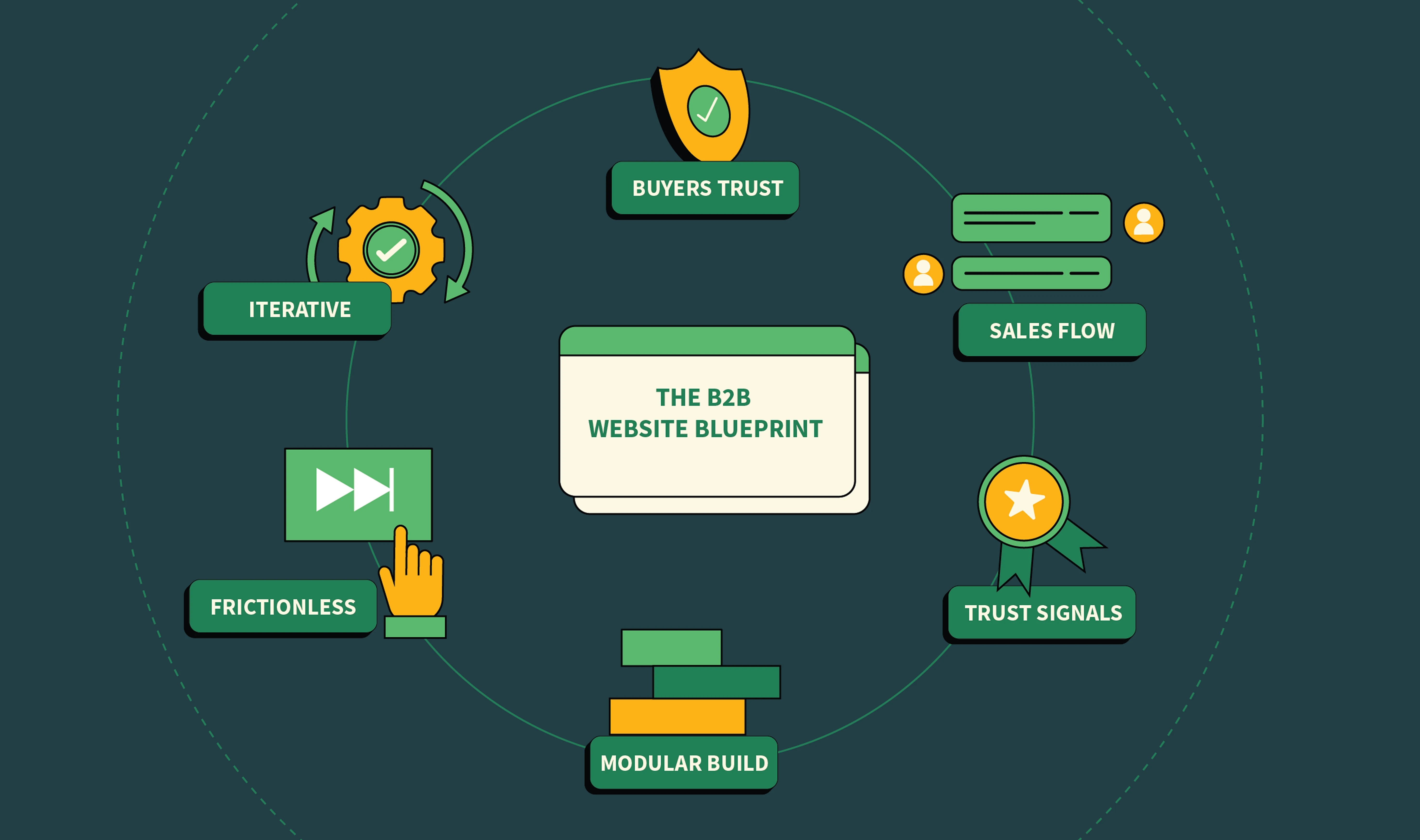
At ThunderClap, a leading B2B branding agency, we use the SIGNAL Framework to do this consistently. Every website we audit or redesign follows these six layers, applied in order because storytelling breakdowns compound from top to bottom.
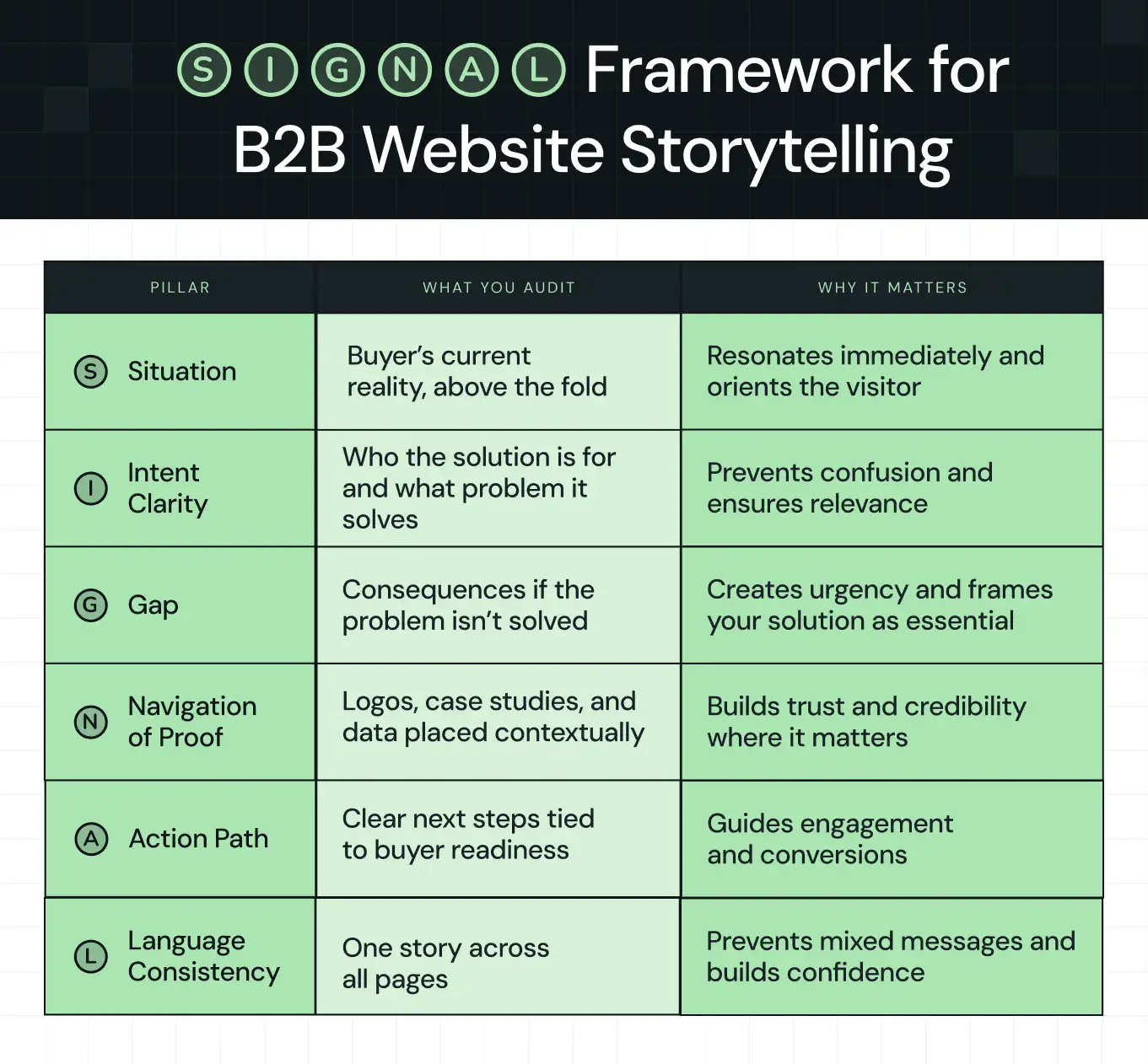
If any one of these layers is weak, the website leaks trust. If multiple layers are misaligned, even a redesign can fail to drive pipeline growth. That’s why ThunderClap treats website storytelling as the connective tissue between brand, design, and revenue.
{{specficService}}
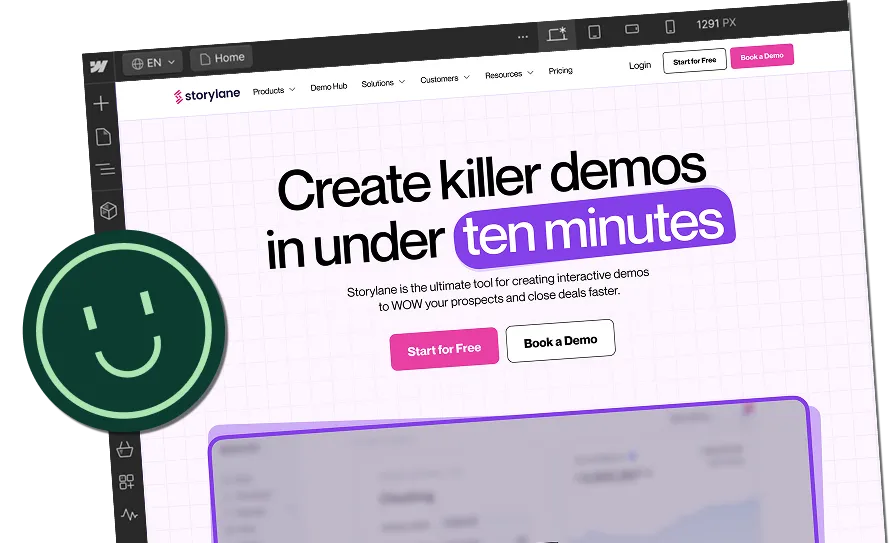
For example, when we implemented it on ConsultAdd’s site, their homepage redesign guided visitors more clearly through the story, and conversions increased by 60%.
This real-world outcome shows that structuring narrative, proof, and action paths directly impacts pipeline performance.
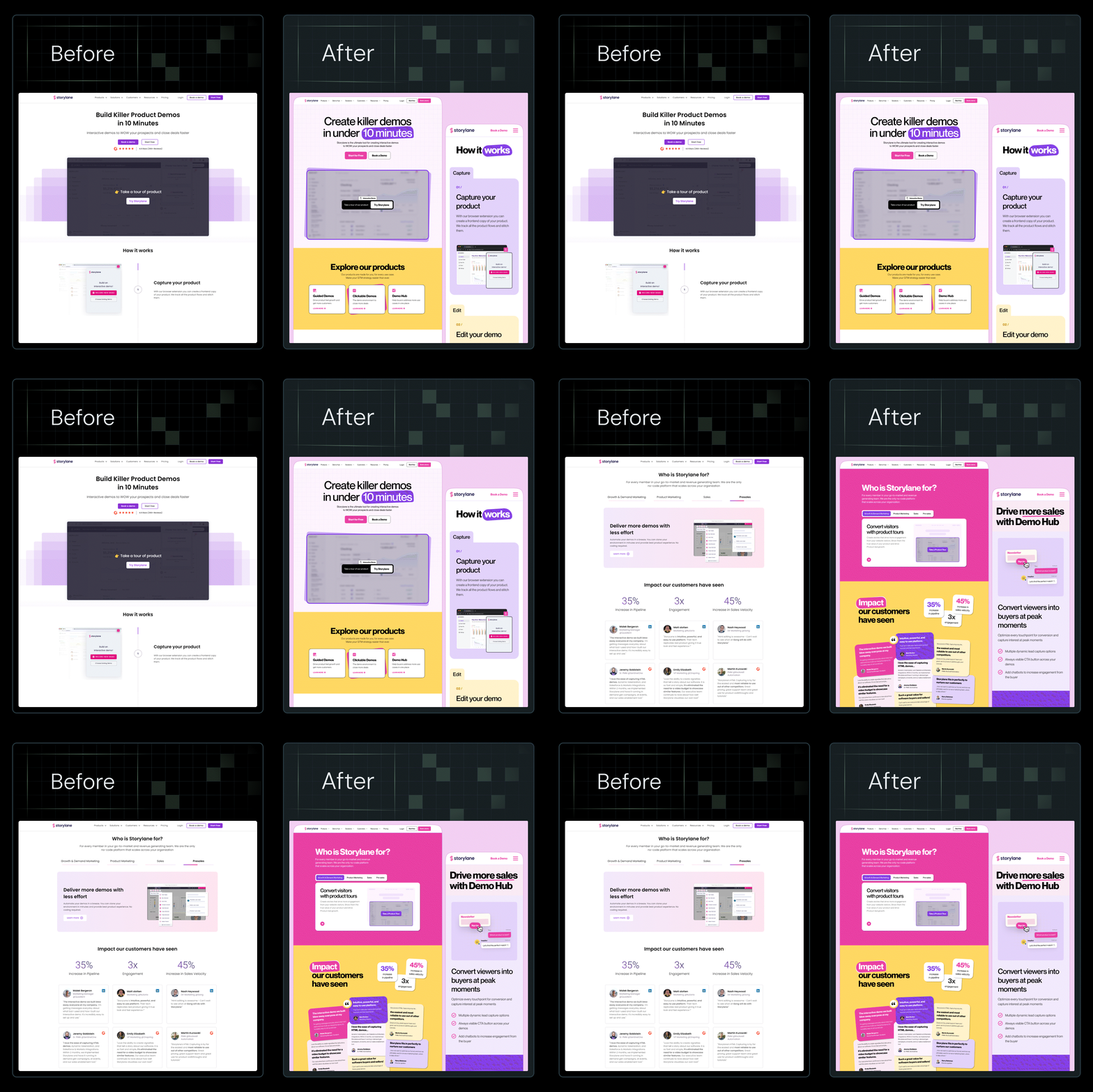
3 SaaS Website Storytelling Examples (Before & After Thinking)
Let’s take a look at three examples that show how B2B websites can transform from cluttered or generic experiences into purposeful storytelling machines that guide buyers clearly, build trust, and drive measurable results.
1. roommaster PMS: Homepage & website redesign that puts the buyer first
roommaster PMS, a property management platform, had a website packed with content, including blogs, ebooks, guides, templates, and case studies, but the experience layer was breaking down. Content updates were slow, complex, and often required developer support, which limited marketing agility and risked brand inconsistency.
Here’s what we did:
- Migrated 40+ pages and multiple CMS collections to Webflow for faster, flexible updates.
- Built reusable form components integrated with Salesforce, UTM tracking, Chili Piper scheduling, and analytics to capture leads and campaign data.
- Structured the content hierarchy with consistent H1/H2 usage, clean categories and tags, and SEO-conscious redirects.
- Implemented 97-page and domain-level redirects to preserve SEO performance.
We mapped every decision to the ThunderClap SIGNAL Framework and improved messaging consistency through structured brand storytelling services, while preserving the visual identity with reusable components. We also reduced experience friction, allowing marketers to launch new pages without developer support.
As Qamar Aziz, Webflow Lead at ThunderClap, noted:
“roommaster’s marketing team struggled with updating content quickly because every new page required developer intervention. By moving to Webflow, we were able to implement global classes and reusable components, so the team could launch new property and campaign pages without risking brand inconsistency.”
Before jumping into UI, we asked a foundational question: What should a hotel manager feel three days after visiting the site?
This insight reframed the approach:
- Concept: Treated the software like a blueprint, using visuals inspired by floor plan motifs and grids.
- Logo: Shaped the logo so the letters “R” and “M” formed a doorway that symbolizes welcome.
- Palette: Refreshed the legacy blue to Royal Blue and paired it with warm beige to create a modern, human feel.
See how roommaster’s redesign boosted demo requests and organic traffic by 80% by making the product the hero:
2. NativeMSG: Redefining business messaging with RCS
NativeMSG, an enterprise messaging platform, had a strong product but a website that did not reflect its leadership in Rich Communication Services (RCS). Prospects often did not understand what RCS could do. The site relied on feature lists instead of showing real outcomes. The challenge was to make the platform instantly clear, visually compelling, and category-defining.
Here’s what we did:
- Built 40+ visual mockups with real message examples to make RCS experiences tangible. Users could understand the product in minutes without long explanations.
- Developed a layered visual system inspired by the NativeMSG logo to communicate structure, security, and enterprise reliability.
- Chose a green-focused color palette to stand out from competitors and highlight growth, clarity, and innovation.
- Structured the site around outcomes, not features, emphasizing engagement, ROI, and conversions for key industries like e-commerce and sports.
- Created dedicated pages for Creator, Cloud, and Connect, making the platform architecture clear at a glance.
- Prioritized experience-first storytelling, making the website educational, interactive, and scalable for future marketing content.
As Ayush explained:
“They did not want to be another messaging vendor. They wanted to own RCS entirely. Our visual-first approach helped people understand the product in minutes.”
See how NativeMSG’s redesign turned a complex technology into a clear, visually compelling, and authoritative RCS brand.
3. Zamp
Zamp is a fully managed, enterprise-focused sales tax solution built for mid- to large companies navigating complex U.S. compliance. The product delivers rooftop-level accuracy, proactive nexus monitoring, automated filings, and white-glove onboarding.
However, the brand and website failed to reflect that strength. The design felt outdated, and their messaging lacked precision. Plus, the experience did not signal premium expertise to CFOs and Controllers evaluating global vendors.
That’s when they reached out to us. Here’s how we helped them:
- Redefined Zamp’s positioning around three pillars: owned data, best-in-class accuracy, and elite tax experts
- Sharpened differentiation against Avalara, TaxJar, and emerging challengers by highlighting rooftop-accurate calculations, a deep taxability library, and 99.9% filing accuracy
- Simplified the messaging into tighter, more confident statements aligned to finance leaders
- Rebuilt the sitemap and navigation to create persona-driven paths that guide users toward demo bookings
- Designed a cleaner, more premium visual system with stronger typography and refined hierarchy
- Reinforced the fully managed model and transparent pricing to build confidence and predictability
Every decision focused on making Zamp feel as premium and reliable as the service itself.
The result is a sharper, more differentiated brand that reflects Zamp’s premium service, backed by 99.9%+ filing accuracy, under two-hour onboarding, sub-hour response times, and recognition from G2. With $30M+ raised and enterprise-grade credibility, Zamp now looks and sounds like the category leader it already is.
How to Apply Brand Storytelling During a Website Redesign
A website redesign is the perfect time to clarify your story. So, you need to do it before wireframes. Every decision should support a single, clear narrative.
Here are some of the key moves that impact storytelling:
- Align teams on one story. Host a short workshop with the marketing, product, and sales teams. Define the core narrative and three key buyer outcomes. Use this as the guiding document for all content.
- Lead with the main message. Place your primary value proposition and hero visuals above the fold. Test it by asking someone unfamiliar with your product if they “get it” in 5 seconds.
- Simplify page hierarchy. Map all pages in a sitemap. Remove redundant pages or sections that distract from the story. Only keep content that moves the buyer closer to conversion.
- Use visuals to teach. Replace long blocks of text with screenshots, mockups, or diagrams. For example, show workflows for key features rather than describing them in paragraphs.
- Focus on outcomes, not features. For each product section, clearly show the user's result. E.g., “Increase conversions by 25% with automated messaging” instead of listing features.
- Audit and remove clutter. Go through every page and ask: “Does this section help the buyer understand, trust, or act?” If not, cut it.
- Keep branding consistent. Choose a clear palette, typography, and iconography. Ensure every page feels like part of the same story.
- Design for conversion. Make CTAs obvious. Reduce friction by limiting the number of form fields, adding interactive previews, and keeping navigation simple.
- Plan for iteration. Build reusable components on a platform like Webflow. This allows marketing to test new messaging, visuals, or campaigns without a developer.
{{ctaBlock}}
At ThunderClap, we see the biggest impact when redesigns remove friction rather than just add pages. For NativeMsg, that meant making RCS instantly understandable through visuals, outcomes-first copy, and clear product architecture. As a result, they gained a website that educates, builds trust, and converts.
Whether you’re planning a complete rebuild or refining your current site, applying these principles ensures your B2B website becomes a revenue-generating engine, not just a digital brochure.
Strong Website Storytelling Turns Browsers into Believers
For SaaS companies, the website often serves as the first and most consistent touchpoint with users. It can drive the full growth cycle, with lead generation, revenue generation, and lifetime value expansion.
At ThunderClap, we help B2B SaaS teams redesign websites around narratives that convert, not just visuals that look modern:
- Map complex buyer journeys: We structure content, layout, and messaging to guide users clearly through discovery, evaluation, and decision-making.
- Build scalable Webflow solutions: As a certified Webflow Enterprise Partner, we create robust CMS structures, dynamic content hubs, and seamless integrations that empower marketing teams.
- Optimize for performance and conversion: We focus on demo signups, high-quality leads, and revenue growth to turn the website into a growth engine.
- Implement SEO and AI-ready builds: We use structured data, fast-loading pages, and discoverable content to reach the right audience and drive measurable results.
- Full-spectrum project ownership: From strategy and design to development and ongoing managed services, we keep your business goals front and center throughout the project.
Ready to turn your website into a growth engine? Book a free strategy session with ThunderClap and see how we can redesign your site to build trust, drive leads, and boost revenue.
FAQs
How does brand storytelling help close more B2B deals?
Brand storytelling clarifies why your solution matters, reduces buyer uncertainty, and aligns decision-makers before a sales conversation. When your website clearly communicates value and guides prospects through their journey, buyers enter calls confident and informed. As a certified Webflow Enterprise Partner, ThunderClap helps B2B companies craft narratives that connect with buyers and accelerate deal closure.
Why is brand storytelling important for building buyer trust on a website?
Buyers trust websites that communicate clearly, show proof of success, and maintain consistency across messaging and visuals. Brand storytelling turns features into meaningful outcomes and positions your company as reliable. When every page supports the narrative, prospects feel confident, lowering friction and increasing the likelihood they will engage with your team.
What types of stories resonate most with B2B buyers?
B2B buyers respond to stories that reflect real problems, highlight credible outcomes, and guide decision-making. Case studies, client journeys, and scenario-based narratives demonstrate how your solution solves challenges. Clear, actionable stories help buyers see themselves achieving success with your product, making them more likely to move forward in the sales process.



.webp)
Browse Similar Articles





Leading 5 SaaS Branding Agencies in Florida (That Actually Understand SaaS Growth)

.svg)
How to Turn Your B2B Website into a Self-Serve Growth Engine? (PLG Ready in 2026)

9-Step Website Copy Audit Checklist to Improve Conversions (Examples from Top B2B Brands)

.webp)

How to Choose the Right Fintech Web Development Company for Your Business
Top B2B Website Design Principles That Turn Visitors into Qualified Leads
%20Audit%20That%20Actually%20Improves%20Revenue.webp)
How to Do a Conversion Rate Optimization (CRO) Audit That Actually Improves Revenue
Web Design Agency vs. Freelancer vs. In-House: What Actually Works in 2026
5 CRO Agencies in London and How to Choose the Best CRO Agency for Your Business

The Ultimate Fintech B2B Positioning Guide for 2026 (That Actually Drives Conversions)
Mapping the B2B Buyer Journey to Improve Conversions Across Every Touchpoint
.webp)
7 Best Website Maintenance Companies in India for Growth-Led B2B Teams (2026)

.webp)

8 Best Healthcare Website Design Agencies for HIPAA-Compliant Sites in 2026


How to Find the Best Web Design Company in Houston, Texas for B2B Brands (6 Best Picks)
Positioning That Wins: How to Make Complex B2B Products Clear and Compelling
The Step-by-Step Website Redesign Process B2B Teams Use to Increase Conversions (Without Killing SEO and Pipeline)
7 Best Video Production Agencies for SaaS Product Walkthroughs and Feature Videos

How to Choose the Best B2B Website Maintenance Company: 9 Questions to Ask Before You Hire One


How to Choose a Web Design Company in San Francisco in 2026 (with Examples)

10 Best Web Design Companies in Florida in 2026 and How to Choose the Right One
SaaS CRO Best Practices: What High-Growth Brands Do Differently to Win Conversions

How a Rebranding Agency Can Redefine Your B2B SaaS Identity and Boost Pipeline
B2B Marketing Trends in 2026 That Directly Influence Pipeline and Revenue
Top 7 Video Marketing Agencies Driving B2B SaaS Brand Awareness in 2026

Why Partnering with a B2B Brand Positioning Agency Accelerates Market Differentiation

The Complete Website Redesign Checklist for B2B SaaS Teams Ready to Scale
.avif)
9 Best Webflow Development Agencies in India for 2026 (In-Depth Review)

10 Product Marketing Companies Powering the Fastest-Growing SaaS Brands in 2026
Website Copywriting Services vs In-House: What's Right for Your Business?

How to Choose a Marketing Agency That Understands B2B SaaS Growth Metrics


How to Choose a Video Marketing Agency That Understands B2B Storytelling

Outsourcing Web Design: Cost-Benefit Analysis for Mid-Market & Enterprise Brands

From Leads to Lifetime Value: How Growth Marketing Agencies Scale SaaS Revenue
Build a B2B Website Strategy That Aligns with Sales and Marketing Goals
Webflow vs WordPress: Which Platform Is Better for Your Business Website in 2026?
Fintech Web Design That Builds Trust: 8 UX Principles Every Fintech Site Needs
Optimizing for Intent: How B2B Website Messaging and UX Changes Help Capture Top-Funnel Buyers


12 Best B2B Web Development Agencies in the US to Build Scalable Websites

From Audit to Action: 8-Step Process to Optimize Your B2B Website Strategy for 2026 Buyers
How to Design a High-Converting Landing Page from Scratch (2026 Edition)
From Click to Customer: Proven Landing Page Conversion Optimization Techniques

How to Write Website Copy That Converts: A Step-by-Step Guide for 2026

How to Optimize a Landing Page for Maximum ROI: A Step-by-Step Breakdown


AI Landing Pages That Convert: 7 Design Principles Every AI Platform Should Follow
From Traffic to Pipeline: B2B Website Growth Strategy for Scaling Teams

B2B Website Optimization Strategy: Speed, UX, SEO, and CRO in One Playbook




Interested in seeing what we can do for your website?



.webp)
