















How to Choose a Marketing Agency That Understands B2B SaaS Growth Metrics


8% of your annual recurring revenue.
That’s the typical portion of B2B SaaS teams' budgets they allocate to marketing. High-growth players often push that to 14%, which means every time you bring in $12, you tuck at least one back into marketing. It’s a big bet, and you want that bet to pay off.
Here’s the tricky part. Plenty of teams spend that money yet still wonder why it’s not doing the work. Growth stops. Pipelines drag. Dashboards look sleepy.
The real issue usually hides in plain sight. You need B2B marketing agencies that actually understand B2B SaaS growth metrics, not one that just makes vague promises. The right agency helps you boost visibility, sharpen conversions, and track results you can feel.
Now here’s where your website steps in. A strong site works like your best salesperson, and that’s exactly what we build at ThunderClap. We’ve rebuilt over 129 B2B sites for SaaS, fintech, AI, and enterprise tech clients, including Amazon, Storylane, Factors, Deductive AI, and roommaster. In fact, our sites convert and get recognized by AI.
You deserve that level of clarity and momentum, so let’s jump in.
TL;DR
- Most SaaS teams pour 8–14% of ARR into marketing, yet growth stalls when agencies don’t understand SaaS metrics.
- To scale effectively, look for agencies that track downstream metrics like SQLs, CAC payback, LTV/CAC, and meetings per 1,000 sessions.
- Prioritize teams that align with sales and RevOps, experiment continuously, and treat your website as a revenue engine rather than a design project.
- ThunderClap stands out by treating websites as revenue engines and running continuous experiments that improve demos, trials, and pipeline performance.
The SaaS Metrics That Actually Matter (And Most Agencies Ignore)
As mentioned earlier, most marketing agencies don’t actually understand B2B SaaS growth math. Choosing a SaaS marketing agency isn’t about finding “creative people.” It’s about finding a partner who understands the metrics that move revenue.
Here’s where most agencies fail:
- Report traffic instead of activation
- Celebrate form fills instead of meetings booked
- Optimize ad spend instead of LTV/CAC
- Ship content with no downstream impact on SQLs or revenue
- Treat websites like brochures instead of pipeline engines
This means that every qualified SaaS agency should be fluent in the metrics that truly move revenue.
At ThunderClap, we call it the SaaS Revenue Chain, a framework for understanding how every stage of your funnel contributes to growth.
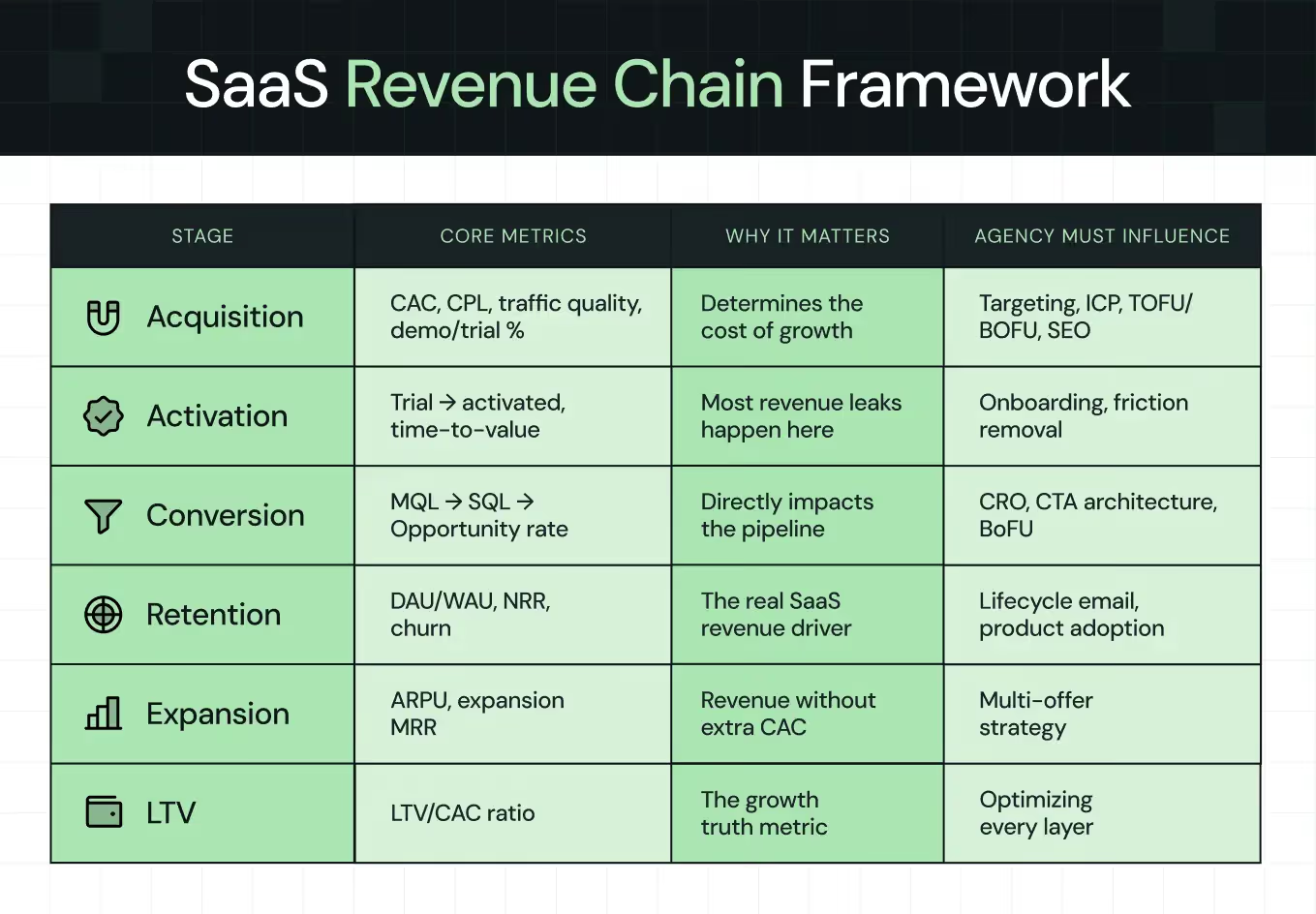
If a B2B SaaS marketing agency cannot influence these metrics across the full SaaS Revenue Chain, it merely spins assets rather than driving growth. ThunderClap focuses on metrics first, not assets, and drives real SaaS revenue.
This is precisely what we did for ClearlyRated. Their users weren’t moving meaningfully through the funnel, so assets alone wouldn’t fix the problem. We had to redesign how people experienced value, not just how pages looked.
That’s why every decision around landing pages, navigation, and CTAs focused on one outcome: Keep users engaged, guide them deeper, and move them closer to revenue-driving actions.
The website stopped acting like a static brochure and started behaving like a pipeline engine. Because when agencies optimize for attention instead of revenue, growth stalls. And when they design with the SaaS Revenue Chain in mind, engagement, conversion, and long-term value follow naturally.
{{specficBlog}}
7 Criteria to Choose a B2B SaaS Growth Agency
Many agencies talk about campaigns, impressions, or traffic, yet few understand what truly moves revenue. At ThunderClap, we built a simple approach to evaluating agencies that keeps the focus where it belongs:
- Activation
- Conversion
- Retention
- Long-term revenue
Here are the seven criteria we use to identify growth-ready partners.
Criteria 1: They speak “activation,” not just “attraction”
Many agencies talk about traffic and impressions, but growth happens after users engage with your product. The best B2B SaaS marketing agencies understand activation events and know how to shorten paths to value.
Ask them:
“What percentage of your clients’ trials or demos activate into usage?”
If they can’t answer, it’s a red flag. Hence, you must move on.
A true growth partner knows:
- Activation events (trial → meaningful outcome)
- Fast paths to value within the product
- Onboarding flows that reduce friction
- Website conversion psychology
- Product-led growth signals
When we worked on ClearlyRated’s website redesign, the focus was on improving trial signup activation and onboarding clarity.
.avif)
Here’s what we did:
- Conduct messaging audits to clarify the value proposition on signup pages
- Optimize CTAs so users move quickly from awareness to trial
- Redesign onboarding steps to minimize friction during initial login
- Monitor first-dashboard engagement to measure time-to-value
These updates aligned the website more closely with product onboarding goals. The site evolved into a clearer extension of the product, helping guide new users logically and giving the team a stronger framework to evaluate how experience design influences user behavior over time.
Also read: SaaS Website Design That Converts: 7 Must-Have Elements to Win More Signups
Criteria 2: They report the downstream pipeline, not vanity metrics
Some agencies still focus on likes, impressions, clicks, or CTR. While visually appealing in reports, these numbers rarely tie back to revenue. The right partner tracks metrics that reflect pipeline contribution and sales readiness.
You must look for agencies that track:
- Meetings per 1,000 sessions
- SQL acceptance rate
- SQL → Opportunity conversion
- Pipeline contribution per channel
- CAC payback period
- LTV/CAC ratios
According to recent benchmarks, CAC payback periods are increasing, with some B2B SaaS companies reporting payback periods of up to 57 months. That means it can take nearly five years just to recover what you spent to acquire a customer.
On the LTV/CAC front, healthy SaaS businesses are still generally targeting a 3:1 ratio or better. When these numbers are off, it’s a signal that your acquisition strategy or unit economics aren’t optimized.
When we redesigned RecruiterFlow’s Webflow-based site, we didn’t just build pretty pages. Here’s what we did:
- Track SQLs and opportunities generated directly from demo-signup forms
- Measure how each channel (paid, organic, referral) contributed to pipeline value
- Build dashboards that clearly visualize CAC payback and ROI for each campaign
- Iterate on form fields, CTAs, and page layouts based on SQL-to-opportunity conversion trends
As a result, their sales team could prioritize leads that actually converted into the pipeline. If your metrics stop at traffic and clicks, you’re flying blind. But when you track meetings, SQLs, pipeline, and CAC payback, you build a growth engine. That kind of clarity helps you invest smartly, knowing exactly how each dollar spent moves you closer to real business outcomes.
Criteria 3: They align marketing with sales & RevOps
Marketing cannot operate in isolation. B2B marketing agencies that succeed in SaaS integrate marketing systems directly with sales and RevOps processes to drive measurable outcomes.
They use:
- CRM and attribution tools to track leads from first touch to closed deal
- Sales call recordings to inform messaging decisions
- Use-case insights to tailor content and campaigns
- ICP scoring and lead routing to ensure high-value prospects reach the right rep
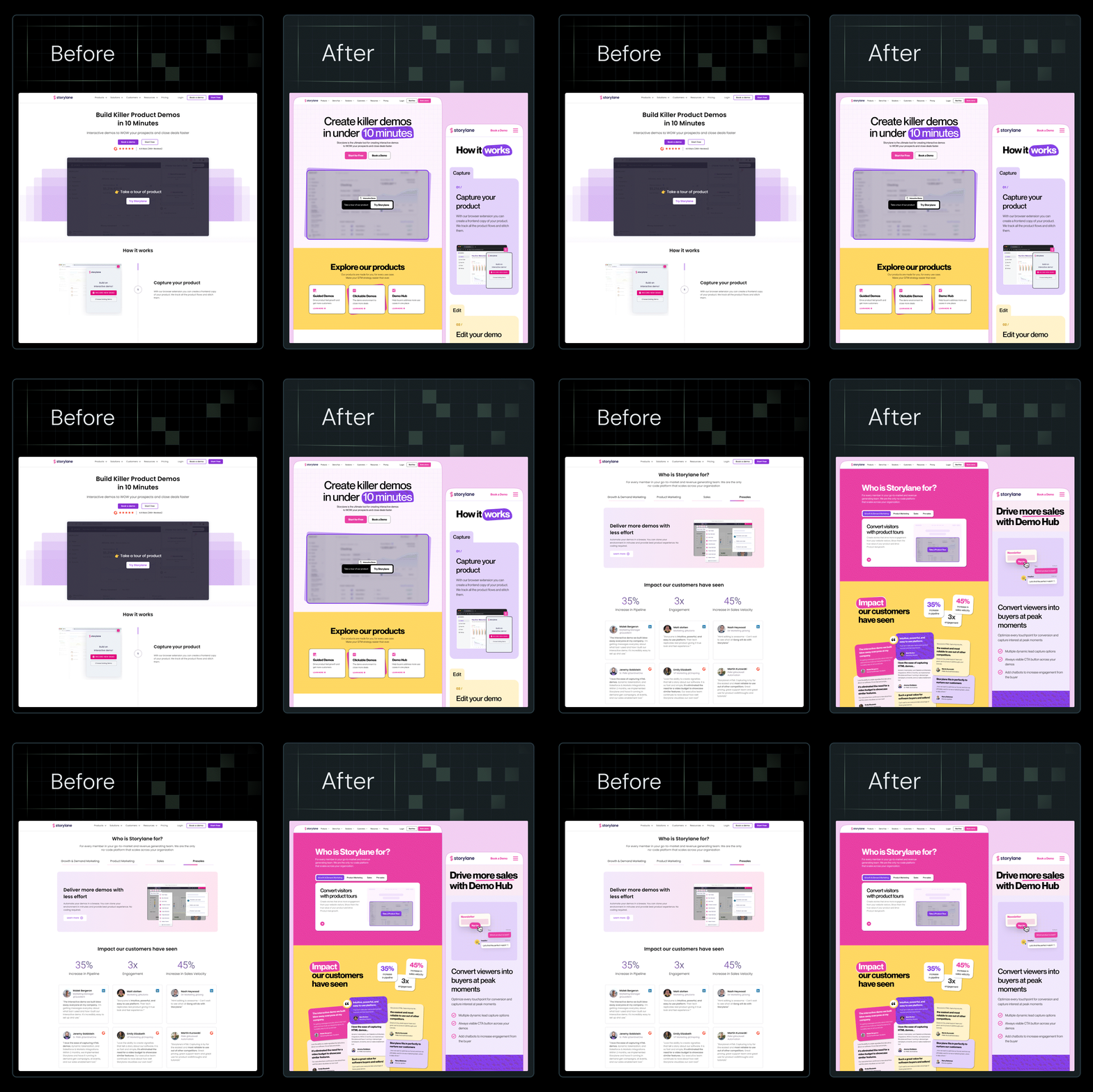
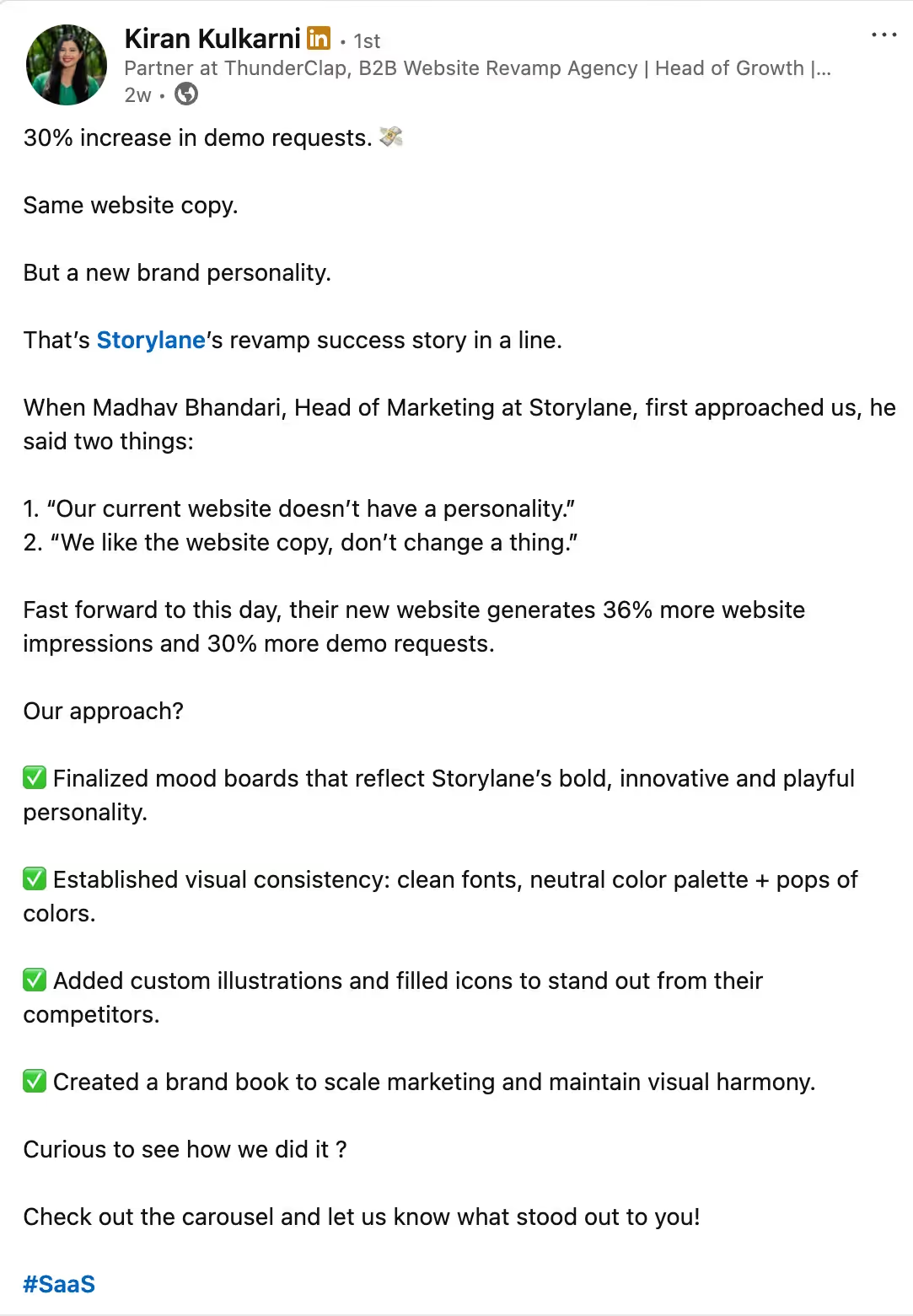
When we redesigned Storylane’s website, we leaned hard into this alignment. We introduced mood boards, a clean yet playful visual identity, and custom illustrations. The copy stayed untouched, yet impressions rose by 36% and demo requests by 30%.
That is the power of thoughtful B2B web design supporting your narrative. Every change supported alignment between marketing and sales:
- Form submissions flowed directly into CRM pipelines, routed by ICP scoring
- Analytics dashboards allowed RevOps to monitor demo-to-SQL conversions
Here’s a complete breakdown in this LinkedIn post by Kiran Kulkarni, Partner and Head of Growth at ThunderClap, where she shares the detailed process and before-and-after results.
This kind of integrated model actually mirrors what leading B2B companies are doing today. According to recent research, organizations that adopt a RevOps function are 1.4× more likely to exceed revenue goals than those without one.
The Storylane redesign demonstrates this integration in practice. Marketing, design, and sales all had shared visibility into lead quality and engagement, and the website served as a real revenue engine. Mood boards and custom illustrations made first impressions human and trustworthy, while the underlying B2B website optimization strategy ensured every click, demo request, and conversion opportunity was measurable.
Criteria 4: They understand the website is a revenue engine
Your website should drive revenue, not just look visually appealing. Agencies that understand SaaS growth treat the website as the first sales conversation, where every page, CTA, and layout nudges visitors toward conversion.
So, ask agencies to show:
- Optimized pricing pages
- Comparison or alternative product pages
- Conversion-focused hero sections
- Clear CTA hierarchy and CRO experiments
That same principle guided our work with Factors, one of our most recent and visible engagements. Factors is a B2B marketing analytics and attribution platform built for demand generation and revenue teams. Its product helps teams visualize how buyers move across touchpoints and identify what actually drives pipeline and revenue.
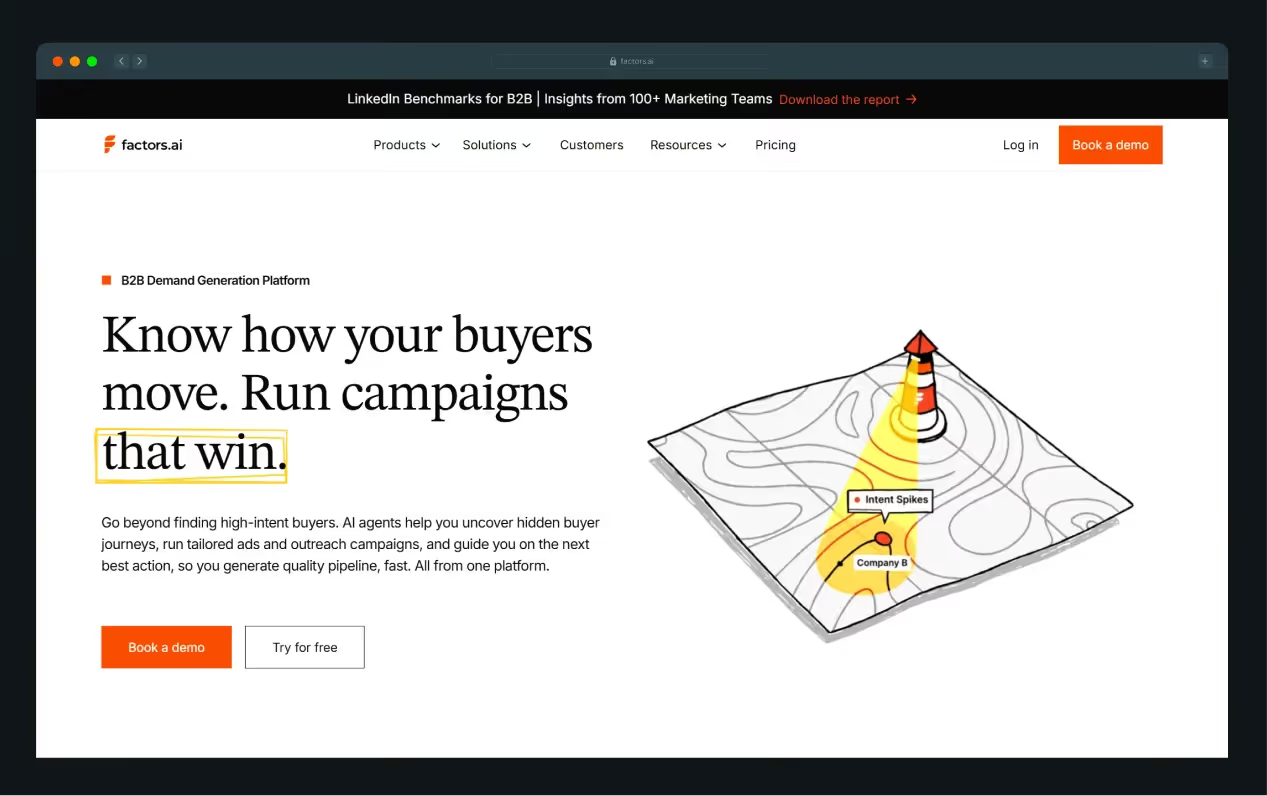
Our challenge was not decoration. We needed to translate a complex, data-heavy product into a site that felt intuitive, approachable, and confidence-building for marketers. We anchored the experience around the “Marketing Compass” concept, positioning Factors as a guide that helps teams navigate buyer journeys with clarity and direction.
Here’s what we did:
- Balanced precision with warmth through hand-drawn illustrations and contour-line motifs
- Used a distinct orange-led palette to stand apart from blue-heavy, data-centric competitors
- Structured layouts and hierarchy to keep the product story clear and scannable
- Designed interaction patterns to support understanding, not distract from core messaging
The result was a website that supported product storytelling, reinforced brand positioning, and set a strong foundation for growth-focused engagement.
Criteria 5: They run experiments, not campaigns
Campaigns alone rarely produce scalable SaaS growth. Growth-focused agencies continuously test and iterate across messaging, design, and offers.
Look for teams that run:
- Weekly CRO sprints
- Messaging and CTA tests
- Landing page variations
- Offer positioning experiments
Meanwhile, ask them, “How many experiments do you run per month for clients?” Anything under four monthly experiments indicates a campaign-first mindset.
During Deductive.ai’s launch, we tested multiple landing page variations, including:
- Headlines tailored to different personas
- Hero section that emphasizes either ROI or workflow efficiency
- CTA placements and color variations to improve click-through
- Microcopy changes in form fields to reduce friction
Within weeks, our tests paid off. The site won multiple industry recognitions, and user engagement multiplied 10×. Each experiment informed the subsequent design round, building a self-sustaining growth engine backed by data.
A LinkedIn post by Harsh Barnwal, Partner at ThunderClap, walks through that process and shows how experiments shaped their conversion journey.
That kind of rigor reflects what leading B2B organizations are doing today. According to a McKinsey analysis, high-performing companies now run up to 5 variants of each design change in rapid sprint cycles, testing not just for conversion but for financial and marketing outcomes.
And real research backs this shift.
In a 2025 survey, 30% of B2B marketers who achieved exceptional growth said they balanced data strategy with relentless testing across channels.
That’s why we use tools like Hotjar, VWO, and Google Optimize to measure how users interact, validate each hypothesis, and continuously refine every element of the experience so users repeatedly experience value and engagement scales.
Criteria 6: They have SaaS benchmarks
Knowing SaaS benchmarks is critical to measure funnel health and setting realistic targets. This is why agencies should understand:
- Expected demo-to-SQL conversion by ACV range
- Normal activation rates for trials
- Typical CAC payback and traffic-to-meeting ratios
- Healthy NRR and churn levels
Without benchmarks, an agency cannot tell you whether performance is good, average, or poor.
According to McKinsey’s 2024 analysis of more than 100 B2B SaaS companies, those in the top quartile of valuation multiples (with a median enterprise-value-to-revenue multiple of 24x) achieved net revenue retention (NRR) of 113%, compared to 98% for lower-performing peers. This means the best SaaS companies are growing more than 13% just from existing customers (with renewals and expansion), which strongly highlights why a growth agency must understand NRR as a core benchmark.
Similarly, from SaaSCan’s 2024 B2B SaaS Metric Benchmarks report, which surveyed 936 B2B SaaS firms, the data shows:
- CAC payback period improved (i.e., got shorter) in 4 of the 6 ACV bands compared to prior years
- Their median net revenue retention (NRR) across respondents was just around or slightly above 100%
These benchmarks matter for organic growth as much as paid performance. Traffic quality, activation depth, sales readiness, and retention directly influence CAC efficiency and payback. These shifts highlight how efficiency gains increasingly come from better conversion paths, clearer messaging, and stronger inbound quality.
An organic growth partner like ThunderClap uses these benchmarks to:
- Set realistic acquisition and retention expectations
- Prioritize experiments that improve inbound conversion and expansion readiness
- Identify issues like extended payback caused by weak positioning or website friction
This approach aligns organic strategy with the metrics investors and operators actually care about.
Criteria 7: They understand your ICP’s buying triggers
Every SaaS product sells to multiple personas. Agencies must understand what CFOs, CTOs, end users, and procurement teams care about and tailor messaging to each stakeholder.
They should know:
- CFO priorities (ROI, cost, risk)
- CTO concerns (security, integration, scalability)
- End-user needs (efficiency, usability)
- Enterprise procurement evaluation
You can also ask them to pitch a 30-second value prop for your product.
If they rely on buzzwords instead of clear, targeted messaging, they are not ready to drive growth.
Also read: Best Conversion Rate Optimization Companies in the US in 2025
The ThunderClap Agency Scorecard: A 1-Page Tool to Pick the Right Partner
Nowadays, every firm promises “results” and “creative solutions,” but how do you objectively compare them?
That’s why we created the ThunderClap Agency Scorecard, a one-page scoring system that founders and marketing leaders can actually use to pick the partner who will drive real growth.
Unlike flashy presentations or vanity metrics, this scorecard evaluates agencies on factors such as:
- Metrics
- Experiments
- ICP knowledge
- Website performance
- Reporting
It’s quick, repeatable, and makes decision-making simple. You assign scores for each category based on the agency’s performance, then tally the weighted results. The agency with the highest score emerges as the clear winner.
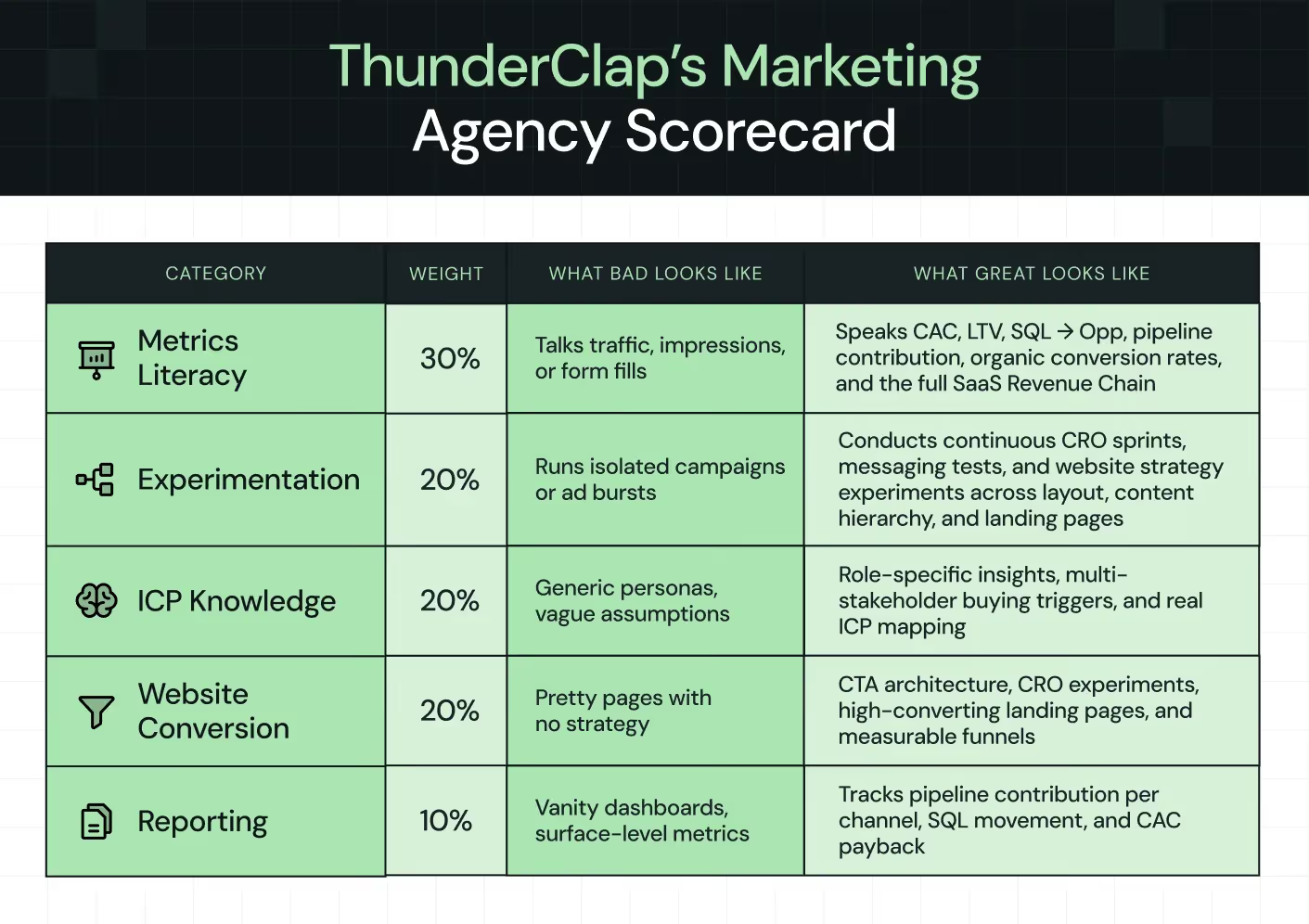
To use the scorecard, simply:
- Rate each agency in every category on a scale of 1–5
- Multiply the score by the category weight
- Add the totals to get a final score out of 100
- Compare agencies objectively and pick the highest-scoring partner
Choosing a SaaS Marketing Agency is a Metrics Decision, Not a Creative One
The wrong B2B marketing agency fills your pipeline with unqualified prospects, putting both revenue targets and your reputation at risk. To scale effectively, you need an agency that understands your numbers better than your dashboards do.
This is where a Webflow Enterprise Partner like ThunderClap makes the difference. We help SaaS teams think holistically about storytelling, building websites and digital experiences that amplify your videos, clarify your narrative, and support scalable campaigns. Your website is not just a static brochure, but your first sales conversation, conversion engine, and the foundation for repeatable growth.
Here’s what happens when story-driven video meets a properly built website:
- Communicate your product’s value and impact clearly to every stakeholder
- Strengthen credibility and trust through a professional, high-converting web presence
- Scale campaigns fast using modular, reusable systems for video, pages, and assets
- Launch content that consistently drives demos, trials, and sign-ups
- Track measurable results, which leads to more demo requests, higher engagement, and faster adoption
We have seen this approach work across 129+ projects, including Amazon, Storylane, Deductive.ai, ClearlyRated, and Factors. Our sites guide audiences naturally while also getting noticed by AI, giving SaaS companies both visibility and conversions.
{{ctaBlock}}
FAQs
1. How to choose a marketing agency for B2B SaaS?
To choose a B2B SaaS marketing agency, evaluate their understanding of your metrics, ideal customer profile, and revenue funnel. Look for a partner who tracks activation, SQL conversion, and CAC/LTV ratios, aligns marketing with sales, and can scale campaigns through measurable experiments. Avoid agencies that focus solely on vanity metrics like traffic or impressions.
2. How do agencies design B2B marketing campaigns?
B2B marketing agencies design campaigns by mapping content, assets, and messaging to each stage of the buyer journey. They define ICPs, create tailored offers, and integrate multi-channel touchpoints. ThunderClap complements campaigns with Webflow-based website design and development, ensuring landing pages, CTAs, and funnels convert effectively while supporting videos, content, and scalable growth.
3. What services do marketing agencies typically offer?
Marketing agencies typically provide strategy, content creation, campaign management, paid media, SEO, and analytics. ThunderClap extends these services by integrating B2B web design and development through its Webflow Enterprise Partner status, building websites, landing pages, and digital experiences that support video, CRO, and pipeline-focused campaigns, turning marketing assets into measurable revenue drivers.



.webp)
Browse Similar Articles





Leading 5 SaaS Branding Agencies in Florida (That Actually Understand SaaS Growth)

.svg)

How to Turn Your B2B Website into a Self-Serve Growth Engine? (PLG Ready in 2026)


9-Step Website Copy Audit Checklist to Improve Conversions (Examples from Top B2B Brands)

.webp)

How to Choose the Right Fintech Web Development Company for Your Business

Top B2B Website Design Principles That Turn Visitors into Qualified Leads
%20Audit%20That%20Actually%20Improves%20Revenue.webp)
How to Do a Conversion Rate Optimization (CRO) Audit That Actually Improves Revenue
Web Design Agency vs. Freelancer vs. In-House: What Actually Works in 2026
5 CRO Agencies in London and How to Choose the Best CRO Agency for Your Business

The Ultimate Fintech B2B Positioning Guide for 2026 (That Actually Drives Conversions)
Mapping the B2B Buyer Journey to Improve Conversions Across Every Touchpoint
.webp)
7 Best Website Maintenance Companies in India for Growth-Led B2B Teams (2026)


.webp)

8 Best Healthcare Website Design Agencies for HIPAA-Compliant Sites in 2026



How to Find the Best Web Design Company in Houston, Texas for B2B Brands (6 Best Picks)

Positioning That Wins: How to Make Complex B2B Products Clear and Compelling
The Step-by-Step Website Redesign Process B2B Teams Use to Increase Conversions (Without Killing SEO and Pipeline)

7 Best Video Production Agencies for SaaS Product Walkthroughs and Feature Videos



How to Choose the Best B2B Website Maintenance Company: 9 Questions to Ask Before You Hire One




How to Choose a Web Design Company in San Francisco in 2026 (with Examples)

10 Best Web Design Companies in Florida in 2026 and How to Choose the Right One

How to Use Brand Storytelling on Your Website to Close More B2B Deals and Build Buyer Trust

SaaS CRO Best Practices: What High-Growth Brands Do Differently to Win Conversions


How a Rebranding Agency Can Redefine Your B2B SaaS Identity and Boost Pipeline

B2B Marketing Trends in 2026 That Directly Influence Pipeline and Revenue

Top 7 Video Marketing Agencies Driving B2B SaaS Brand Awareness in 2026

Why Partnering with a B2B Brand Positioning Agency Accelerates Market Differentiation

The Complete Website Redesign Checklist for B2B SaaS Teams Ready to Scale


.avif)
10 Best Webflow Development Agencies in India for 2026 (In-Depth Review)

10 Product Marketing Companies Powering the Fastest-Growing SaaS Brands in 2026
Website Copywriting Services vs In-House: What's Right for Your Business?



How to Choose a Video Marketing Agency That Understands B2B Storytelling

Outsourcing Web Design: Cost-Benefit Analysis for Mid-Market & Enterprise Brands

From Leads to Lifetime Value: How Growth Marketing Agencies Scale SaaS Revenue
Build a B2B Website Strategy That Aligns with Sales and Marketing Goals

Webflow vs WordPress: Which Platform Is Better for Your Business Website in 2026?

Fintech Web Design That Builds Trust: 8 UX Principles Every Fintech Site Needs


Optimizing for Intent: How B2B Website Messaging and UX Changes Help Capture Top-Funnel Buyers




12 Best B2B Web Development Agencies in the US to Build Scalable Websites

From Audit to Action: 8-Step Process to Optimize Your B2B Website Strategy for 2026 Buyers


How to Design a High-Converting Landing Page from Scratch (2026 Edition)

From Click to Customer: Proven Landing Page Conversion Optimization Techniques

How to Write Website Copy That Converts: A Step-by-Step Guide for 2026


How to Optimize a Landing Page for Maximum ROI: A Step-by-Step Breakdown


AI Landing Pages That Convert: 7 Design Principles Every AI Platform Should Follow
From Traffic to Pipeline: B2B Website Growth Strategy for Scaling Teams


B2B Website Optimization Strategy: Speed, UX, SEO, and CRO in One Playbook




Interested in seeing what we can do for your website?



.webp)
