















From Leads to Lifetime Value: How Growth Marketing Agencies Scale SaaS Revenue



Every SaaS team faces pressure to grow as new competitors emerge and fight for the same customers. As a result, founders often rely on a growth marketing agency to guide strategy and achieve results. A promising product usually attracts early attention, yet sustained revenue requires deliberate focus on lead nurturing, brand visibility, and measurable performance metrics across campaigns.
Companies that prioritize lead nurturing generate 50% more sales-qualified leads at a 33% lower cost, which clearly shows the importance of demand generation in growth marketing. Similarly, many teams implement familiar demand-generation tactics that consistently deliver results, including:
- Content marketing
- Influencer marketing
- Paid search
- Webinars
- Paid social advertising
SaaS teams grow faster when they treat their website as a strategic asset and optimize their B2B website strategy with designs that guide visitors to take action.
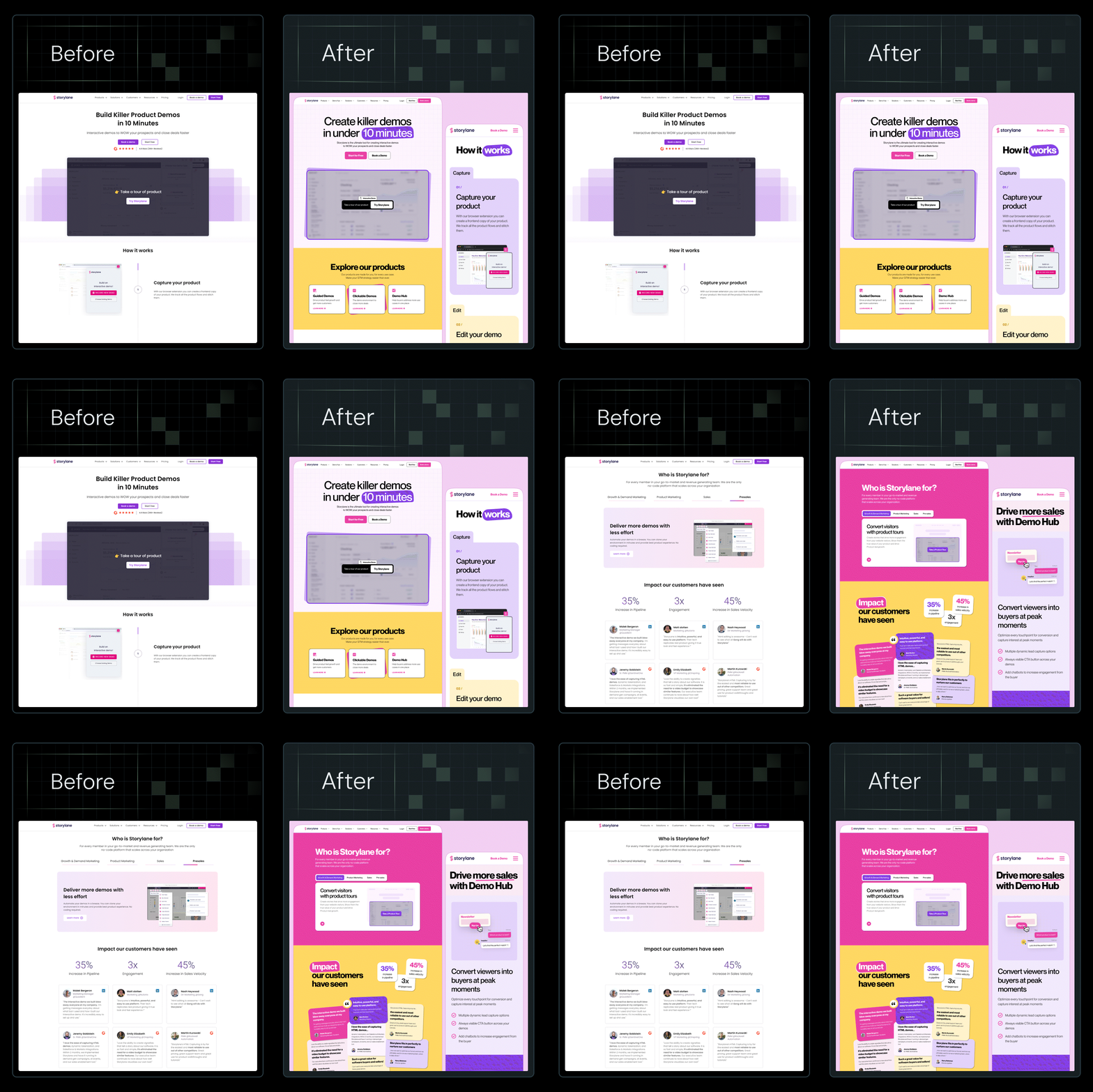
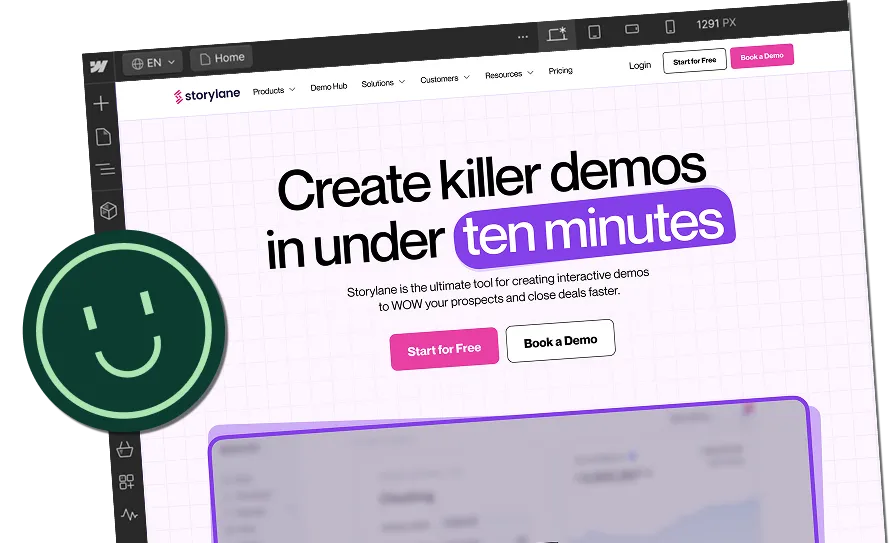
At ThunderClap, we have rebuilt over 129 B2B websites for SaaS, fintech, AI, and enterprise tech clients, including Amazon, Storylane, Factors, Deductive AI, and Zenda, while creating high-converting landing pages recognized by AI for measurable results.
In this article, we will show how a B2B growth marketing agency helps companies turn leads into revenue and long-term value while scaling predictable growth.
TL;DR
- SaaS teams chase leads, but real growth begins when those leads are nurtured with intent, especially since nurtured prospects generate 50% more SQLs at lower cost.
- That momentum grows when acquisition ties directly into activation and onboarding, creating early wins that prevent churn and strengthen retention.
- Strong retention unlocks expansion revenue, now a major source of new ARR for scaling SaaS companies, and this is where ThunderClap’s conversion-driven website frameworks support healthier pipelines.
- With acquisition, activation, retention, and expansion working together, growth agencies turn simple lead flow into predictable lifetime value.
Why Traditional Marketing Fails in SaaS Growth
SaaS teams often feel like they’re running hard for leads, but the real struggle lies in turning those leads into long-term paying customers. Here’s how:
Misalignment between Demand Gen → Product → RevOps
Many companies push demand generation without building their product or revenue operations to support predictable monetization. As McKinsey’s recent research describes, only a handful of SaaS firms hit the “Rule of 40,” and underperformance often stems from under-investing in retention, cross-sell, and upsell motions.
When demand gen runs separately from your RevOps, the promise of pipeline usually fails to convert into real, recurring revenue.
Siloed teams optimizing different metrics
Growth teams frequently count MQLs, sales teams count SQLs, and RevOps watches revenue. That mismatch creates confusion, and nobody cares enough about what happens after someone signs up.
According to a recent report, when net revenue retention (NRR) rises from the 90–100% range to 100–110%, the growth rate improves dramatically. Still, many SaaS firms don’t connect their acquisition and post-sales metrics.
Over-focus on TOFU content
Teams invest too much in content and lead generation without building a playbook to grow existing customers. Research shows that expansion ARR now accounts for a big piece of new ARR for many scaling SaaS companies.
If you run a growth marketing agency for startups or a simple digital agency, you know that your work can’t stop at new leads. Activation, expansion, and retention must drive real value.
Lack of experimentation infrastructure
Without a continuous testing framework, too many SaaS firms default to top-funnel tactics. They don’t build real feedback loops around product usage, pricing, or onboarding.
Because of this, they miss chances to improve conversion by using landing page conversion optimization techniques or refining website copy that converts, both of which are proven levers for better customer flow.
Poor activation and onboarding experiences
Onboarding is where many SaaS products fail. If new users struggle to get value quickly, they churn before they even begin. That weak activation undermines long-term metrics like net revenue retention.
McKinsey found that companies that invest in post-sales functions, rather than just chasing acquisitions, achieve much stronger NRR and valuation multiples.
Across these breakdowns, too many SaaS companies treat their website or acquisition engine as the only growth lever. A smarter approach combines website analytics tools, B2B web design and development blueprint, and a full-funnel growth mindset to fix leaks and drive sustainable revenue.
{{specficBlog}}
The Growth Marketing Model: Revenue > Leads
The world’s best SaaS growth agencies no longer use the old funnel. Funnels leak, rely on linear steps, and don’t compound.
Instead, they use growth loops.
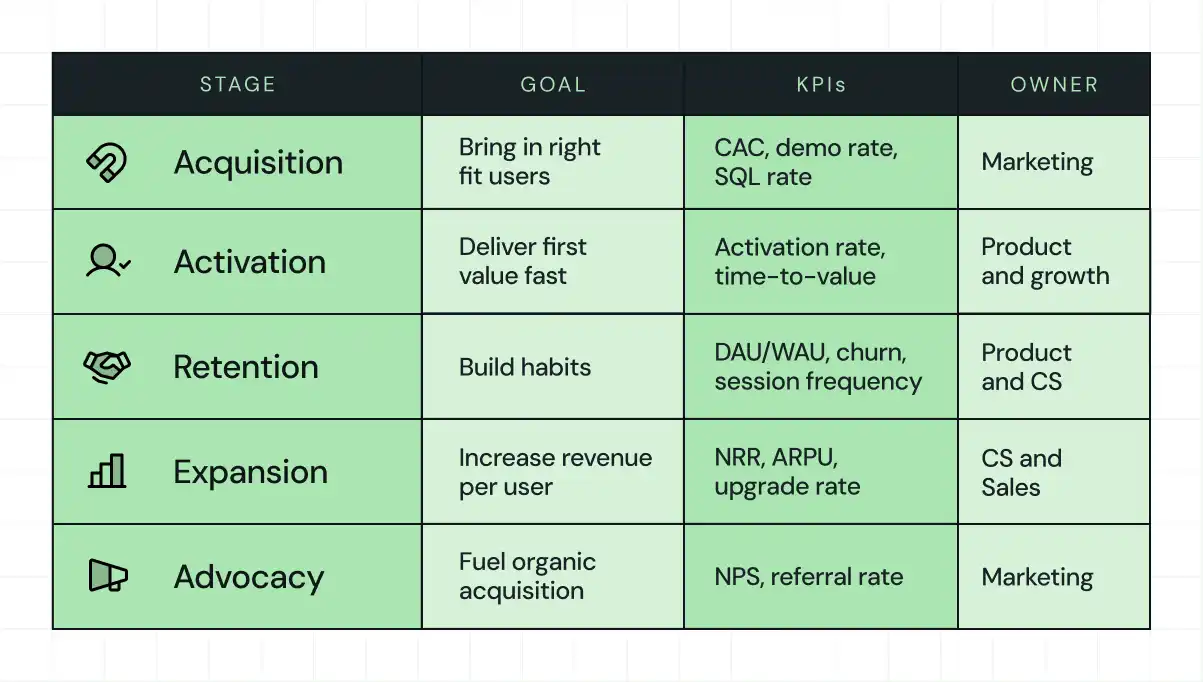
At ThunderClap, we shaped ours to help teams think of growth as a continuous motion that builds strength with every customer interaction with the product. The loop moves through in this format:
Acquisition → Activation → Retention → Expansion → Advocacy → Back to Acquisition
This helps founders see how each stage works together and shows how thoughtful choices in product experience, messaging, and customer care drive momentum that compounds over time, without relying solely on new leads to carry the load.
Here’s a simplified look at it:
To show how this works in real life, here’s a quick look at how we applied this Growth Loop model to help roommaster, a hospitality tech platform, grow beyond lead generation and create real revenue momentum. roommaster rebuilt its brand from scratch with new positioning, a new identity, and a clearer emotional story. However, the brand needed higher-quality traffic, stronger activation, and a website experience that actually converted.
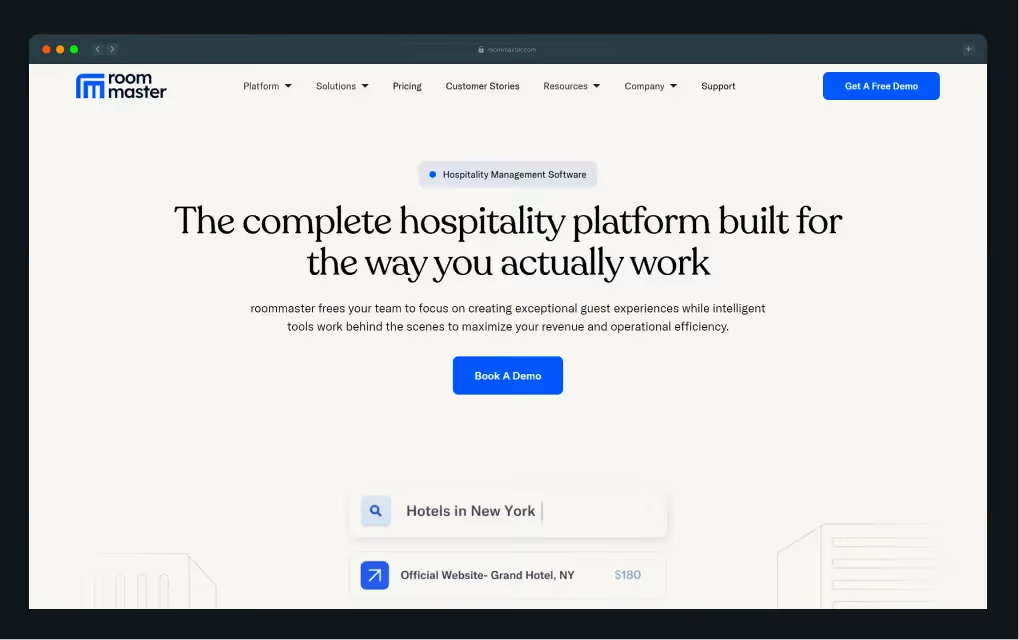
So we rebuilt their growth engine using our loop. We tightened their messaging, restructured the site around buyer intent, redesigned the booking engine, and integrated analytics to identify drop-off points. In the first few months, roommaster saw approximately 40% more leads. The system didn’t depend on a single channel. It amplified the impact of each interaction by improving how users discovered the product, understood its value, and moved toward becoming long-term customers.
Now, let’s see how each stage works together to support steady, long-term growth.
Stage 1: Acquisition That Brings the Right Users (Not Just More Users)
Any agency can generate more visitors. Real growth lies in attracting users who activate, adopt, and eventually pay more over time.
At ThunderClap, we see acquisition as a way to build a quality pipeline, not just volume. Here’s how we do it for our clients:
- Define the Ideal Customer Profile (ICP) with laser clarity and run exact targeting
- Create high-intent content, including comparison pages, ROI calculators, deep-integration landing pages, and industry-specific pages
- Focus our paid campaigns on keyword capture, competitor conquest ads, and LinkedIn persona-based mapping
- Build a technical SEO base and author content that’s ready for large language models (LLMs), so your site remains future-proof
- Set a bottom-of-funnel (BoFU) traffic target of 30–40% to avoid wasting your budget on top-of-funnel awareness
- Activate dark social by using your founder's POV and using a meme-creator for relatable content that reaches users in private communities
To give an example, HubSpot’s comparison pages are a masterclass in themselves.
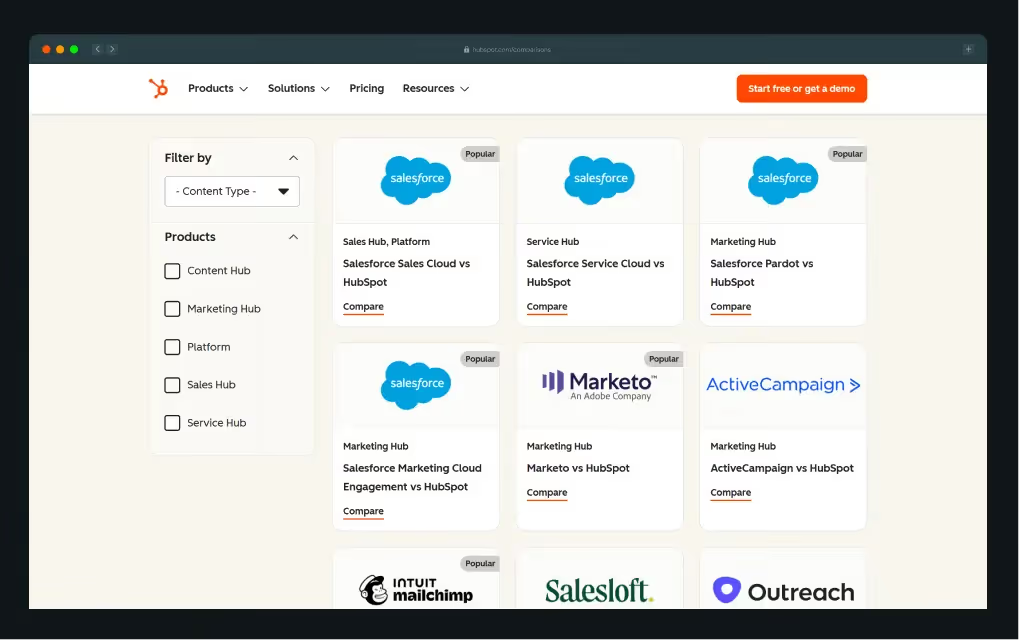
The platform runs dozens of comparison pages, such as “HubSpot vs Salesforce,” “HubSpot vs Zoho,” and more, which let them intercept high-intent traffic from buyers who are already evaluating competitors. Their strategy boosts SEO, builds trust, and drives conversions by making it obvious why many users should pick them over rivals.
Stage 2: Activation: Turning Signups Into “Aha!” Moments
Acquisition is worthless if users never activate. Activation is where real growth begins. We treat activation as the point where curiosity turns into conviction, and that shift happens only when users reach their first meaningful win as quickly as possible.
The key is to:
- Create onboarding flows: Welcome screens with guided walkthroughs, checklists, and progressive onboarding that help users settle in quickly
- Personalize: Role-based, industry-based, and use case-based sequencing that gives users clarity from the start
- Remove friction: Fewer form fields with fewer steps supported by simple prompts that reduce hesitation during setup
The fastest path to value matters more than fancy design.
Loom has been making waves since its founding in 2017 and was acquired by Atlassian in 2023. What sets it apart is its relentless focus on the first meaningful user experience: the activation moment.
Loom defines activation with a simple, clear metric: Video First View (VFV).
A user is considered “activated” when they create and share their first video, and it receives at least one view within the first week.
- 1 VFV = One recording with at least one view in Week 1
This ensures users don’t just record videos, but experience meaningful engagement, turning curiosity into conviction.
Many new users enjoyed recording, but skipped adding titles or context. This led to:
- Creators: Their videos went unwatched, leaving them discouraged
- Viewers: Videos felt unclear, reducing engagement
Without addressing this, users never reached their “Aha!” moment.
Loom introduced AI to automatically generate titles, chapters, and summaries from video transcripts. This gave viewers immediate clarity about the content and included:
- AI-generated titles: Concise titles instantly clarify the video’s purpose
- Chapters: Break long videos into digestible sections for easier viewing
- Summaries: Provide a quick snapshot that helps viewers decide what to watch
This approach allowed creators to focus on recording without worrying about adding extra context, while viewers could quickly understand each video and engage more effectively. The results were clear and measurable:
- Quantitative:
- Higher view rates and reduced drop-off between sharing and viewing
- Increased VFV
- More engagement through comments and interactions
- Qualitative:
- Creators focused on recording rather than editing
- Viewers quickly understood the video content and navigated efficiently
- Confirmed that polished videos drive engagement without adding friction
Once you understand what activation means for your product, it’s time to put it into practice. Here’s a step-by-step framework:
- Define your activation event: This is the first meaningful action that proves your product delivers value (e.g., send one email in Klaviyo or create the first workspace in Notion).
- Optimize: Most drop-offs happen before users reach their first win. Map the steps leading up to activation and remove friction wherever possible:
- Simplify onboarding flows with checklists, guided walkthroughs, and progressive steps
- Personalize based on user role, industry, or use case
- Automate repetitive tasks or add smart defaults (like Loom’s AI-generated titles)
- Benchmark smartly: Activation rates vary by product type, but a good target is 20–40% of new users reaching the activation event. Measure, iterate, and compare against peers to understand whether your onboarding and activation flows are performing as they should.
- Focus on empty states: Users often encounter empty dashboards or blank screens when they first sign in, which leads to confusion and churn. Combat this by:
- Showing templates, sample content, or pre-filled examples
- Highlighting key features in context
- Giving users an immediate, low-effort way to experience value
Stage 3: Retention: The Most Ignored Revenue Lever
Retention is where SaaS revenue is won or lost. Acquisition and activation are just the beginning. If users don’t stick around, growth stops, and churn quietly drains your revenue.
To avoid this from happening, here’s what digital growth marketing agencies do:
- Cohort analysis: Identify where churn happens. Look at user groups by signup date, plan type, or usage pattern to understand when and why people drop off.
- Habit-building loops: Design triggers that keep users coming back. (e.g., Slack notifications, Monday.com automation prompts or Loom’s reminders to engage with shared videos)
- Feature adoption playbooks: Nudge users to discover and use key features through in-app messages, lifecycle emails, or improving empty-state UX.
- Cross-functional alignment: Product, marketing, and customer success teams must work together to understand user behavior and proactively reduce churn.
To turn these retention principles into action, focus on practical steps that track engagement, prevent churn, and build repeated value for users:
A] Create retention dashboards
Track DAU/WAU, usage frequency, and feature depth. Measure meaningful engagement and product value.
B] Build activation-retention loops inside the product
Ensure the actions that define activation naturally feed into behaviors that drive retention. Users who complete onboarding and hit the first “Aha!” moment should be guided toward their second, third, and fourth wins.
Take Deductive.ai, for example. We collaborated with this startup to create a cohesive website and product experience that guided users toward meaningful interactions. Post revamp, the website received multiple industry recognitions, and engagement increased by 10x.
This LinkedIn post by Harsh Barnwal demonstrates how this process took place:
That's why we use tools like Hotjar, VWO, and Google Optimize to measure interactions and continuously refine the experience, so users repeatedly experience value and stay engaged.
C] Identify churn predictors
Highlight signals that indicate a user might leave, such as:
- Time-to-value (are they getting results quickly?)
- Number of key actions completed (low usage often predicts churn)
- Engagement with core features
Stage 4: Expansion: Turning Users Into Bigger Accounts
Expansion revenue is the most predictable and profitable in SaaS. To capture this revenue, you can:
- Target high-potential users with personalized offers based on usage and behavior
- Educate users on premium features or add-ons (e.g., Notion AI upsell)
- Trigger upgrade messages when users hit free plan thresholds (e.g., Figma, Slack)
- Identify meaningful wins and offer relevant upgrades at the right moment
Spotify makes clever use of usage-based upgrade prompts. For free users, skips are capped at 6 per hour, and when they reach this limit, Spotify shows a contextual in‑app message prompting them to upgrade to Premium.

This is a classic “usage limit → upgrade” trigger, where users experience the value (listening) but hit friction, which creates a natural moment to offer expansion.
In fact, acquiring new customers is expensive. Studies show that the average SaaS customer acquisition cost (CAC) has climbed to over $700 per customer in recent years. Meanwhile, upselling and cross-selling to existing users drive significant growth, accounting for 16% of new contract value, and 72% of sales teams report higher revenue from expansion.
Here’s what to do to turn these insights into actionable growth:
- Map the upgrade path: Define each tier clearly: Free → Pro → Teams → Enterprise. Ensure users know what value unlocks at each level.
- Create expansion playbooks: Use usage thresholds, feature adoption, and engagement signals to trigger upsells and cross-sells
- Route expansion leads to Sales with context: Provide Sales teams with usage data and context to personalize and make outreach more relevant.
Stage 5: Revenue Optimization & RevOps Alignment
Revenue leaks often hide in plain sight. Broken attribution models, slow speed-to-lead, missing lifecycle automation, and siloed teams quietly undermine growth. This is where most internal teams struggle and where SaaS growth marketing agencies create enormous impact.
At ThunderClap, we help SaaS companies align revenue operations by building web infrastructure that supports better data flow and user insights. For example, when redesigning or migrating a client’s site to Webflow, we integrate CRM, product usage tracking, and marketing analytics directly into the platform.
In the RecruiterFlow project, we developed a user-friendly Webflow system that enabled the client to manage pages with ease while retaining their WordPress blog. The project included:
- Migrating pages, ebooks, webinars, and case studies to Webflow
- Integrating HubSpot and APIs to track user interactions and campaigns
- Maintaining responsive design and aligning with the existing WordPress blog
- Delivering a scalable system with reusable components, a style guide, and training for easy content management
This approach illustrates how a well-designed, integrated web platform can serve as the backbone for revenue optimization. By connecting content, CRM, product usage, and marketing analytics into a single system, teams gain visibility into user behavior, identify pain points, and reveal high-value opportunities.
With this foundation in place, SaaS companies can turn revenue optimization principles into action:
- Build revenue dashboards: Track every step, including sessions, trials, activations, SQLs, and LTVs. Visibility into the whole funnel allows teams to prioritize where to optimize next.
- Set RevOps SLAs: Define clear expectations for response times, lead handoffs, and follow-ups to prevent friction that kills conversions.
Implement a Revenue Flywheel: Create a loop (Marketing → Product → Sales → Customer Success → Marketing), feeding insights and growth back into the top of the funnel.
What You Should Expect From a True Growth Agency
A true growth agency goes beyond surface-level metrics and vanity KPIs, focusing instead on the strategies, systems, and processes that drive measurable business impact. When evaluating a partner, look for capabilities that cover the full growth spectrum, including:
.avif)
How to use this checklist
- Print it out and keep it handy when evaluating a partner (yes, really!)
- Check each item against your current strategy to identify gaps
- Prioritize partners who cover the full spectrum, not just one or two areas
- Apply it consistently to all growth initiatives, from redesigns to campaigns
Turning Leads Into LTV Is a System, Not an Accident
Leads mean nothing without activation, retention, and expansion.
The significant shift in SaaS growth is moving from:
Lead Generation → Revenue Generation → Lifetime Value Generation
For SaaS companies, the website is often the first and most consistent touchpoint with users, making it a critical lever in that system. At ThunderClap, we help brands select and implement the CMS that best fits their needs:
- Enterprise-driven strategy: We build websites for complex B2B journeys with clarity and confidence at every touchpoint.
- Performance-first approach: Every site is designed to deliver measurable results, from demo signups to high-quality lead generation.
- Scalable Webflow solutions: As a certified Webflow Enterprise Partner, we build robust CMS structures, dynamic content hubs, and seamless integrations that empower marketing teams.
- SEO & AI-optimized builds: With structured data, fast load times, and discoverable content, your site reaches the right audience and converts effectively.
- Full-spectrum project ownership: From strategy and design to development and ongoing managed services, we oversee every step while keeping your business goals front and center.
For example, Avanti Fellows, a student-focused NGO platform with media-heavy content and complex animations, approached us to migrate their entire website from WordPress to Webflow and remove plugin dependencies. According to Qamar Aziz, Webflow Lead & GSAP Developer at ThunderClap,
“Avanti Fellows needed a visually rich site with sliders, animated elements, and interactive content. Their previous WordPress site was replaced with Webflow, allowing us to replicate the Figma designs with full animation support.”
Some of the key changes made during the project included:
- Rebuilding five animated pages with interactive sliders and Lottie files
- Incorporating media and student resource pages with rich interactivity
The new site faithfully replicated Figma designs, delivered visually engaging animations, and empowered the Avanti Fellows team to present content dynamically and independently.
{{ctaBlock}}
FAQs
How to ensure agency alignment with startup growth goals?
Start by clearly defining your startup’s objectives, KPIs, and website goals. Share your roadmap, product vision, and technical requirements with the agency. At ThunderClap, we align on design, CMS strategy, and integrations upfront, using shared dashboards and project milestones to track progress. This ensures every redesign, migration, or Webflow build supports measurable business outcomes, from lead generation to conversion optimization and retention.
How can startups use agency services for growth?
Startups can leverage agencies like ThunderClap to turn their websites into growth engines. This includes Webflow migrations, high-converting landing pages, interactive content, and seamless CRM integrations. By outsourcing complex design, development, and optimization tasks, startups save time and scale faster. Close collaboration ensures the website supports acquisition, onboarding, engagement, and expansion, directly contributing to measurable revenue growth.
How to choose a growth marketing agency?
While choosing the best B2B growth marketing agency, you need to focus on partners who drive measurable revenue outcomes across the entire customer journey. Review their experience with performance marketing, full-funnel strategy, experimentation, analytics, and data-backed execution. Evaluate their ability to manage Webflow development, CRM integrations, and conversion optimization as part of a larger growth ecosystem. Ask for case studies that show clear improvements in acquisition, activation, and retention. The right agency is a long-term growth partner that builds scalable systems, tests continuously, and supports your business through every stage of expansion.



.webp)
Browse Similar Articles





Leading 5 SaaS Branding Agencies in Florida (That Actually Understand SaaS Growth)

.svg)


How to Turn Your B2B Website into a Self-Serve Growth Engine? (PLG Ready in 2026)


9-Step Website Copy Audit Checklist to Improve Conversions (Examples from Top B2B Brands)

.webp)

How to Choose the Right Fintech Web Development Company for Your Business

Top B2B Website Design Principles That Turn Visitors into Qualified Leads

%20Audit%20That%20Actually%20Improves%20Revenue.webp)
How to Do a Conversion Rate Optimization (CRO) Audit That Actually Improves Revenue
Web Design Agency vs. Freelancer vs. In-House: What Actually Works in 2026

5 CRO Agencies in London and How to Choose the Best CRO Agency for Your Business

The Ultimate Fintech B2B Positioning Guide for 2026 (That Actually Drives Conversions)
Mapping the B2B Buyer Journey to Improve Conversions Across Every Touchpoint
.webp)
7 Best Website Maintenance Companies in India for Growth-Led B2B Teams (2026)


.webp)

8 Best Healthcare Website Design Agencies for HIPAA-Compliant Sites in 2026



How to Find the Best Web Design Company in Houston, Texas for B2B Brands (6 Best Picks)


Positioning That Wins: How to Make Complex B2B Products Clear and Compelling

The Step-by-Step Website Redesign Process B2B Teams Use to Increase Conversions (Without Killing SEO and Pipeline)


7 Best Video Production Agencies for SaaS Product Walkthroughs and Feature Videos



How to Choose the Best B2B Website Maintenance Company: 9 Questions to Ask Before You Hire One





How to Choose a Web Design Company in San Francisco in 2026 (with Examples)


10 Best Web Design Companies in Florida in 2026 and How to Choose the Right One

How to Use Brand Storytelling on Your Website to Close More B2B Deals and Build Buyer Trust

SaaS CRO Best Practices: What High-Growth Brands Do Differently to Win Conversions


How a Rebranding Agency Can Redefine Your B2B SaaS Identity and Boost Pipeline

B2B Marketing Trends in 2026 That Directly Influence Pipeline and Revenue

Top 7 Video Marketing Agencies Driving B2B SaaS Brand Awareness in 2026

Why Partnering with a B2B Brand Positioning Agency Accelerates Market Differentiation

The Complete Website Redesign Checklist for B2B SaaS Teams Ready to Scale


.avif)
9 Best Webflow Development Agencies in India for 2026 (In-Depth Review)

10 Product Marketing Companies Powering the Fastest-Growing SaaS Brands in 2026
Website Copywriting Services vs In-House: What's Right for Your Business?


How to Choose a Marketing Agency That Understands B2B SaaS Growth Metrics


How to Choose a Video Marketing Agency That Understands B2B Storytelling

Outsourcing Web Design: Cost-Benefit Analysis for Mid-Market & Enterprise Brands
Build a B2B Website Strategy That Aligns with Sales and Marketing Goals

Webflow vs WordPress: Which Platform Is Better for Your Business Website in 2026?

Fintech Web Design That Builds Trust: 8 UX Principles Every Fintech Site Needs



Optimizing for Intent: How B2B Website Messaging and UX Changes Help Capture Top-Funnel Buyers




12 Best B2B Web Development Agencies in the US to Build Scalable Websites

From Audit to Action: 8-Step Process to Optimize Your B2B Website Strategy for 2026 Buyers


How to Design a High-Converting Landing Page from Scratch (2026 Edition)

From Click to Customer: Proven Landing Page Conversion Optimization Techniques

How to Write Website Copy That Converts: A Step-by-Step Guide for 2026


How to Optimize a Landing Page for Maximum ROI: A Step-by-Step Breakdown


AI Landing Pages That Convert: 7 Design Principles Every AI Platform Should Follow
From Traffic to Pipeline: B2B Website Growth Strategy for Scaling Teams


B2B Website Optimization Strategy: Speed, UX, SEO, and CRO in One Playbook




Interested in seeing what we can do for your website?



.webp)
