















5 Fintech Web Development Agencies Built for Compliance & UX


Your fintech platform could be built on the most robust compliance architecture in the market, and still lose up to 70% of its users before they finish signing up. Similarly, a beautifully designed website that hasn't been architected for regulatory requirements will eventually cost you far more in fines, legal exposure, or lost banking partnerships.
The challenge for fintech brands today is finding a website development agency that understands the financial repercussions, data, trust, and design all at once. This guide breaks down exactly what separates average web development from expert fintech web development, and the five agencies that have actually cracked it.
TL;DR
- Fintech web development is fundamentally different from standard web development, as it requires security compliance, regulatory architecture (KYC, AML, GDPR), and high-converting UX to be designed together from the start rather than added later.
- Poor UX in fintech is costly, where 73% of users abandon financial applications during onboarding due to poor design, costing the industry an estimated $18 billion annually in lost customer acquisition.
- The best fintech web development services firms are not general digital agencies. They understand PCI DSS, GDPR, PSD2, and AML/KYC requirements at an architectural level.
- In this guide, we’ll cover 5 conversion-focused fintech web design agencies, including specialists in B2B SaaS CRO, enterprise UX, conversion-led web design, and full-cycle product engineering.
Why is Fintech Web Development More Complex Than Regular Web Development?
Most industries can afford to separate their marketing website from their compliance architecture. Fintech cannot.
In fintech, as Michal Skvarenina highlights, design operates under extreme constraints, where even a slight deviation in branding, UX patterns, or disclosures can break compliance or user trust.
A retail brand that launches with a poorly converting homepage loses revenue. A fintech brand that launches with a non-compliant onboarding flow or an insecure payment gateway can face regulatory sanctions, licensing revocations, or data breach liability, all of which carry a far heavier price tag than a missed conversion.
Global AML fines reached $4.6 billion in 2024, with North America accounting for 94% of that total. In the first half of 2025 alone, fines totaled $1.23 billion, a 417% increase over the same period in 2024. These numbers signal a market where regulators are actively tightening the screws, and where the consequences of getting your web architecture wrong are not theoretical.
At the same time, Fenergo's 2025 research found that 70% of financial institutions lost clients during the past year due to inefficient onboarding, up from 67% in 2024 and 48% in 2023. Every extra field in a KYC form, every slow identity verification step, every confusing dashboard navigation path translates directly into churn.
This creates a three-sided pressure on any fintech website or web application:
- Security: Data protection, encrypted transactions, secure payment gateways, and breach prevention must be part of the architecture from day one.
- Compliance: KYC verification flows, AML monitoring integration, GDPR data handling, PSD2 authentication standards, and DORA resilience requirements are non-negotiable.
- UX: Onboarding flows, trust-building interface design, and frictionless transaction paths must make a complex product feel simple enough that users complete the journey.
Fintech teams worry about one thing: "If we mess this up, will it cost us legally or financially?"
The right development partner answers that question before it's asked (via architecture).
Why Fintech Web Development Requires Both Compliance and UX
In fintech, compliance gets users through the door. UX gets them to stay. The challenge is that the two often pull in opposite directions. Identity verification, disclosures, consent requirements, and security checks add friction to the user journey. But removing them isn't an option.
The best fintech web development agencies don't treat compliance and user experience as separate workstreams. They design them together from the start.
Compliance is the baseline
Every fintech website must meet regulatory, security, and data privacy requirements. Depending on the product, that may include KYC and AML workflows, identity verification, consent management, and secure handling of customer data.
These requirements shape how users move through onboarding, account creation, and transaction flows. Getting them wrong creates legal and operational risk.
UX is where competitive advantage comes from
Compliance may be mandatory, but user experience determines whether prospects become customers.
Strong fintech UX makes complex processes feel simple. It reduces friction during onboarding, clearly explains what's happening at each step, and helps users complete critical actions with confidence.
This is important because fintech users are often making decisions involving their money, personal information, or both. Confusing forms, unclear messaging, or cumbersome verification flows can quickly lead to abandonment.
The most effective fintech websites balance trust, clarity, and conversion. They meet regulatory requirements without making the experience feel like a regulatory process.
What Makes a Good Fintech Web Development Partner?
Choosing a fintech web development partner isn't the same as hiring a design agency. The consequences are too different.
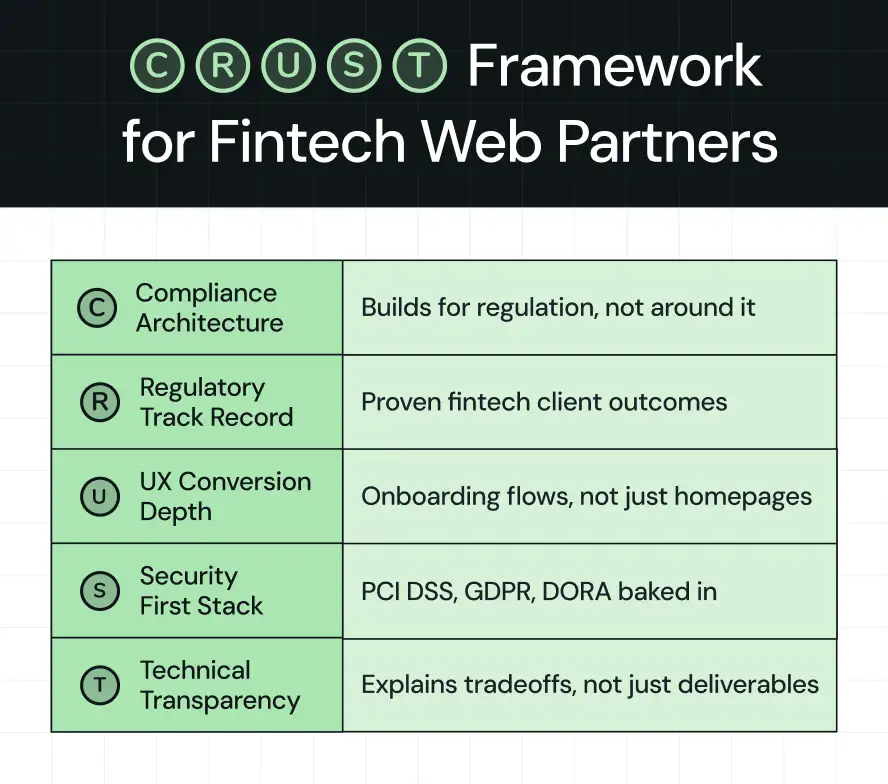
To evaluate partners systematically, use the CRUST Framework, five non-negotiable capabilities that separate genuinely fintech-ready agencies from general practitioners who've worked with a single payments brand.
1. Compliance architecture
The agency must show experience in building regulatory requirements directly into the product's technical structure. Ask them specifically how they handle PCI DSS data flow design, GDPR data residency, and KYC vendor integration.
If the answer is, "We work with your legal team on that," keep looking.
2. Regulatory track record
Client references in fintech are not optional. Hence, ask for examples of live regulated products. Platforms that have successfully passed compliance audits, obtained PSP licenses, or launched in EU-regulated markets are meaningful proof points.
Marketing portfolio pieces are not.
3. UX conversion depth
Look for experience with the specific UX challenges of fintech: KYC onboarding flows, multi-step authentication, dashboard complexity, and trust-building design systems.
Generic conversion rate optimization experience from e-commerce does not transfer to financial products.
4. Security-first stack
The agency should be able to articulate their approach to threat modeling, penetration testing, and secure coding practices before they start.
ISO 27001 certification, SOC 2 experience, or documented security audit processes are indicators worth asking about.
5. Technical transparency
Fintech projects involve trade-offs that most web projects don’t, such as choosing between native and cross-platform development, balancing compliance needs with launch speed, and keeping UX simple while still collecting all required user data.
A good partner explains these trade-offs clearly and helps you make informed decisions, rather than silently absorbing them and billing for the consequences.
5 Best Fintech Web Development Agencies for Compliance + High-Converting UX
We evaluated over 20+ fintech web development agencies to find the ones you can rely on for secure, compliant, and high-converting fintech platforms. Below is a quick side-by-side comparison of these agencies:
Now, let’s cover these fintech agencies from the list in detail, ranked by their compliance capabilities, UX approach, security standards, and client reviews.
1. ThunderClap
.webp)
Best for: B2B SaaS and fintech brands at the growth stage (Series A–C) that need a website that converts, builds trust, and positions them as category leaders.
Would you work with a team that is as obsessed with your fintech platform’s success as you are?
That is ThunderClap, a leading standard in fintech website design. ThunderClap is the design A-team for fintech brands, with talented designers, developers, and marketers who have helped 129+ B2B SaaS and fintech brands scale quickly. From startups to enterprises, they build websites that convert, stay compliant, and build trust.
What makes ThunderClap stand out is its obsession with results. They strategize, optimize, and deliver websites that improve lead pipeline by an average of 50%. They also bring SEO into the process from day one, so your fintech platform is built to rank and scale over time. Learn more about their process.
When the founders of Rezolv, an AI-powered fintech platform that helps financial institutions streamline and modernize debt collections, approached ThunderClap, they had strong technical expertise but lacked a brand, a website, and a clear way to explain their product.
The team built their identity from scratch, starting with a logo and visual system that reflected their approach to solving complex problems. They then developed the B2B website strategy, created clear messaging, and simplified complex financial workflows while maintaining trust and credibility. The site was built in Webflow with a focus on speed, responsiveness, and conversion from day one.
After launch, Rezolv saw higher engagement from prospects and faster adoption from target customers.
“As an early-stage company, we needed a clear brand identity and messaging before launching. ThunderClap delivered exactly that! Concise, impactful copy and branding that feels right.” - Karan Mehta, Founder, Rezolv
As Ayush Barnwal, Founder at ThunderClap, shared in a LinkedIn post, Rezolv was a stealth fintech startup founded by ex-Kissht leaders with a full suite of products for bank debt collection.
We helped them build a trusted brand, clear messaging, and a high-converting website to communicate their value to large banking clients.
This shows that ThunderClap designs with purpose. Every project starts with a deep understanding of your business, your users, their pain points, and your goals. They build fintech-specific strategies that balance compliance and trust with conversion-focused design. Their team handles everything from strategy and UX design to web development and ongoing maintenance.
Website: www.thethunderclap.com
Rating: 4.9 (Clutch)
Company size: 11-50 employees (in-house team of designers, developers, PMMs, CROs, and copywriters)
Average engagement period: 8–12 weeks for a full website revamp; ongoing retainers available post-launch
Services offered:
- End-to-end website design and development (including Webflow, WordPress, and Framer builds), Figma-to-development workflows, CMS implementation, enterprise-scale development, custom integrations, and ongoing website support and optimization
- Conversion rate optimization (CRO), SEO integration, copywriting, post-launch support (30 days included)
- Turns websites into revenue engines, not just redesigns
- Serves mid-market and enterprise B2B brands
- Creates scalable, marketer-owned CMS systems that are easy to update and future-proof
What customers have to say: "ThunderClap's speed of execution, high-quality work, and transparent communication make them stand out. It's rare to find an agency this reliable, and that's why we keep coming back." — Matt Cope, Co-founder, Overpass Studio
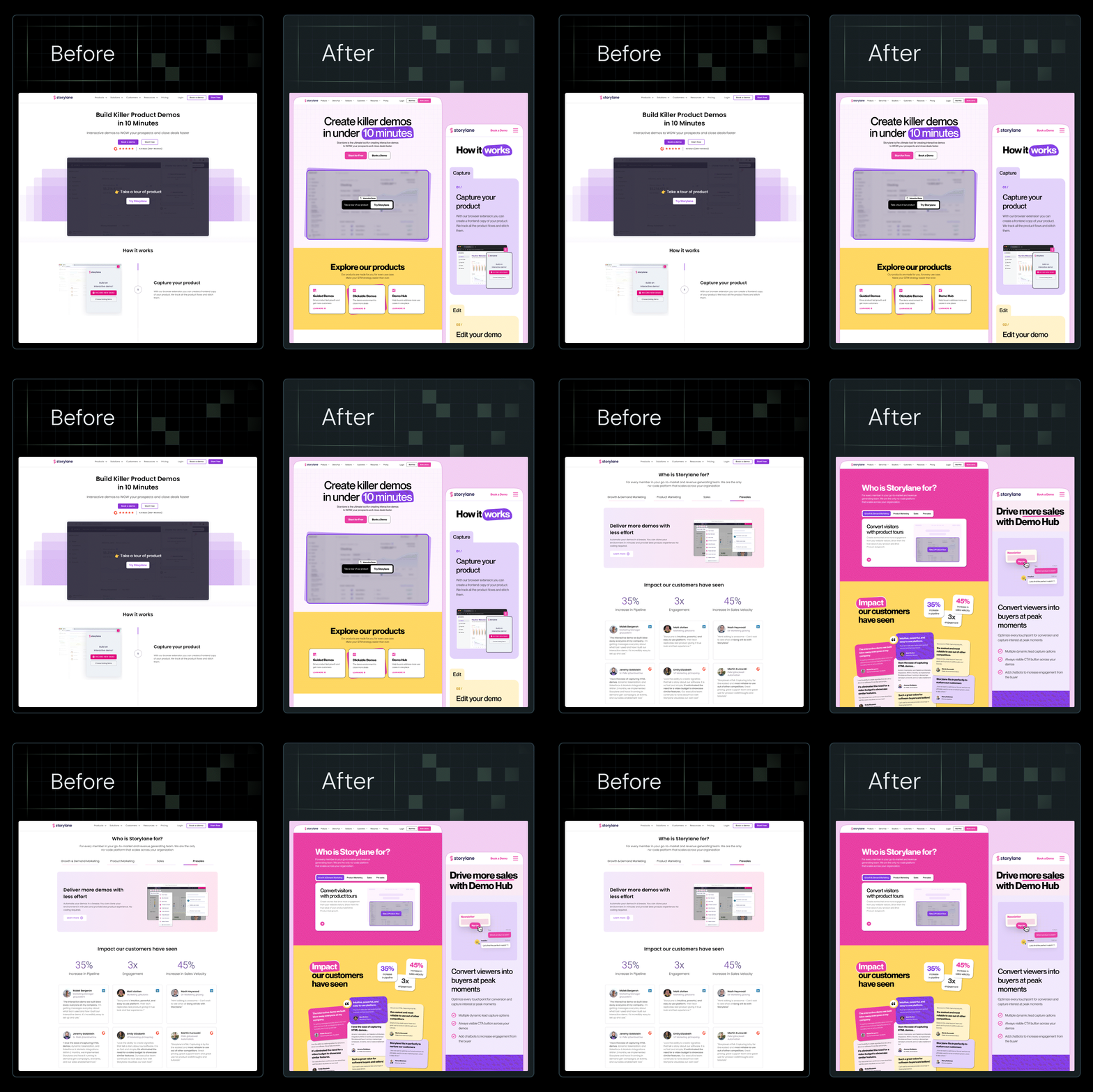
Notable projects/partnerships: ThunderClap brings deep expertise across SaaS, fintech, consulting, commerce, B2B services, and AI. Their clients include Shopline, Mysa, Spentra, Rezolv, and Razorpay, helping them with positioning, UX, and conversion-focused web experiences. Beyond fintech, their portfolio spans global B2B and enterprise clients such as Amazon, Storylane, Factors, Roommaster, Zamp, Dropit, Wizcommerce, and DPDZero, among others that prioritize measurable business outcomes over design alone. Their work has also received recognition through awards such as the Webby Awards and CSS Design Awards.
As a result, clients have seen up to a 50% increase in conversions, an 80% increase in demo bookings, and a 60% increase in engagement after working with the agency.
Join 88+ fast-growing fintech and B2B brands to build high-performing websites that drive measurable business results across SaaS, AI, and financial services.
{{ctaBlock}}
2. Clay
.webp)
Best for: Well-funded fintech startups and enterprise financial products that need world-class UX, product design systems, and brand identity, and have the budget for a premium engagement.
Clay is a San Francisco-based UI/UX design and branding agency with one of the most credible fintech portfolios in the market. Their work covers AI-powered financial products, trading platforms, credit tools, and digital banking interfaces.
They approach web development for fintech through the lens of behavioral science and brand cohesion, building design systems that hold up across the entire product, not just the marketing surface.
Website: www.clay.global
Rating: 4.8 (Clutch)
Company size: 11-50 employees
Average engagement period: Up to 20 weeks, depending on scope; tends toward longer strategic engagements
Services offered: UI/UX design, branding and identity, product design, web design and development, design systems, AI-powered product design
Notable projects: Coinbase, Credit Karma, Stripe, Marqeta, Lulo Bank, MoneyLion, and STC Bank.
{{specficService}}
3. CSTMR
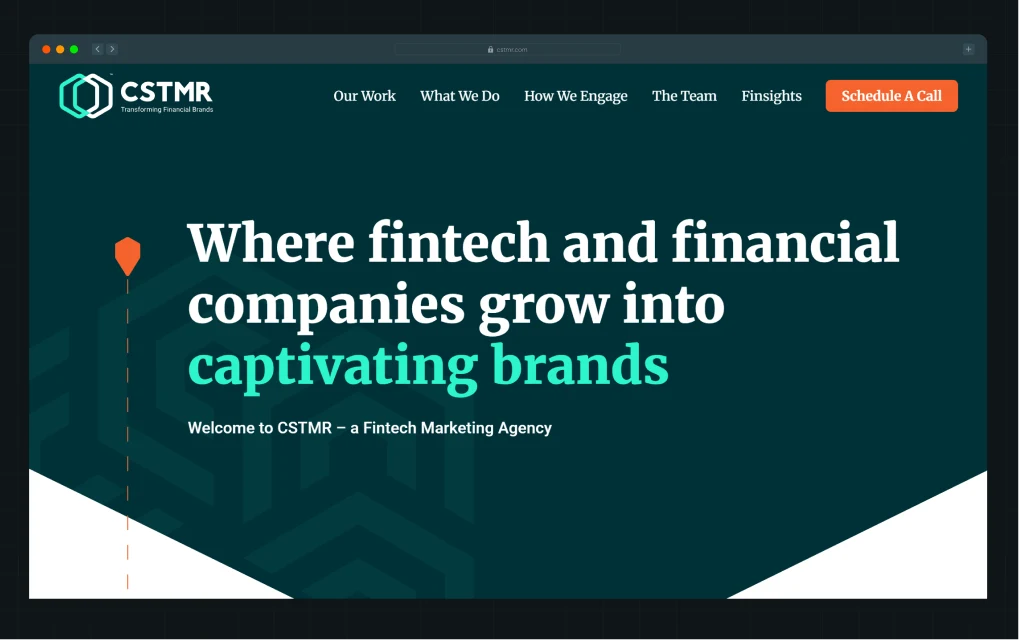
Best for: Growth-stage fintech companies (Series A–B) that need brand strategy, web development, SEO, and paid acquisition managed by a team that genuinely understands financial services regulation and audience psychology.
CSTMR is one of the few agencies on this list that positions itself exclusively as a fintech and financial services marketing and web agency. Founded by industry veterans with experience at some of the largest financial brands, they bring a decade-plus of domain knowledge to every engagement.
Their approach integrates brand positioning, fintech web design, conversion-led web development, and performance marketing into a single program, which is particularly valuable for fintech companies that need to move marketing and compliance strategy in parallel.
Website: www.cstmr.com
Rating: NA
Company size: 11-50 employees
Average engagement period: Typically ongoing retainer model (3–12+ months); strong long-term partnership culture
Services offered: Brand strategy and positioning, web design and development, SEO, content marketing, paid media, UX/UI design, conversion optimization
Notable projects: LendingTree Business Loans, ValidMind, UniTeller, Bankuity
4. Kindgeek
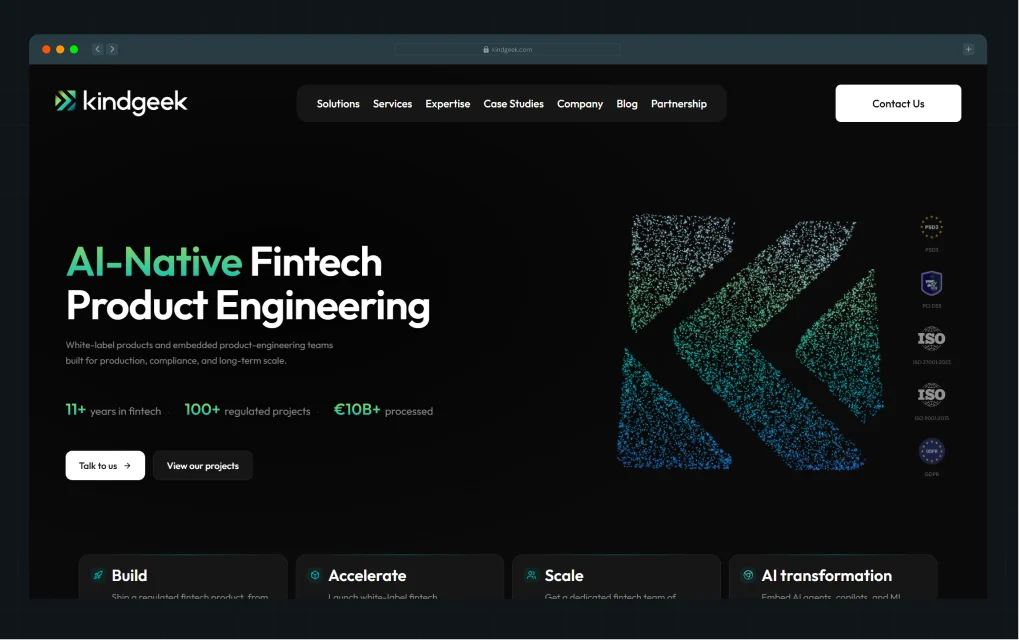
Best for: Series B+ companies, licensed fintech operators, and enterprises with complex compliance scopes.
Kindgeek is a Palo Alto-headquartered, full-cycle, AI-native fintech development company with over 200 engineers and 100+ fintech products delivered. Unlike the other agencies on this list, Kindgeek works at the product engineering layer, not the marketing or brand layer.
Their value proposition is specifically for companies where security compliance is a first-class engineering concern. PCI DSS, DORA, GDPR, PSD2/PSD3, MiCAR, and ISO 27001 are built into every pull request, not reviewed after launch.
Website: kindgeek.com
Rating: 4.8 (Clutch)
Company size: 51-200 employees
Average engagement period: 4–6+ months (MVP to full platform); white-label infrastructure can reduce time-to-market from 12+ months to weeks
Services offered: Neobank development, payment gateway integration, card issuing platforms, BaaS architecture, KYC/AML systems, AI transformation for fintech, white-label compliance-ready infrastructure, PCI DSS/DORA/ISO 27001 compliance
Notable projects: payabl, HyperJar, STCpay
5. Uitop
.webp)
Best for: Fintech companies and SaaS brands with complex, multi-feature products that need systematic UX design. Suited to growth-stage and enterprise companies with an in-house development team.
Uitop is a product design agency that has built a strong fintech specialization through deep research methodology and scalable design systems. They focus exclusively on the design and UX layer, which makes them a strong complement to an in-house engineering team or a development-focused partner like Kindgeek.
Their strength is in making complex financial products feel intuitive to non-expert users, which directly reduces support tickets, onboarding abandonment, and feature confusion.
Website: www.uitop.design
Rating: 5.0 (Clutch)
Company size: 51-200 employees
Average engagement period: 4-24 weeks; scales based on product complexity and research depth required
Services offered: UX/UI design, product research and user testing, onboarding flow design, design systems, dashboard and data visualization design, mobile app design
Notable projects: TangoPay and other fintech trading platforms, digital banking products, and investment dashboards across European and US markets.
{{specficBlog}}
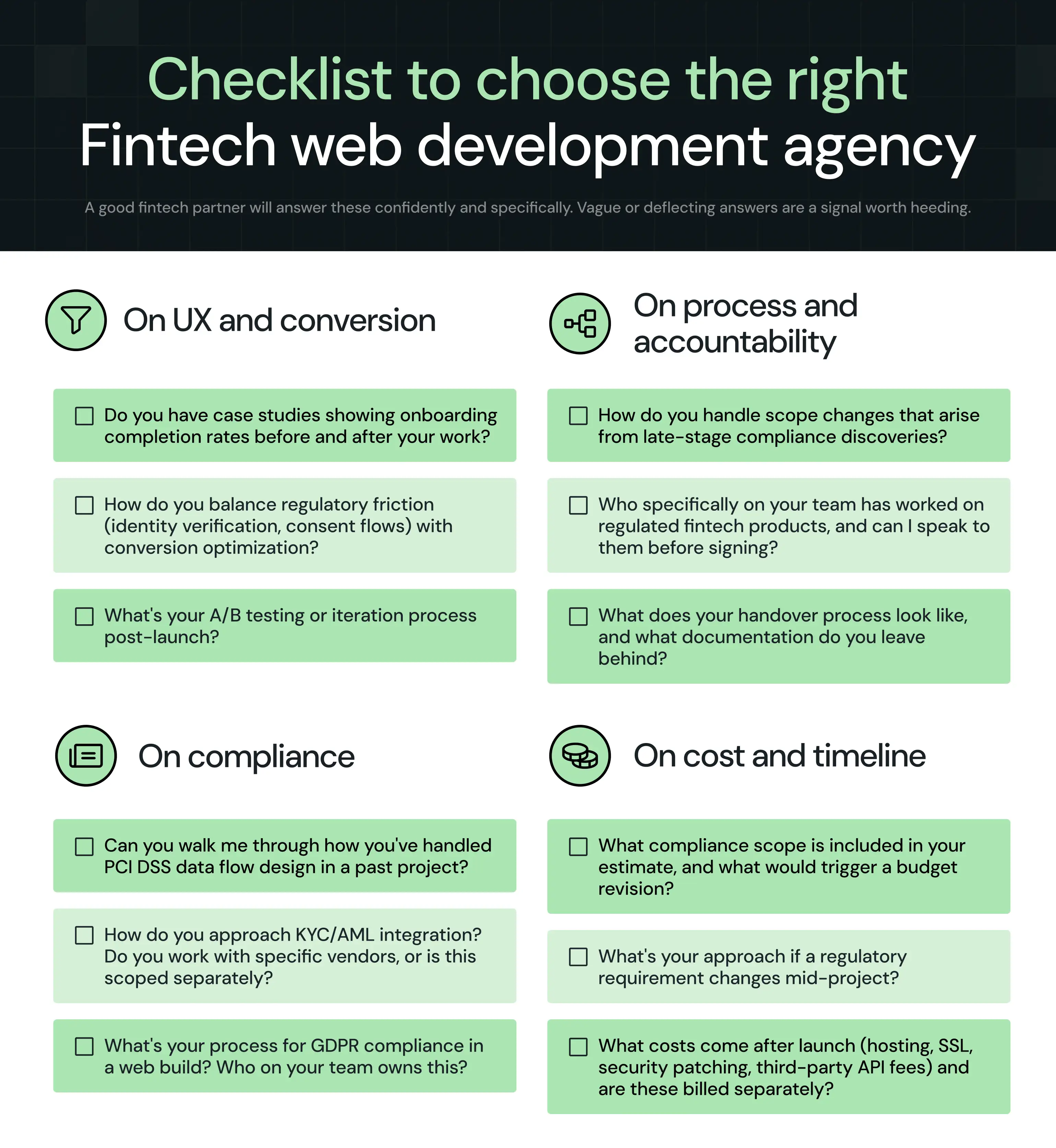
Questions to Ask a Fintech Web Development Agency Before You Sign
The brief you send to an agency shapes the partner you end up with.
Before committing to any fintech web develo
How Long Does It Take to Build a Fintech Website?
The timeline in fintech web development is shaped by three variables:
- Compliance scope
- Feature complexity
- Integration depth
Compared to standard web projects, you cannot compress a fintech build by cutting QA or security audits. Instead of a missed deadline, the exposure is a compliance failure.
A realistic planning framework looks like this:
One note worth making is that the compliance discovery phase, which includes mapping regulatory requirements, jurisdictional obligations, and third-party integration complexity, should occur before the development scope is finalized. Skipping this step can mean the cost estimate range varies by ±60%. Completing it first narrows that range to approximately ±50%.
How Much Does It Cost to Build a Fintech Website?
In fintech, a website is not just a digital asset but a part of your compliance, security, and revenue system. If you build a website that converts poorly, it’d cost you in CAC. Similarly, a fintech platform that fails a compliance audit will incur fines, legal fees, and potentially the loss of its operating license.
Here's how costs typically break down:
- Strategy and discovery: $10,000–$15,000+. Positioning audits, regulatory scoping, UX research, and competitive analysis. Often compressed or skipped by clients who then pay for it later in expensive revisions.
- Design (UX/UI): $15,000–$80,000+. Ranges from a marketing site redesign (lower end) to a full product design system with onboarding flow optimization (higher end). Agencies like ThunderClap, Clay, and Uitop sit at the premium end of this range for a reason.
- Development: $25,000–$500,000+. For marketing websites, Webflow development keeps costs manageable. For regulated product platforms, full-stack development with compliance architecture, including PCI DSS, DORA, GDPR residency, commands significantly higher rates.
- Compliance architecture: $55,000–$50,000+. Often, the most underestimated line item. Includes KYC/AML vendor integration, GDPR data flow design, PCI DSS scoping, and security audit preparation.
- Ongoing maintenance and optimization: $1,500–$15,000+. Post-launch optimization, compliance updates as regulations evolve, CRO iteration, and content management.
Verdict: Which Fintech Web Development Agency Is Right for You?
Choosing the right fintech web development partner comes down to where you are in your journey, what layer of the stack you need help with, and how much compliance complexity you're carrying.
Choose ThunderClap if:
- You're a B2B SaaS or fintech brand that needs a conversion-optimized marketing website that reflects your product's maturity
- Your product and compliance team are already in place, and you need the web layer to catch up
Choose Clay if:
- You want a fintech-focused growth partner that combines web development with SEO, content, and paid media
- You need long-term marketing support, not just a website build.
Choose CSTMR if:
- You want a fintech-focused growth partner that combines web development with SEO, content, and paid media.
- You need long-term marketing support, not just a website build.
Choose Kindgeek if:
- You are building a regulated fintech product from scratch and need compliance, infrastructure, and engineering tightly integrated.
- You are focused on systems like payments, neobanking, or KYC-heavy platforms.
Choose Uitop if:
- You already have development in place and need specialized UX and product design for complex fintech flows like onboarding, verification, or financial dashboards.
ThunderClap sits at an interesting intersection for most growth-stage fintech companies. It addresses the layer that most teams underinvest in, including the positioning, messaging, and conversion architecture of the web presence, while delivering fast, structured outcomes.
For teams that already have a compliance and engineering foundation and need their website to reflect and accelerate their category leadership, it's the most direct path to measurable pipeline impact, closing the gap between how good the product is and how clearly the web presence communicates it.
{{ctaBlock}}
FAQs
1. What are the things to consider before hiring a fintech web development agency?
Start by mapping your compliance scope before you contact any agency. Know your regulatory obligations (PCI DSS, GDPR, KYC/AML, PSD2), your target jurisdiction, and your current technical infrastructure. Then evaluate agencies on their fintech-specific track record, not just their general portfolio. Ask for client references in regulated financial products, and verify that those products are live and licensed.
2. Why is compliance important in fintech web development?
Compliance is important in fintech web development because it ensures your platform complies with financial regulations such as KYC, AML, GDPR, and PCI DSS. It protects user data, prevents fraud, and avoids fines or legal issues. It also shapes how onboarding, payments, and data handling are designed from the start.
3. What features should a fintech website include?
A fintech website should include a secure payment gateway, a KYC-integrated onboarding flow, GDPR-compliant consent and data management, multi-factor authentication, clear regulatory disclosure language, and a trust-building design system (security badges, certifications, and a transparent privacy policy). For B2B fintech platforms, a demo request flow optimized for conversion is equally critical, as your website is typically the first impression for procurement decision-makers.
4. How long does it take to build a fintech website?
A fintech marketing website typically takes 8–14 weeks to build. An MVP with onboarding and basic KYC integration takes around 10+ weeks. A full platform with payment rails, dashboards, compliance systems, and API integrations usually takes 8–24 weeks. Enterprise-grade regulated products, such as neobanks or BaaS platforms, can take months to complete. Timelines are driven primarily by compliance scope, not design complexity.
5. Can fintech websites use templates?
Fintech websites can use templates, but it is usually not a good idea. Most templates are not built to meet compliance requirements or the custom onboarding flows that fintech products need. They also struggle to support trust-building design, which is important in financial services, and can make the brand look less credible to investors or partners. For most fintech companies, custom development or a heavily customized Webflow build is the standard.
6. What are common mistakes in fintech web development?
Common fintech web development mistakes include treating compliance as a post-launch step, underestimating KYC/AML complexity, and skipping regulatory discovery. Teams often prioritize visuals over onboarding conversion, hire non-specialist agencies, and face costly rework. Launching without a conversion strategy also leads to lost growth opportunities from day one.



.webp)
Browse Similar Articles





Leading 5 SaaS Branding Agencies in Florida (That Actually Understand SaaS Growth)

.svg)

How to Turn Your B2B Website into a Self-Serve Growth Engine? (PLG Ready in 2026)


9-Step Website Copy Audit Checklist to Improve Conversions (Examples from Top B2B Brands)

.webp)

How to Choose the Right Fintech Web Development Company for Your Business

Top B2B Website Design Principles That Turn Visitors into Qualified Leads

%20Audit%20That%20Actually%20Improves%20Revenue.webp)
How to Do a Conversion Rate Optimization (CRO) Audit That Actually Improves Revenue
Web Design Agency vs. Freelancer vs. In-House: What Actually Works in 2026
5 CRO Agencies in London and How to Choose the Best CRO Agency for Your Business

The Ultimate Fintech B2B Positioning Guide for 2026 (That Actually Drives Conversions)
Mapping the B2B Buyer Journey to Improve Conversions Across Every Touchpoint
.webp)
7 Best Website Maintenance Companies in India for Growth-Led B2B Teams (2026)

.webp)


8 Best Healthcare Website Design Agencies for HIPAA-Compliant Sites in 2026


How to Find the Best Web Design Company in Houston, Texas for B2B Brands (6 Best Picks)

Positioning That Wins: How to Make Complex B2B Products Clear and Compelling
The Step-by-Step Website Redesign Process B2B Teams Use to Increase Conversions (Without Killing SEO and Pipeline)

7 Best Video Production Agencies for SaaS Product Walkthroughs and Feature Videos

How to Choose the Best B2B Website Maintenance Company: 9 Questions to Ask Before You Hire One




How to Choose a Web Design Company in San Francisco in 2026 (with Examples)

10 Best Web Design Companies in Florida in 2026 and How to Choose the Right One

How to Use Brand Storytelling on Your Website to Close More B2B Deals and Build Buyer Trust

SaaS CRO Best Practices: What High-Growth Brands Do Differently to Win Conversions


How a Rebranding Agency Can Redefine Your B2B SaaS Identity and Boost Pipeline


B2B Marketing Trends in 2026 That Directly Influence Pipeline and Revenue

Top 7 Video Marketing Agencies Driving B2B SaaS Brand Awareness in 2026

Why Partnering with a B2B Brand Positioning Agency Accelerates Market Differentiation

The Complete Website Redesign Checklist for B2B SaaS Teams Ready to Scale
.avif)
9 Best Webflow Development Agencies in India for 2026 (In-Depth Review)

10 Product Marketing Companies Powering the Fastest-Growing SaaS Brands in 2026
Website Copywriting Services vs In-House: What's Right for Your Business?


How to Choose a Marketing Agency That Understands B2B SaaS Growth Metrics


How to Choose a Video Marketing Agency That Understands B2B Storytelling

Outsourcing Web Design: Cost-Benefit Analysis for Mid-Market & Enterprise Brands

From Leads to Lifetime Value: How Growth Marketing Agencies Scale SaaS Revenue
Build a B2B Website Strategy That Aligns with Sales and Marketing Goals

Webflow vs WordPress: Which Platform Is Better for Your Business Website in 2026?
Fintech Web Design That Builds Trust: 8 UX Principles Every Fintech Site Needs

Optimizing for Intent: How B2B Website Messaging and UX Changes Help Capture Top-Funnel Buyers


12 Best B2B Web Development Agencies in the US to Build Scalable Websites

From Audit to Action: 8-Step Process to Optimize Your B2B Website Strategy for 2026 Buyers

How to Design a High-Converting Landing Page from Scratch (2026 Edition)

From Click to Customer: Proven Landing Page Conversion Optimization Techniques

How to Write Website Copy That Converts: A Step-by-Step Guide for 2026


How to Optimize a Landing Page for Maximum ROI: A Step-by-Step Breakdown


AI Landing Pages That Convert: 7 Design Principles Every AI Platform Should Follow
From Traffic to Pipeline: B2B Website Growth Strategy for Scaling Teams


B2B Website Optimization Strategy: Speed, UX, SEO, and CRO in One Playbook




Interested in seeing what we can do for your website?



.webp)
