















Web Design Agency vs. Freelancer vs. In-House: What Actually Works in 2026

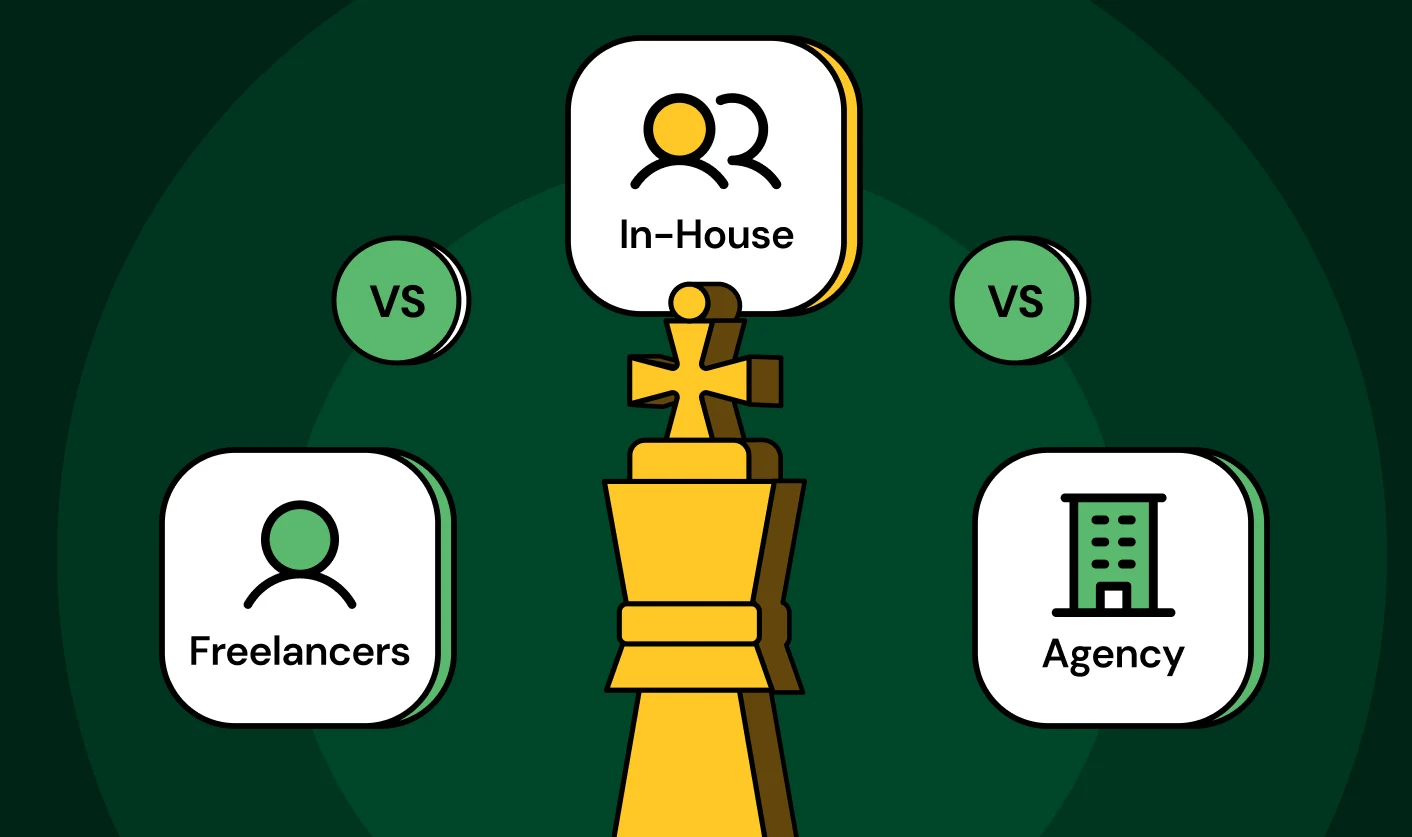

Every founder faces this decision. You need a website designed, redesigned, or rebuilt, and you have three ways to move forward:
↳Hire a freelancer. Lean, affordable, but dependent on one person.
↳Partner with a design agency. Strategic, full-service, scalable, but more expensive.
↳Build an in-house team. Dedicated, aligned with your vision, but slow and costly to build.
The challenge is that all three can work, or fail, depending on your stage, budget, and growth goals.
This article helps you evaluate freelance designers vs. agencies for B2B website projects based on what your project actually requires, not just which option costs less upfront.
TL;DR
- Choosing between a freelancer, an agency, and an in-house team isn't just a cost decision. The right choice depends on your website's scope, complexity, timeline, and long-term business goals.
- Freelancers are often the right fit for narrow, well-defined tasks, such as a landing page, motion asset, or specific technical fix.
- In-house teams keep operations running well, but they’re rarely set up to handle a full website redesign on their own.
- Agencies combine specialized expertise across strategy, design, development, and project management, allowing them to handle complex B2B website projects faster and more reliably.
- In 2026, the difference comes down to execution systems, not just talent. Who can take ownership of the entire project without needing constant oversight from your team?
Why has the Freelancer vs. Agency vs. In-House Decision Become So Complicated in 2026?
A few years ago, the choice felt simpler. Agencies were expensive but reliable. Freelancers were affordable but limited. The categories were clear. Today, they've collapsed into each other.
According to Upwork’s 2025 Future Workforce Index, more than 1 in 4 U.S. knowledge workers now freelance or work independently, generating an estimated $1.5 trillion in earnings in 2024. These shifts have made the decision even harder.
No-code and AI builder tools have enabled solo designers to ship what used to require a full dev team. Freelancers now market themselves as ‘full-stack’ and ‘growth-focused.’ Agencies have splintered into boutiques, collectives, and project-based studios that price like freelancers but position like agencies. Meanwhile, buyers, burned by overpromising on both ends, have grown skeptical of everyone.
The confusion gets worse because the lines between freelancers and agencies barely exist anymore.
In a discussion on Reddit’s r/webdesign community, one developer explained that freelancers today are often encouraged to “build your own brand and start with your core strength,” then expand by partnering with specialists for development, analytics, consulting, SEO, or photography as projects grow.
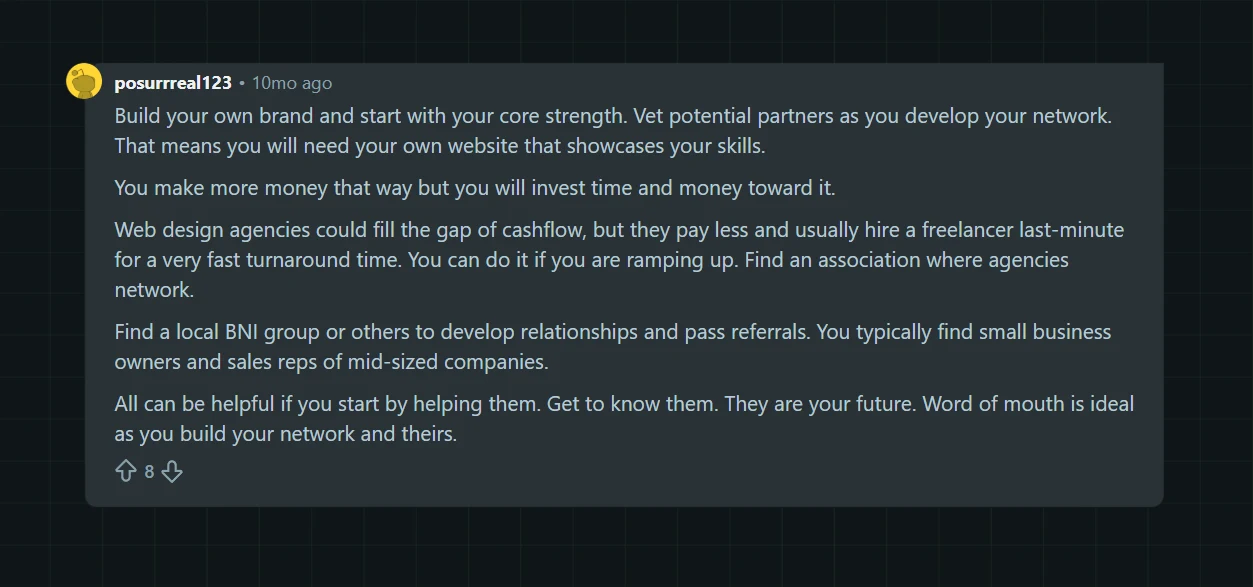
The same comment also pointed out that many agencies now hire freelancers “last-minute for a very fast turnaround time,” which makes the traditional difference between agency teams and independent freelancers far less obvious than it used to be.
For buyers, this creates a new challenge. The label on the proposal no longer tells you much about how the work will actually get done. A freelancer may operate with a network of specialists behind the scenes. An agency may rely heavily on contractors. An in-house team may outsource specific functions to external experts. The categories are no longer clear.
A freelancer charging $8,000 and an agency charging $25,000 may promise nearly identical deliverables on paper. The difference is usually not the website itself. It is the execution system behind the work.
Who manages revisions? Who handles SEO? Who keeps the project moving when timelines slip? Who is responsible after launch?
The real question in 2026 isn't "Who can design a website?"
Almost everyone can, to some degree, at the very least.
The real question is: Which setup can execute this project reliably, without you becoming the project manager?
What Do B2B Website Projects Require Today?
A modern B2B website project involves more than most buyers anticipate, and the underestimation usually becomes visible two months in, not two weeks before kickoff.
A B2B website in 2026 is not a design project. It's a positioning project, a messaging project, a UX project, an SEO project, and a technical migration, often all at once. It requires UX thinking, SEO architecture, product marketing alignment, conversion rate optimization, development, and frequently a CMS migration.
If you're going through a rebrand, stakeholder coordination and approval cycles add another layer of complexity that can easily affect timelines. Webstacks estimates that B2B website redesigns can take anywhere from 6 weeks to 6 months, depending on scope, approvals, and coordination.
The complexity is why the freelancer vs. agency vs. in-house debate has shifted so much in recent years. In her latest LinkedIn post, Growth Advisor and Consultant Daphne Tideman argued that companies are often asking the wrong question entirely.
Instead of asking, “Who is going to run our A/B tests?”, she suggests companies should ask, “Who owns our experimentation strategy and the learning that comes from it?”
When you break it down, a modern B2B website touches multiple disciplines:
- Brand positioning and messaging
- UX research and information architecture
- SEO strategy and technical SEO
- Product marketing and competitive differentiation
- Visual design and motion
- Frontend and backend development
- CRO and conversion architecture
- Stakeholder alignment and approval management
- CMS migration and QA
This is where the freelancer vs. agency vs. in-house decision starts to depend less on cost and more on execution. The question becomes: Which setup can reliably coordinate multiple moving parts without breakdowns in ownership, communication, or delivery?
When Should You Hire a Freelancer for Your Website Project?
Freelancers get an unfair reputation in the wrong conversations and too much credit in the right ones. Used correctly, they're a powerful resource.
What type of web design work is a freelancer best suited for?
Freelancers shine on narrow, well-defined, single-discipline work.
- A landing page for a product launch.
- A motion graphics asset for a campaign.
- Specific technical tasks, like a Webflow animation or a HubSpot integration.
- An MVP site to validate an early-stage product.
These are contexts where one person can own the full scope without needing to coordinate across four other specialisms.
According to data from Contra, most skilled freelancers can easily charge $120+ per hour, and a basic five-to-seven-page website can run $2,000+, which is significantly less than agency pricing for the same deliverable. For small tasks and one-page updates, that cost difference is hard to argue with.
What are the benefits of hiring a freelancer for a website project?
Lower upfront cost, faster spin-up time, and the ability to find someone with a very specific skill set. A Figma-to-Webflow developer who's done 20+ SaaS sites can be genuinely valuable.
You can also make faster decisions on small matters because there's no internal approval chain. You talk to the person doing the work, and they move. Unlike an agency engagement, there's no account manager translating your feedback to a project manager who then briefs a designer; you're one conversation away from the person actually doing the work.
That direct relationship often changes the quality of communication, too. In his article 12 Things I Learned During My First 12 Months as a Freelance UX Researcher, UX researcher Konstantin Escher argues that freelancers are often able to be “more unfiltered”.
“As a freelancer, you are expected to bring a different perspective to the conversation. In fact, people will love you for addressing the elephant in the room. Chances are high that many people agree, but you are the first one to ever speak out that something is wrong here. You will know by the nodding and private “glad you said it” messages in your chat window.”
For companies that already have a clear direction internally, that level of speed and directness can make freelancers extremely effective.
Where does a freelance web design engagement typically fall short?
A founder starts with ‘just a landing page’ and ends up needing a full site architecture review, a new navigation structure, SEO-optimized copy across twelve pages, and a CMS migration. Suddenly, the freelancer is stretched beyond their expertise, or the client is coordinating five separate freelancers and has become the de facto project manager.
Agencies deliver on time more reliably because they have resources to reallocate in response to delays. Freelancers who get sick or get busy on another project have no backup. There's also an availability risk that B2B buyers consistently underestimate. For instance, a freelancer managing three concurrent clients is a single point of failure for all three.
Freelancers are strongest when the scope is narrow and clearly owned by one person. The moment a project grows past that single-owner threshold, a different model starts to make more sense. For many B2B companies, the first instinct is to look internally.
When Should You Rely on Your In-house Team for Your Website Project?
In-house teams have one irreplaceable advantage: They know the company.
What is an in-house design team best suited for?
For ongoing content updates, campaign landing pages, and iterative improvements, internal teams are often the most efficient option. This is largely because they know the company in a way no outside partner can. They understand the brand's history, the internal politics, the language your customers respond to, and where the edge cases live in your CMS.
What are the benefits of using your in-house team for website work?
Internal teams move fast on small things. They don't require a briefing process for every task. They know the stakeholders, they're in the same Slack workspace, and they carry institutional knowledge that external teams have to earn over weeks of discovery.
The long-term context is exactly why many designers prefer in-house environments for product-focused work. Writing about his transition from freelance and agency work into an internal UX role, Josh Sassoon describes his desire to work in-house:
“My jump over to an in-house team was born out of a desire to go deeper on problems than I was able to with contract projects, and to work closely with cross-functional product teams to ship and iterate on ideas and get to great solutions. The transition wasn’t easy, but it was worthwhile.
[…]
The in-house experience is all about cultivating relationships with your cross-functional teams and building a deep, long-term understanding around a problem space.
Where does an in-house team typically fall short?
The problems show up when a company decides to redesign the entire site, which is fundamentally different from maintaining it. They struggle with redesigns because:
1. Redesigns compete with day-to-day operational work
Your in-house designer is simultaneously updating the product page, building a trade show banner, and is now supposed to lead a six-month website overhaul? The bandwidth math doesn't hold. Most in-house design functions at B2B companies are staffed for continuity rather than transformation.
The most common reasons internal redesigns stall are not about skill. They're about capacity and prioritization; a VP of Marketing managing six competing priorities will consistently defer the redesign when it collides with a campaign deadline.
2. Ownership is split across teams, so momentum stalls
A redesign requires dedicated ownership, a team structure that doesn't yet exist, and the ability to run a complex, cross-functional process without getting pulled back into business-as-usual (BAU) work week after week.
In a 2026 analysis on enterprise redesign failures, Siteimprove argued that most redesigns fail not because of poor design decisions, but because “nobody actually owned them.” Marketing owned design, IT owned technical implementation, and content ended up assigned to whoever still had bandwidth left. Without a single dedicated owner whose sole job is to ship the new site, the project drifts by design.
In-house teams are usually optimized for continuity, not transformation. That's the constraint that brings agencies into the picture, not because internal teams lack skill but because transformation requires a dedicated structure that continuity work never had to build.
When Should You Hire a Web Design Agency for Your Website Project?
The agency case is earned here because you now understand what the alternatives can't sustain at scale.
What is a web design agency best suited for?
If your website drives most of your leads and sales, you can't afford to get it wrong. Professional services, B2B companies, and service businesses that rely heavily on website performance should hire agencies. For a company going through a rebrand, a fundraise, a repositioning, or an enterprise market entry, the website is a primary artifact that every prospect will evaluate.
At that stage, the challenge is not just execution. You also need to decide what the website should say and how it should say it. Internal teams often have deep product knowledge, but translating that into a narrative that resonates with external buyers is a different skill entirely.
Agencies help you solve this by shaping those decisions with you. They help you decide what to include, what to leave out, how to position the product, and how to structure the story so buyers understand it quickly. Instead of spending weeks aligning internally on messaging and structure, you can work with specialists who help you arrive at those decisions through the process itself. You rely on external expertise to pressure-test ideas, simplify messaging, and turn fragmented inputs into a clear direction that you can ship.
Kiran Kulkarni, Partner and Head of Growth at ThunderClap, described this as a recurring pattern in early-stage fintech, where simplifying complex products into trust-building narratives is often what determines whether buyers move forward or lose interest.
{{specficBlog}}
What are the benefits of hiring a web design agency?
Agencies don't win on design talent alone. They win because they've built an execution system around a specific type of project.
1. Reduced coordination work compared to freelancers
The highest invisible cost in any website project is coordination. Every time your internal team has to brief a freelancer, review a handoff, chase a missing asset, or reconcile conflicting feedback from three stakeholders, that's time that delays the project and costs energy you don't account for in the budget.
If you need strategy, B2B web design and development, copywriting, and ongoing website maintenance, all from one source, agencies provide this. Coordinating multiple freelancers for each specialty becomes your job. An agency removes you from that coordination role entirely, with one account manager, one workflow, and one accountability layer.
For example, when Freehand launched as an AI platform for freight operations, the challenge extended far beyond website design. The company needed to reposition itself in the market and communicate a new category story to enterprise buyers.
In a recent LinkedIn post shared by Ayush Barnwal, partner at ThunderClap, he mentioned the engagement involved aligning multiple stakeholders around a single market narrative, defining how the platform should be positioned, identifying what enterprise buyers needed to understand first, and translating those decisions into the website experience.
Rather than simply executing design requests, the agency acted as a coordination layer between strategy, messaging, branding, and execution. The result was a launch that gave sales and marketing teams a unified story while helping enterprise buyers quickly understand where Freehand fits into their existing workflows.
This suggests that agencies reduce coordination complexity by consolidating fragmented internal inputs into a single execution path, without requiring the client to manage every dependency themselves.
2. Faster execution than in-house teams for redesigns
A B2B company doing a website redesign for the first time in three years is doing something novel and uncomfortable. An agency that runs B2B redesigns every month has a process, decision frameworks, and the muscle memory to avoid the mistakes that first-timers make.
Webstacks reports that focused B2B redesigns with an MVP strategy can go live in 6 to 10 weeks with an agency. Internal teams attempting the same scope routinely take 9 to 12 months, not because they're less talented, but because the project competes with everything else.
The operational speed is one reason companies continue to rely on specialized agencies for high-stakes launches. As Matt Cope, Co-founder at Overpass Studio, explained after working with ThunderClap:
“ThunderClap has been an invaluable partner for us. Their speed of execution, high-quality work, and transparent communication make them stand out. We trust them completely to deliver on time without compromising on quality.”
The combination of process, specialization, and delivery consistency is difficult to replicate internally when redesign work is competing with everything else the business already needs to ship.
3. Cross-functional disciplines under one roof
A strong B2B web agency brings SEO, product marketing, CRO, design, motion, and development under one roof. All of these disciplines affect each other throughout the project instead of happening one after another.
Your SEO lead needs to shape the information architecture while your copywriter builds the messaging hierarchy. The simultaneous coordination is what agencies are built to handle, and what falls apart when you're managing separate contractors.
A good example of this is NativeMSG. The platform was already strong, but the website failed to communicate why the company mattered in the RCS space. Prospects did not fully understand what the product could do, because the experience relied too heavily on feature explanations instead of showing real-world outcomes.
The redesign required more than visual improvements. It needed product positioning, UX clarity, messaging strategy, conversion thinking, and technical structure to work together at the same time.
The agency team rebuilt the experience around visual education. They created more than 40 real-world message mockups so visitors could immediately understand how RCS campaigns worked in practice. The messaging shifted away from platform features and toward outcomes like engagement, conversions, and ROI. Dedicated pages for Creator, Cloud, and Connect simplified the platform architecture, while a layered visual system reinforced ideas of security, reliability, and scale.
As Ayush Barnwal, partner at ThunderClap, explained:
“They did not want to be another messaging vendor. They wanted to own RCS entirely. Our visual-first approach helped people understand the product in minutes.”
Kiran later explained that the redesign helped NativeMSG turn education into a conversion asset and drive a more qualified pipeline.
That is the difference cross-functional execution creates. Strong B2B websites do not treat visuals as decoration. They use design, messaging, UX, and structure together to help buyers understand complex products faster and move forward with confidence.
When does it make sense to pay more for a web design agency?
Agencies make more sense when revenue is directly tied to website performance.
Agencies typically run $15,000 to $200,000+, or roughly $100–$149 an hour, compared to about $47.71 an hour for most freelancers. On paper, that gap looks hard to justify. It gets easier to justify once you price in what happens when the cheaper option doesn't work out.
A $5,000 freelancer who delivers poor work that later needs to be rebuilt by a $15,000 agency does not cost $5,000. The real cost becomes $20,000, plus the months of delay and the pipeline impact during that period. The project cost estimation math changes completely when you include the cost of a redo.
That redo risk is highest exactly where the earlier sections flagged it: narrow scopes that quietly expand, freelancers who double as a single point of failure, in-house teams without a dedicated owner. Paying the agency premium upfront is, in effect, paying to remove those failure points before they cost you a relaunch.
The premium is worth it when the stakes match it: a full redesign, a rebrand, a fundraise, an enterprise market entry, or any project where the website is doing real revenue work. It's harder to justify for a single landing page or a one-off update, which is exactly the kind of task the freelancer section above is built for.
Agency vs. Freelancer vs. In-House: A Side-by-Side Comparison
Most B2B teams do not choose between freelancers, agencies, and in-house teams based on capability. They choose based on budget, urgency, and how much complexity they can realistically manage internally.
Let’s see how these aspects compare for each:
Which Option Is Best for Long-Term Growth?
The right answer depends less on company size and more on the type of work ahead of you. Most website decisions come down to how complex the work is and how much coordination it requires.
- Choose a freelancer when the scope is narrow and clearly defined. You use them for isolated tasks like landing pages, specific features, or design components where speed and cost efficiency matter more than coordination.
- Choose your in-house team when the work is ongoing and tightly tied to your brand. You rely on them for continuous updates, campaign execution, and day-to-day improvements where context and consistency matter more than one-time delivery.
- Choose an agency when the work is cross-functional and high-stakes. That includes a full redesign, rebranding, a CMS migration, a brand repositioning, preparing for an upcoming launch or funding round, or any project where website scalability and revenue are directly at risk, and where multiple disciplines need to run in parallel. The higher upfront cost is the cost of reliability and delivery speed.
Most mature SaaS and B2B brands do not rely on just one model. They combine them based on the type of work, using each where it fits best.
The right partner should help you clarify positioning, simplify complexity, align teams, and build a website that actually supports growth.
This is the approach ThunderClap takes with B2B brands. Through structured discovery sessions, the team works through positioning, messaging, UX, and conversion strategy before design begins, making sure that execution aligns with business outcomes.
If you are evaluating agencies, the real differentiator is not portfolios or pricing alone, but process, ownership, communication, and execution clarity. And if ThunderClap is on your shortlist, booking a discovery call is a good place to start.
FAQs
1. Is hiring a web design agency more expensive than hiring a freelancer?
Yes, agencies typically cost $15,000 to $200,000+ compared to $47.71/hr for most freelancers. But accurate project cost estimation has to include the cost of a redo. A failed freelance engagement that hands off to an agency rebuild often runs more in total than hiring the agency from the start, plus the pipeline impact during the delay.
2. What are the advantages of working with a web design agency?
The biggest advantage is coordinated execution. You get a PM, a designer, a developer, a strategist, and often a CRO or SEO specialist, all working within one workflow. You stop managing the pieces yourself. For B2B companies where the website is a primary revenue driver, that coordination is what separates a 10-week launch from a 10-month one.
3. Which option is best for long-term growth?
A hybrid model is the most durable answer. Use an agency for high-stakes redesigns, your internal team for ongoing operations, and freelancers for specific overflow tasks. Each model has a job it does better than the others, and the web design agency vs. freelancer question gets easier once you're choosing based on scope rather than budget alone.
4. How does quality differ between agencies, freelancers, and in-house teams?
Quality tracks scope-fit, not model prestige. A specialist freelancer on a single-discipline task can outperform an agency on that specific deliverable. An agency on a full redesign will almost always outperform a stretched in-house team on the same project. Match the model to the scope, and quality follows.



.webp)
Browse Similar Articles



Leading 5 SaaS Branding Agencies in Florida (That Actually Understand SaaS Growth)

.svg)

How to Turn Your B2B Website into a Self-Serve Growth Engine? (PLG Ready in 2026)

9-Step Website Copy Audit Checklist to Improve Conversions (Examples from Top B2B Brands)

.webp)

How to Choose the Right Fintech Web Development Company for Your Business

Top B2B Website Design Principles That Turn Visitors into Qualified Leads

%20Audit%20That%20Actually%20Improves%20Revenue.webp)
How to Do a Conversion Rate Optimization (CRO) Audit That Actually Improves Revenue
5 CRO Agencies in London and How to Choose the Best CRO Agency for Your Business

The Ultimate Fintech B2B Positioning Guide for 2026 (That Actually Drives Conversions)
Mapping the B2B Buyer Journey to Improve Conversions Across Every Touchpoint
.webp)
7 Best Website Maintenance Companies in India for Growth-Led B2B Teams (2026)

.webp)


8 Best Healthcare Website Design Agencies for HIPAA-Compliant Sites in 2026


How to Find the Best Web Design Company in Houston, Texas for B2B Brands (6 Best Picks)

Positioning That Wins: How to Make Complex B2B Products Clear and Compelling
The Step-by-Step Website Redesign Process B2B Teams Use to Increase Conversions (Without Killing SEO and Pipeline)
7 Best Video Production Agencies for SaaS Product Walkthroughs and Feature Videos


How to Choose the Best B2B Website Maintenance Company: 9 Questions to Ask Before You Hire One


How to Choose a Web Design Company in San Francisco in 2026 (with Examples)

10 Best Web Design Companies in Florida in 2026 and How to Choose the Right One
How to Use Brand Storytelling on Your Website to Close More B2B Deals and Build Buyer Trust

SaaS CRO Best Practices: What High-Growth Brands Do Differently to Win Conversions

How a Rebranding Agency Can Redefine Your B2B SaaS Identity and Boost Pipeline

B2B Marketing Trends in 2026 That Directly Influence Pipeline and Revenue

Top 7 Video Marketing Agencies Driving B2B SaaS Brand Awareness in 2026
Why Partnering with a B2B Brand Positioning Agency Accelerates Market Differentiation

The Complete Website Redesign Checklist for B2B SaaS Teams Ready to Scale
.avif)
9 Best Webflow Development Agencies in India for 2026 (In-Depth Review)

10 Product Marketing Companies Powering the Fastest-Growing SaaS Brands in 2026
Website Copywriting Services vs In-House: What's Right for Your Business?


How to Choose a Marketing Agency That Understands B2B SaaS Growth Metrics

How to Choose a Video Marketing Agency That Understands B2B Storytelling

Outsourcing Web Design: Cost-Benefit Analysis for Mid-Market & Enterprise Brands

From Leads to Lifetime Value: How Growth Marketing Agencies Scale SaaS Revenue
Build a B2B Website Strategy That Aligns with Sales and Marketing Goals
Webflow vs WordPress: Which Platform Is Better for Your Business Website in 2026?
Fintech Web Design That Builds Trust: 8 UX Principles Every Fintech Site Needs
Optimizing for Intent: How B2B Website Messaging and UX Changes Help Capture Top-Funnel Buyers


12 Best B2B Web Development Agencies in the US to Build Scalable Websites

From Audit to Action: 8-Step Process to Optimize Your B2B Website Strategy for 2026 Buyers
How to Design a High-Converting Landing Page from Scratch (2026 Edition)

From Click to Customer: Proven Landing Page Conversion Optimization Techniques

How to Write Website Copy That Converts: A Step-by-Step Guide for 2026


How to Optimize a Landing Page for Maximum ROI: A Step-by-Step Breakdown


AI Landing Pages That Convert: 7 Design Principles Every AI Platform Should Follow
From Traffic to Pipeline: B2B Website Growth Strategy for Scaling Teams

B2B Website Optimization Strategy: Speed, UX, SEO, and CRO in One Playbook





Interested in seeing what we can do for your website?



.webp)
