















The Ultimate Fintech B2B Positioning Guide for 2026 (That Actually Drives Conversions)


TL;DR
- Most fintech B2B companies lose deals not because their product is weak, but because their positioning fails to reduce buyer risk and create clarity at the decision stage.
- Fintech buyers are risk-sensitive and comparison-driven, with trust and clarity outperforming innovation and creativity as drivers of conversion.
- Strong fintech positioning starts with a clearly defined ICP, a sharp problem narrative, and differentiation that holds up under real buyer scrutiny.
- Proof points, including metrics, case studies, and trust signals, consistently outperform positioning statements in enterprise fintech sales.
- Positioning is not a one-time exercise. It needs to be continuously tested, refined, and aligned across marketing, sales, and product.
- The fintech companies winning in 2026, such as Stripe, Ramp, and Plaid, lead with clarity and outcome-first messaging, not feature lists.
Open ten fintech websites right now, and you’ll likely see the same familiar phrases repeated:
- “Secure, scalable, seamless”
- “Efficiency and innovation,”
- “The all-in-one platform for modern finance”
The messaging feels interchangeable, and buyers recognize it immediately. As a result, momentum fades during evaluation, especially in rooms full of stakeholders who approach vendors with built-in skepticism from the very first interaction.
The contrast becomes obvious when you look at companies like Stripe or Ramp. Their products are undeniably complex, but their positioning is anything but.
Stripe describes itself as “the financial infrastructure to grow your revenue.” Ramp entered the market as a corporate card designed to help companies spend less, a deliberately counterintuitive message in an industry built on rewards and cashback.
Neither company buried the lead in features. Both made it difficult to misinterpret what they stand for.
This guide is about that gap between what your product does and how clearly a buyer understands why they should choose you over every alternative. It covers how fintech B2B brand positioning impacts buyer decisions, shortens sales cycles, and drives conversion rates across the full funnel.
The Uncomfortable Truth
Most fintech brand positioning fails before it starts. It usually happens right when growth begins to accelerate.
That is, when more teams, more markets, and more pressure quietly fracture a story that once felt obvious inside the company.
Everyone sounds identical
Visit any cluster of fintech competitors today, and the pattern shows up within seconds. The language feels interchangeable because it is. The same claims about infrastructure, scale, and seamless experiences repeat across category pages, pitch decks, and ads.
What has changed after 2024 is how quickly buyers disengage when they see it.
Generic disruption messaging, often characterized by aggressive "we are disrupting X industry" claims, no longer effectively holds attention. The market has matured, leading to consumer skepticism, ad blindness, and increased competition. Now, buyers are more informed and selective, expecting personalized, relevant experiences rather than broad, spray-and-pray marketing.
The environment around fintech has also changed. Regulation is tighter, competition is denser, and embedded finance continues to expand into every category from SaaS to retail. This combination raises the bar for how clearly a company needs to explain where it fits.
When positioning sounds like everyone else, buyers do not spend time figuring it out. They move on.
Messaging is feature-heavy, not decision-focused
The most common symptom of weak fintech positioning is a website that describes what the product does rather than what changes for the buyer when they use it.
Feature-heavy messaging forces buyers to do the interpretive work themselves. This involves translating capabilities into outcomes, and outcomes into a business case that they can take to multiple other stakeholders.
Most buyers won't do that work. They'll move to a vendor that has already done that thinking for them.
This becomes even more critical in how buying behavior has evolved after 2024. Research from Forrester shows that more than half of large B2B purchases are expected to occur through digital self-serve channels. Buyers now form strong opinions before they ever speak to sales. The website is not just a touchpoint anymore. It carries the weight of the entire early evaluation.
When positioning is unclear at that stage, even strong products struggle to communicate value. A clear example of this problem appears in early-stage fintech builds where technical strength exists, but messaging has not yet caught up.
When Rezolv’s founders approached ThunderClap, they had deep technical expertise but no brand, no website, and no clear way to communicate their product, exactly the kind of challenge agencies that focus on fintech brand design help companies solve. That’s where the B2B website strategy and repositioning work began.
We partnered with their team to:
- Create a new logo that captured the product’s power and personality
- Build a distinct brand voice and visual identity that inspires trust and authority
- Develop a messaging framework that communicates product value clearly
- Simplify complex use cases into clear, relatable narratives
One of the founders noted:
“As an early-stage company, we needed a clear brand identity and messaging before launching. ThunderClap delivered exactly that. Concise, impactful copy and branding that feels right.” - Karan Mehta, Founder, Rezolv
Kiran Kulkarni, Partner and Head of Growth at ThunderClap, frames this pattern as a recurring theme in early-stage fintech, where translating complex products into clear, trust-building narratives often marks the shift from attention to adoption.
Read her LinkedIn post to understand more!
Ramp understood this early. Rather than listing reconciliation features or card controls, Ramp built its entire messaging around a single outcome: saving companies both time and money.
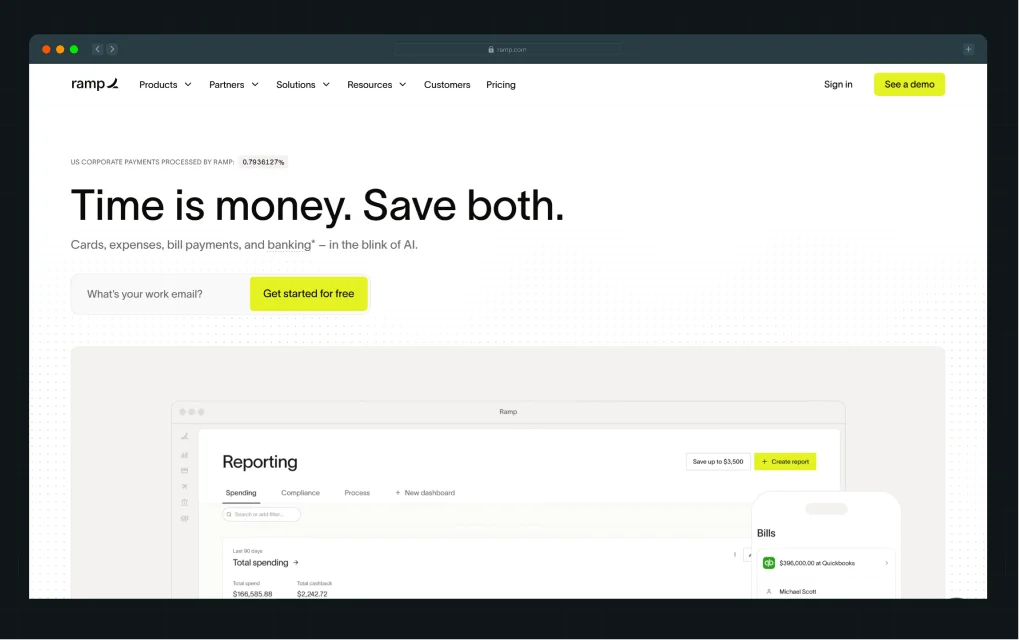
When the era of zero interest rates ended in 2022, and CFOs began prioritizing cost efficiency over growth vanity metrics, Ramp's message was already waiting for them. That's what decision-focused messaging looks like. It anticipates the buyer's priority before they've articulated it themselves.
Positioning ignores how fintech buyers evaluate risk
Fintech buyers do not evaluate vendors the way typical SaaS buyers do. A bad decision can disrupt payment operations, introduce compliance risk, or damage relationships with regulators and customers.
According to Forrester's buyer-journey research, 68% B2B buyers already have a preferred vendor in mind before formal evaluation begins, and 80% of the time, that vendor wins.
In that environment, clarity carries more weight than messaging creativity. If positioning feels vague or interchangeable, it raises uncertainty at the exact moment buyers are forming an early conviction.
Generic innovation messaging falls flat in enterprise fintech conversations for this reason. What trust-sensitive buyers need to hear is why you're safe, who else has trusted you, and what would change if they switch. Positioning that does not address those questions tends to lose traction early in the evaluation process.
What Fintech B2B Positioning Actually Means (and Why it’s Different)
By the time a fintech buyer reaches your sales team, they’ve already formed a version of your story. Most of the time, it’s not the one you intended to tell.
You're not just selling a product; you're selling trust
In fintech B2B, the perceived risk of a wrong vendor decision is categorically higher than in most software categories. Your buyer isn't just worried about whether the product will work. They're also worried about what happens to their compliance standing, their customer data, and their internal reputation if it doesn't.
Companies like Square navigated this by using radical simplicity as a proxy for safety.
- The invisible regulation: Square didn't lead with PCI compliance or encryption protocols (the scary stuff). They led with "Start selling in minutes." By making the onboarding frictionless, they signaled to the buyer that the complex regulatory challenges had already been solved under the hood.
- Aesthetics as professionalism: Notice the emphasis on sleek and modern hardware in the homepage copy? In a world of clunky, beige legacy terminals, Square’s design-forward approach signaled stability and modern standards, which reduced the internal reputation risk for the person choosing the vendor.
- Radical pricing transparency: B2B buyers often stall because they fear hidden costs or predatory contracts. Square’s "No hidden fees, cancel anytime" model removes the financial risk, making "Yes" a much safer decision for a group of 10 stakeholders to agree upon.
B2B buying research found that the average purchase now involves up to 10 decision-makers. According to Forrester’s State of Business Buying, 2026 report, the typical buying decision now includes 13 internal stakeholders and 9 external influencers. The more stakeholders involved, the more room there is for confusion, delays, and indecision. In fact, confused buyers usually default to the safest-looking option or simply avoid making a decision altogether.
For Square, clear positioning is the mechanism that keeps deals moving when they would otherwise stall. You overcome the fear of making the wrong decision by making the right one feel effortless.
Buyers evaluate you against multiple alternatives
A common mistake in fintech positioning is treating the competitive set too narrowly. Most fintech companies position themselves against their two or three closest competitors. But a fintech buyer is simultaneously weighing you against:
- Direct competitors with similar capabilities
- Their existing internal tools or manual processes
- The status quo (doing nothing and deferring the decision)
If your positioning only addresses why you're better than Competitor A, you've already lost buyers who are still weighing whether to change anything at all.
Effective fintech B2B positioning must make the case for why change is worth the risk, not just why you're the best option among those already considering change.
Decisions are slower, more risk-sensitive
The average fintech enterprise sales cycle regularly extends beyond 12 months. A case study from Forth & Scale highlighted a lending solutions provider where technical validation alone took four months. Security and compliance reviews frequently restarted from scratch because the vendor’s initial messaging failed to address risk concerns up front.
By implementing a pre-qualification process and technical acceleration toolkit, that same company cut its sales cycle by 47% and reduced compliance review times by 63%.
According to Gartner’s survey, 67% of the buying journey is now complete digitally before a prospect ever speaks to a sales representative. This means your positioning must do the heavy lifting of persuasion and risk mitigation before a human conversation even begins.
In fintech, positioning is not primarily about standing out. It is about being the safest choice. That safety must be clear from the very first touchpoint to avoid delays in security reviews, which often slow down deals and affect growth.
The Core Elements of Strong Fintech Branding and Positioning
As fintech products become harder to distinguish by features alone, the strength of positioning depends on how clearly the buyer understands where the product fits and why it exists.
Clear ICP definition
Vague positioning almost always traces back to a vague ICP. When a fintech company tries to appeal to financial services companies of all sizes, its messaging ends up serving no one particularly well.
Brex demonstrated the power of specificity by narrowing its ICP to VC-backed startups. This focus allowed them to solve a hyper-specific pain point: founders with millions in the bank but no personal credit history who were being rejected by traditional banks.
By underwriting companies based on capital rather than FICO scores, Brex transformed a complex financial problem into a 5-minute onboarding process. Their famous San Francisco billboard campaign (which they spent $300K on) worked because it achieved nearly 100% brand awareness within that tiny, high-value circle. Buyers recognized themselves in the messaging instantly, which triggered demo requests rather than page exits.
The discipline of ICP definition is not about excluding opportunity. In 2022, Brex famously offboarded thousands of SMB customers to refocus on startups and enterprises after realizing it couldn't be the best for everyone.
This existential choice worked. Their specialized Empower platform alone reached $100M in ARR by May 2023, serving major enterprises such as DoorDash, ClassPass, and Scale. Growth continued until the company reached $950M in annual revenue in 2026, shortly before its $5.15B acquisition by Capital One.
A message built for everyone converts with no one. By choosing who they were not for, Brex made their positioning credible and resonant to the buyers who matter most.
A sharp problem narrative
The second element is what makes the buyer feel seen before you've made a single claim about your product. What breaks in their world if they don't act? What does the status quo actually cost them in day-to-day friction, risk, or inefficiency?
Fintech buyers have heard every vendor ROI claim before. What they respond to is a clear understanding of the problem they are living with, because that signals the solution is likely to address it.
Differentiation that survives comparison
Strong fintech differentiation doesn't collapse the moment a prospect opens a feature comparison spreadsheet. Plaid is the clearest example of this principle in practice.
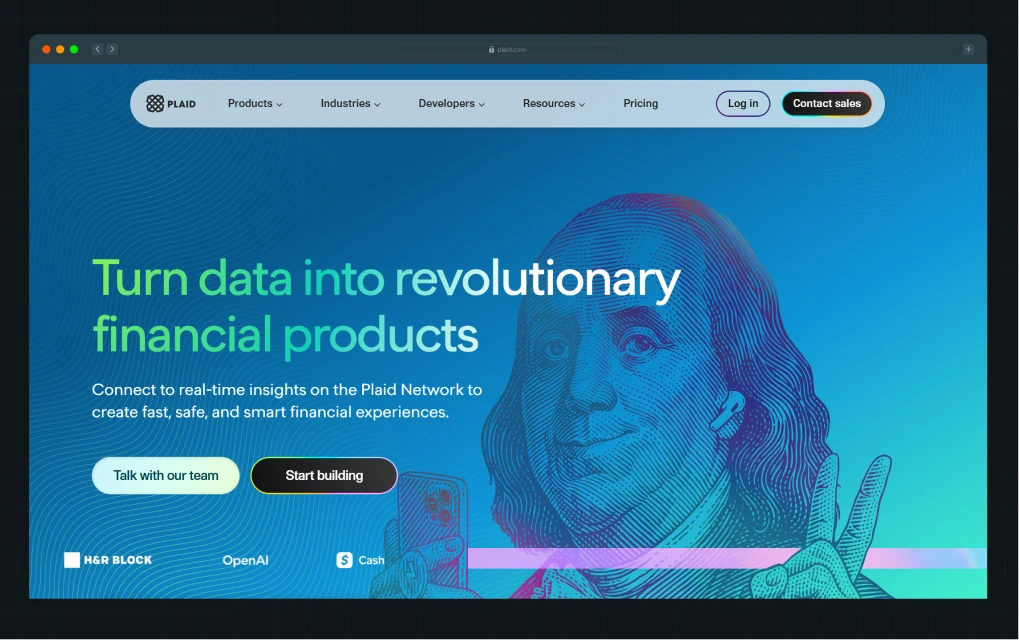
Rather than competing feature-by-feature against data aggregators, Plaid positioned itself as the infrastructure layer of fintech. By 2025, Plaid had reached $546M in ARR with 40% YOY growth, serving over 8,000 fintech apps and 12,000 financial institutions. The growth wasn't driven by having the longest feature list. It was driven by a positioning frame that entirely changed the evaluation criteria. When you're infrastructure, you're not compared to alternatives. You're compared to building it yourself.
Plaid Link is now used by more than half of Americans with bank accounts, handling 750,000 connections every day. When you reach this level of scale, you are no longer compared to alternatives. You are comparing the risk and cost of building it yourself.
Plaid reinforces this infrastructure status by turning its massive network into a product benefit. Their scale allows them to block nearly 3M fraudulent requests annually and achieve conversion rates for returning users 11% higher than the industry average. By integrating advanced threat monitoring and skip-to-OTP features directly into the core flow, they make the build vs. buy decision easy.
A prospect might find a cheaper aggregator, but they cannot easily replicate a network that already holds the trust and data of millions of active users.
Proof beats positioning statements every time
Gartner research shows that 90% of B2B buyers say social proof heavily influences their shortlist decisions. In fintech, that social proof is not optional. It is the mechanism that translates positioning into trust.
A prime example is the recent brand evolution of Factors.ai. Despite having a product that supported complex, data-heavy workflows, their digital experience lacked the structure to convert that complexity into clarity for marketers.
To fix this, they anchored their entire brand experience around the Marketing Compass concept. They positioned the platform as a guide through the buyer journey rather than just another analytics tool.
They proved this positioning through several key design choices:
- Reducing cognitive load: They balanced technical precision with hand-drawn illustrations and a distinct orange palette to stand out from blue-heavy competitors.
- Functional hierarchy: By structuring layouts to make the product story scannable and logical, they demonstrated clarity before the user even logged into the app.
- Contextual validation: They designed interaction patterns that supported user understanding without distraction, reinforcing the guide persona at every touchpoint.
As Ayush Barnwal, Partner at ThunderClap, noted, the redesign helped Factors.ai establish a premium, globally ready brand.
“ThunderClap delivered our website revamp on extremely tight deadlines without compromising on quality. The team was always responsive, quick to act, and highly collaborative. The final output exceeded our expectations - modern, clean, and exactly what we envisioned.” - Tanvi, Product Marketing Lead at Factors.ai
When your visual and functional experience matches your verbal promises, you move from making claims to providing proof.
Messaging that translates across the journey
The strongest fintech companies treat positioning as a system, not a tagline. Ramp’s “Time is money. Save both.” message appears consistently across the homepage, onboarding, sales decks, and content marketing.
This shows up in recent research, which finds that B2B buyers spend only 17% of their purchase journey interacting with a vendor’s sales team. They spend the remaining time on independent research, peer discussions, and internal evaluation, all of which are shaped by what they see across other channels.
When messaging changes from one touchpoint to another, clarity drops. It also signals a lack of conviction in what the company stands for.
{{specficBlog}}
A Practical Fintech B2B Positioning Framework (Step-by-Step)
Most fintech positioning fails because it starts with internal definitions rather than with how buyers actually understand the problem in real-world situations.
The steps below break that process.
Step 1: Start with how buyers describe the problem
The most reliable source material for positioning is the language buyers already use to describe their problem. This could be in sales calls, support tickets, win/loss interviews, and peer community discussions.
This language hasn't been processed through internal jargon or product roadmaps. It reflects how the problem actually feels before any solution has been proposed.
Before writing a single line of positioning copy, spend time auditing this language.
- What words do buyers use to describe the pain point?
- What do they blame?
- What do they fear?
Positioning built on buyer language creates instant recognition. This way, the reader feels understood before they've been asked to trust you.
Step 2: Define your point of tension
Every strong positioning statement rests on a point of tension, the specific thing that is broken for your target buyer today.
Not a broad market trend or a feature gap, but the operational, financial, or compliance problem your buyer deals with regularly.
- For Ramp, it was that every corporate card on the market was designed to make companies spend more, and CFOs had started to notice.
- For Plaid, it was that building bank connectivity from scratch was consuming engineering resources fintech companies needed for their actual product.
The point of tension is what makes positioning feel urgent rather than theoretical.
Step 3: Position against alternatives, not just competitors
In B2B fintech, your real competitor is rarely another startup. It is usually the status quo, involving the spreadsheets, manual workarounds, or legacy institutions that your buyer has tolerated for years.
Your positioning must articulate why the way they currently do things is no longer sustainable.
A great example of this is Zenda, a fintech company that worked with ThunderClap to redefine its digital presence. Instead of just listing features, they positioned their experience against the dry, uninspiring nature of traditional finance.
The final experience felt smart, simple, and intuitive and even earned recognition at Awwwards.
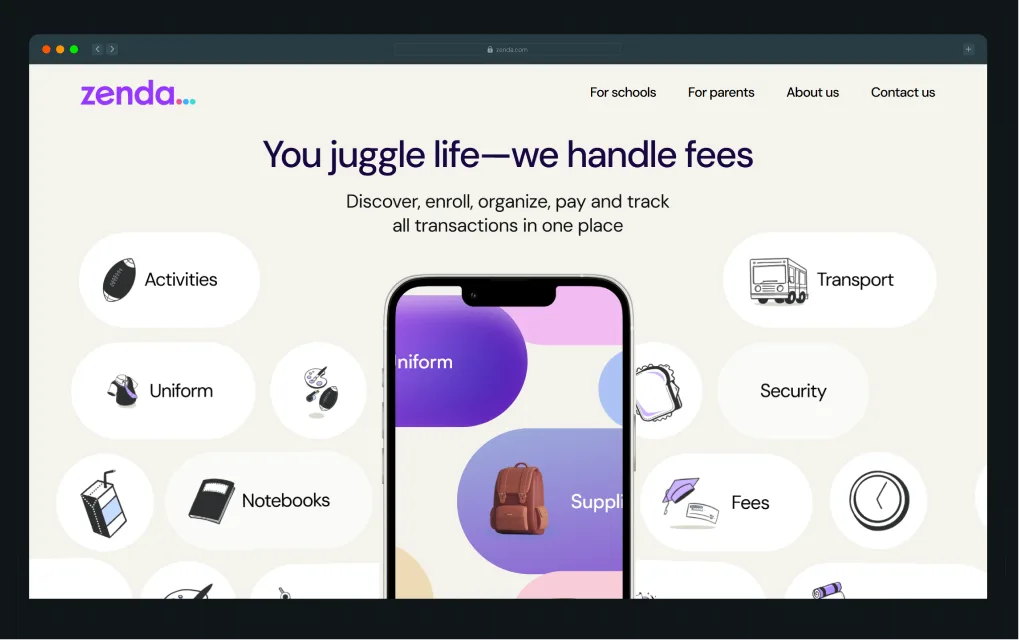
They achieved this by focusing on three key areas:
- A clear, structured journey from the hero section through rewards, features, testimonials, and community
- Scannable sections supported by visual elements that add personality without distracting from the message
- Trust signals like partner badges, stats, and consistent CTAs that build confidence and guide action
Aastha Shad, who leads Brand Design and Communications Marketing at Zenda, spoke about the project in a video testimonial, sharing how it transformed their website and overall messaging. Ayush also walked through the full revamp journey on his LinkedIn, offering a closer look at how the project came together.
Step 4: Build a risk-reduction narrative
In a market where 87% of technology buyers report adjusting their buying process to focus only on mission-critical purchases, your positioning must answer two questions clearly:
- Why are you safe to choose?
- Why is switching worth the disruption?
The risk-reduction narrative is a core component of the value proposition.
Security certifications, compliance credentials, implementation guarantees, and reference customers in the buyer's specific vertical are not footnotes. They are the reasons fintech deals close at the bottom of the funnel.
Step 5: Test positioning in real sales conversations
Positioning is not validated when it sounds good in a strategy presentation. It is validated when it shortens the time to a “yes” in real sales conversations.
The fastest way to test positioning is to introduce new framing during live sales calls and track three things:
- How quickly buyers confirm they understand what you do
- How early do they bring up the budget or next steps
- How often do they repeat your language when discussing you with internal stakeholders
Positioning is working when it helps close deals faster, not when it looks polished in a brand guidelines document.
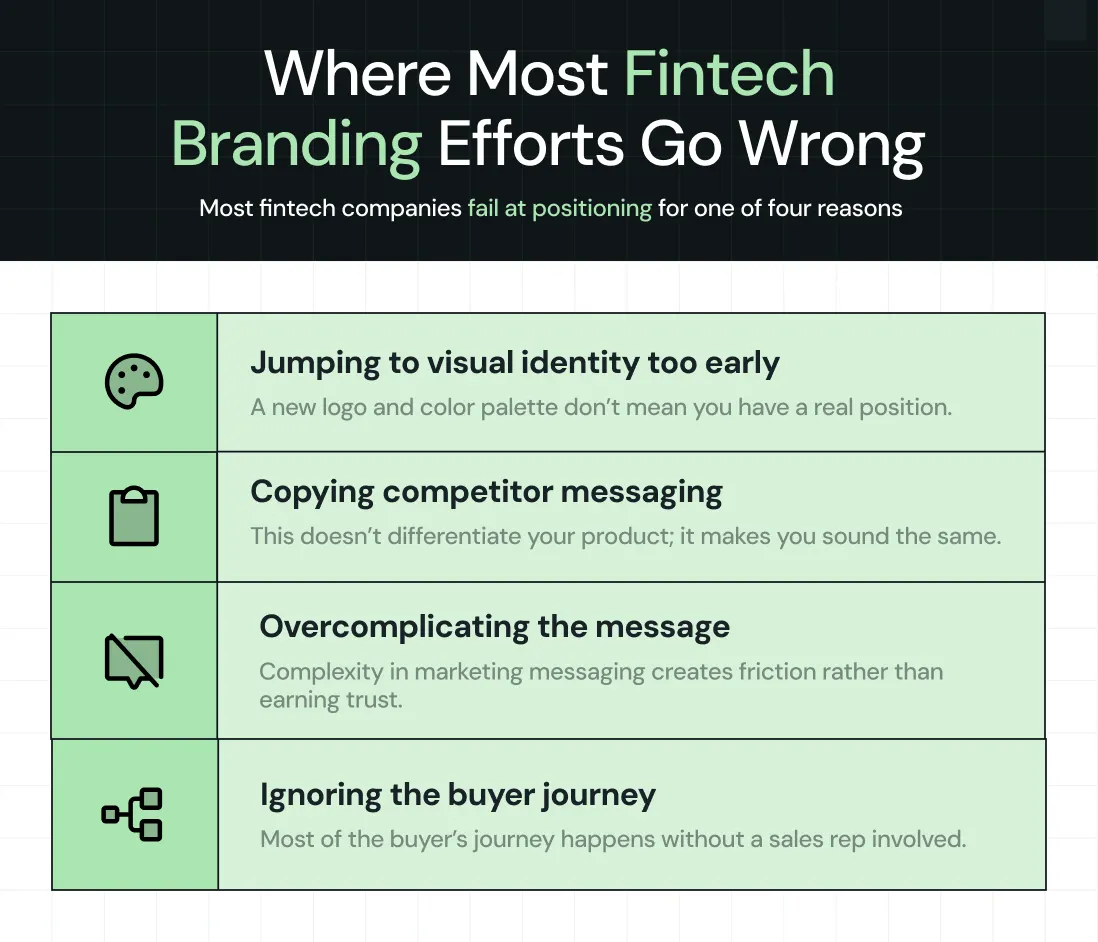
Most fintech companies fail at positioning for one of four predictable reasons below:
- Jumping to visual identity too early: A new logo and color palette get approval faster than a positioning workshop. The speed creates a false sense of progress without the harder conversation about who the product is actually for. Visual identity can reinforce strong positioning. It cannot create it.
- Copying competitor messaging: When a competitor's messaging appears to be working, the temptation is to borrow its structure. This accelerates the generic messaging problem rather than solving it. Buyers see both companies and hear the same story twice, which confirms that no one in the category has anything differentiated to say.
- Overcomplicating the message: Fintech products are genuinely complex, and the instinct to reflect that complexity in the messaging is understandable. However, it's the wrong call. The companies that win in fintech sales, including Stripe, Ramp, and Brex, turned complex systems into simple explanations. Complexity in the product earns trust. Complexity in messaging adds friction during evaluation.
- Ignoring the buyer journey: Most fintech branding efforts focus on a homepage and a sales deck, which represent a fraction of the 83% of the buyer journey that happens without a sales rep. The positioning needs to be present and consistent across every channel where a buyer independently evaluates whether you're worth considering.
Most fintech branding fails because it focuses on how things look rather than how decisions are made.
Why Positioning (Not Branding) is the Real Growth Lever in Fintech
Branding shapes how people perceive you. Positioning shapes how people decide.
In a category where trust drives purchase decisions and compliance risk slows procurement, the ability to make buyers feel confident choosing you carries more commercial weight than visual appeal alone.
Better positioning → Faster sales cycles
When buyers arrive at a sales conversation already understanding what you do, who you do it for, and why it's worth the switch, the early discovery phase compresses. The conversation moves to specifics faster.
The Forth & Scale case study from earlier illustrates this perfectly. By restructuring their positioning to address risk concerns early, a fintech lender reduced their enterprise sales cycle from 14.6 months down to 7.8 months.
Better positioning → Higher conversion rates
Fintech MQL-to-SQL conversion averages 12% to 21% across the sector, which is notably higher than most B2B industries. However, this average conceals a significant variance.
Companies with tightly defined ICPs and clear differentiation consistently outperform this benchmark. The conversion gap is often just a positioning gap. Companies with generic messaging fail to trigger the "this is for me" moment required to move a lead forward.
Better positioning → Stronger trust
According to Forrester's B2B research, 82% of buyers say coworkers and internal advocates are their most trusted information source. This means the stakeholder your sales rep convinced must carry your positioning across procurement, compliance, and the C-suite.
A positioning that's hard to explain is hard to champion. When your ICP can summarize why they're choosing you in one sentence, deal velocity accelerates because advocates can actually defend the decision to their peers.
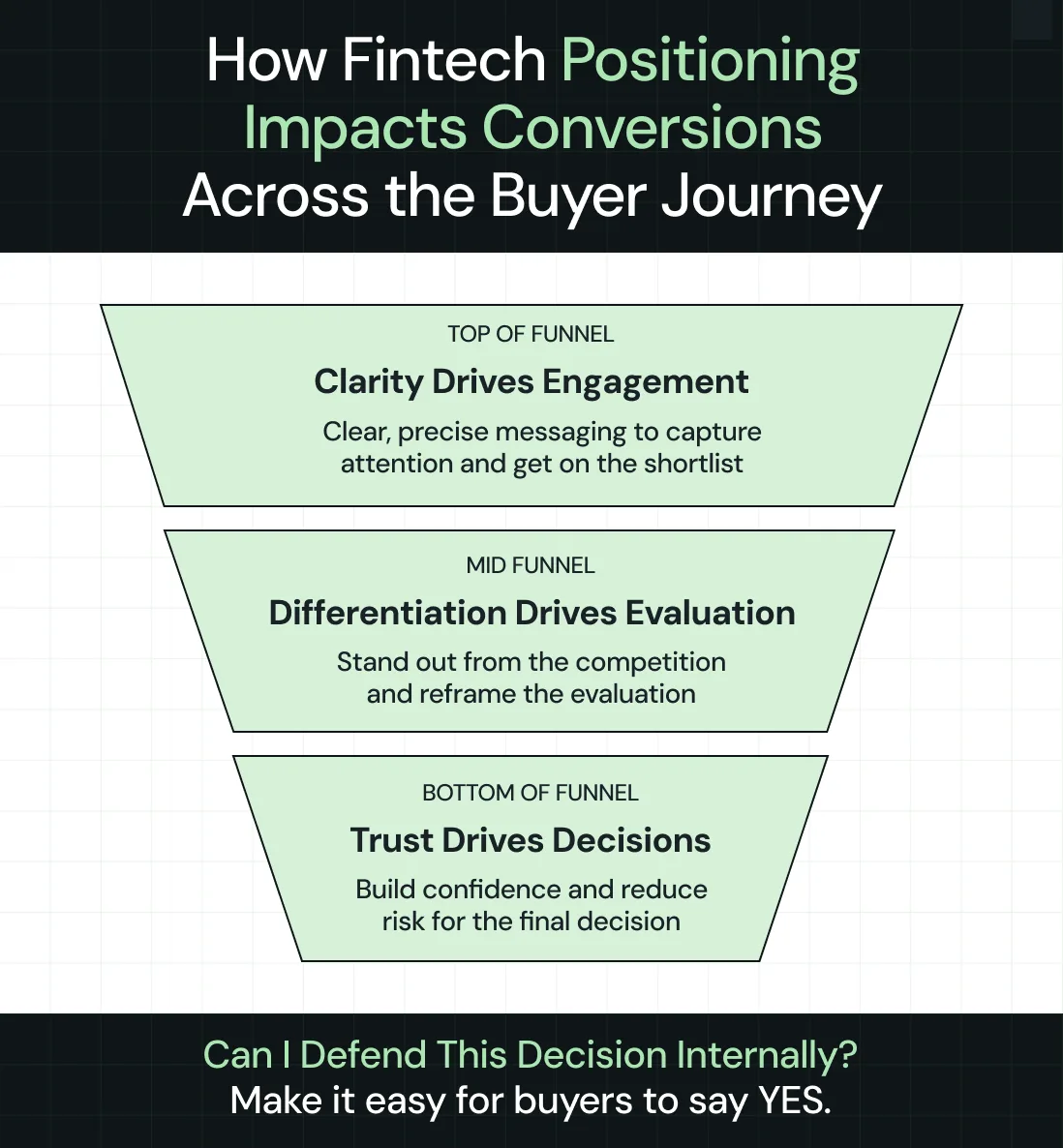
Most fintech teams do not lose deals due to weak product capabilities. They lose them because the positioning never fully aligns with how buyers quietly build conviction across the journey.
Top of funnel: Clarity drives engagement
At the awareness stage, your positioning determines whether a buyer adds you to their consideration set or scrolls past. Most buyers already have a shortlist before speaking to sales, so positioning works long before the first call.
Clear messaging at this stage doesn't mean simple messaging. It means precision. The message needs to signal relevance immediately, showing the right buyer that the product was built for their context and their constraints.
Broad messaging fades out quickly because it does not anchor to a specific situation, while precise messaging earns attention early in the process.
Mid funnel: Differentiation drives evaluation
Gartner research shows that B2B buyers now interact with 22% fewer vendors than in previous years. The average number of vendor engagements, such as demos, trials, and calls, has dropped from 3.2 to 2.5 per buying cycle. In the U.S., that figure has shrunk to just 2.18.
Buyers are doing more filtering before they engage, which means your positioning must do more work at the evaluation stage to get you onto the shortlist and keep you there. The companies that make the shortlist are those whose positioning reframes how buyers think about the evaluation itself, not just where they rank within it.
Bottom funnel: Trust drives decisions
At the late stages of a fintech B2B deal, buyers are not comparing feature lists. They've done that. What they're evaluating now is whether the risk of choosing you is acceptable:
- To them
- To their compliance team
- To the executive who will approve the budget
This is why brands like Stripe invest heavily in enterprise-level clarity. In its 2025 “Make Progress” campaign, Stripe repositioned itself from a payments provider to a core financial infrastructure for modern enterprises. The campaign targeted CFOs, finance leaders, and platform businesses during the exact moment annual budgets and transformation roadmaps were being set.
It focused on scale, resilience, and composability, presenting its financial stack (payments, billing, tax, treasury, and embedded finance) as one unified system built for global complexity.
The campaign reflected a broader shift in finance leadership priorities, with PwC research showing that 73% of CFOs now rank digital transformation of finance functions as a top priority. Stripe aligned its message directly with that reality. The Financial Marketer panel named it January Campaign of the Month for its discipline and clarity.
At the bottom of the funnel, the buyer's question is not "Is your product good?" It's "Can I defend this decision internally?"
Your positioning is either making that defense easy or it's making it harder.
When to Revisit Your Fintech Positioning
Positioning is not a document you file away and revisit at an annual offsite. It is a system that shifts over time as markets move, competitors change, and buyer priorities evolve.
These are clear signals that it is time to revisit it.
- Sales cycles are getting longer: When deals that used to close in 3 months now take 6, it often signals a gap between how buyers understand your category and how you present your place in it. Longer cycles usually point to positioning that is not doing enough early in the journey.
- Win rates are dropping: If close rates are declining without a clear product or pricing explanation, the issue is often that buyers can't clearly differentiate you from alternatives, which is a positioning issue rather than a product issue.
- Messaging feels generic: When internal teams cannot clearly explain what makes you different without sounding like competitors, buyers face the same problem. This lack of clarity often shows up in lower conversion rates.
- Entering a new market: Moving into a new vertical, geography, or buyer segment almost always requires repositioning, even if the product is unchanged. The problem context, ICP language, and competitive set all change with the new audience.
How ThunderClap Approaches Fintech Positioning Differently
Most positioning work starts with brand identity questions:
- What do we look like?
- What do we sound like?
- How do we compare to competitors?
As a fintech design agency, ThunderClap starts from a different place.
{{specficService}}
Starts with pain points in decision-making
Before any positioning work begins, we audit where deals stall, where conversion drops, and where buyers disengage.
For example, in a LinkedIn post highlighted by Ayush, a fintech SaaS platform called Refo, which sells to financial institutions, needed greater clarity at the point of trust and evaluation.
The challenge was not visibility but how quickly enterprise buyers could assess credibility and relevance to use cases. This shaped how we approached positioning, messaging, and journey design from the start.
We use these patterns to understand exactly where the buying process breaks.
Connects positioning to real user journeys
Positioning only works when it shows up in the moments when decisions are made. We map messaging to key touchpoints, including the first homepage visit, the demo request, internal champion conversations, and the procurement review.
Each touchpoint gets a language designed to support the decision at that stage.
Aligns messaging across marketing, sales, and product
Messaging often breaks down when different teams tell different versions of the same story. The website, sales deck, and product onboarding end up misaligned, which weakens clarity during evaluation.
With most B2B purchases involving cross-functional buying groups, consistency becomes essential because internal champions need a clear story they can repeat across stakeholders.
Uses real user behavior to refine positioning
Positioning improves through evidence. We review sales conversations, demo conversion rates, and funnel drop-off data to understand how buyers actually respond.
This feedback replaces assumptions with observed behavior, which leads to clearer positioning over time.
Treats positioning as a system, not a one-time exercise
We build positioning systems that evolve over time. This includes structured buyer research, messaging review points, and feedback loops from sales and product teams.
The goal is to keep positioning aligned with how the market and buyer expectations change.
{{ctaBlock}}
FAQs
1. Why is positioning critical for fintech companies?
Fintech buyers are risk-sensitive and comparison-driven. They evaluate multiple alternatives before making a decision. Clear positioning reduces buyer uncertainty, builds trust faster, and gives internal champions the language they need to advocate for you across a buying committee.
2. What are the key elements of a strong fintech positioning strategy?
Strong fintech positioning starts with a clear ICP, a simple problem story in buyer language, clear differentiation, proof that builds trust, and messaging that stays consistent across the full buyer journey, not just the homepage.
3. How is fintech positioning different from other B2B industries?
In most B2B categories, differentiation is primarily about capability or price. In fintech, the primary evaluation criteria are trust, where buyers need to feel confident that choosing you is safe and compliant internally. That makes clarity and risk reduction the core levers of conversion, ahead of innovation or creativity.




.webp)
Browse Similar Articles









Leading 5 SaaS Branding Agencies in Florida (That Actually Understand SaaS Growth)

.svg)

How to Turn Your B2B Website into a Self-Serve Growth Engine? (PLG Ready in 2026)


9-Step Website Copy Audit Checklist to Improve Conversions (Examples from Top B2B Brands)

.webp)

How to Choose the Right Fintech Web Development Company for Your Business

Top B2B Website Design Principles That Turn Visitors into Qualified Leads
%20Audit%20That%20Actually%20Improves%20Revenue.webp)
How to Do a Conversion Rate Optimization (CRO) Audit That Actually Improves Revenue
Web Design Agency vs. Freelancer vs. In-House: What Actually Works in 2026
5 CRO Agencies in London and How to Choose the Best CRO Agency for Your Business

Mapping the B2B Buyer Journey to Improve Conversions Across Every Touchpoint
.webp)
7 Best Website Maintenance Companies in India for Growth-Led B2B Teams (2026)

.webp)


8 Best Healthcare Website Design Agencies for HIPAA-Compliant Sites in 2026




How to Find the Best Web Design Company in Houston, Texas for B2B Brands (6 Best Picks)


Positioning That Wins: How to Make Complex B2B Products Clear and Compelling
The Step-by-Step Website Redesign Process B2B Teams Use to Increase Conversions (Without Killing SEO and Pipeline)


7 Best Video Production Agencies for SaaS Product Walkthroughs and Feature Videos


How to Choose the Best B2B Website Maintenance Company: 9 Questions to Ask Before You Hire One




How to Choose a Web Design Company in San Francisco in 2026 (with Examples)


10 Best Web Design Companies in Florida in 2026 and How to Choose the Right One

How to Use Brand Storytelling on Your Website to Close More B2B Deals and Build Buyer Trust

SaaS CRO Best Practices: What High-Growth Brands Do Differently to Win Conversions


How a Rebranding Agency Can Redefine Your B2B SaaS Identity and Boost Pipeline

B2B Marketing Trends in 2026 That Directly Influence Pipeline and Revenue

Top 7 Video Marketing Agencies Driving B2B SaaS Brand Awareness in 2026

Why Partnering with a B2B Brand Positioning Agency Accelerates Market Differentiation

The Complete Website Redesign Checklist for B2B SaaS Teams Ready to Scale

.avif)
10 Best Webflow Development Agencies in India for 2026 (In-Depth Review)

10 Product Marketing Companies Powering the Fastest-Growing SaaS Brands in 2026
Website Copywriting Services vs In-House: What's Right for Your Business?


How to Choose a Marketing Agency That Understands B2B SaaS Growth Metrics


How to Choose a Video Marketing Agency That Understands B2B Storytelling

Outsourcing Web Design: Cost-Benefit Analysis for Mid-Market & Enterprise Brands

From Leads to Lifetime Value: How Growth Marketing Agencies Scale SaaS Revenue

Build a B2B Website Strategy That Aligns with Sales and Marketing Goals

Webflow vs WordPress: Which Platform Is Better for Your Business Website in 2026?
Fintech Web Design That Builds Trust: 8 UX Principles Every Fintech Site Needs


Optimizing for Intent: How B2B Website Messaging and UX Changes Help Capture Top-Funnel Buyers



12 Best B2B Web Development Agencies in the US to Build Scalable Websites

From Audit to Action: 8-Step Process to Optimize Your B2B Website Strategy for 2026 Buyers


How to Design a High-Converting Landing Page from Scratch (2026 Edition)

From Click to Customer: Proven Landing Page Conversion Optimization Techniques

How to Write Website Copy That Converts: A Step-by-Step Guide for 2026



How to Optimize a Landing Page for Maximum ROI: A Step-by-Step Breakdown


AI Landing Pages That Convert: 7 Design Principles Every AI Platform Should Follow




Interested in seeing what we can do for your website?



.webp)
