















Website Redesign Cost Breakdown for B2B SaaS Companies in 2026


TL;DR
- B2B SaaS teams often struggle to estimate redesign costs because prices depend on strategy depth, content complexity, buyer journeys, integrations, and platform choice.
- When teams treat redesign as a growth tool rather than a cosmetic update, they see measurable results. In fact, 43% of companies in 2025 overhauled their sites primarily to improve UX.
- Costs scale with the business stage, ranging from $15,000–$40,000 for early-stage SaaS to $80,000–$160,000+ for enterprise platforms with custom modules and complex integrations.
- The biggest cost drivers are buyer journeys, content depth, custom interactions, and platform choice, highlighting that complexity, not size, drives budgets.
- Strategic redesigns improve conversion rates, demo and trial sign-ups, and SEO performance, with benchmarks showing up to 28% YOY growth in organic traffic.
- At ThunderClap, we help B2B SaaS teams design and launch websites that increase leads, engagement, and pipeline performance while reducing rework and future costs.
B2B SaaS leaders struggle to determine the cost of a website redesign. Most articles give vague ranges and fail to explain what drives the numbers. You have likely seen quotes that feel too low to be realistic and others that feel shockingly high. That happens because SaaS website redesign costs do not scale as simply as price lists. The real drivers lie in the depth of strategy, the complexity of messaging, buyer journeys, performance requirements, and integrations with tools such as CRM and analytics.
In 2025, companies redesigned their websites every 2.1 years on average, and 43% cited UX improvements as the top reason for a full overhaul. This proves redesigns improve performance and growth, not just aesthetics.
Teams that treat redesign as a cosmetic project achieve cosmetic results. Teams that treat redesign as a B2B growth tool see measurable performance improvements. At ThunderClap, we’ve helped 88+ B2B SaaS, fintech, and enterprise tech companies redesign their websites. We don’t just explain the numbers. We show exactly where your budget goes. Every dollar must answer one question: Will this drive growth and conversions?
This guide breaks down website redesign cost and shows you exactly how to budget smart for growth.
What Goes Into a B2B SaaS Website Redesign (Cost Components Explained)
When stakeholders ask how much it costs to redesign a website for their SaaS brand, they often expect a single number.
In reality, a redesign breaks into several cost buckets. Each bucket solves a specific business problem. Skipping one often leads to rework later and increases the overall cost of the website redesign.
Strategy and discovery
This step defines your Ideal Customer Profile (ICP), core problems, key positioning, and buyer narratives. Strategy often carries the highest ROI because it anchors all subsequent design and development work.
According to industry benchmarks, strategy and research account for roughly 22% of redesign spend but deliver disproportionate long-term gains. A strong strategy helps your messaging to resonate, guides the user journey, and helps the team prioritize features that actually drive conversions. Companies that skip this step often face expensive revisions later because design and content decisions lack direction.
For example, when Factors partnered with us, they wanted a landing page that clearly showed how unifying scattered buyer data drives better campaigns. We built a page that communicates value instantly with the headline: “Know how your buyers move. Run campaigns that win.”
The page walks visitors through a clear story:
- Explains the problems of fragmented data
- Shows how Factors solves them
- Highlights results through testimonials and client logos
One standout section presents the execution timeline, showing how users move from raw signals to actionable campaigns in just three weeks.
Furthermore, we added visual elements to create impact, including bold patterns, vibrant colors, and customer quotes. We kept calls to action (CTA) clear and repeated, using buttons like “Get a demo” and “Learn more” to guide users through the journey. Enterprise-grade security badges and recognizable client brands reinforced trust.
As Tanvi, Product Marketing Lead at Factors AI said,
"Thunderclap delivered our website revamp on extremely tight deadlines without compromising on quality. The team was always responsive, quick to act, and highly collaborative. The final output exceeded our expectations - modern, clean, and exactly what we envisioned."
This suggests that if your product organizes complex information, structure your landing page like a story: problem, solution, proof, and action.
As Kiran Kulkarni, Website Revamp Expert at ThunderClap, shared on LinkedIn, the Factors rebrand was a full-circle moment:
The team preserved the core identity while developing a visual language that ultimately reflected the product’s world-class quality.
Information architecture and UX
The structure of your content and navigation determines how easily prospects find answers and take action. Effective UX planning improves conversion pathways and reduces friction. UX improvements ranked as the top reason for redesign efforts, ahead of visual or branding updates.
Clear information architecture also helps your marketing and sales teams scale campaigns efficiently, as users can quickly access landing pages, product content, and pricing information without confusion.
For example, Mailmodo’s SaaS landing page shows how tailoring content to a specific audience drives results. The headline “Bring more conversions with interactive emails” immediately conveys value. The subhead positions the product as a “One-stop solution for SaaS email marketing.”
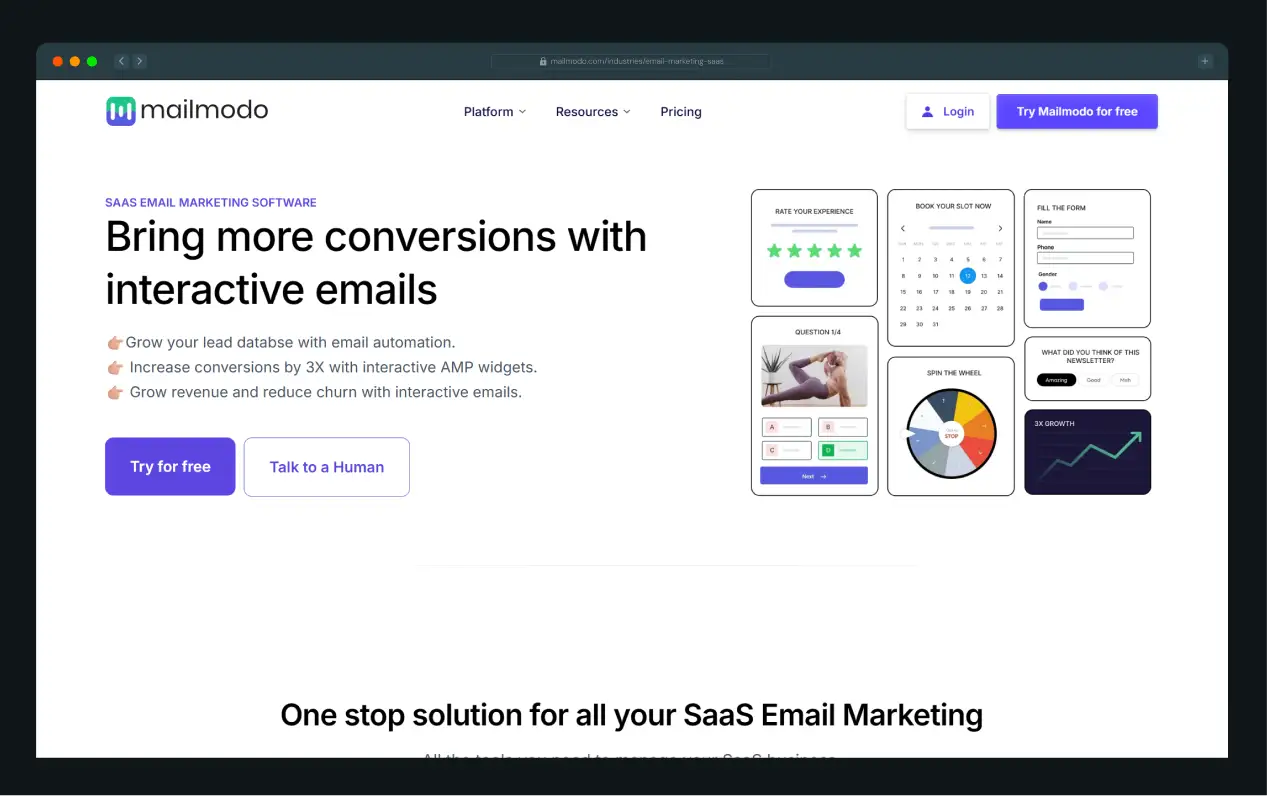
The layout guides users through common SaaS use cases, such as user onboarding and feature adoption, using visuals, product screenshots, and sample templates. Customer testimonials and logos from recognizable SaaS brands add credibility, while ROI-focused language such as “3X email conversions” reinforces impact.
Calls to action appear at natural scroll points and remain consistent, encouraging users to “Start free trial.” Every element, from integrations with HubSpot, Salesforce, and Zapier to template examples, aligns with SaaS team workflows and priorities.
{{specficBlog}}
Visual design and design systems
Visual design brings your brand to life and aligns perception with value. A design system creates reusable components that reduce complexity and speed development across the entire project.
Beyond aesthetics, strong visual design builds trust and credibility. It maintains consistency across pages, campaigns, and integrations, reducing the cost of future redesigns or updates.
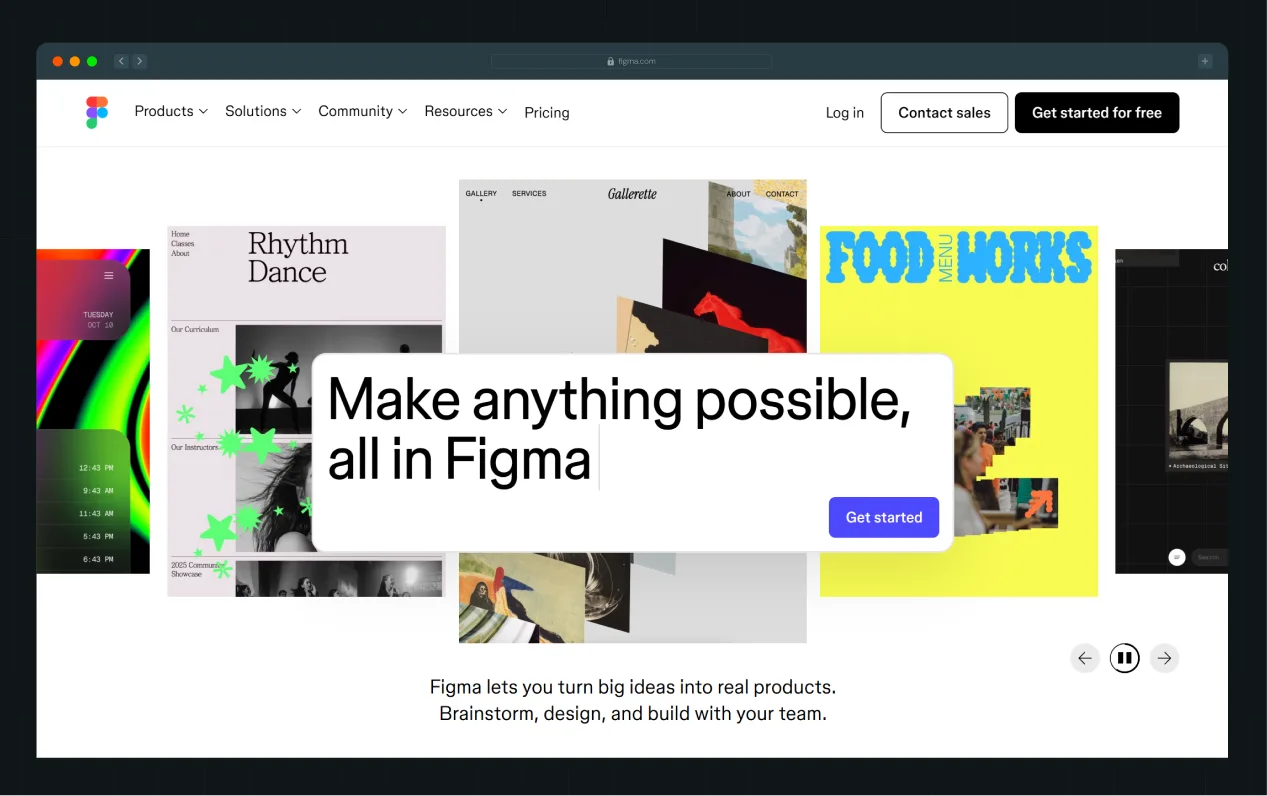
For example, Figma’s landing page delivers a design-first experience that reflects the product. The headline, “Prompt, code, and design from first idea to final product,” communicates value immediately.
Vibrant project previews, screenshots, templates, and community examples show how teams collaborate in real scenarios. Bold colors, playful shapes, and endorsements from brands like GitHub build credibility and emotion. One clear “Get started for free” call to action guides users, and every section speaks directly to designers and developers.
Development (Webflow, CMS or integrations)
Development includes translating the design into a functional, responsive website. Your technology choice directly affects the cost of a website redesign. Modern platforms like Webflow reduce long-term maintenance costs and offer greater flexibility, which better supports marketing teams than legacy CMS stacks.
It also covers integrations with CRM, analytics, marketing automation, and other critical SaaS tools, ensuring your website supports lead tracking, reporting, and growth goals from day one.
Content migration and optimization
This phase brings your existing pages into the new structure and improves them for clarity, SEO, and conversion. Content work often influences organic performance more than any other individual piece of the site.
Updating copy to reflect buyer journeys, simplifying messaging, and optimizing CTAs can have an immediate impact on lead generation and pipeline velocity. Skipping content updates may save money upfront, but it often reduces ROI over time.
QA, performance, and SEO testing
Testing helps verify that everything works reliably in real-world conditions. Strong performance and SEO planning increase visibility and reduce bounce rates. QA covers responsiveness across devices, page speed, form functionality, and accessibility compliance.
SEO testing ensures your pages maintain ranking and that redirects, metadata, and structured data work correctly. These steps protect the investment you make in design and development.
If teams skip strategy and UX planning, they end up paying later in rework because foundational decisions leak into every part of the project.
Average Website Redesign Cost for B2B SaaS in 2026
The question of ‘how much does a website redesign cost?’ does not have a single answer in 2026. The true cost varies widely based on scope, features, audience complexity, platform choice, custom work, and integrations, all of which matter greatly for B2B SaaS companies.
A quality B2B website redesign typically ranges from $3,000 to $160,000+, depending on customization, features, and integrations.
Here are practical ranges tied to the SaaS stage and needs:
Early‑stage SaaS (MVP to product‑market fit)
Early-stage SaaS businesses focus on clear messaging, basic demo or trial flows, and strong positioning. Projects at this stage typically cost between $15,000 and $40,000.
This investment covers strategic UX, essential pages, integrated demo or trial forms, and lead capture workflows, ensuring the website supports growth from the start.
Scaling SaaS (Series A–C)
These teams have broader buyer sets, multiple products, and deeper conversion paths. Redesigns at this stage usually range from $40,000 to $80,000 and include advanced analytics, CRM and marketing automation integrations, and landing page systems designed to capture demos at scale.
A real-world example is Zamp, a fully managed, enterprise-focused sales tax solution for mid- to large companies navigating complex U.S. compliance. Their product delivers rooftop-level accuracy, proactive nexus monitoring, automated filings, and white-glove onboarding.
However, their website and brand did not reflect this strength. The design felt outdated, messaging lacked clarity, and the experience did not communicate premium expertise to CFOs and Controllers evaluating global vendors.
Zamp reached out to us for a redesign. Here’s how we helped:
- Redefined Zamp’s positioning around three pillars: owned data, best-in-class accuracy, and elite tax experts
- Sharpened differentiation against Avalara, TaxJar, and emerging challengers by highlighting rooftop-accurate calculations, a deep taxability library, and 99.9% filing accuracy
- Simplified the messaging into tighter, more confident statements aligned to finance leaders
- Rebuilt the sitemap and navigation to create persona-driven paths guiding users toward demo bookings
- Designed a cleaner, more premium visual system with stronger typography and refined hierarchy
- Reinforced the fully managed model and transparent pricing to build confidence and predictability
Every decision focused on making Zamp feel as premium and reliable as the service itself. The result is a sharper, more differentiated brand that reflects Zamp’s premium service, backed by 99.9%+ filing accuracy, under two-hour onboarding, sub-hour response times, and recognition from G2. With $30M+ raised and enterprise-grade credibility, Zamp now looks and sounds like the category leader it already is.
Enterprise SaaS
Enterprise redesigns include custom modules, multi‑product pages, complex CRM integrations, automation, and governance systems. They often sit at the top of the range because they need scalable infrastructure and governance for long sales cycles.
Here, redesigns function as GTM infrastructure rather than marketing assets.
Projects at this level typically cost between $80,000 and $160,000+, covering scalable infrastructure, personalization, multi-brand support, and performance optimization. This ensures the website functions as a high-performing, revenue-generating platform for large audiences.
Across these bands, cost drivers include:
- Depth of content and buyer research
- Number of templates and reusable components
- Conversion rate optimization readiness and experimentation support
- SEO architecture, redirects, and performance rigor
- Integrations with CRM, analytics, and marketing automation
- Custom UX/UI features, animations, or interactive modules
- Accessibility and compliance requirements
The Biggest Factors That Increase (or Reduce) Website Redesign Cost
When SaaS teams consider a B2B website redesign, they often think about page counts or templates. However, the cost rises with complexity around buyer journeys, content depth, decision logic, and technical integrations.
Below are the most impactful factors and how much they typically influence cost in 2026:
Number of ICPs and buyer journeys
Every unique buyer profile requires tailored messaging, conversion paths, and specialized page templates. Simple sites with a single buyer journey cost less because designers and writers can reuse content patterns.
In contrast, sites built for multiple ICPs require more strategic research, UX mapping, and content differentiation. This often adds $3,000 to $12,000 or more just for a deeper UX strategy and prototyping before any design or code begins. For reference, a project of this scope with us typically falls around $20,000–$30,000, covering strategy, UX, content, and design.
Content volume and complexity
Content‑heavy sites with blogs, knowledge hubs, resources, and gated assets take more planning, migration effort, and on‑page optimization.
Each page can cost between $900 and $1,500 to migrate and optimize. Large sites with 40–50+ pages may see total content costs reach $10,000 to $15,000+, depending on volume and SEO requirements. With ThunderClap, this is factored into the overall investment, ensuring every page is optimized for messaging, usability, and conversions.
Custom interactions vs standard components
Custom logic, animations, interactive workflows, and micro‑interactions cost more than standard templates because they require detailed UX mapping, prototyping, validation, and development time.
Simple custom UI systems can cost $5,000 to $25,000, while advanced interactive modules or guided journeys may add $15,000 to $50,000+. For example, ThunderClap’s redesigns incorporate motion graphics, interactive collections, and guided journeys into the final price, helping SaaS sites communicate premium value.
CMS choice
The content management system you choose directly affects redesign costs. Basic platforms with templates and out‑of‑the‑box features are cheaper to set up.
More advanced CMS platforms with custom components, workflow setup, and template logic require more extensive development. We include CMS reconfiguration and cleaning as part of the design process for smooth future updates without hidden costs.
Internal preparedness
Teams with clear data, defined goals, and content ready for implementation move faster and reduce overall cost.
On the other hand, teams making decisions mid-project may incur additional hours of strategy, redesign, and development work, which can add $5,000–$ 20,000 to the total project budget.
📌Interesting read: Website Design Cost vs ROI: Making the Right Investment Decision
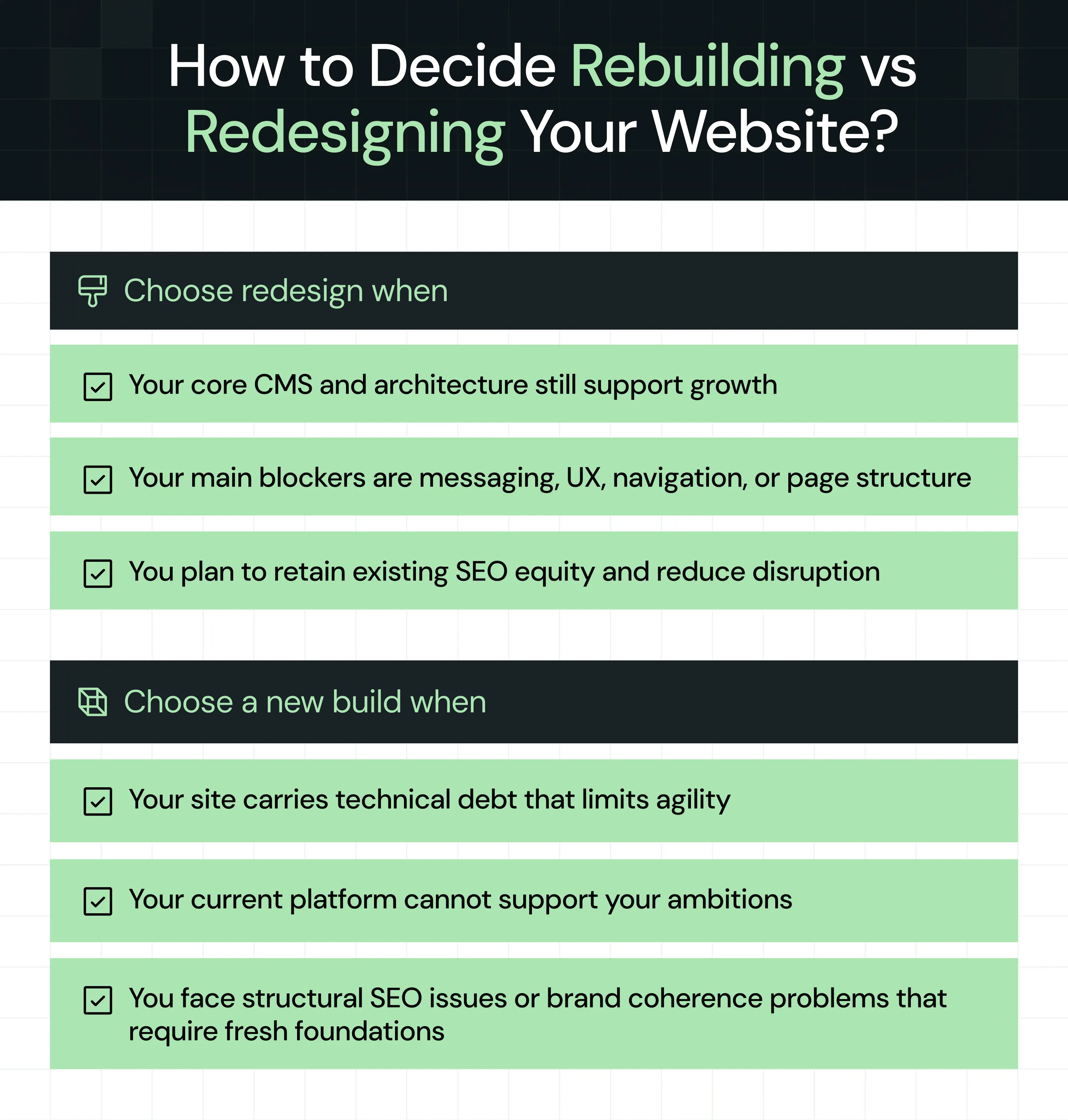
Redesign vs New Website: Which Costs More for SaaS Teams?
SaaS leaders frequently debate whether to redesign an existing website or build a new one from scratch. The right choice depends on the condition of your current site foundation, your business goals, and the long-term cost impact.
Cost is not just a line item today, but it’s tied to technical debt, conversions, scalability, and future agility.
When redesign is more cost‑effective
A professional redesign typically costs less than a full rebuild when your core site architecture already works, your CMS supports your goals, and your main issues relate to messaging, navigation, conversion paths, or outdated visuals.
In 2026, a strategic redesign with strong UX, refreshed content, optimized flows, and tighter conversion logic often falls into ranges like:
- $15,000 – $40,000 for early‑stage SaaS or mid‑size sites
- $40,000 – $80,000 for scaling SaaS with broader buyer journeys and integrations
In these cases, teams keep what works, eliminate duplication, strengthen clarity, and improve effectiveness without tearing down foundations that still deliver value. Redesign wins on cost when it elevates performance without rebuilding core technical elements.
When building new actually saves money
A fresh build can save time and money compared with repeated fixes when your existing site shows deep technical debt, poor code structure, an outdated CMS, stagnant metrics, or tangled integrations that impair performance.
In market benchmarks, building a new site from scratch often looks like:
- $50,000+ for mid‑tier full service (agency builds with strategy, UX, and integrations)
- $80,000 – $160,000+ for enterprise or multi‑product SaaS platforms with custom logic
A new build eliminates unscalable structures, outdated templates, and legacy constraints. It lets teams choose modern platforms (e.g., Webflow) that reduce long‑term maintenance costs, reduce reliance on developers for content changes, and support future growth.
For SaaS companies with poor search performance, inconsistent branding, or inaccessible architecture, a rebuild often delivers stronger ROI than patchwork redesigns.
The hidden costs of partial redesigns
Partial work that touches only visuals, homepage sections, or a handful of templates may feel cheaper up front.
However, when you fail to address buyer flows, analytics inconsistencies, page structure, or SEO architecture, the costs show up later as rework, performance loss, and missed pipeline opportunities.
For example:
- Fixing content structure after launch often means rewriting copy, reworking UX, and redeploying pages, and it can cost $5,000 – $20,000+ each time you circle back.
- SEO losses from failing to handle redirects or metadata properly can cost months of traffic and leads that no redesign budget alone can recover.
The cost does not rise simply because you add pages. It rises as decision complexity increases, with more buyer journeys, integrations, custom interactions, and data touchpoints that demand clarity and cohesion.
How a Website Redesign Impacts ROI (With SaaS Examples)
Understanding SaaS website redesign costs is important, but decision-makers also want to know what return they can expect. For instance, a 2025 industry analysis found that B2B SaaS redesign efforts delivered an average ROI of 265%, with a payback of around 10.4 months, a 45% lift in conversion rates, and a 61% improvement in lead quality.
Here’s how strategic redesigns impact SaaS outcomes:
Higher conversion rates
Improved flows, better messaging, and clearer funnels boost conversion. In 2026, the average SaaS website conversion rate is around 3.4%, up from about 2.9% in 2024, showing that optimization continues to drive gains.
For example, roommaster PMS, a property management platform, had a website full of blogs, ebooks, guides, templates, and case studies, but the experience layer was breaking down. Content updates were slow, complex, and often required developer support. This limited marketing agility and risked brand consistency.
Here’s what we did:
- Migrated 40+ pages and multiple CMS collections to Webflow for faster, flexible updates.
- Built reusable form components integrated with Salesforce, UTM tracking, Chili Piper, and analytics to capture leads and campaign data.
- Structured the content hierarchy with consistent H1/H2 usage, clear categories and tags, and SEO-conscious redirects.
- Implemented 97-page and domain-level redirects to preserve SEO performance.
- Preserved visual identity with reusable components, reducing future redesign costs.
These changes allow the marketing team to launch new pages without developer assistance, preserve brand consistency, and reduce friction.
After the redesign, demo requests and organic traffic rose by 80%. Ayush Barnwal, Team Lead at ThunderClap, highlighted this on LinkedIn, and rightly so:
Better demo and trial sign‑ups
When you streamline paths to demo or trial actions, you capture more intent from existing traffic. One example comes from Z47, one of India’s leading VC funds. We revamped their website to clarify messaging, simplify page purposes, and optimize content structure.
The redesign included a full audit of engagement metrics, competitor benchmarking, a “founders first” messaging strategy, clear wireframes, a refreshed visual system, and a content hub to showcase thought leadership.
Ayush Barnwal shared on LinkedIn how this redesign elevated both brand perception and user engagement:
In just six weeks post-launch, Z47 saw:
- +59% website traffic
- +54% active users
- +50% engagement
- +121% direct traffic
- +465% social traffic
SEO efficiency and organic growth
Redesigns that improve architecture and performance capture more organic traffic over time. One industry benchmark shows that successful redesigns can improve SEO traffic by around 28 percent year‑over‑year when planned strategically.
For example, when we redesigned the ClearlyRated website, we worked closely with sales, marketing, and product teams to clarify messaging, optimize user flows, and restructure pages. Every word and layout choice was intentional, ensuring visitors immediately understood the product’s value.
Some of the key improvements included:
- Auditing and refining messaging on signup and landing pages
- Optimizing CTAs to move users quickly from awareness to trial
- Redesigning onboarding steps to reduce friction during initial login
- Monitoring first-dashboard engagement to measure time-to-value
These changes helped the site become a reliable extension of the product, guiding new users seamlessly and showing the team how targeted tweaks can drive measurable results.
As Ayush Barnwal describes in his LinkedIn post, the revamp led to a 35% increase in impressions and clicks after launch.
This shows how focused messaging, improved architecture, and SEO-aligned content can directly accelerate growth.
What to measure post‑redesign
After a website redesign, track metrics that show real business impact. For example:
- Count demo requests and trial sign-ups to see if the new design guides visitors toward conversion.
- Check conversion rates by page type to identify which pages perform well and which need improvement.
- Monitor organic traffic and search rankings over 6-12 months to evaluate whether changes to structure, content, and SEO attract the right audience.
- Assess lead quality and sales engagement to confirm that the redesign brings in prospects who move through the funnel and generate revenue.
Measuring these metrics provides a clear view of how your redesign affects growth and informs future improvements.
📌Suggested read: Top 9 B2B Website Redesign Agencies in India
Budget for Outcomes, Not Just a Website
The cheapest redesign often becomes the most expensive when teams redo it within a year. So, you must treat your redesign as a growth investment tied to measurable goals like conversions, leads, and pipeline impact, and plan every decision around clarity, scalability, and ROI. Prioritize strategy, UX, SEO, and messaging alongside visuals, so your website generates demand, not just exists.
When teams use this approach, every design and development decision contributes to measurable growth. At ThunderClap, we help B2B SaaS teams and agencies invest in redesigns that deliver measurable results.
Here’s why we stand out:
- Proven B2B expertise: We design high-converting websites for SaaS, fintech, and B2B brands. Our work drives up to 50% more leads and 60% higher engagement.
- Seamless Webflow migrations: We handle full Figma/WordPress to Webflow transitions, including content audits, SEO optimization, and fixing common migration issues.
- End-to-end redesign services: As an enterprise Webflow partner, we cover strategy, design, copy, SEO, CRO, development, and ongoing maintenance.
- Post-launch support: We actively monitor performance and fix conversion or UX issues, ensuring your investment continues to pay off.
{{ctaBlock}}
FAQs
What factors affect the cost of a website redesign?
Website redesign costs depend on project scope, strategy depth, content volume, and technology choices. Teams that clarify goals and align internally reduce unnecessary spend. However, complex buyer journeys, multiple templates, custom interactions, and integrations with CRM or analytics increase the total investment.
Is a website redesign more expensive than building a new website?
Redesign costs less when the existing site’s structure works, and core messaging only needs refinement. Additionally, building a new website costs less when legacy technology, poor UX, or confusing content prevents scaling. Teams save time and avoid rework by choosing the right approach for their foundation.
Can a website redesign help improve ROI?
A strategic redesign improves conversion paths, messaging clarity, and lead quality. Clearer flows and optimized content capture more high-intent visitors. Over time, these improvements increase demo requests, trial sign-ups, and revenue, delivering measurable ROI for SaaS companies that invest in purposeful design. ThunderClap helps B2B SaaS teams achieve these results through expert strategy, design, and execution.



.webp)
Browse Similar Articles







Leading 5 SaaS Branding Agencies in Florida (That Actually Understand SaaS Growth)

.svg)


How to Turn Your B2B Website into a Self-Serve Growth Engine? (PLG Ready in 2026)

9-Step Website Copy Audit Checklist to Improve Conversions (Examples from Top B2B Brands)

.webp)

How to Choose the Right Fintech Web Development Company for Your Business
Top B2B Website Design Principles That Turn Visitors into Qualified Leads

%20Audit%20That%20Actually%20Improves%20Revenue.webp)
How to Do a Conversion Rate Optimization (CRO) Audit That Actually Improves Revenue
Web Design Agency vs. Freelancer vs. In-House: What Actually Works in 2026
5 CRO Agencies in London and How to Choose the Best CRO Agency for Your Business

The Ultimate Fintech B2B Positioning Guide for 2026 (That Actually Drives Conversions)
Mapping the B2B Buyer Journey to Improve Conversions Across Every Touchpoint
.webp)
7 Best Website Maintenance Companies in India for Growth-Led B2B Teams (2026)

.webp)


8 Best Healthcare Website Design Agencies for HIPAA-Compliant Sites in 2026


How to Find the Best Web Design Company in Houston, Texas for B2B Brands (6 Best Picks)

Positioning That Wins: How to Make Complex B2B Products Clear and Compelling
The Step-by-Step Website Redesign Process B2B Teams Use to Increase Conversions (Without Killing SEO and Pipeline)

7 Best Video Production Agencies for SaaS Product Walkthroughs and Feature Videos


How to Choose the Best B2B Website Maintenance Company: 9 Questions to Ask Before You Hire One




How to Choose a Web Design Company in San Francisco in 2026 (with Examples)

10 Best Web Design Companies in Florida in 2026 and How to Choose the Right One

How to Use Brand Storytelling on Your Website to Close More B2B Deals and Build Buyer Trust

SaaS CRO Best Practices: What High-Growth Brands Do Differently to Win Conversions

How a Rebranding Agency Can Redefine Your B2B SaaS Identity and Boost Pipeline

B2B Marketing Trends in 2026 That Directly Influence Pipeline and Revenue

Top 7 Video Marketing Agencies Driving B2B SaaS Brand Awareness in 2026
Why Partnering with a B2B Brand Positioning Agency Accelerates Market Differentiation

The Complete Website Redesign Checklist for B2B SaaS Teams Ready to Scale
.avif)
10 Best Webflow Development Agencies in India for 2026 (In-Depth Review)

10 Product Marketing Companies Powering the Fastest-Growing SaaS Brands in 2026
Website Copywriting Services vs In-House: What's Right for Your Business?


How to Choose a Marketing Agency That Understands B2B SaaS Growth Metrics


How to Choose a Video Marketing Agency That Understands B2B Storytelling

Outsourcing Web Design: Cost-Benefit Analysis for Mid-Market & Enterprise Brands

From Leads to Lifetime Value: How Growth Marketing Agencies Scale SaaS Revenue
Build a B2B Website Strategy That Aligns with Sales and Marketing Goals

Webflow vs WordPress: Which Platform Is Better for Your Business Website in 2026?
Fintech Web Design That Builds Trust: 8 UX Principles Every Fintech Site Needs

Optimizing for Intent: How B2B Website Messaging and UX Changes Help Capture Top-Funnel Buyers



12 Best B2B Web Development Agencies in the US to Build Scalable Websites

From Audit to Action: 8-Step Process to Optimize Your B2B Website Strategy for 2026 Buyers
How to Design a High-Converting Landing Page from Scratch (2026 Edition)

From Click to Customer: Proven Landing Page Conversion Optimization Techniques

How to Write Website Copy That Converts: A Step-by-Step Guide for 2026

How to Optimize a Landing Page for Maximum ROI: A Step-by-Step Breakdown


AI Landing Pages That Convert: 7 Design Principles Every AI Platform Should Follow




Interested in seeing what we can do for your website?



.webp)
