















A High-Impact B2B Marketing Plan Template Designed for Revenue Teams


TL;DR
- Most B2B marketing plans fail to generate revenue because they focus on activity rather than pipeline, even though only 16–20% of organizations have reached true revenue-marketing maturity.
- Start by defining your ICP, building funnels, and setting clear revenue goals so marketing drives measurable pipeline and sales alignment.
- Prioritize high-impact channels and conversion-focused content, as shown by our work with Factors.ai and roommaster PMS, to turn websites and campaigns into growth engines.
- Track every metric, optimize continuously, and use a 90-day execution roadmap to convert strategy into predictable revenue month after month.
Every revenue leader we talk to tells the same story.
They build a marketing plan full of tasks, checklists, campaigns and tactics. Everyone signs off, and the deck looks polished. However, the B2B marketing plans fail to generate revenue. This happens because teams often produce decks full of campaigns, channels, and content calendars. The pattern is well-documented.
According to a recent study, while over 70% of B2B organizations say pipeline or revenue is their primary marketing metric, only about 16–20% have reached true revenue-marketing maturity, where marketing is directly accountable for revenue outcomes. At the same time, buyers use around 10 interaction channels and complete most of their evaluation before engaging sales, making tactic-first, activity-based plans ineffective.
When marketing lacks a clear strategic framework, including defined buyers, revenue math, sales alignment, and measurable conversion stages, work feels urgent but produces little business value. High-performing revenue teams operate differently. They design marketing plans as pipeline systems, not activity lists.
This post introduces a strategic B2B marketing plan template built to translate strategy into a predictable pipeline, tighter sales alignment, and measurable revenue impact.
The Revenue-Ready B2B Marketing Plan Template
A B2B marketing plan defines how you generate demand, capture intent, and turn it into a pipeline. Most plans span multiple drivers like paid channels, organic content and AI SEO, community, partnerships, events, and sales-led distribution. But no matter the channel, everything ultimately leads back to one place: the website. It’s your biggest organic asset and the moment of truth for every campaign.
This is also where many SaaS teams go wrong. When the website isn’t built to convert intent, marketing activity stalls. We’ve seen it work: after redesigning roommaster’s site, demo requests and organic traffic both grew by 80%.
To close the gap between activity and revenue, revenue leaders need a B2B marketing plan template designed specifically to drive pipeline, not just plans. Below, we break down the exact steps to build one that actually converts effort into outcomes. Let’s begin.
Step 1: Define your ICP & buying committee
The foundation of any revenue-focused plan is a clear marketing plan for a B2B business. Nothing matters more than knowing exactly who buys your product and how decisions get made. The Ideal Customer Profile (ICP) guides every decision, from messaging and channels to pricing, sales cycle expectations, and content strategy. A vague ICP yields low-quality leads, long cycles, and wasted spend.
Outreach, a leading sales engagement SaaS platform, struggled early on with diluted marketing and inconsistent conversions because it targeted too broad a market. After analyzing customer data and segmenting its audience, Outreach refined its ICP to focus on mid-sized technology companies with $10M–$50M in annual revenue that rely heavily on CRM systems and need sales automation. By narrowing its focus to this specific firmographic and pain set, Outreach tailored its messaging, content, and demand generation to match the real buying triggers of its best buyers.
As a result of this ICP refinement, Outreach increased its lead conversion rate by 30% within six months and boosted revenue by 25%.
This shows that every successful ICP definition includes these characteristics:
- Firmographics (industry, company size, region)
- Core challenges they urgently need to solve
- Budget ownership and authority lines
- Buying committee roles (decision maker, influencer, gatekeeper)
- Average deal size and sales cycle length
- Experience with similar solutions
To make this step actionable, document your ICP and buying committee in a single, shared table. This forces clarity, exposes assumptions, and aligns marketing, sales, and revenue operations.
The goal is not perfection on day one, but precision over time.
{{specficBlog}}
Step 2: Set revenue goals & pipeline math
A revenue‑ready B2B strategic marketing plan must start with clear revenue targets and pipeline math. When marketing goals are tied only to traffic, form fills, or content volume, teams optimize for activity rather than actual revenue impact.
To drive predictable revenue, marketing needs to align on the same numbers that sales and finance use, such as pipeline value, conversion rates, and revenue coverage targets. That means defining your ARR/MRR targets, understanding how much pipeline you need, and setting conversion assumptions for each funnel stage (MQL → SQL → Close).
Industry benchmarks show that healthy B2B SaaS funnels convert at consistent ratios. For example, MQL → SQL often runs in the 15‑21% range, and overall win rates tend to land around 20–30% depending on segment and deal size.
At ThunderClap, we saw these advantages play out with roommaster PMS, a property management platform, when we migrated their entire website from WordPress to Webflow within 6 weeks. Their original WordPress setup included numerous CMS collections for blogs, news, ebooks, guides, templates, and case studies, which made content updates complex and often required developer involvement.
Here’s what we did:
- Migrated 40+ pages and multiple CMS collections for blogs, news, ebooks, guides, templates, case studies, and testimonials.
- Created reusable form components integrated with Salesforce, UTM tracking, Chili Piper scheduling, and analytics to capture leads and campaign data.
- Implemented a structured content hierarchy with consistent heading (H1/H2) usage, category/tag cleanup, and SEO-conscious redirects.
- Set up 97 page-level and domain-level redirects to maintain SEO integrity while changing URLs.
As a result, the roommaster’s team can now update content and manage resources more efficiently, with a scalable structure that reduces reliance on developers and maintains brand and design consistency across the website.
As Qamar Aziz, Webflow Lead & GSAP Developer at ThunderClap, noted:
“roommaster’s marketing team struggled with updating content quickly because every new page required developer intervention. By moving to Webflow, we were able to implement global classes and reusable components, so the team could launch new property and campaign pages without risking brand inconsistency.”
This kind of efficiency directly impacts pipeline velocity and MQL generation because marketing can rapidly launch campaigns, capture leads through forms integrated with Salesforce, and accurately track campaign performance, all of which are essential for revenue-focused planning.
Every revenue plan should clearly define:
Step 3: Design your funnel architecture
Funnels decide how attention turns into a pipeline. A well-designed funnel ensures that marketing efforts progressively nurture prospects from awareness to opportunity to close. Without a clear funnel architecture, your campaigns may generate traffic and leads, but the pipeline and revenue will stagnate.
A strong funnel maps demand creation vs. demand capture and defines TOFU (Top of Funnel), MOFU (Middle of Funnel), and BOFU (Bottom of Funnel) journeys. Each stage should have explicit goals, channels, and content that guide prospects toward the next stage.
To turn strategy into action, map each funnel stage with explicit goals, channels, and content:
This guarantees every prospect moves smoothly from awareness to opportunity to close.
Step 4: Prioritize your marketing channels
Channel choice defines speed, cost, and scalability. The right channels help you invest where your buyers actually engage. The wrong ones waste time, budget, and attention.
Most B2B teams default to the same list of channels without prioritizing based on buyer behaviour. They throw resources at SEO, paid search, partnerships, LinkedIn, outbound, events, and more, hoping something sticks. The result is spread‑thin marketing, inconsistent performance, and no clear pipeline ownership.
Revenue teams avoid this trap by prioritizing channels based on where their ICP actively researches, evaluates, and decides. A good rule of thumb is to focus deeply on 2 or 3 channels that move the pipeline fast and measurably, rather than spreading across 7 or more with mixed results.
When Factors.ai partnered with ThunderClap, the challenge was not decoration. Their analytics product handled complex data, but the website needed to feel intuitive, approachable, and confidence-building for marketers. The team anchored the experience around the “Marketing Compass” concept, positioning Factors as a guide to help teams navigate buyer journeys with clarity and direction.
.webp)
Some of the key actions included:
- Balancing precision with warmth through hand-drawn illustrations and contour-line motifs
- Using a distinct orange-led palette to stand out from blue-heavy, data-centric competitors
- Structuring layouts and hierarchy so the product story was clear and scannable
- Designing interaction patterns that supported understanding, not distracted from core messaging
The result was a website that supported product storytelling, reinforced brand positioning, and set a strong foundation for growth-focused engagement. Ayush Barnwal, Partner at ThunderClap, highlights that the redesign created a premium, globally-ready brand for Factors.ai while keeping their existing messaging intact.
This focus on high‑impact channels and the data to prove where intent signals actually convert is what separates revenue‑driven plans from scattershot activity lists.
To help operationalize this, you can create a table documenting cost, time to ROI, pipeline potential, and priority for each channel. Here’s what it would look like:
This gives your team a clear roadmap and ensures marketing spends money where it actually drives revenue.
👉 Read more: B2B Website Redesign Agencies: Choosing a Partner That Gets SaaS
Step 5: Build your B2B content marketing plan
Content is what moves buyers between funnel stages. A strategic content plan makes sure prospects are educated, engaged, and nurtured at every step of the funnel, from awareness to opportunity to close. Without a clear strategy, content can be scattered, repetitive, or irrelevant, resulting in wasted effort and weak pipeline impact.
High-performing B2B teams design content to answer real buying questions at each stage. TOFU content attracts and educates, MOFU content nurtures and builds trust, and BOFU content directly supports conversion. Aligning topics, formats, and ownership with KPIs confirms every piece contributes to measurable pipeline growth.
To turn this strategy into action, use the template below to document what content goes where, who owns it, and how its performance will be measured.
Step 6: Design your digital funnel & conversion paths
Traffic alone doesn’t pay the bills. Without clear conversion paths, every visitor who lands on your site risks bouncing without taking meaningful action. That’s why designing your digital funnel is as essential as driving awareness. Every page needs a purpose, and every element should nudge visitors deeper into the funnel.
At ThunderClap, we’ve helped dozens of B2B SaaS companies fix underperforming websites by building design systems rooted in conversion strategy. As a conversion-focused SaaS website design agency, we understand how user psychology, UI/UX, and storytelling intersect to drive signups, demos, and pipeline. The goal is simple: make every interaction frictionless and every CTA impossible to miss.
Take Segment, for example. Instead of using generic labels like “Features” or “Pricing,” Segment restructured its navigation around Jobs-to-Be-Done. Their “Solutions” menu is segmented by persona, with a dedicated “AI Solutions” section to showcase fast-paced innovation and a “Case Studies” section to build trust.
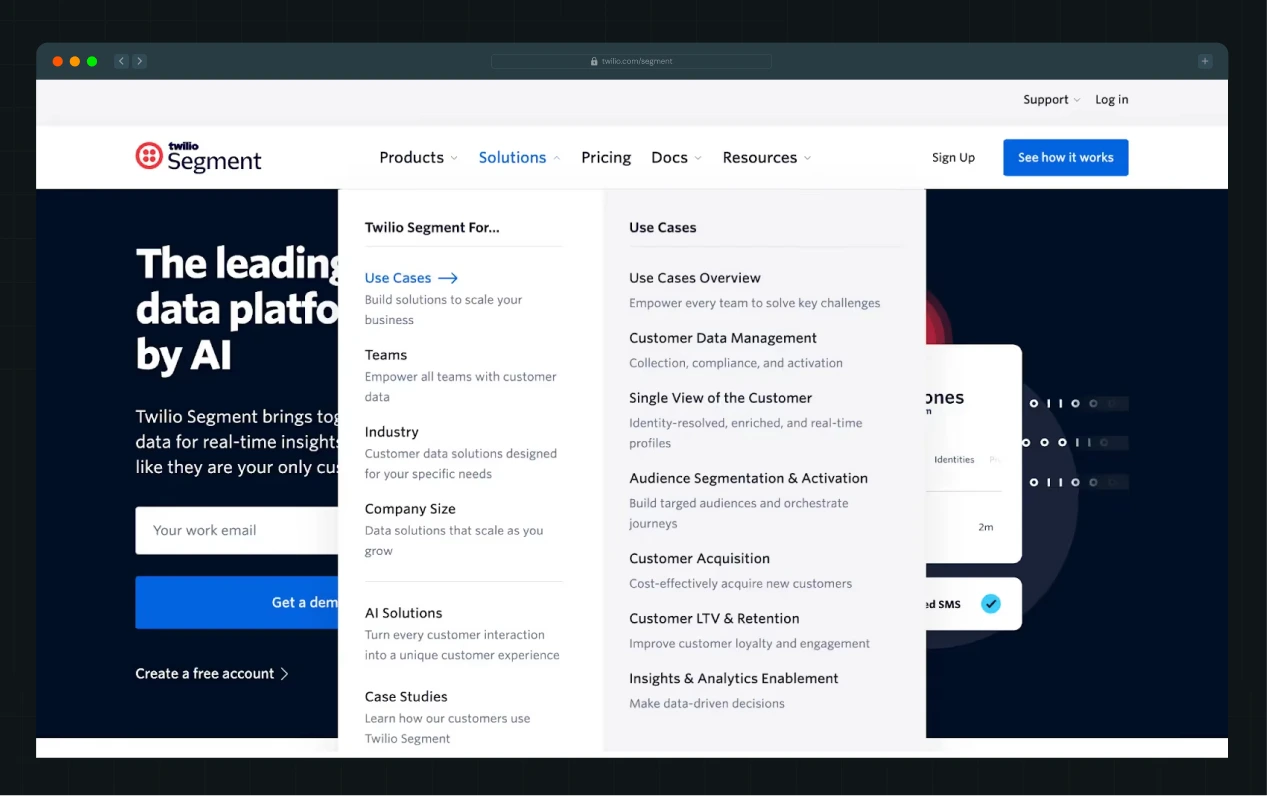
Here’s why it works:
- ICP-specific journeys: Navigation prioritizes paths most relevant to their target buyers.
- Clear dropdowns: Typography and short descriptions help users avoid guessing where to click.
- Persistent CTAs: On scroll, sticky navigation keeps the primary CTA visible at all times.
Similarly, ClearlyRated’s legacy website made page updates slow and caused inconsistent performance, especially during high-traffic campaigns. ThunderClap worked with their sales, marketing, and product teams to clarify messaging, restructure key pages, and rebuild the site in Webflow with speed and scalability in mind.
.webp)
Here’s how we transformed the experience:
- Audited messaging across signup pages to make the value proposition crystal clear
- Optimized CTAs so visitors move effortlessly from awareness to starting a trial
- Redesigned onboarding steps to remove friction during initial login
- Tracked first-dashboard engagement to measure time-to-value and identify drop-off points
These improvements made the website a seamless extension of the product. New users now navigate the experience logically, while the team has a clear framework for seeing how design decisions directly influence user behavior and conversions over time.
To make this actionable for your team, you can document conversion goals for each key page in a simple table. This bridges strategy to execution, ensuring that every page serves the funnel and moves visitors closer to conversion:
{{specficService}}
Step 7: Define sales alignment & lead handoff
A poor handoff between marketing and sales kills revenue. Even the best marketing campaigns can fail if leads sit in a queue, are poorly qualified, or are passed to sales without context. Clear definitions, Service level agreements (SLAs), and alignment on expectations are essential to keep the pipeline moving efficiently and close deals faster.
To make this actionable, define each lead stage (MQL, SQL, SAL), document the criteria, and set SLAs for response times and follow-up. This creates accountability, accelerates conversions, and ensures that marketing and sales share ownership of pipeline outcomes.
Step 8: Create your B2B product launch marketing plan
Launches create pipeline spikes when structured and sequenced around buyer needs. A product launch is not a single campaign, but a phased program of awareness, engagement, and follow‑through that fills the funnel, accelerates sales conversations, and builds pipeline velocity.
In B2B, launches often don’t generate immediate closed deals. What matters most is how many qualified leads and demos you book and how fast those opportunities enter your pipeline.
To increase predictability and impact, define what happens before, during, and after launch, and align content, channels, and ownership to each launch phase.
For example, when two ex-MAANG leaders founded Deductive AI, they partnered with us to shape a bold brand identity and build a website from the ground up.

Some of our key launch actions included:
- Designing a dark, futuristic aesthetic to match their positioning as an “AI on-call engineer.”
- Using concise headlines, clear hero CTAs, and diagrams to explain complex product functionality
- Placing CTAs consistently across scroll depth to drive demo bookings
- Leaning into authority through enterprise-grade messaging, security visuals, and trusted integrations
The launch successfully translated a complex product into clear value for technical buyers, generating early demo requests and a measurable pipeline. Every element, from messaging to action, was tied to revenue-focused objectives.
A LinkedIn post by Harsh Barnwal walks through that process and shows how experiments shaped their conversion journey.
Step 9: Measurement, attribution & optimization
What you can’t measure, you can’t scale. Tracking leads alone is not enough, so marketing teams must measure the impact of every campaign on pipeline, revenue, and customer acquisition. Attribution helps determine which channels, content, and tactics actually drive deals, enabling smarter budget allocation and continuous optimization.
To make this actionable, document key metrics, assign owners, and set targets. This confirms accountability and gives the team a clear view of which marketing activities generate measurable revenue.
Step 10: 90-day execution roadmap
A solid plan is useless if it’s not executed. The 90-day roadmap breaks strategy into manageable sprints, assigning clear priorities, owners, and KPIs for every action. By focusing on short-term, measurable objectives, teams maintain momentum, quickly address gaps, and drive consistent pipeline growth.
Use this template to translate your B2B marketing strategy into concrete actions for the next three months, ensuring alignment across marketing, sales, and revenue operations.
How to Use This B2B Marketing Plan Template
Now that you have a strategic marketing plan template for B2B businesses, here’s how to use it:
Who should own it
The marketing plan should be owned by the head of marketing or VP of revenue marketing, with contributions from sales, RevOps, and product teams.
Ownership means maintaining the plan, updating metrics, and ensuring alignment across all revenue teams.
How often to review
Review the plan weekly for tactical progress (sprints, campaigns, content) and quarterly for strategic adjustments (ICP, funnel optimization, pipeline targets). Frequent review keeps the plan dynamic, actionable, and aligned with real-world performance.
How to adapt as you scale
As your team, products, or markets grow:
- Refine your ICPs and buying committees based on new data
- Expand or prioritize channels that generate the highest ROI
- Adjust MQL/SQL targets and pipeline coverage to reflect larger ARR goals
- Continuously optimize content, handoffs, and attribution models to maintain predictable revenue
This approach ensures the plan remains a living document, guiding marketing decisions and driving measurable business results rather than collecting dust.
Turn Strategy into Predictable Revenue
If you want predictable revenue, you need a plan that connects every element to the pipeline. Clear ICP definitions, math that ties goals to activity, funnels that move buyers, seamless handoffs to sales, measurable ROI, and disciplined execution are all essential.
This marketing plan for B2B businesses gives you a step-by-step path from strategy to outcomes. Use it to align teams, forecast results, and build a pipeline consistently month after month. Build with rigor, measure everything, optimize continually, and revenue will follow.
As a B2B design agency, we’ve helped 129+ B2B brands, including Amazon, Razorpay, and Factors, transform their websites into high-converting growth engines. At ThunderClap, we focus on turning every landing page and campaign into measurable impact.
{{ctaBlock}}
FAQs
1. What is a B2B marketing plan, and why is it important?
A B2B marketing plan is a pipeline-first blueprint that connects positioning, website experience, and channel execution to revenue outcomes. At ThunderClap, we build marketing plans around how buyers actually research and convert, using the website as the core engine that ties paid, organic, and sales-led efforts together. Without this structure, teams generate activity but struggle to turn it into predictable pipeline and growth.
2. How do I measure the success of a B2B marketing plan?
Success comes from tracking revenue impact, not just traffic. Measure pipeline contribution, customer acquisition cost (CAC), lifetime value (LTV), and channel ROI. Monitor conversions at every funnel stage, review campaign performance weekly, and continuously optimize. Focus on metrics that reflect revenue and buyer movement, not vanity stats.
3. How do I know which marketing channels to prioritize for B2B?
Prioritize channels where your ICP actively researches, engages, and purchases. Start by testing multiple channels, analyze which deliver leads and pipeline fastest, and scale the top performers. Common choices include LinkedIn, SEO, paid search, and partnerships. Let buyer behavior guide your allocation for maximum ROI.



.webp)
Browse Similar Articles





Leading 5 SaaS Branding Agencies in Florida (That Actually Understand SaaS Growth)

.svg)

How to Turn Your B2B Website into a Self-Serve Growth Engine? (PLG Ready in 2026)


9-Step Website Copy Audit Checklist to Improve Conversions (Examples from Top B2B Brands)

.webp)

How to Choose the Right Fintech Web Development Company for Your Business

Top B2B Website Design Principles That Turn Visitors into Qualified Leads
%20Audit%20That%20Actually%20Improves%20Revenue.webp)
How to Do a Conversion Rate Optimization (CRO) Audit That Actually Improves Revenue
Web Design Agency vs. Freelancer vs. In-House: What Actually Works in 2026
5 CRO Agencies in London and How to Choose the Best CRO Agency for Your Business

The Ultimate Fintech B2B Positioning Guide for 2026 (That Actually Drives Conversions)
Mapping the B2B Buyer Journey to Improve Conversions Across Every Touchpoint
.webp)
7 Best Website Maintenance Companies in India for Growth-Led B2B Teams (2026)

.webp)
8 Best Healthcare Website Design Agencies for HIPAA-Compliant Sites in 2026


How to Find the Best Web Design Company in Houston, Texas for B2B Brands (6 Best Picks)

Positioning That Wins: How to Make Complex B2B Products Clear and Compelling
The Step-by-Step Website Redesign Process B2B Teams Use to Increase Conversions (Without Killing SEO and Pipeline)

7 Best Video Production Agencies for SaaS Product Walkthroughs and Feature Videos


How to Choose the Best B2B Website Maintenance Company: 9 Questions to Ask Before You Hire One




How to Choose a Web Design Company in San Francisco in 2026 (with Examples)

10 Best Web Design Companies in Florida in 2026 and How to Choose the Right One

How to Use Brand Storytelling on Your Website to Close More B2B Deals and Build Buyer Trust

SaaS CRO Best Practices: What High-Growth Brands Do Differently to Win Conversions


How a Rebranding Agency Can Redefine Your B2B SaaS Identity and Boost Pipeline

B2B Marketing Trends in 2026 That Directly Influence Pipeline and Revenue

Top 7 Video Marketing Agencies Driving B2B SaaS Brand Awareness in 2026

Why Partnering with a B2B Brand Positioning Agency Accelerates Market Differentiation

The Complete Website Redesign Checklist for B2B SaaS Teams Ready to Scale

.avif)
10 Best Webflow Development Agencies in India for 2026 (In-Depth Review)

10 Product Marketing Companies Powering the Fastest-Growing SaaS Brands in 2026
Website Copywriting Services vs In-House: What's Right for Your Business?

How to Choose a Marketing Agency That Understands B2B SaaS Growth Metrics


How to Choose a Video Marketing Agency That Understands B2B Storytelling

Outsourcing Web Design: Cost-Benefit Analysis for Mid-Market & Enterprise Brands

From Leads to Lifetime Value: How Growth Marketing Agencies Scale SaaS Revenue
Build a B2B Website Strategy That Aligns with Sales and Marketing Goals

Webflow vs WordPress: Which Platform Is Better for Your Business Website in 2026?
Fintech Web Design That Builds Trust: 8 UX Principles Every Fintech Site Needs



Optimizing for Intent: How B2B Website Messaging and UX Changes Help Capture Top-Funnel Buyers




12 Best B2B Web Development Agencies in the US to Build Scalable Websites

From Audit to Action: 8-Step Process to Optimize Your B2B Website Strategy for 2026 Buyers

How to Design a High-Converting Landing Page from Scratch (2026 Edition)

From Click to Customer: Proven Landing Page Conversion Optimization Techniques

How to Write Website Copy That Converts: A Step-by-Step Guide for 2026

How to Optimize a Landing Page for Maximum ROI: A Step-by-Step Breakdown


AI Landing Pages That Convert: 7 Design Principles Every AI Platform Should Follow
From Traffic to Pipeline: B2B Website Growth Strategy for Scaling Teams

B2B Website Optimization Strategy: Speed, UX, SEO, and CRO in One Playbook




Interested in seeing what we can do for your website?



.webp)
