















How to Choose the Right Web Design Partner for Your B2B or SaaS Website


3 guesses about you because you landed on this blog:
- You've decided to redesign your B2B website
- You've settled the outsourcing vs in-house web design battle
- You've shortlisted a few agencies and need to finalize the right web design partner
If this sounds like you, you're in the right place.
This is where most B2B brands struggle. Without the right questions, it's challenging to find strategic design partners that build both stunning and conversion-ready websites.
This blog walks you through the 11 essential questions you should ask during your first discovery call with any web design partner.
These aren't random; they're distilled from the most common concerns our prospects raised when evaluating agencies, based on our experience working with 88+ B2B brands like Storylane, Factors.ai, and Amazon at ThunderClap.
How to Choose the Right Web Design Partner: 11 Questions for B2B and SaaS Companies
The 11 questions we discuss cover four main areas: their B2B expertise, their strategy and process, their collaboration and execution style, and technical and post-launch support.
For each question, we break down what strong answers look like and red flags to watch for, so you can quickly assess whether a B2B website design partner is the right fit for your needs.
Questions to gauge your web design partner’s B2B expertise
1. Can you show me a B2B/SaaS project from our industry and walk me through the business results?
This question reveals whether the website design partner understands your specific challenges and is competent enough to drive measurable outcomes, not just stunning designs.
What a strong answer looks like:
Ideally, the SaaS design agency should walk you through the specific challenges their clients faced, the strategic decisions they made, and the results they delivered.,
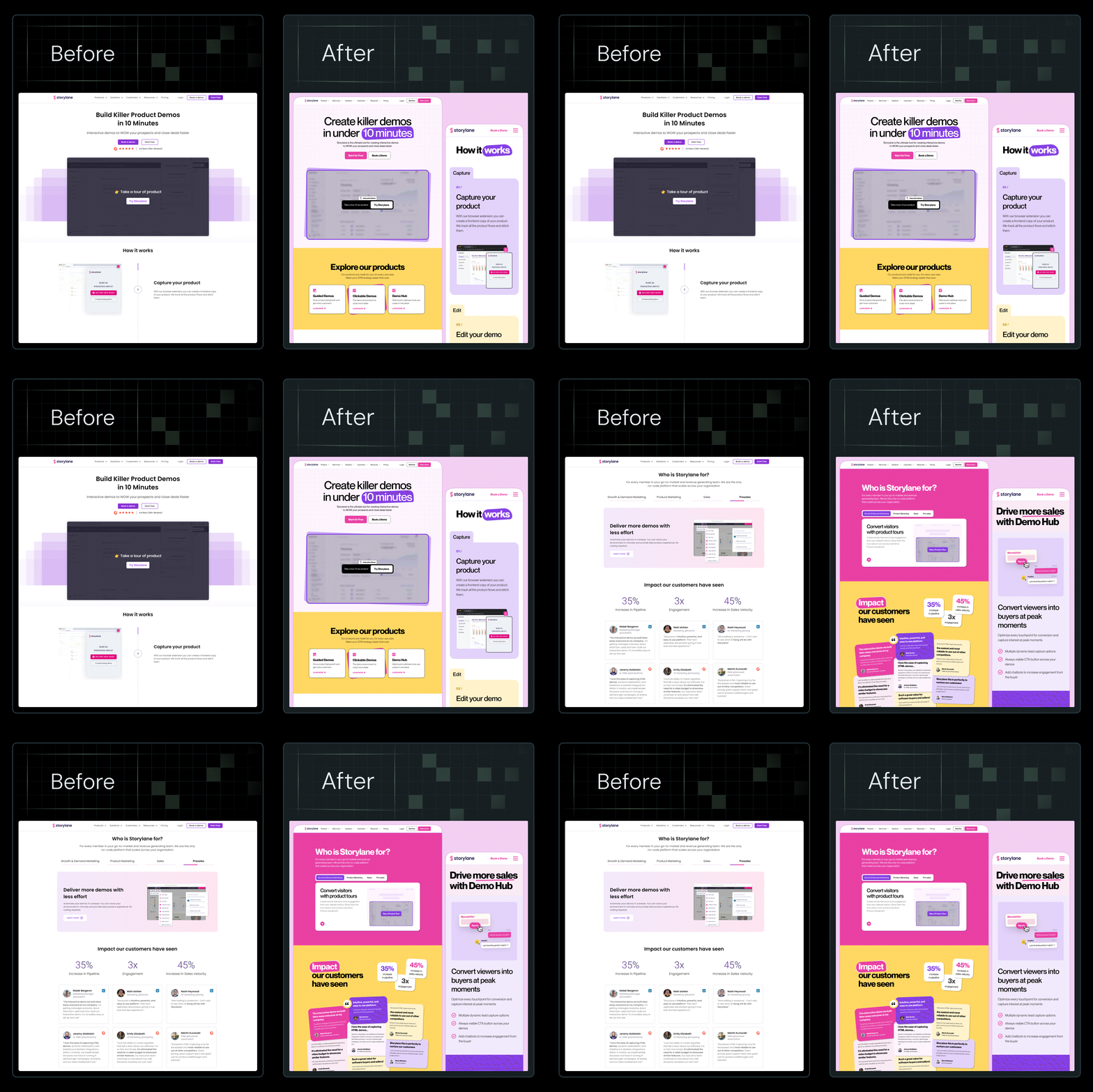
At ThunderClap, we show before-and-after snapshots as we walk through the logic behind every design decision. We also offer real-time suggestions for your current website, so you can see how we think before committing.
Red flags to look for:
- Vague results like 'the client was super happy' or 'the traffic increased': This is a sign that designing for conversions isn't their priority.
- Showcasing pretty designs without a backstory: If the agency can't tie their design decisions to strategy or data, they just create designs that look good but don't necessarily convert.
- Minimal knowledge about your industry or buying cycles: The B2B buying cycle is complex, and unless the agency has proven B2B expertise, it's like throwing darts in the dark, hoping they hit the target.
2. What's included in your web design service? Is it just design, or do you handle strategy, development, and content too?
The range of services included under 'web design' differs from agency to agency. At ThunderClap, we offer end-to-end website design services, including strategy, copywriting, and development, while some agencies might only handle the visual design. Knowing this early on helps you avoid surprises and choose the agency that matches your needs.
What a strong answer looks like:
Most agencies list their services on their website, but during your call, clarify what's included and what costs extra. For example, copywriting isn't a service most design agencies offer, but those that do tend to be more strategic about driving conversions, since messaging and design work hand in hand.
Similarly, development is another add-on. If an agency handles both design and development, you get a seamless handoff without playing middleman between two vendors. This end-to-end approach typically means faster timelines and fewer miscommunications.
What to clarify upfront:
- Is the website strategy included, or is it an add-on?
- Who writes the website copy?
- Do they build the site or just hand off designs to your dev team?
3. Who will actually be working on my project, and what are their roles?
This question helps you gauge the level of expertise of the people working on your project. You'll also know whether you'll have a dedicated project manager to ensure smooth communication.
What a strong answer looks like:
The agency should clearly outline the team structure, who's handling strategy, design, development, and project management. They should be able to introduce key team members and share relevant projects they've worked on.
Your project should have a dedicated project manager to ensure seamless communication and handoffs between phases. This person becomes your main point of contact, keeping things on track and preventing details from slipping through the cracks.
At ThunderClap, one of our partners personally manages each project from start to finish. This kind of senior-level involvement typically leads to better strategic decisions and smoother collaboration.
Here’s a post from Kiran Kulkarni, Head of Growth and Partner at ThunderClap, sharing her experience as the POC for Z47, the VC behind unicorns like Ola and RazorPay, and the results achieved post revamp:
Red flags to look for:
- Vague answers like "we have experts on board": This usually means they are being evasive about experience levels.
- Junior designers leading your project: Nothing against juniors, but B2B/SaaS projects need strategic thinking that comes with experience.
- No dedicated project manager: You'll end up chasing multiple people for updates, and things will fall through the cracks.
4. How do you communicate throughout the project, and how often should I expect updates?
Figuring this out early is important because it directly impacts project cost, timeline, and decision quality. An agency that under-communicates can make you feel like you're losing control, while over-communication can slow things down.
What a strong answer looks like:
A good web design partner will have a clear communication roadmap showing how often you get updates, which tools they use, and how they handle misalignment. At ThunderClap, we offer 24/7 async communication via Slack, Loom, and Notion.
Red flags to look for:
- Too much flexibility: If they say "we figure things out on the go," expect messy communication, countless iterations, and delays.
- Vague about response times: "It depends on our workload" means they're setting you up for delayed responses.
- Avoiding hard questions: If they have no documentation on handling missed deadlines or conflicts, they don't have a plan.
Questions to learn more about your web design partner’s strategy and process
5. Can you help us if we don't have a clear vision or strategy yet?
This question reveals whether the agency is just a design vendor or a strategic partner capable of shaping your brand positioning and driving conversions.
What a strong answer looks like:
The best agencies see strategy as their responsibility, not yours. They should have a structured discovery process to uncover your USP, refine your positioning, and translate it into visual direction.
At ThunderClap, we create multiple mood boards to help you find the visual language that best describes your brand.
Recently, we helped Factors.ai discover their "marketing compass" visual concept. By incorporating visual elements aligned with this theme: contour lines for buyer movement, pixel mapping for data precision, and nautical cues for strategic direction, we transformed their site to look bold, data-driven, and enterprise-ready. Here’s a LinkedIn post from the ThunderClap team that breaks down the thinking behind each design decision:
Red flags to look for:
- Focuses on tools and execution speed over discovery: If they jump straight to timelines and software without discussing positioning, they can't help you build a strategy.
- Expects you to figure out the strategy: That's a vendor mindset, not a partner. You need someone who challenges your assumptions and brings a fresh perspective.
{{specficBlog}}
6. Can you walk me through your design process from kickoff to launch?
This question helps you visualize how accountability shifts as the project moves from strategy to development to optimization. You'll get clarity on when you can change direction, what review windows look like, when development begins, and when key decisions lock in.
What a strong answer looks like:
Most agencies outline high-level steps on their websites, but during the call, they should explain the exact process, including clear timelines and what's excluded.
At ThunderClap, we start by sending a brand overview questionnaire to understand your needs and product inside out. Simultaneously, we audit your current site using CRO tools like GA and Microsoft Clarity to identify gaps.
We then run our competitor analysis framework and messaging audit checklist. Next, we pull together all the loose ends into a new strategy, creating mood boards and finalizing stylescapes. While our design team works on wireframes, our copywriting team crafts messaging in parallel. Once finalized, designs move to development, and our CRO team optimizes before the website launch.
Red flags to look for:
- No simultaneous phases: If each team waits for the previous one to finish, expect longer timelines. Smart agencies run discovery, audits, and competitor research concurrently.
- Vague or missing timelines: This leads to scope creep and endless iterations.
- No clear handoff points: You need to know when feedback windows close and decisions become final.
Read more about ThunderClap’s CERTTN messaging audit framework to find gaps in your current messaging here.
7. What's your turnaround time, and what factors influence it?
This question reveals whether the agency has a structured process with realistic timelines or if they're just playing the guessing game.
What a strong answer looks like:
The agency should give you a phase-by-phase breakdown of timelines. At ThunderClap, we take 8-12 weeks to complete a web design and development project. They should also explain what could cause delays, like waiting on content or stakeholder approvals from your side, or technical integrations and third-party dependencies on their side.
Red flags to look for:
- Unrealistically short timelines (under 6 weeks): High-converting B2B websites need proper strategy, design iterations, and testing. Rushing things might backfire sooner or later.
- Can't explain what influences timeline: If they can't identify dependencies like your approval speed or content readiness, they haven't thought it through.
- No buffer for revisions: Every project has feedback cycles. If they don't factor this in, expect delays or pushback when you want changes.
Questions to understand your web design partner’s execution and collaboration style
{{specficService}}
8. How do you handle revisions and feedback?
This question reveals how the agency balances client input with strategic thinking based on ICP needs and industry standards. It also helps you spot misalignments in their timelines or processes before you commit.
For example, if they don't factor in buffer time for revisions while discussing timelines but now say "we're flexible with feedback," that's an incongruence right there!
What a strong answer looks like:
The best agencies push back when feedback conflicts with what your audience needs. They should explain their structured feedback process: how many revision rounds are included, how they evaluate feedback (brand goals vs. ICP needs), and realistic turnaround times for revisions.
As ThunderClap's Head of Creative Design, Ragini Ramanathan, puts it:
"We aren't here to win an argument. We aim to understand the client's POV. But we also need to do what's best for the brand and what would resonate with the ICP. We're on the same team, aiming for the same win."
Red flags to look for:
- "We'll implement whatever you want": A follower mindset means no strategic partnership. The right agency isn't afraid to push back.
- Defensive about their work: Agencies that can't handle feedback without ego create friction, not collaboration.
9. How do you pressure test designs before launch?
Unless you pressure-test a website design, you're just building pretty designs that break under real-world use. This question reveals how thoroughly the agency catches responsiveness issues, broken flows, and browser inconsistencies before launch.
What a strong answer looks like:
Good web design agencies walk you through their testing process step-by-step:
- Responsiveness across devices
- Edge cases
- Cross-browser compatibility
- Final design QA pass
They also explain when developers get involved, ideally early in the process, not just at handoff. Early collaboration prevents "looks good in design, breaks in code" scenarios.
As Ishika Mitra, Senior UI Designer at ThunderClap, puts it:
"A good agency does the dirty work so your site doesn't break after launch. This separates surface-level design from production-ready work."
Red flags to look for:
- No mention of edge-case testing: Real users have long names, small screens, and unexpected behaviors. If they only test the straightforward path, expect issues post-launch.
- Designers and developers work in silos: Late developer involvement means technical issues are discovered too late, leading to rework.
- "We test on Chrome": Your users browse on Safari, Firefox, and mobile browsers, all of which render differently.
Questions to know how your web design partner will manage the technical side and post-launch support
10. How do you handle migration from our current platform?
This is critical if you're planning a website migration after a redesign. Without a proper plan, you risk missing content, losing SEO authority, and having poor performance post-launch.
What a strong answer looks like:
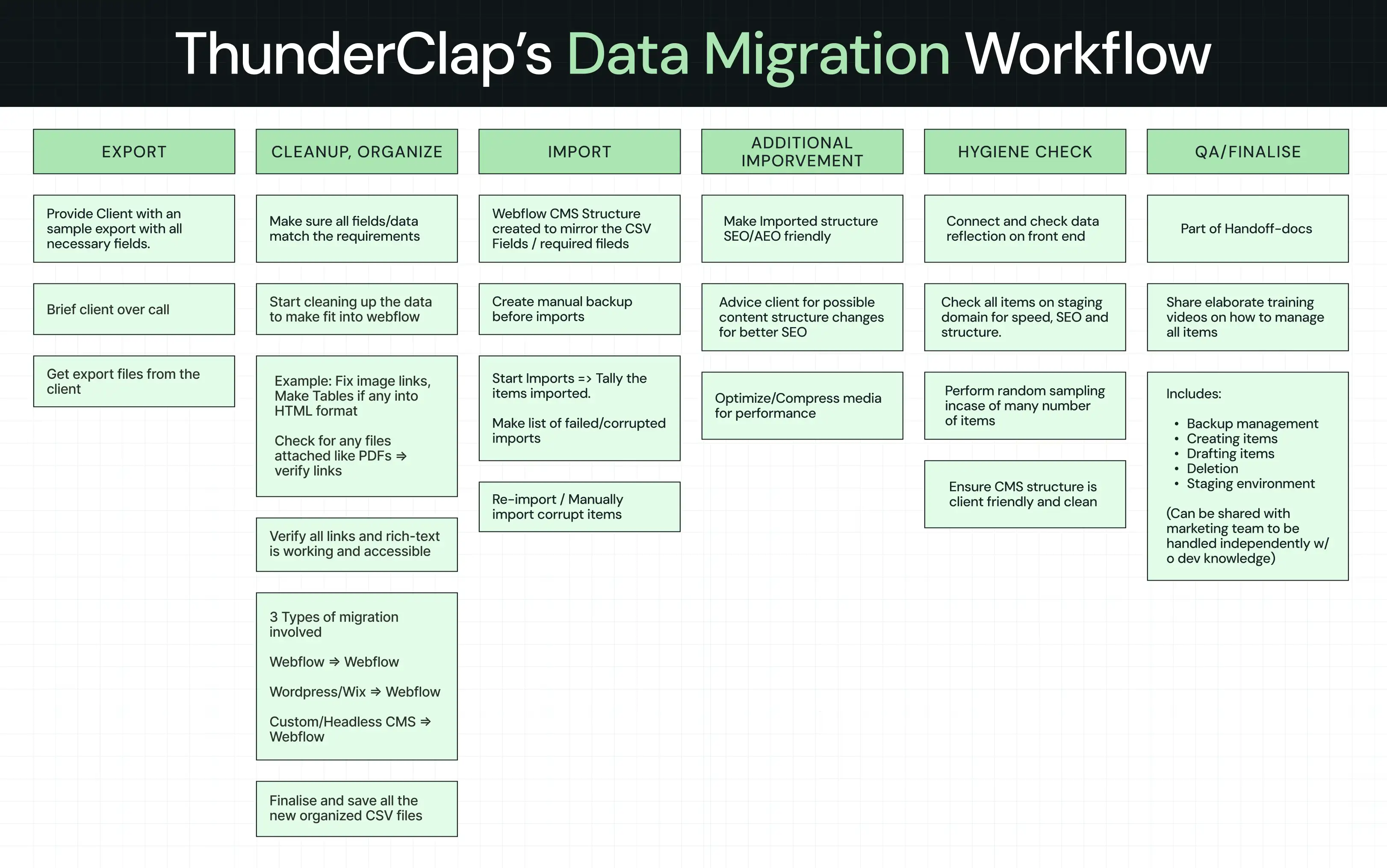
A good agency starts by auditing your current platform and content to devise the right migration strategy. They should explain how they'll preserve content integrity, manage 301 redirects to protect SEO rankings, test for broken links and missing assets, and optimize performance on the new platform.
They should also provide a clear timeline and explain their testing process before going live.
At ThunderClap, we've handled 35+ migration projects using a structured process to move from WordPress, Wix, and custom setups like Elementor to Webflow. Our typical migration timeline is 3–4 weeks, which includes pre-launch testing and post-launch monitoring.
Red flags to look for:
- No clear SEO preservation plan: Without proper 301 redirects and URL mapping, you'll lose search rankings you've built over the years.
- Vague timeline or process: Migration requires careful planning. "We'll figure it out" means trouble.
- No post-launch support: Issues often surface after migration. You need an agency that trains you till you learn the ropes.
11. How do you measure success, and what support do you offer post-launch?
Skipping this question can leave you with partners who disappear after launch, forcing you to either pay extra for maintenance or struggle alone with issues, both painful after investing in a new website.
What a strong answer looks like:
A good web design partner does not vanish after launch. They stay for a defined support window, provide technical and maintenance support, and track key KPIs to see whether the website is actually performing.
As Ankita Deb, Senior Accounts Manager at ThunderClap, explains:
“We measure success through a mix of quantitative and qualitative metrics. Quantitative indicators include improvements in conversions, lead quality, organic traffic, bounce rates, and other performance metrics.
Qualitative metrics include brand perception, messaging clarity, user experience, and how easy the new CMS is for internal teams. We also gather feedback from stakeholders to understand how the website performs in real workflows.”
ThunderClap also provides 30 days of post-launch support and monitors Analytics and Search Console to proactively share what’s improving and what needs attention.
Red flags to look for:
- Only tracks surface-level performance: If success is measured by traffic alone and not conversions or lead quality, real business impact gets ignored.
- No post-launch support: Most issues surface after launch, and without guided support, you are left troubleshooting a brand-new system on your own.
Why Top Brands Choose ThunderClap as their Web Design Partner?
The right web design agencies work as an extension of your team. While mediocre agencies dodge questions, the right ones answer them honestly and fearlessly push back when required.
At ThunderClap, we go beyond pretty websites and great UX to deliver websites that perform.
Here's why brands like Storylane, Factors.ai, Razorpay, and Amazon have chosen us:
- B2B expertise: We've worked with B2B brands across major industries like SaaS, Venture Capital, AI, and Fintech. We stay on top of industry best practices and know how to design for category leadership and conversions.
- Post-launch support: We don't just guarantee results to get our foot in the door. We offer free support for the first 30 days post-launch to ensure your website truly delivers.
- Panel of experts with dedicated PMs: We have a team of global talent, including CRO specialists, UI/UX designers, developers, copywriters, and project managers.
{{ctaBlock}}
FAQs
1. What should I look for in a B2B or SaaS web design partner?
Things you should look for in a B2B or SaaS web design partner include:
- Proven B2B expertise across industries like SaaS, fintech, AI, etc.
- Post-launch support to ensure you get the results they promised
- Clear project timelines and communication style to ensure things run seamlessly
- Structured revision handling to avoid bottlenecks and timeline misalignment
2. Should I choose a full-service agency or a specialized SaaS design partner?
If you belong to the B2B industry, it is better to choose a white-label web design partner specialized in SaaS. SaaS design partners are already well aware of industry standards and trends, having worked with other brands in the same space. They also understand the SaaS buying cycle, funnels, and the target audience well.
3. Do web design partners also help with website copy and SEO?
Not all do. Many white-label However, the best website design and development companies, like ThunderClap, focus on technical SEO and website performance to ensure the websites they build not just look good, but also perform well in terms of speed, visibility, and conversions.d user experience. However, the best website design and development companies, like ThunderClap, focus on technical SEO and website performance to ensure the websites they build not just look good, but also perform well in terms of speed, visibility, and conversions.



.webp)
Browse Similar Articles


Leading 5 SaaS Branding Agencies in Florida (That Actually Understand SaaS Growth)

.svg)

How to Turn Your B2B Website into a Self-Serve Growth Engine? (PLG Ready in 2026)

9-Step Website Copy Audit Checklist to Improve Conversions (Examples from Top B2B Brands)

.webp)
How to Choose the Right Fintech Web Development Company for Your Business
Top B2B Website Design Principles That Turn Visitors into Qualified Leads
%20Audit%20That%20Actually%20Improves%20Revenue.webp)
How to Do a Conversion Rate Optimization (CRO) Audit That Actually Improves Revenue
Web Design Agency vs. Freelancer vs. In-House: What Actually Works in 2026
5 CRO Agencies in London and How to Choose the Best CRO Agency for Your Business
The Ultimate Fintech B2B Positioning Guide for 2026 (That Actually Drives Conversions)
Mapping the B2B Buyer Journey to Improve Conversions Across Every Touchpoint
.webp)
7 Best Website Maintenance Companies in India for Growth-Led B2B Teams (2026)

.webp)

8 Best Healthcare Website Design Agencies for HIPAA-Compliant Sites in 2026
How to Find the Best Web Design Company in Houston, Texas for B2B Brands (6 Best Picks)
Positioning That Wins: How to Make Complex B2B Products Clear and Compelling
The Step-by-Step Website Redesign Process B2B Teams Use to Increase Conversions (Without Killing SEO and Pipeline)
7 Best Video Production Agencies for SaaS Product Walkthroughs and Feature Videos
How to Choose the Best B2B Website Maintenance Company: 9 Questions to Ask Before You Hire One

How to Choose a Web Design Company in San Francisco in 2026 (with Examples)

10 Best Web Design Companies in Florida in 2026 and How to Choose the Right One
How to Use Brand Storytelling on Your Website to Close More B2B Deals and Build Buyer Trust
SaaS CRO Best Practices: What High-Growth Brands Do Differently to Win Conversions
How a Rebranding Agency Can Redefine Your B2B SaaS Identity and Boost Pipeline
B2B Marketing Trends in 2026 That Directly Influence Pipeline and Revenue

Top 7 Video Marketing Agencies Driving B2B SaaS Brand Awareness in 2026
Why Partnering with a B2B Brand Positioning Agency Accelerates Market Differentiation

The Complete Website Redesign Checklist for B2B SaaS Teams Ready to Scale
.avif)
9 Best Webflow Development Agencies in India for 2026 (In-Depth Review)

10 Product Marketing Companies Powering the Fastest-Growing SaaS Brands in 2026
Website Copywriting Services vs In-House: What's Right for Your Business?

How to Choose a Marketing Agency That Understands B2B SaaS Growth Metrics


How to Choose a Video Marketing Agency That Understands B2B Storytelling
Outsourcing Web Design: Cost-Benefit Analysis for Mid-Market & Enterprise Brands

From Leads to Lifetime Value: How Growth Marketing Agencies Scale SaaS Revenue
Build a B2B Website Strategy That Aligns with Sales and Marketing Goals
Webflow vs WordPress: Which Platform Is Better for Your Business Website in 2026?
Fintech Web Design That Builds Trust: 8 UX Principles Every Fintech Site Needs
Optimizing for Intent: How B2B Website Messaging and UX Changes Help Capture Top-Funnel Buyers

12 Best B2B Web Development Agencies in the US to Build Scalable Websites

From Audit to Action: 8-Step Process to Optimize Your B2B Website Strategy for 2026 Buyers
How to Design a High-Converting Landing Page from Scratch (2026 Edition)

From Click to Customer: Proven Landing Page Conversion Optimization Techniques

How to Write Website Copy That Converts: A Step-by-Step Guide for 2026

How to Optimize a Landing Page for Maximum ROI: A Step-by-Step Breakdown


AI Landing Pages That Convert: 7 Design Principles Every AI Platform Should Follow
From Traffic to Pipeline: B2B Website Growth Strategy for Scaling Teams
B2B Website Optimization Strategy: Speed, UX, SEO, and CRO in One Playbook




Interested in seeing what we can do for your website?



.webp)
