















5 CRO Agencies in London and How to Choose the Best CRO Agency for Your Business


TL;DR
- London’s CRO scene has matured, but most agencies still deliver incremental gains, not real growth.
- Most CRO agencies focus on pages, not decisions: they test endlessly without diagnosing why users hesitate or drop off.
- The best agencies flip this, combining research, messaging, and journey-level thinking to influence how buyers actually decide.
- High-impact CRO connects the full user journey across touchpoints, aligns product, marketing, and sales, and prioritizes high-intent users over average traffic. That’s where real pipeline growth comes from, not marginal A/B test wins.
- ThunderClap’s diagnostic-first approach (Clarity → Design → Testing) fixes positioning and decision gaps before optimization begins. It shows how system-level CRO differs from traditional test-led execution and how to evaluate the right agency for your growth challenge.
A decade ago, in the days before founders were the new rock stars, when co-working meant making a cappuccino last an entire morning in Starbucks, and west London advertising execs found far-flung Shoreditch genuinely edgy, London’s digital entrepreneurs were less a community than a curiosity.
Yes, a run of internet companies, from Skype to Betfair, from Lastminute to MoneySupermarket, had broken through. But these were outliers. Growth was the exception, not the system.
Today, the picture is very different. There are 41 unicorns in the UK, and London has become one of the world's most competitive digital markets. Attention is expensive. Traffic is everywhere.
And growth? Growth is engineered.
It’s no longer about bringing users in, but what you do with them once they arrive. That’s where conversion rate optimization (CRO) agencies come in.
In this guide, we’ll look at five of the top CRO agencies in London and how to choose the right one for your business.
When Does it Actually Make Sense to Hire a CRO Agency?
Not every company is ready for a CRO agency, and hiring one at the wrong stage is an expensive way to learn that. Here's how to think about timing.
You have meaningful traffic but low conversion
CRO is an optimization discipline. It works by improving the yield on existing traffic. If you're getting consistent volume from qualified sources, CRO can meaningfully improve how you use that traffic. Brands running structured CRO programs see an average ROI of 223%, but that return assumes there's a real audience to optimize for.
This is where strong execution and partnership quality start to matter as much as strategy. When CRO is done well, it understands the business context behind the traffic.
As one Sumil, head of brand & communications at Skyroot Aerospace, noted after working with ThunderClap:
“ThunderClap built a website that truly represents our brand and handles our complex needs. Their transparent and collaborative process, along with professionalism, stood out. I’d strongly recommend them to anyone looking for a partner beyond cookie-cutter solutions.”
You're scaling paid acquisition
The faster you scale paid spend, the more expensive a low conversion rate becomes. If you're increasing your budget on paid channels, every percentage-point improvement in conversion has a disproportionately large impact on unit economics.
This is one of the highest-leverage moments to invest in CRO.
Your funnel feels leaky, but the data isn't clear
You can see the drop-off in your analytics. You can see that users are reaching key pages and leaving. But you can't tell why, and your internal team doesn't have the bandwidth or the methodology to find out.
This is exactly the situation a good CRO agency is built for.
This is exactly where CRO stops being about surface-level fixes and starts becoming about understanding decision-making. In a recent project with FillHQ, a HIPAA-compliant eSignature platform serving healthcare, finance, and legal teams, the challenge wasn’t traffic or design but clarity in a high-friction buying process. Buyers needed to quickly understand security, compliance, and workflow automation to move from evaluation to trust.
We rebuilt the experience around those decision points, highlighting audit trails, AI-assisted document generation, secure data intake, and compliance standards like HIPAA, SOC 2, and GDPR. The goal wasn’t a better-looking site, but a clearer path to conversion across multiple stakeholders. The result was a structured journey from problem awareness to evaluation to decision, rather than disconnected pages.
A recent LinkedIn post by Kiran Kulkarni, Partner & Head of Growth at ThunderClap, further expands on this work, explaining how FillHQ’s brand and website were rebuilt to serve both compliance-first buyers and enterprise decision-makers.
This is what CRO looks like when the problem isn’t traffic or testing, but clarity of decision.
When NOT to hire a CRO agency
If you don't yet have consistent, meaningful traffic, CRO has nothing to work with. If your ICP isn't clearly defined, any improvements you make will be for a generalized audience that may not reflect your best customers.
And if your product hasn't found genuine product-market fit, optimizing the funnel will only accelerate the delivery of a value proposition that isn't resonating with customers, which helps no one.
5 CRO Agencies in London for Scaling Leads, Sales, and ROI
Choosing a CRO agency is less about finding the most decorated one and more about finding the one that fits your specific problem.
Here are five worth understanding.
1. ThunderClap
.webp)
Best for: B2B and SaaS companies that need conversion clarity, not just experimentation.
ThunderClap's CRO approach differs from the standard CRO playbook in one important way: they diagnose before they test. Most agencies build a testing roadmap on day one. ThunderClap starts earlier by understanding why users aren't converting, examining messaging clarity, positioning strength, journey fragmentation, and the specific points where user confidence breaks down. The difference is foundational.
Traditional CRO often begins with a website that already has unclear positioning, then runs tests on top of that weak base. Those tests might produce a 5–10% lift, but they're ultimately optimizing something fundamentally flawed rather than fixing the reason users weren't converting in the first place.
ThunderClap's work connects CRO to the broader commercial system rather than treating it as a page-level exercise. That shift shows up in how the engagement is structured:
- Phase 1: Clarity – Define positioning, messaging, and buyer psychology first
- Phase 2: Design – Create a design that reinforces positioning and trust
- Phase 3: Testing – Optimize the clear, strategic, trust-building website through rigorous testing
A recent example of this approach in action is Factors.ai, whose product already had strong foundations but lacked sharp positioning in the US market.
ThunderClap reworked the design, and aligned the entire website experience with US customer expectations, resulting in improved visibility and a stronger inflow of high-quality US customers.
Watch the full breakdown by Ayush in his LinkedIn post:
Unlike pure CRO agencies that test whatever they are given, ThunderClap’s experimentation is guided by positioning strategy rather than isolated page hypotheses.
What they do well
- Identify the specific decision points where users hesitate or disengage
- Connect messaging and positioning to on-site behavior
- Map user journeys across touchpoints, not just individual sessions
Where they're different: Less emphasis on high-volume testing, more focus on insight-led, system-level optimization.
2. Conversion
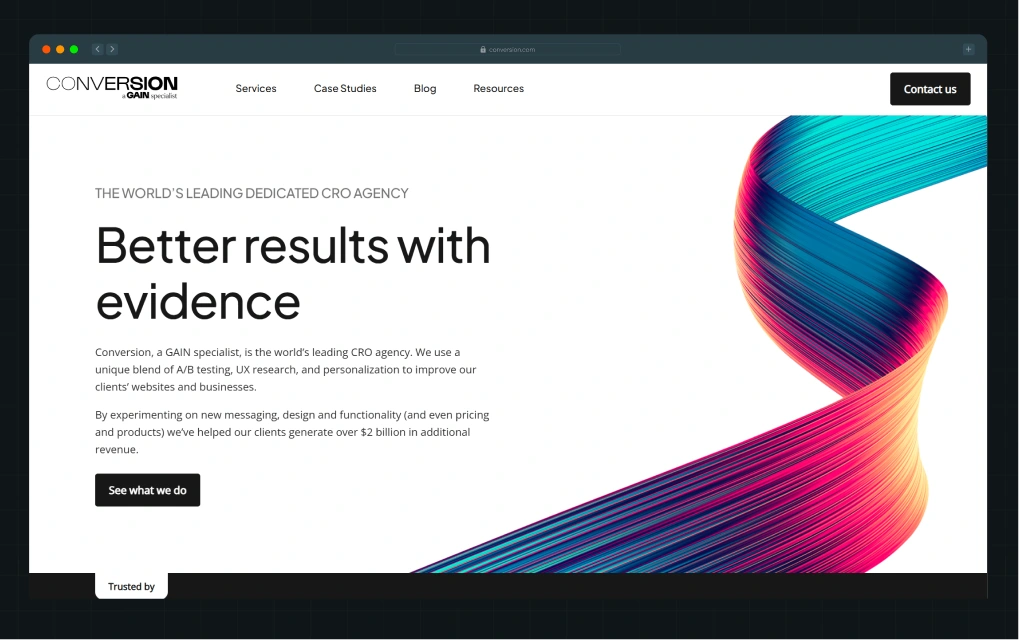
Best for: Enterprise and high-growth companies that want structured, experimentation-led CRO programs.
Conversion is a specialist CRO agency focused on large-scale experimentation across UX, product, pricing, and personalization. With over 100 specialists across the UK and North America, they combine A/B testing, user research, analytics, and design to optimize digital experiences end-to-end.
Their work goes beyond website tweaks, helping organizations build mature experimentation functions that influence broader business strategy and drive consistent revenue growth.
What they do well
- Enterprise-grade experimentation programs with strong operational depth and scale
- Combines UX research, A/B testing, analytics, and personalization into one system
- Strong track record with global brands like Meta, Microsoft, and HP
- Known for turning CRO into a long-term, organization-wide capability rather than a one-off optimization effort
Where they fall short: The emphasis is heavily on the testing layer. Companies looking for insight into broader journey dynamics or messaging-level diagnosis may find the scope too narrow.
“I am very impressed by their knowledge base and how many employees have worked at Conversion for a long time.” - Marc Miller, Manager of Direct Sales, Direct Energy Canada (Clutch)
3. Speero
.webp)
Best for: SaaS companies that want research-driven CRO
Speero is a CRO and experimentation consultancy focused on turning optimization into a disciplined, research-led system. They combine deep user research, analytics audits, and structured testing frameworks to identify friction across the customer journey and prioritize high-impact opportunities.
Their approach emphasizes building internal CRO maturity as much as running experiments, making them a long-term partner for organizations that want CRO embedded into how they operate.
What they do well
- Strong research-first methodology (UX research, analytics audits, behavioral insight before testing)
- Known for building experimentation culture and internal CRO maturity in large organizations
- Structured, end-to-end CRO programs covering discovery, ideation, prioritization, and testing
- Proven impact with enterprise clients through research-backed, high-value experiments
Where they fall short: The thoroughness of their process makes them resource-intensive and slower to reach execution. Teams that need rapid iteration may find the pace frustrating.
“Speero is far and away the best agency partner we have ever worked with. We have worked with them for multiple years and continue to find success together. From attention to detail, process and execution, the entire team is constantly on point. If you are looking for an Experimentation Agency to take your CRO or other business areas to a new level, they are your team.” - Cory (Trustpilot)
4. Kameleoon
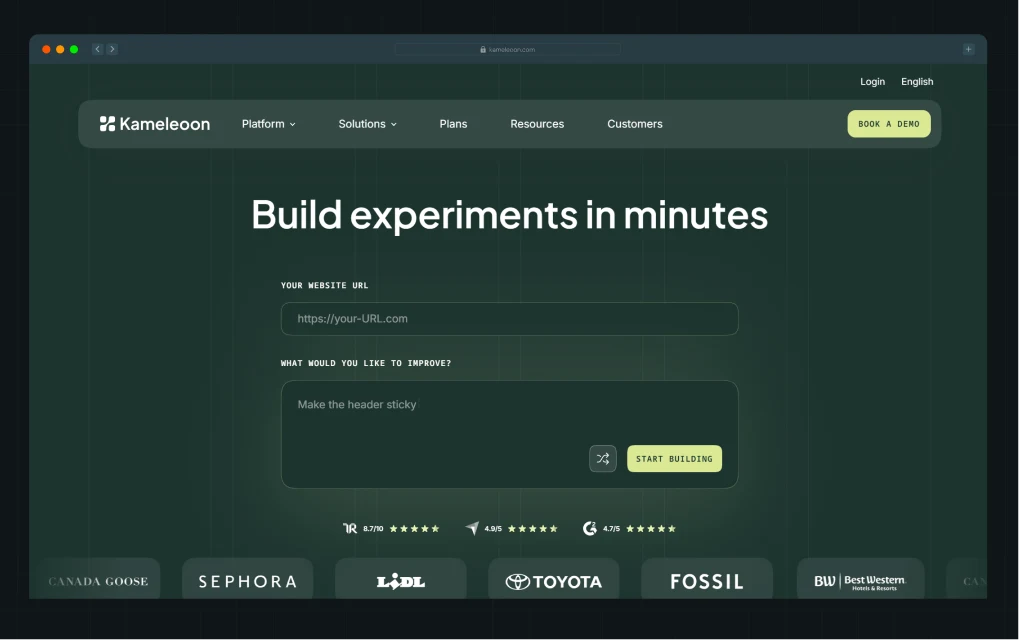
Best for: Companies focused on personalization and AI-driven experimentation
Kameleoon is less a traditional CRO agency and more a technology-led CRO platform with services around it. It supports both front-end and back-end experimentation, allowing organizations to test everything from messaging changes to product features.
With advanced statistical models, real-time reporting, and strong collaboration features, Kameleoon is designed to unify teams around faster, more reliable decision-making.
What they do well
- AI-powered experimentation (Prompt-Based Experimentation) that speeds up test creation and launch
- Strong support for both website and product feature experimentation across web, mobile, and apps
- Advanced statistical engine (CUPED, sequential testing) for more reliable results
- Built for cross-functional collaboration between product, marketing, and engineering teams
Where they fall short: This is a platform-first approach, which means it requires internal maturity to use effectively. Teams without a strong data infrastructure or a clear personalization strategy may not realize the full value of the investment.
“Kameleoon is an optimization solution that allows me to be completely autonomous in setting up and launching A/B tests/customizations to improve site navigation; notably thanks to PBX. In just a few minutes, simply by talking with the AI, I can turn ideas into tests. It is a real time saver and very easy to use. The results of the first tests launched via PBX are convincing.” - Phane D., Data analyst (G2)
5. Creative CX
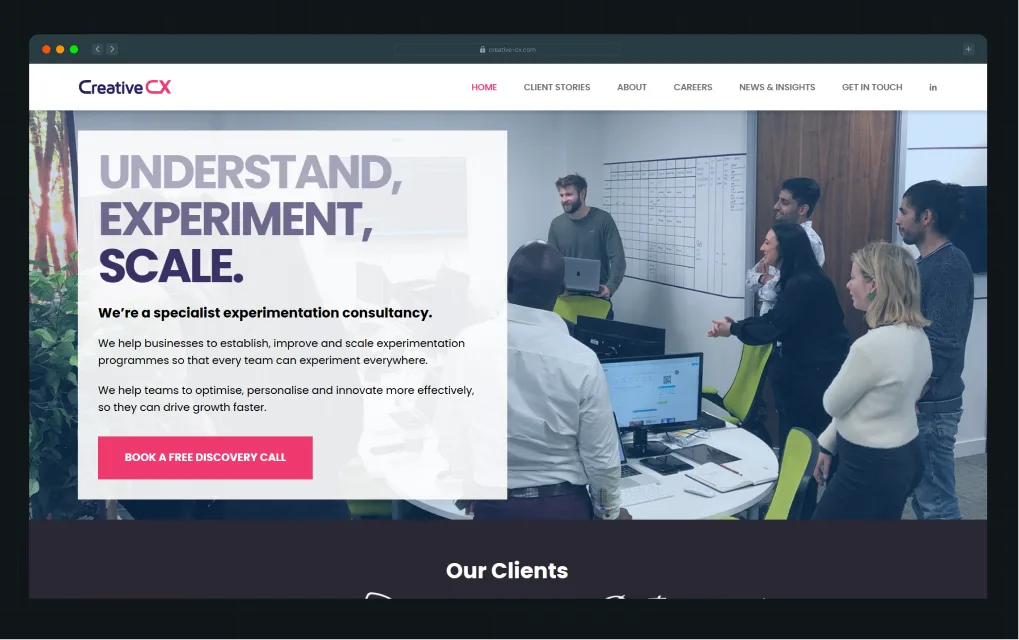
Best for: Enterprise and high-growth companies looking to build, scale, and mature experimentation programs across product, marketing, and UX teams
Creative CX is a full-service experimentation consultancy that helps organizations build structured, scalable CRO programs grounded in deep customer understanding. Their approach spans the entire lifecycle of experimentation, from user research and journey mapping to UX design, development, and large-scale optimization.
Beyond running tests, they focus on enabling internal teams, improving operating models, and embedding experimentation into decision-making.
What they do well
- Strong end-to-end approach covering research, experimentation, and organizational scaling
- Deep customer understanding through behavioral analysis, journey mapping, and usability research
- Full-service CRO execution including UX/UI design, development, and advanced testing
- Known for helping enterprises build experimentation maturity and internal capability at scale
Where they fall short: The focus is more experiential than commercial. Teams that need CRO tied directly to revenue modeling or pipeline metrics may find that the work doesn't connect closely enough to those outcomes.
“I just wanted to say a massive thank you for all you have done and educated us on. It’s been a great couple of years and 100% wouldn’t have been able to do it or get to where we are without you.” — Russel Lau, Site Optimisation Analyst, ASDA George
Why Most CRO Agencies in London Deliver Incremental, Not Transformative, Results
If you’ve hired an agency before and saw a 2% lift that disappeared a month later, you’ve experienced incrementalism.
Many CRO agencies in London focus on the visible surface rather than the underlying issues.
They optimize elements, not decisions
Most CRO agencies are trained to look at pages. They assess button placement, hero image contrast, headline length, and form field count. These details matter at the margins. Reducing form fields from seven to three can lift conversion rates by 20 to 35%, but it addresses symptoms rather than the underlying causes.
A user who doesn't understand what the product does or doesn't trust the company offering it won't convert, regardless of how optimized the layout is. The decision to convert happens in the user's mind long before they reach a call to action. Agencies that work only at the element level never get close to that decision.
They rely on testing without deep insight
A/B testing is genuinely useful. But it's a tool for validating hypotheses, not generating them. Around 84% of marketers run only one or two tests a month, and 38% do so weekly, which means most testing programs aren't generating the volume of learning needed to drive real change.
More critically, when tests are run without a clear diagnostic foundation, without understanding why users behave the way they do, wins tend to be random. You get a 4% lift on a landing page variation and call it a success, without knowing whether you've actually addressed the core reason users weren't converting.
This is where many founders start to feel something is off. As Mia Umanos, CEO at Clickvoyant, puts it, most CRO agencies don’t fail because they’re bad, but because they optimize the wrong thing.
Testing without insight produces incremental movement, not strategic improvement.
They treat CRO as a funnel problem, not a journey problem
The funnel metaphor is useful for reporting. It's less useful for diagnosing. Real user behavior doesn't follow a clean linear path. The average B2B deal now involves 6 to 10 stakeholders, each arriving at different touchpoints with different information needs and different levels of trust.
An agency focused on page-level metrics will optimize each page in isolation and miss what's actually happening across the full journey. Users who've visited your pricing page three times and your competitors' sites twice aren't a "bounce". They're a high-intent prospect sitting on the edge of a decision. Treating them like any other session is where most CRO programs leave real revenue behind.
You see the same pattern in how many teams approach acquisition. Lead magnets, for example, are often built to appeal to everyone and end up resonating with no one.
This is why many companies invest in CRO and see "improvements" in their dashboards, but no meaningful growth in their pipeline.
What Actually Makes the Best CRO Agency in London Stand Out
There's a meaningful difference between agencies that practice CRO as a technical discipline and those that practice it as a strategic one.
They focus on decision-making, not just behavior
Behavioral data tells you what users did. It doesn't tell you why they didn't convert. The best CRO agencies combine quantitative data with qualitative research, such as user interviews, session analysis, and exit surveys, to understand the mental model a user brings to a page.
They're trying to identify the specific moment when confidence broke down, a question went unanswered, or competing priorities made the user hesitate. That's fundamentally different from measuring scroll depth and click rates.
This distinction becomes apparent when CRO is treated as a surface-level exercise rather than a strategic one. In ThunderClap’s work with Z47, one of India’s leading VC funds, the objective wasn’t to optimize isolated conversion elements but to rethink how the brand communicated credibility, clarity, and founder alignment across the entire website journey.
ThunderClap conducted a full audit of engagement behavior, benchmarked competing VC brands, and developed a “founders first” messaging strategy to clarify what the site was actually trying to communicate and how users interpreted it.
In just six weeks post-launch, Z47 saw:
- +59% website traffic
- +54% active users
- +50% engagement
- +121% direct traffic
- +465% social traffic
Ayush Barnwal, Website Revamp Expert and Founder at ThunderClap, shared on LinkedIn how this redesign elevated both brand perception and user engagement:
But understanding why users hesitate on a page is only one layer of effective CRO. The next challenge is understanding how those decisions evolve across the broader customer journey.
They connect data across touchpoints
Gartner research shows that 80% of B2B sales interactions now occur in digital channels, meaning the journey from first touch to conversion spans multiple sessions, channels, and often multiple devices.
The agencies that generate real conversion improvements are the ones that understand this journey as a system, not as a collection of individual pages. They're looking at how a user who came in through a LinkedIn ad on Tuesday behaves differently from one who found you through organic search on Thursday, and they're designing experiences accordingly.
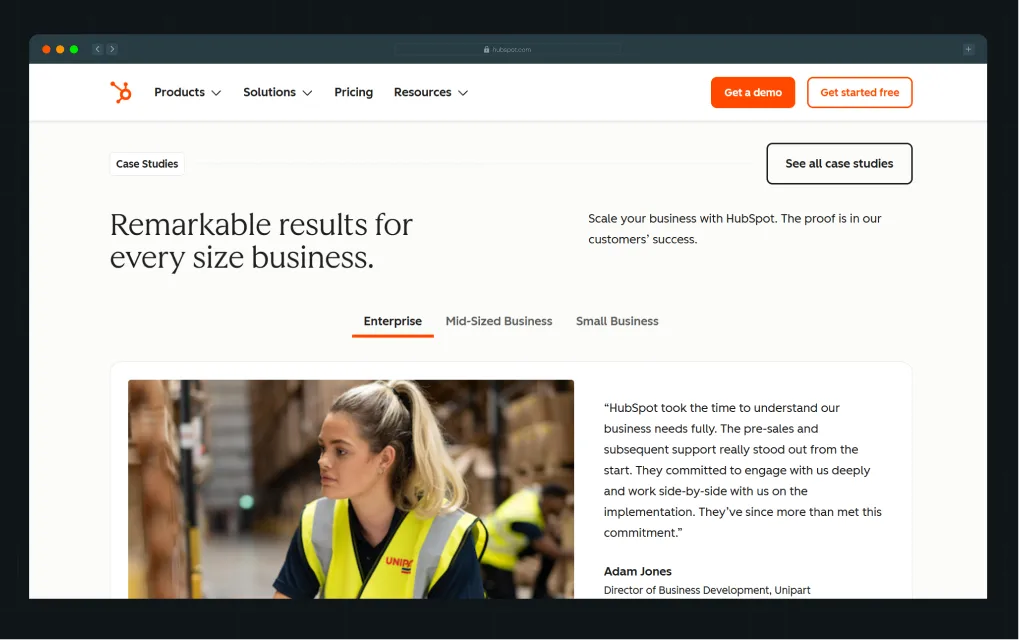
This approach is reflected in how leading SaaS companies design their funnels. For example, HubSpot integrates social proof throughout its homepage and key landing pages. A grid of well-known customer logos at the top builds immediate credibility. Further down, ROI-focused content combines data, testimonials, and customer success videos to reinforce trust and demonstrate impact.
Here’s why it works:
- Logos create instant recognition and credibility
- Testimonials are backed by clear metrics (e.g., “50% increase in lead conversion”)
- Case studies add depth and emotional connection
This is where CRO starts to move beyond marketing optimization alone. Once you understand how users build trust across touchpoints, you begin to see how closely conversion performance is tied to product positioning, sales conversations, and overall brand consistency.
They align CRO with product, marketing, and sales
Conversion problems rarely live on a single page. They're usually symptoms of a deeper misalignment between what the product promises, what the marketing says and what sales hears on calls versus what the website communicates.
The best CRO work identifies these misalignments and feeds that insight back into messaging, positioning, and even product decisions. Agencies that operate in a silo from the rest of the business will always be limited by that silo.
That alignment also changes how high-performing teams think about traffic itself. Instead of optimizing broadly for every visitor, they focus first on the users already showing strong buying intent.
They prioritize high-intent users
Top-performing B2B SaaS teams convert demo requests at 60 to 80% or higher, precisely because they focus disproportionate attention on users who are already close to a decision. Not all traffic is created equal. An agency that measures success purely by overall conversion rate is optimizing for the average, which means they're often spending energy on users who were never going to convert in the first place.
The most effective CRO work identifies who the high-intent users are, what's specifically stopping them and removes that friction first.
Once you understand what separates strategic CRO from surface-level optimization, evaluating agencies becomes much clearer. The goal is no longer finding the agency with the biggest testing program but finding the one best equipped to solve the specific growth constraints in your business.
How to Choose the Best CRO Agency in London for Your Business
The right agency depends entirely on your specific challenge. Here’s how to evaluate fit rather than reputation.
- Start with your actual challenge: There’s a meaningful difference between a traffic problem, a conversion problem, and a positioning problem. If traffic is thin, CRO won’t help. If traffic is strong but conversions are weak, that’s a CRO issue. If the wrong customers are converting, that’s a positioning problem CRO alone can’t fix. CRO works best when the right audience is already showing intent, but friction, unclear messaging, or weak trust signals are preventing conversion.
- Look beyond A/B testing: Ask how an agency diagnoses issues before testing. Their answer matters more than case studies. Teams that jump straight into test plans are signaling a tactical mindset. Teams that start with research, behavior analysis, and messaging clarity are working from a different foundation.
- Evaluate their thinking, not just their results: Case studies show outcomes, not reasoning. Ask why a test worked, not just what improved. Can they explain the insight behind the hypothesis? Do they understand the user decision they were influencing? Clear thinking compounds. Outcome-only reporting does not.
- Check how they handle high-intent users: Ask how they segment users in CRO work. Agencies that treat all traffic the same are optimizing for averages. A strong CRO focuses on high-intent users and removes specific friction points for them.
- Understand their scope: Ask whether they optimize pages or journeys. Page-level optimization drives incremental gains. Journey-level optimization drives commercial impact. The difference shapes everything from the data used to the hypotheses formed.
{{specficService}}
Are CRO Agencies in London Suitable for SaaS and B2B Companies?
Yes, but only specific types.
B2B and SaaS buying behavior is fundamentally different from e-commerce. In fact, recent shows that 92% of B2B buyers start the buying process with at least one vendor already in mind.
This means a large portion of your traffic arrives pre-informed and pre-comparing. The conversion problem isn't getting them to notice you, but giving them enough confidence to choose you over the alternatives they're already considering.
Ultimately, it requires an agency that understands how SaaS buying decisions actually work, including:
- Longer cycles
- Multiple stakeholders
- Heavy emphasis on trust signals
- Conversion events
These aren't transactions but micro-commitments, involving a demo request, a trial signup, a pricing page engagement. An agency that treats your SaaS funnel like an e-commerce checkout will optimize the wrong things entirely.
Which leaves us looking for agencies that can speak specifically to decision-making in complex sales cycles, understand the role of content in building pre-conversion trust, and measure success by pipeline contribution.
How ThunderClap's Approach to CRO Differs from Traditional Agencies
Most CRO agencies are built around a testing cadence. ThunderClap is built around a diagnostic one. That difference shapes everything about how the work gets done.
CRO isn't just testing; it's understanding
Traditional agencies run tests to find wins. As a Conversion Rate Optimization agency, ThunderClap runs research to find answers. The test is the validation step, not the starting point. This means the hypotheses they bring to testing are grounded in a real understanding of user psychology, messaging gaps, and journey friction.
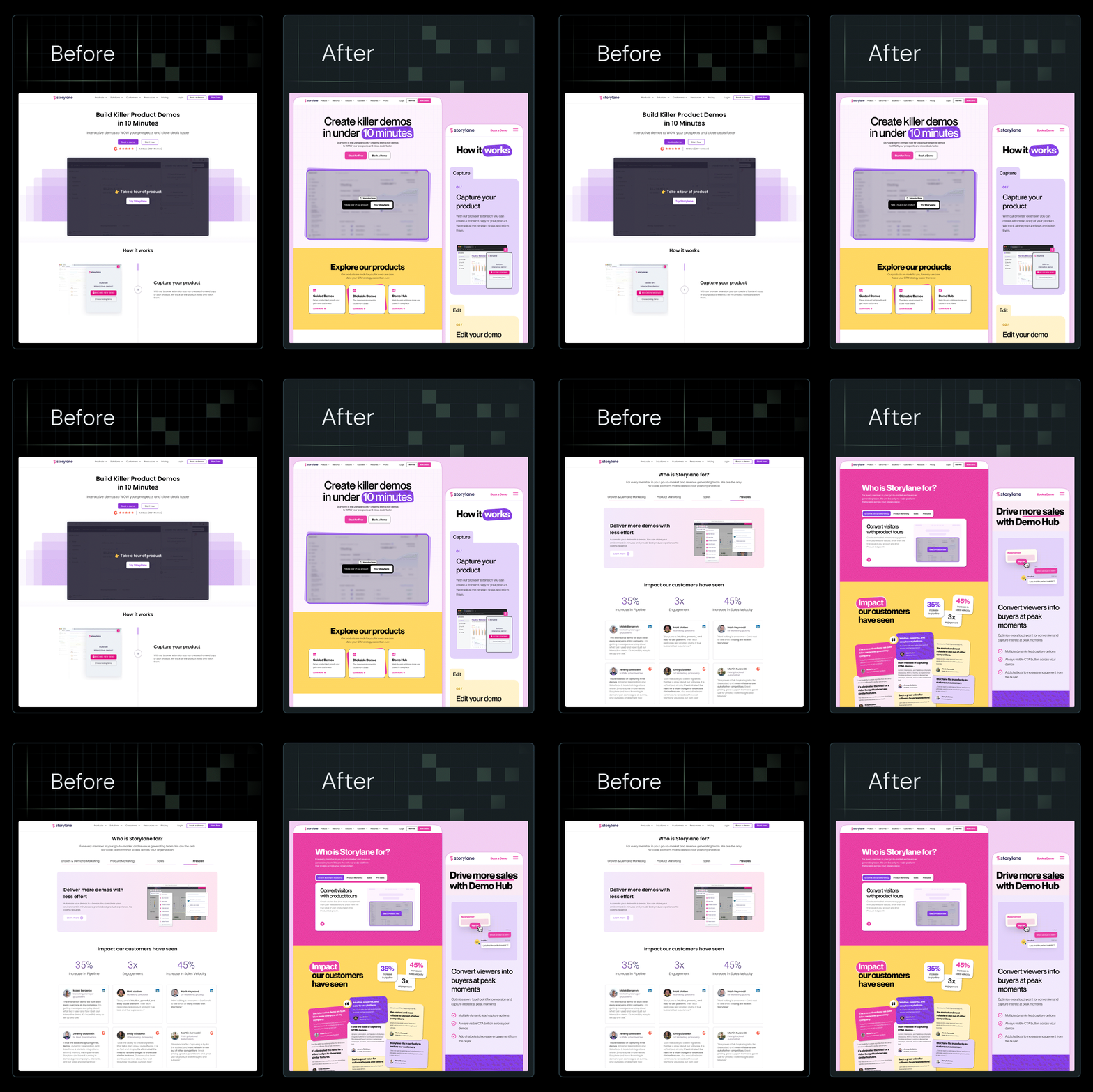
This approach is strengthened by a proven track record across SaaS and B2B growth environments. ThunderClap has optimized 129+ websites and landing pages for companies including Amazon, Storylane, Factors, and roommaster, consistently turning static pages into conversion systems rather than cosmetic redesigns.
The focus isn’t redesign for its own sake, but conversion-first architecture that drives demo signups, accelerates trials, and improves pipeline quality, often resulting in 40–50% conversion lifts within months.
Across engagements, the impact tends to show up in consistent, measurable ways:
- 60% increase in engagement after onboarding flow optimization
- 30% decrease in bounce rate through clarity-led experiments
- 50% increase in conversions by improving forms and microcopy
- Faster pipeline velocity after removing friction in demo and signup journeys
In one engagement with ConsultADD, an HR consultancy that relied entirely on its website for lead generation, the core issue was misaligned messaging and fragmented user journeys.
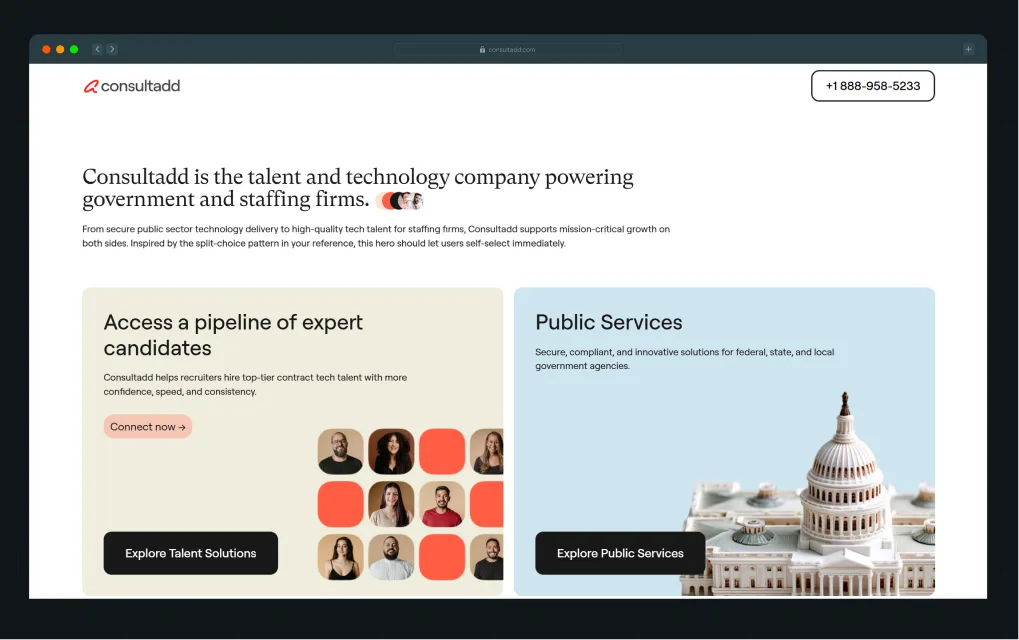
After restructuring the experience around the right ICP, simplifying flows, and redesigning key conversion paths, engagement increased by 500% (11 seconds to 72 seconds average time on site) and conversions rose by 50–60%, turning the website into a primary growth engine.
Conversion happens across journeys, not pages
B2B buyers now spend only about 17% of their purchase journey actually engaging with vendor content. The rest of the time, they're comparing, deliberating, and building internal consensus. ThunderClap’s work accounts for the full arc of that journey rather than trying to solve conversion at the page level.
This shows up in their execution at scale through segment-level personalization across firmographic, persona, and campaign-specific touchpoints rather than generic messaging. For example:
- SMB users may see messaging framed around speed and simplicity, while enterprise users may see compliance and security signals such as SSO.
- Finance stakeholders are guided toward ROI clarity, while technical users are directed toward APIs and documentation.
The idea is simple: start with headline and CTA personalization for the top 2–3 segments, where most of the conversion lift comes from, before increasing complexity.
Experimentation without context leads to random wins
Even among companies at the highest maturity level of CRO, 33% have been A/B testing for a year or less, which means most testing programs haven’t yet developed the institutional knowledge needed to connect results to strategy. ThunderClap’s model is designed to build that context from the beginning.
For teams running high-consideration funnels like demos, they often extend this thinking into structured assets such as their High-Converting Demo Page Playbook.
Built from analysis of 30 B2B SaaS brands, it breaks down landing page patterns, provides an editable wireframe for SaaS demo pages, and includes ready-to-use prompts for crafting high-performing headlines.
The team's thinking matters more than the tools
Every major agency has access to the same testing platforms, heatmaps, and analytics suites. The variable is how those tools are used, including which questions they answer and how insights inform strategy.
Tool parity means that differentiation lies entirely in thinking, not in software.
CRO should be continuous, not campaign-based
Conversion optimization isn’t a project with a start and end date. User behavior shifts, messaging evolves, acquisition channels change, and the competitive context moves constantly.
The most effective CRO programs are ongoing systems that learn and adapt, not one-time interventions followed by waiting.
{{ctaBlock}}
FAQs
1. How much does it cost to hire a CRO agency in London?
Pricing for CRO agencies in London typically scales with the scope and complexity of the engagement. Lower-tier agencies typically charge $2,000–$5,000/month (£3,000+) and are often early in their CRO maturity. Mid-tier agencies with a stronger track record charge $6,000–$15,000/month (£4,000–£11,000+). Top-tier CRO agencies with 7+ years of experience typically start around $10,000/month, with most ranging from $16,000–$30,000+ per month (£11,500–£22,000+), depending on scope and depth of experimentation.
2. How long does it take to see results from CRO services?
Here’s how long it typically takes to see results from CRO services:
- Weeks 1–2 (Clarity): Competitor audit, ICP mapping, positioning, and messaging work to establish clear differentiation and identify core conversion issues.
- Weeks 3–4 (Strategy): Strategy-led design, copy refinement, visual improvements, and CTA hierarchy updates create a conversion-ready user experience.
- Weeks 5–10 (Testing & Optimization): Positioning tests, A/B testing, copy and CTA refinement, and social proof upgrades are implemented, leading to measurable conversion lift.
3. Are CRO agencies in London suitable for SaaS and B2B companies?
Yes, but fit depends heavily on the agency's experience with complex buying cycles. B2B and SaaS conversions involve longer timelines, multiple decision-makers, and conversion events that aren't always transactions. Agencies like ThunderClap that understand this dynamic and build programs around it consistently deliver stronger results for SaaS and B2B clients than those applying a generalist or e-commerce playbook.
4. What's the difference between CRO and A/B testing?
A/B testing is one method within CRO. It tells you how to validate whether a change improves performance. CRO is the broader discipline of understanding why users aren't converting and systematically removing those barriers. Good CRO uses A/B testing as a confirmation tool, but the work starts with research, diagnosis, and hypothesis formation well before any test goes live.
5. How do I know if my business is ready for a CRO agency?
The clearest signal is having consistent, qualified traffic that isn't converting at the rate you'd expect. If you're generating visits from the right audience but losing them before they take action, CRO has meaningful work to do. If traffic is low, inconsistent, or poorly qualified, addressing those issues first will yield better returns than optimizing a funnel that lacks sufficient volume to learn from.



.webp)
Browse Similar Articles


Leading 5 SaaS Branding Agencies in Florida (That Actually Understand SaaS Growth)

.svg)
How to Turn Your B2B Website into a Self-Serve Growth Engine? (PLG Ready in 2026)

9-Step Website Copy Audit Checklist to Improve Conversions (Examples from Top B2B Brands)

.webp)

How to Choose the Right Fintech Web Development Company for Your Business
Top B2B Website Design Principles That Turn Visitors into Qualified Leads
%20Audit%20That%20Actually%20Improves%20Revenue.webp)
How to Do a Conversion Rate Optimization (CRO) Audit That Actually Improves Revenue
Web Design Agency vs. Freelancer vs. In-House: What Actually Works in 2026
The Ultimate Fintech B2B Positioning Guide for 2026 (That Actually Drives Conversions)
Mapping the B2B Buyer Journey to Improve Conversions Across Every Touchpoint
.webp)
7 Best Website Maintenance Companies in India for Growth-Led B2B Teams (2026)

.webp)
8 Best Healthcare Website Design Agencies for HIPAA-Compliant Sites in 2026

How to Find the Best Web Design Company in Houston, Texas for B2B Brands (6 Best Picks)
Positioning That Wins: How to Make Complex B2B Products Clear and Compelling
The Step-by-Step Website Redesign Process B2B Teams Use to Increase Conversions (Without Killing SEO and Pipeline)
7 Best Video Production Agencies for SaaS Product Walkthroughs and Feature Videos
How to Choose the Best B2B Website Maintenance Company: 9 Questions to Ask Before You Hire One

How to Choose a Web Design Company in San Francisco in 2026 (with Examples)

10 Best Web Design Companies in Florida in 2026 and How to Choose the Right One
How to Use Brand Storytelling on Your Website to Close More B2B Deals and Build Buyer Trust
SaaS CRO Best Practices: What High-Growth Brands Do Differently to Win Conversions
How a Rebranding Agency Can Redefine Your B2B SaaS Identity and Boost Pipeline
B2B Marketing Trends in 2026 That Directly Influence Pipeline and Revenue
Top 7 Video Marketing Agencies Driving B2B SaaS Brand Awareness in 2026

Why Partnering with a B2B Brand Positioning Agency Accelerates Market Differentiation

The Complete Website Redesign Checklist for B2B SaaS Teams Ready to Scale
.avif)
9 Best Webflow Development Agencies in India for 2026 (In-Depth Review)
10 Product Marketing Companies Powering the Fastest-Growing SaaS Brands in 2026
Website Copywriting Services vs In-House: What's Right for Your Business?

How to Choose a Marketing Agency That Understands B2B SaaS Growth Metrics


How to Choose a Video Marketing Agency That Understands B2B Storytelling
Outsourcing Web Design: Cost-Benefit Analysis for Mid-Market & Enterprise Brands
From Leads to Lifetime Value: How Growth Marketing Agencies Scale SaaS Revenue
Build a B2B Website Strategy That Aligns with Sales and Marketing Goals
Webflow vs WordPress: Which Platform Is Better for Your Business Website in 2026?
Fintech Web Design That Builds Trust: 8 UX Principles Every Fintech Site Needs
Optimizing for Intent: How B2B Website Messaging and UX Changes Help Capture Top-Funnel Buyers

12 Best B2B Web Development Agencies in the US to Build Scalable Websites

From Audit to Action: 8-Step Process to Optimize Your B2B Website Strategy for 2026 Buyers
How to Design a High-Converting Landing Page from Scratch (2026 Edition)
From Click to Customer: Proven Landing Page Conversion Optimization Techniques

How to Write Website Copy That Converts: A Step-by-Step Guide for 2026

How to Optimize a Landing Page for Maximum ROI: A Step-by-Step Breakdown


AI Landing Pages That Convert: 7 Design Principles Every AI Platform Should Follow
From Traffic to Pipeline: B2B Website Growth Strategy for Scaling Teams
B2B Website Optimization Strategy: Speed, UX, SEO, and CRO in One Playbook




Interested in seeing what we can do for your website?



.webp)
