
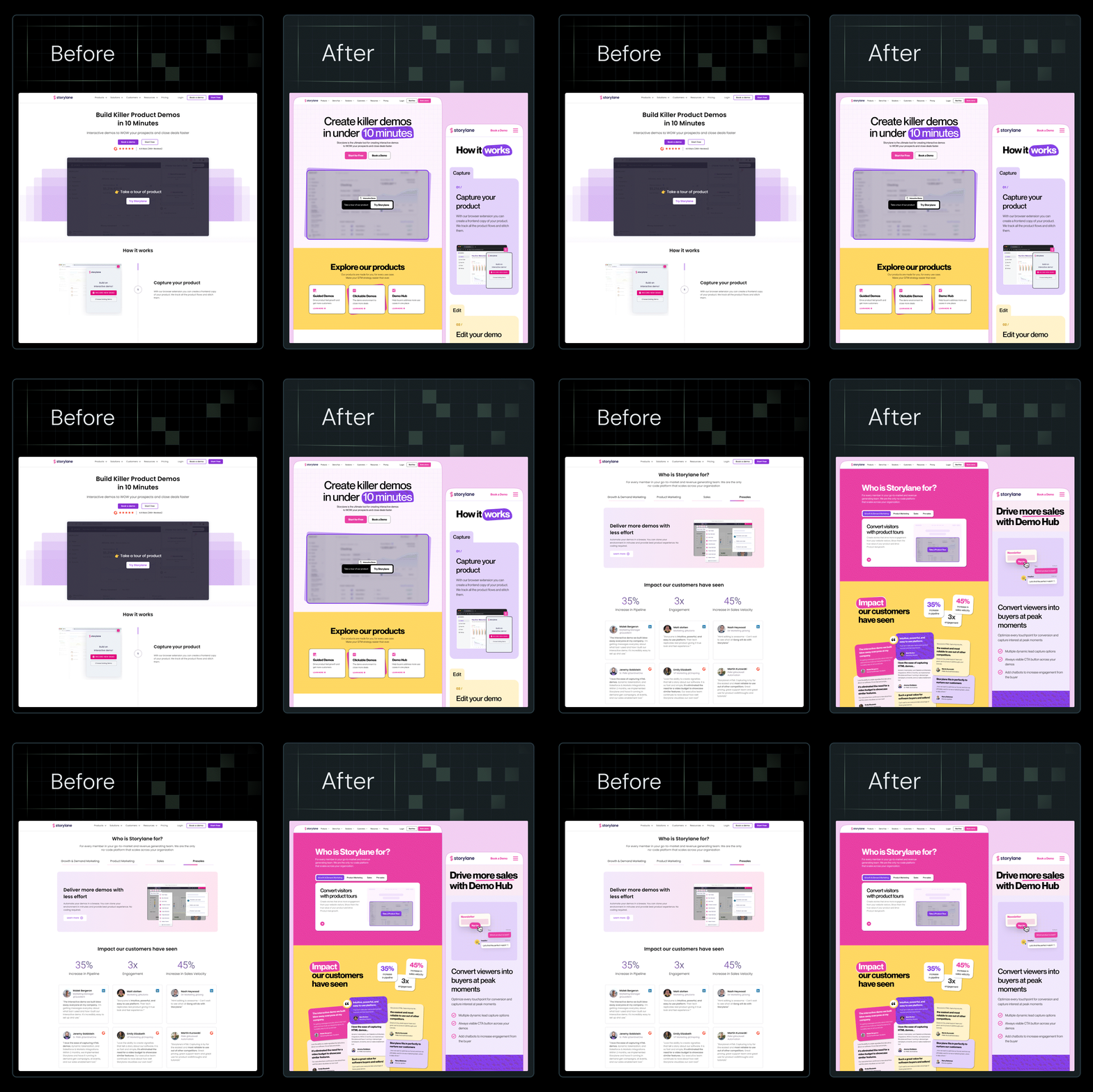













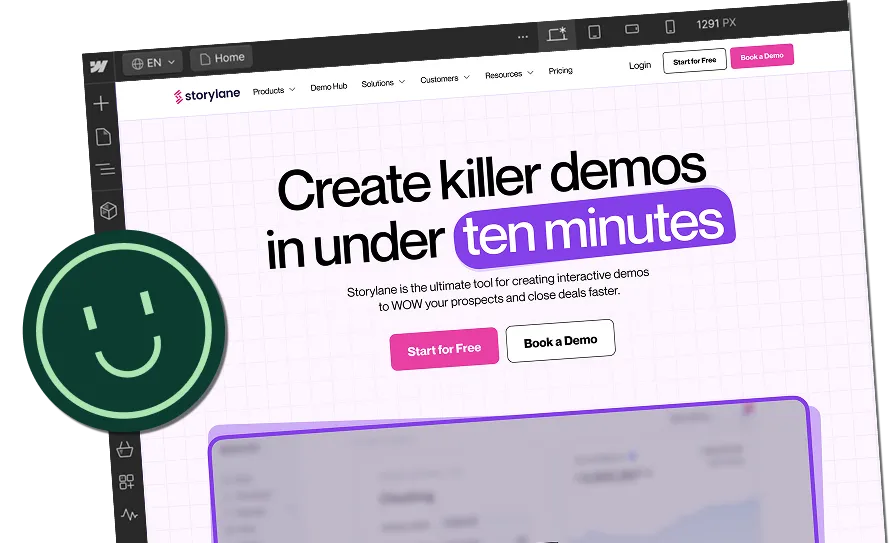

Leading 5 SaaS Branding Agencies in Florida (That Actually Understand SaaS Growth)



TL;DR
- Most branding agencies lead with visuals and identity, but SaaS companies need positioning and messaging first.
- B2B SaaS has some of the lowest average conversion rates across industries, at just 2.9%, and brand clarity directly affects that number.
- The average B2B software purchase involves up to 13 stakeholders, so your brand has to hold up across multiple conversations, not just one.
- The best Florida branding agencies for SaaS prioritize how a brand communicates, ensuring the message is clear and credible before translating it into a visual identity.
- Within this context, ThunderClap approaches branding as a conversion system rather than a design project, aligning messaging, positioning, and identity to drive measurable outcomes.
What if we tell you most branding advice isn't built for SaaS?
It’s built for consumer brands, retail, and hospitality, the industries where a compelling logo and a sharp color palette can actually influence buying decisions.
SaaS is a different game. Your buyer is methodical, and they’re running a five-tool comparison. They've got a buying committee with 13 stakeholders, a legal team on hold, and a CFO who wants to see the ROI before they even get on a call.
A beautiful brand won't close that deal. A clear one might.
Florida is home to a growing cluster of branding agencies, and with 1089 SaaS companies now based in the state, the demand is only increasing. But only a handful of these agencies truly understand how SaaS buyers think and make decisions.
This guide filters through the branding agencies in Florida and highlights the ones actually worth talking to.
The Uncomfortable Truth
Most branding agencies don’t work for SaaS.
Walk into most branding agency pitches and you’ll see the same pattern. They’ll show you a mood board, talk about brand personality, present 2 or more logo variations, and walk you through the reasoning behind each color choice.
It will probably look great.
The problem is that none of it addresses why your trial-to-paid conversion is stuck, why prospects go quiet after the second demo, or why your homepage takes ten seconds to explain what your product actually does.
They start with visuals, not positioning
Traditional brand agencies operate on a visual-first model. The logo comes before the language. The identity system gets built before anyone has defined what makes the product different or why a skeptical buyer should care.
For consumer brands, that sequence can work. For SaaS, it is backwards.
Because if your positioning is unclear, your design ends up amplifying confusion instead of solving it. You get a brand that looks refined on the surface, but fails to explain differentiation in a way a skeptical buyer can immediately understand.
They optimize for brand perception, not buyer decisions
A strong brand can win awards, generate positive sentiment on LinkedIn, and can make your team feel proud. What it does not automatically do is help a risk-averse procurement manager feel confident enough to move forward.
However, for Florida’s SaaS ecosystem, that risk is increasingly distributed across teams. As of April 2026, these businesses generate a combined $17.1B in revenue, employing 196.4K people, and having collectively raised $5.3B in capital while serving 68.6M customers.
In that kind of market, buying decisions are rarely simple or individual. They are multi-layered, cross-functional, and heavily scrutinized before a contract is ever signed.
This is also where the gap between “branding for perception” and “branding for decisions” becomes most visible.
A recent project with FillHQ illustrates this shift. FillHQ, a HIPAA-compliant eSignature platform serving healthcare, finance, and legal industries, needed a website that could do more than look polished. It had to communicate security, compliance, and workflow automation clearly enough to convert regulated, high-friction buyers into trial users and enterprise demos.
We rebuilt the experience around the buyer journey, focusing on decision-critical elements like automated workflows, audit trails, AI-assisted document generation, and secure data intake. The positioning emphasized compliance standards such as HIPAA, SOC 2, and GDPR, along with efficiency and cost advantages, supported by educational content and case studies to build trust across multiple stakeholders.
The result was a system designed to guide visitors from problem recognition to evaluation and finally to a decision.
A recent LinkedIn post by Kiran Kulkarni, Partner & Head of Growth at ThunderClap, further expands on this work, explaining how FillHQ’s brand and website were rebuilt to serve both existing customers and compliance-first buyers.
This is what SaaS branding looks like when it is built around buyer decisions rather than surface-level perception.
They ignore how SaaS buyers actually evaluate tools
Modern SaaS buying is slow, multi-layered, and increasingly self-directed. According to Gartner’s recent study, 67% buyers now prefer a rep-free or minimal-sales interaction experience, meaning they rely heavily on digital touchpoints before ever speaking to a sales team.
Buyers are relying on websites, documentation, comparisons, peer input, and internal discussions to form a point of view. By the time they reach your team, they are rarely trying to understand what the product is. They are trying to validate whether it is worth the risk. These buying decisions are rarely made by a single person and often involve multiple departments evaluating risk, compliance, and ROI in parallel.
This is where most branding systems fail.
SaaS buyers are comparison-heavy, stakeholder-driven, and deeply risk-averse. In fact, Forrester’s 2024 research also shows that 86% of B2B purchases stall during the buying process. And stalled deals rarely stall because the logo was not strong enough.
It is because something in the story did not survive contact with how real buyers actually make decisions.
What Actually Matters in SaaS Branding (and What to Look for in a Florida Branding Agency)
Not all SaaS branding criteria are created equal. Here's what actually separates useful brand work from expensive decoration.
Clarity beats creativity
Clever taglines and abstract brand language might feel differentiated, but B2B SaaS sits at the bottom of the conversion rate spectrum at just 2.9%, and muddled messaging is a major reason why. Similarly, usability research shows that 88% of users won’t return after a poor first experience, meaning unclear messaging reduces both conversions and kills second chances entirely.
If a first-time visitor to your website can't understand what your product does, who it's for, and why it's different in the first few seconds, the brand has already failed. Clarity isn't the boring option. It's the effective one.
Positioning before identity
Your brand visuals should come from your positioning, not the other way around. Who you're for, what problem you solve, and how you're different from the other four tools on the shortlist are questions that have to be answered before anyone picks a typeface.
This is especially relevant in fast-growing SaaS ecosystems like Florida’s, where post-2024 startup growth (particularly in fintech, healthtech, and AI) has intensified category saturation. In fact, conversion gaps between average and top-performing SaaS companies (often 3–5x higher) are driven more by positioning clarity and content structure than visual design.
In her LinkedIn post, Kiran illustrates this well. For example, in the case of 101 GenAI, a healthcare AI platform operating in a highly regulated environment, the product was built for enterprise from day one, but the brand had not caught up to that reality.
The engagement focused on repositioning the company for regulated healthcare buyers, aligning messaging around compliance, data privacy, and model reliability, and reinforcing credibility signals such as HIPAA alignment and SOC 2 readiness. The outcome was a clearer articulation of enterprise readiness that directly influenced how investors and buyers perceived the company.
Agencies that skip this step produce brands that actively mislead buyers about what kind of company they're dealing with.
Messaging that survives comparison
Research from Wynter found that the median number of stakeholders involved in SaaS purchase decisions is five people.
What matters to them during shortlisting is different from what drives the final decision. That means your messaging has to hold up in multiple contexts simultaneously:
- Landing page
- Sales deck
- G2 review
- Slack thread
Recent SaaS funnel data shows that visitor-to-lead conversion happens within 1–3 days, but full enterprise buying cycles stretch up to ~120 days, meaning your messaging is repeatedly re-evaluated across stages and stakeholders.
If it only works in one format, it won't survive the shortlist phase.
Brand that extends into the full journey
Your website, in-product experience, sales collateral, and customer success touchpoints all need to feel like the same company making the same promise. This matters even more now because end-to-end SaaS conversion (visitor → customer) often lands as low as ~1–1.8%, meaning every inconsistency across the journey compounds drop-off.
A recent example from Wizcommerce shows how this plays out in practice. Wizcommerce processes $100M+ in GMV, powers 700+ sales reps, and serves 300K buyers through AI-powered sales tools, B2B storefronts, and ERP integrations for wholesale businesses.
During discovery, we worked with their leadership, marketing, and product teams to map buyer journeys and identify friction points like fragmented systems, misaligned messaging, and outdated tools slowing down both reps and buyers.
We translated these insights into a scalable digital experience that clearly communicated Wizcommerce’s value across multiple audiences. The platform highlighted their AI sales assistant, storefront capabilities, and ERP integrations while positioning the brand as enterprise-ready, with a structure designed to support both immediate conversion and long-term growth.
As highlighted by Kiran in her LinkedIn post, the revamp focused on aligning the website with the scale and maturity of Wizcommerce’s product.
This made enterprise-grade capabilities, multi-product complexity, and buyer-specific journeys immediately clear from the first interaction.
Leading 5 SaaS Branding Agencies in Florida
Most lists will show you the same “top branding agencies” in Florida. This one doesn’t.
It filters agencies through a SaaS-specific lens, where clarity beats creativity, positioning drives perception, and branding is judged by how well it holds up in real buying decisions.
1. ThunderClap
.webp)
Best for: B2B SaaS, tech, and enterprise companies
ThunderClap leads this list because we focus entirely on B2B branding that drives measurable growth. We’ve won Webby Awards and CSS Design Awards for projects that balance creativity with conversion, proving that strong strategy and design can work together to move the needle.
We begin every engagement with deep market research and competitive analysis to uncover what actually matters to B2B buyers. We define brand architecture, build messaging hierarchies, and sharpen value propositions so every element communicates with precision. We prioritize product clarity throughout, helping buyers quickly understand complex offerings without friction.
Our design team builds visual systems that actively guide users through the sales funnel. We use color psychology, layout structure, and content hierarchy intentionally to drive action. As a platform-agnostic team, we build fast, responsive, and conversion-focused websites tailored to each client’s technical and business needs. After launch, we continue optimizing through A/B testing, analytics, and performance tracking to sustain growth.
When Rezolv’s founders approached us, they had deep technical expertise but no brand, no website, and no clear way to communicate their product. We built their identity from the ground up, starting with a logo and visual system that reflected their problem-solving approach.
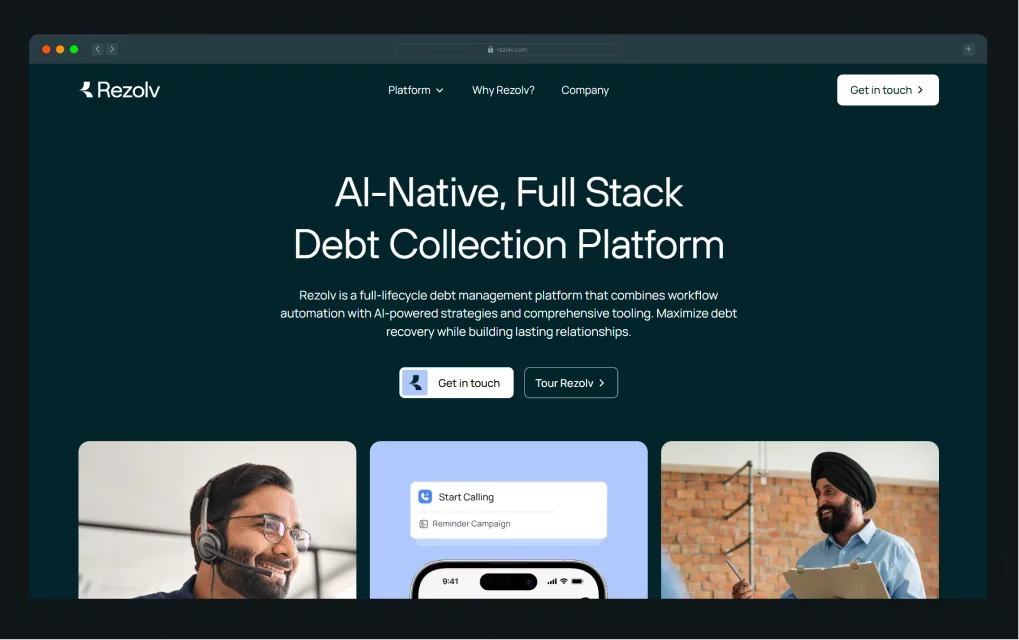
We shaped their B2B website strategy, wrote clear and persuasive messaging, and simplified complex financial workflows without losing credibility. We then developed the site in Webflow, ensuring speed, responsiveness, and conversion readiness from day one.
After launch, Rezolv saw stronger engagement from prospects and faster adoption among target customers.
“As an early-stage company, we needed a clear brand identity and messaging before launching. ThunderClap delivered exactly that! Concise, impactful copy and branding that feels right.” - Karan Mehta, Founder, Rezolv
What they do well
- Build positioning-led brand strategies that align with how B2B buyers evaluate solutions
- Design visual systems that guide users through the funnel and drive conversions
- Develop high-performance Webflow websites optimized for speed, usability, and lead generation
- Continuously improve performance through testing, analytics, and data-driven optimization
Why they stand out
They align positioning, messaging, design, and performance into a single system that drives measurable results across the entire SaaS buying journey.
2. Flocksy
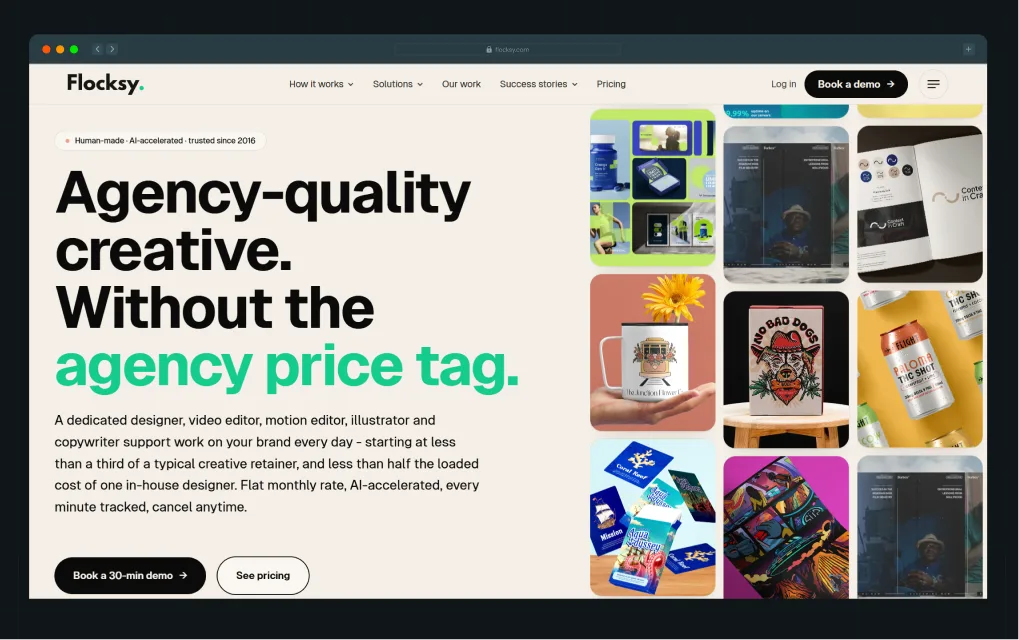
Best for: High-growth SaaS teams needing ongoing creative production at scale
Flocksy operates as a subscription-based creative service that gives SaaS and marketing teams continuous access to design, copywriting, and video production. Instead of traditional project-based branding, it delivers daily creative output through a dedicated team model, supported by AI-assisted workflows and centralized brand profiles.
This makes it especially useful for high-volume content needs, rapid iteration, and maintaining consistency across channels without managing multiple freelancers or agencies.
What they do well
- Deliver high-volume creative output across 140+ services under one system
- Provide dedicated teams that learn and maintain brand consistency over time
- Use AI-assisted briefs and workflows to speed up execution cycles
- Simplify budgeting with flat-rate pricing and predictable delivery
Why they stand out
They function as an always-on creative engine, replacing fragmented freelancer workflows with a scalable, systemized production model.
3. SIX The Agency
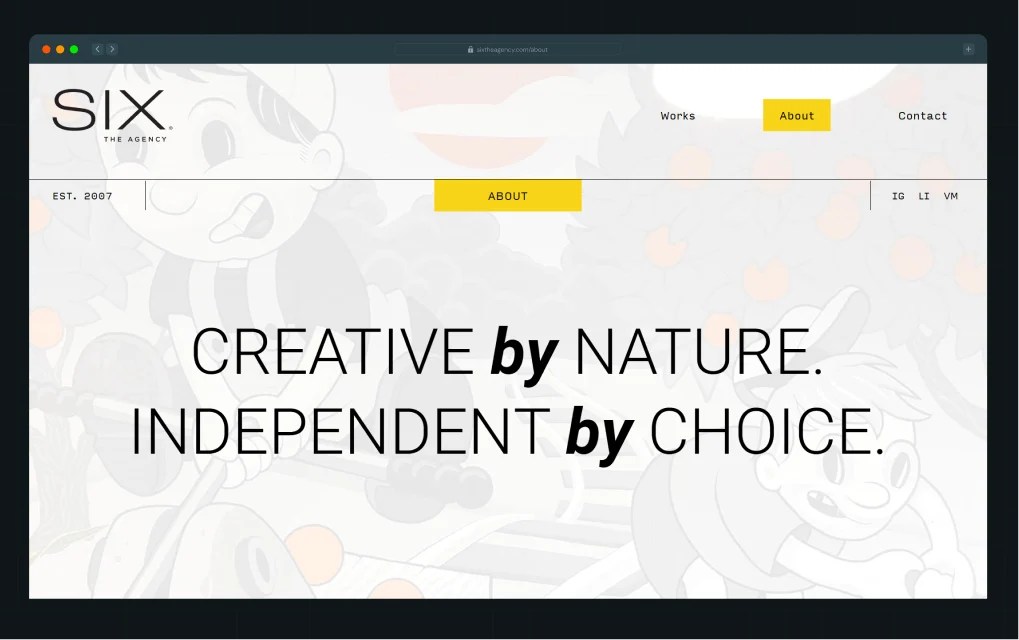
Best for: Companies that want brand storytelling and perception-driven positioning
SIX The Agency positions itself as a branding and communications firm focused on building emotionally resonant brands through strategy, design, and storytelling. Based in Orlando, it works across industries including SaaS and technology, combining brand identity, PR, and digital marketing to shape perception.
Its work emphasizes narrative-driven branding and audience psychology, helping companies differentiate through messaging and experience rather than just visuals.
What they do well
- Build cohesive brand narratives across design, PR, and communications
- Create emotionally driven brand positioning rooted in audience behavior
- Deliver integrated branding across industries including tech and SaaS
- Execute multi-channel brand experiences beyond just websites
Why they stand out
They combine branding, PR, and storytelling into a unified system that shapes how audiences perceive and engage with a brand.
4. Funk Web Development
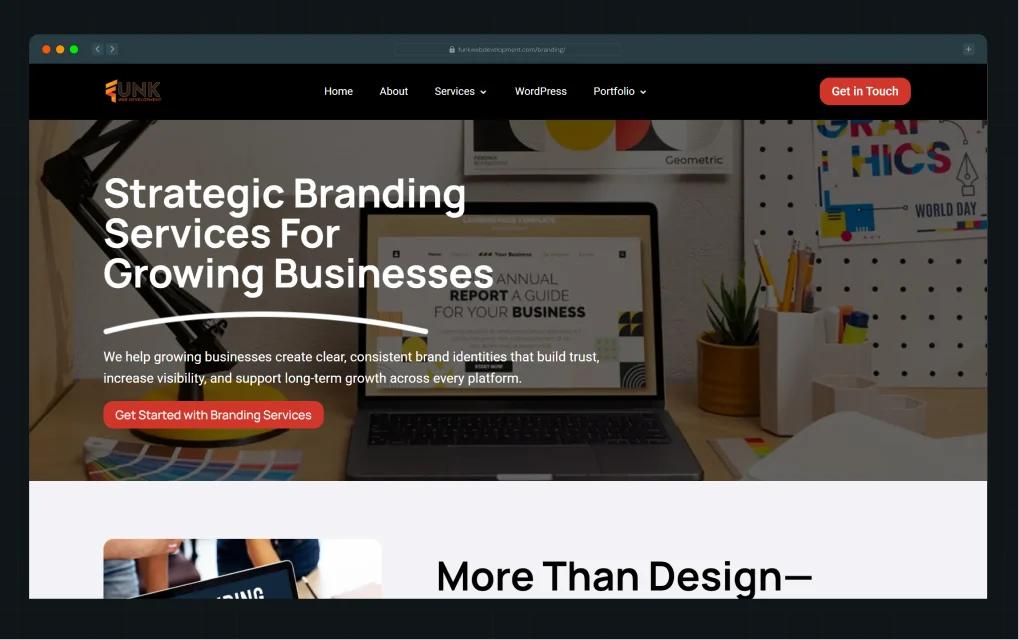
Best for: SaaS companies that need strong web execution and conversion-focused builds
As one of Florida’s best B2B branding agencies, Funk Web Development focuses on building custom websites that prioritize performance, usability, and business outcomes. Their work emphasizes responsive design, modern UX, and conversion-focused development to help companies generate leads and improve digital presence.
They align design decisions with measurable growth metrics such as traffic, engagement, and conversions, rather than purely aesthetic outcomes.
What they do well
- Build responsive, high-performance websites optimized for user experience
- Focus on conversion-driven design rather than just visual appeal
- Improve SEO, usability, and engagement through structured web development
- Deliver end-to-end web solutions aligned with business goals
Why they stand out
They prioritize performance and conversion outcomes, ensuring websites function as growth assets rather than static brand pieces.
5. Starmasa
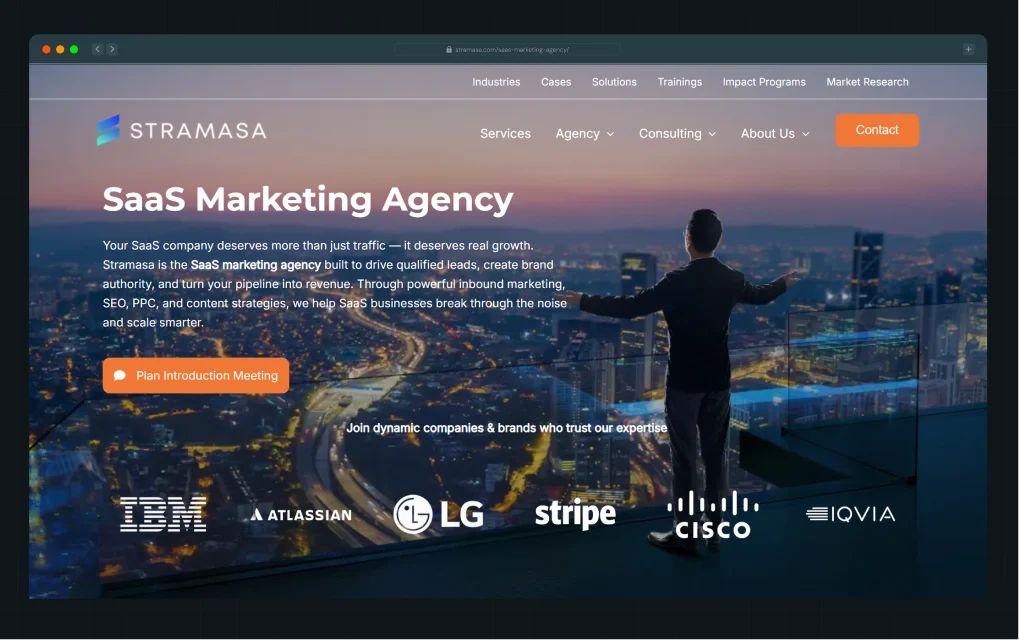
Best for: SaaS companies needing integrated web and branding support
Starmasa is a digital and branding-focused agency that blends web design, development, and marketing to help businesses build a strong online presence. Their approach centers on combining UX design, branding elements, and digital strategy to improve visibility and engagement.
Like many modern Florida agencies, they position websites as growth tools, integrating SEO, performance optimization, and user-centric design to support lead generation and long-term scalability.
What they do well
- Combine branding, UX, and development into unified digital experiences
- Focus on SEO and performance to drive visibility and growth
- Build scalable websites that support long-term digital strategy
- Align design with marketing and lead generation goals
Why they stand out
They bridge branding and digital execution, helping companies turn their website into a consistent growth channel.
Why "Florida Branding Agency" Matters Less Than You Think
Searching for a “Florida branding agency” is a reasonable starting point. But for SaaS companies today, geography plays a much smaller role than most people assume. This shift comes down to how work actually gets done now.
Brand strategy is no longer tied to a single office or location. Talent is distributed. By 2025, 74% of U.S. businesses operate in hybrid or remote models, with roughly 28% of roles are projected to be fully remote and another 44% hybrid. For SaaS, this change is even more pronounced.
SaaS has always been a global business. Your buyers are not local, your competitors are not local, and increasingly, neither is the talent building your brand. Whether your strategist sits in Miami or Austin has little impact on the quality of thinking.
What actually determines fit is much simpler, and much harder to fake.
- First, does the agency understand how B2B SaaS buyers think?
- Second, does their work move people closer to a decision, not just make the brand more memorable?
Those two filters will tell you more about an agency than its location ever will.
That said, working with a Florida-based agency still carries practical advantages, but they’re operational, and not strategic. Proximity can make collaboration easier, and regional pricing often reflects lower overhead compared to premium markets.
Florida itself has also become a more serious player in tech. Cities like Miami have continued to attract startups and capital post-2024, making the state a growing SaaS hub.
But even that momentum does not override the larger shift. Talent is distributed. Strategy is location-agnostic. For SaaS companies, choosing the right agency is less about where they are, and more about how they think.
How to Choose a Branding Agency (If You're a SaaS Company)
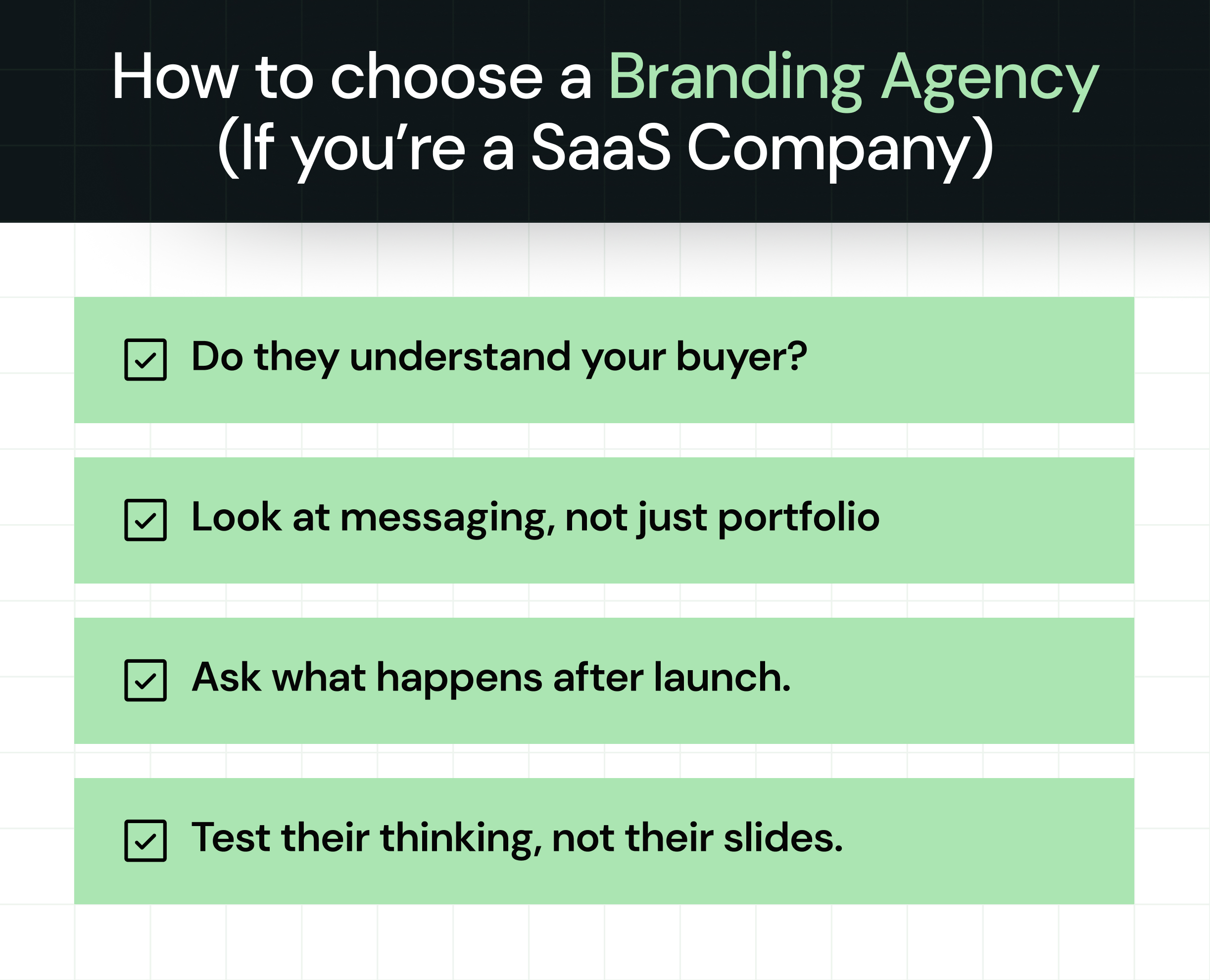
Getting on a call with the right agencies is only half the job. How you run that evaluation will tell you more than any pitch deck.
{{specficService}}
Do they understand your buyer?
Start with your buyer, not your product or category.
A strong agency should be able to explain how your buyers actually make decisions, including how they research options, who else gets involved, where deals tend to slow down, and what builds enough confidence to move forward.
If they cannot clearly articulate this, it becomes difficult for them to build a brand that fits into that decision process.
Look at messaging, not just portfolio
Most agencies lead with visual work, but that only tells part of the story.
Look deeper into how the work was developed. Ask for positioning documents, messaging frameworks, or brand narratives that show how the thinking was structured before design began.
When that layer is missing, the visuals often lack direction, which creates inconsistency when the brand is applied across different channels.
Ask what happens after launch
A brand only starts working once it is implemented across real touchpoints.
It helps to understand how the agency approaches handoff and rollout, especially across the website, sales materials, and product surfaces where most buyer interactions happen.
Without that clarity, execution tends to fragment over time as different teams interpret the brand in different ways.
Test their thinking, not their slides
One of the simplest ways to evaluate an agency is to bring a real problem into the conversation, such as a positioning challenge, a conversion issue, or a segment that is not responding as expected.
Pay attention to how they approach it. The questions they ask, how they structure the problem, and how they arrive at conclusions reveal far more than a polished presentation ever could.
And for some teams, this process leads to a different realization entirely.
After a few conversations, a pattern usually starts to emerge. Some agencies focus on how the brand looks, while others focus on how it performs within real buying situations. The difference becomes clear in how they talk about buyers, how they approach messaging, and how closely they connect brand work to actual growth outcomes.
Can a Branding Agency Actually Improve SaaS Conversions?
Yes, but only under specific conditions.
Branding contributes to conversion when a few fundamentals are in place:
- Positioning is specific enough to attract the right buyer, not just a broad market
- Messaging aligns with how buyers think at each stage of evaluation, from first touch to final decision
- The brand is applied consistently across every touchpoint, including website, sales, product, and customer experience
When these conditions are met, brand work stops being cosmetic and starts influencing how buyers understand, evaluate, and choose your product.
That is when it earns its budget.
Why Some SaaS Teams Choose ThunderClap Over Traditional Branding Agencies
By now, one thing should be clear.
Most branding agencies focus on execution first. They redesign websites, refresh logos, polish interfaces, and create cleaner marketing assets.
But branding, especially in B2B SaaS, rarely starts there.
The strongest B2B branding agencies emerge from a much deeper process of strategic thinking, creative exploration, and visual experimentation. Before you design a single landing page or interface, you need to define how buyers should perceive your company, what emotional signals your brand should communicate, and how your visual identity should express trust, sophistication, innovation, or category leadership.
At ThunderClap, we treat branding as a strategic exercise that shapes how buyers understand, evaluate, and remember your company.
We begin with brand audits, competitor analysis, positioning workshops, archetype exploration, and messaging discovery sessions. These exercises help us identify the gap between how your company currently presents itself and how it needs to position itself in the market.
From there, we move into visual exploration. We develop multiple moodboards, stylecapes, typography studies, color systems, visual references, and creative directions that push your brand into entirely new territories.
One direction may feel bold and disruptive. Another may lean editorial and premium. A third may focus on enterprise-grade structure and technical sophistication. Each direction explores a different interpretation of your company’s personality, positioning, and buyer perception.
We do not create these explorations because every visual decision answers a strategic question:
- Should your brand feel innovative or operationally reliable?
- Should your product appear highly technical or intentionally simplified?
- How can the visual system reduce buyer hesitation?
- What design language helps your company stand apart from competitors?
- How can the identity strengthen category leadership across every touchpoint?
Once we identify the strongest direction, we build a cohesive system around it. Typography, color, spacing, UI patterns, imagery, layouts, motion, and messaging all work together to reinforce a consistent perception across the buyer journey.
A strong example of this approach came through our work with roommaster PMS. After nearly three decades in the hospitality industry, roommaster had outgrown its existing identity. The challenge was to modernize the brand without losing the trust, familiarity, and SEO equity the company had built over the years.
We approached the rebrand with one core idea: reassurance. Through visual exploration across moodboards, typography systems, layouts, and interface directions, we created a calmer, more structured brand identity that felt modern while still familiar to hotel operators. After launch, the rebrand drove a 110% increase in organic traffic and an 80% increase in demo requests.
{{ctaBlock}}
FAQs
1. What makes a branding agency in Florida suitable for SaaS companies?
A Florida branding agency is a strong fit for SaaS when it prioritizes messaging and positioning over visual design. SaaS buyers evaluate tools through detailed comparison and multi-stakeholder review, so your brand needs to communicate value clearly and quickly.
2. Can a branding agency help improve SaaS conversions and growth?
A branding agency can directly improve SaaS conversions when the work goes beyond design. Clear positioning, buyer-aligned messaging, and consistent brand execution across your website, sales process, and product all contribute to moving prospects through a decision faster.
3. What are the benefits of working with a Florida-based branding agency?
Florida-based agencies offer competitive rates compared to coastal markets, proximity to a growing SaaS ecosystem across Miami, Orlando, and Fort Lauderdale, and teams that work within the same time zones as many of their clients.



.webp)
Browse Similar Articles

How to Turn Your B2B Website into a Self-Serve Growth Engine? (PLG Ready in 2026)

.svg)

9-Step Website Copy Audit Checklist to Improve Conversions (Examples from Top B2B Brands)
.webp)

How to Choose the Right Fintech Web Development Company for Your Business

Top B2B Website Design Principles That Turn Visitors into Qualified Leads
%20Audit%20That%20Actually%20Improves%20Revenue.webp)
How to Do a Conversion Rate Optimization (CRO) Audit That Actually Improves Revenue
Web Design Agency vs. Freelancer vs. In-House: What Actually Works in 2026
5 CRO Agencies in London and How to Choose the Best CRO Agency for Your Business
The Ultimate Fintech B2B Positioning Guide for 2026 (That Actually Drives Conversions)
Mapping the B2B Buyer Journey to Improve Conversions Across Every Touchpoint
.webp)
7 Best Website Maintenance Companies in India for Growth-Led B2B Teams (2026)

.webp)

8 Best Healthcare Website Design Agencies for HIPAA-Compliant Sites in 2026
How to Find the Best Web Design Company in Houston, Texas for B2B Brands (6 Best Picks)

Positioning That Wins: How to Make Complex B2B Products Clear and Compelling
The Step-by-Step Website Redesign Process B2B Teams Use to Increase Conversions (Without Killing SEO and Pipeline)
7 Best Video Production Agencies for SaaS Product Walkthroughs and Feature Videos
How to Choose the Best B2B Website Maintenance Company: 9 Questions to Ask Before You Hire One

How to Choose a Web Design Company in San Francisco in 2026 (with Examples)

10 Best Web Design Companies in Florida in 2026 and How to Choose the Right One
How to Use Brand Storytelling on Your Website to Close More B2B Deals and Build Buyer Trust
SaaS CRO Best Practices: What High-Growth Brands Do Differently to Win Conversions
How a Rebranding Agency Can Redefine Your B2B SaaS Identity and Boost Pipeline
B2B Marketing Trends in 2026 That Directly Influence Pipeline and Revenue

Top 7 Video Marketing Agencies Driving B2B SaaS Brand Awareness in 2026

Why Partnering with a B2B Brand Positioning Agency Accelerates Market Differentiation

The Complete Website Redesign Checklist for B2B SaaS Teams Ready to Scale
.avif)
10 Best Webflow Development Agencies in India for 2026 (In-Depth Review)

10 Product Marketing Companies Powering the Fastest-Growing SaaS Brands in 2026
Website Copywriting Services vs In-House: What's Right for Your Business?

How to Choose a Marketing Agency That Understands B2B SaaS Growth Metrics


How to Choose a Video Marketing Agency That Understands B2B Storytelling
Outsourcing Web Design: Cost-Benefit Analysis for Mid-Market & Enterprise Brands

From Leads to Lifetime Value: How Growth Marketing Agencies Scale SaaS Revenue
Build a B2B Website Strategy That Aligns with Sales and Marketing Goals
Webflow vs WordPress: Which Platform Is Better for Your Business Website in 2026?
Fintech Web Design That Builds Trust: 8 UX Principles Every Fintech Site Needs

Optimizing for Intent: How B2B Website Messaging and UX Changes Help Capture Top-Funnel Buyers


12 Best B2B Web Development Agencies in the US to Build Scalable Websites

From Audit to Action: 8-Step Process to Optimize Your B2B Website Strategy for 2026 Buyers
How to Design a High-Converting Landing Page from Scratch (2026 Edition)
From Click to Customer: Proven Landing Page Conversion Optimization Techniques

How to Write Website Copy That Converts: A Step-by-Step Guide for 2026

How to Optimize a Landing Page for Maximum ROI: A Step-by-Step Breakdown


AI Landing Pages That Convert: 7 Design Principles Every AI Platform Should Follow
From Traffic to Pipeline: B2B Website Growth Strategy for Scaling Teams
B2B Website Optimization Strategy: Speed, UX, SEO, and CRO in One Playbook




Interested in seeing what we can do for your website?



.webp)
