















The 6-Step B2B Brand Strategy Framework Built for Growth

.webp)

Most B2B companies sound exactly the same. For starters, your homepage probably has a headline somewhere along the lines of "AI-powered solutions for modern businesses." Or maybe "end-to-end platform built for scale." Something like that.
The problem is, every competitor says it too.
Most companies already have strong products. What they lack is a brand that makes a clear, memorable impression. In crowded markets, that kind of invisibility costs pipeline opportunities.
This is exactly what a brand strategy framework is designed to fix. It gives your business a clear positioning that helps buyers quickly understand who you are, why you exist, and why you are the obvious choice over every other tab they have open.
This guide walks you through exactly that, in six steps, with real examples from companies that have done it well.
TL;DR
- A strong brand strategy framework starts with emotional positioning before it touches visual identity, messaging, or design.
- Positioning only works when buyers instantly understand who you serve, what problem you solve, and why you are different in a way that matters.
- Storytelling systems like metaphors, visual language, motion, and illustration create the memory hooks that make brands impossible to forget.
- Brand strategy and GTM work as one system. When they align, brands convert faster, build trust sooner, and grow more predictably.
- The brands that win in crowded B2B markets are not always the ones with the best features. They are the ones buyers remember first.
Why Do Most B2B Brand Strategies Fail?
Before introducing the framework, we must address why so many B2B brand strategies fail. Failure rarely stems from a lack of effort. Rather, companies focus their energy on entirely the wrong variables.
Most brands communicate features, not perception
Most B2B companies overload their messaging with technical capabilities instead of building clear brand messaging that buyers instantly remember. This creates a critical mismatch.
Buyers already understand what the product does. However, they simply fail to remember the brand itself.
Research presented at Cannes Lions by LinkedIn’s Senior Director of Marketplace Innovation, Jann Schwarz, found that in 81% of B2B buying decisions, buyers already knew the winning brand at the start of the process.
“Almost everyone knew the brand at the start,” he said.
This matters even more today because buyers form opinions long before they ever speak to sales. In a recent post, B2B marketing operator Nick Bennett highlighted research showing that 81% of the buyer journey now occurs before a prospect speaks with a sales team.
His breakdown is worth reading because it shows how brand visibility and familiarity influence the pipeline long before attribution tools can measure it.
Conversely, an unfamiliar company only closes the deal in 4% of cases, even if the direct buyer likes the product. Brand recall directly determines which vendors get invited to pitch in the first place.
Trying to say everything weakens positioning
Many B2B brands try to talk about every feature, every audience segment, and every single use case, all at once. This chaotic approach overwhelms prospects. Buyers never walk away with a clear sense of what the company does best, so they leave with no lasting impression.
Strong positioning requires a deliberate trade-off. Companies must decide what to emphasize and what to leave out. A brand that tries to be everything to everyone inevitably means nothing to anyone. One sharp, specific, and memorable concept beats ten diluted corporate messages every time.
Strong brands create emotional association beyond the product
B2B founders frequently underestimate how much emotion goes into corporate purchases. Buyers make enterprise decisions based on feelings first, then they use logic to justify the choice later.
Research by Nobel Prize-winning psychologist Daniel Kahneman indicates that emotions drive roughly 90% of human choices. Furthermore, another research study of more than 70 enterprise software and services projects confirmed that emotional motivators played a significant role in decision-making. Elements such as trust, brand alignment, and fear of making a bad career move were the primary drivers of vendor selection for every account.
As Josh Ritchie, President of Strategic Partnerships at Column Five, pointed out in his LinkedIn post, buyers naturally lean toward brands that feel credible, familiar, and easy to defend internally.
The strongest B2B brands win by creating trust and credibility from the first interaction, not by having the longest feature list. When competing products look similar, emotional association becomes the key driver of buyer preference and loyalty.
The 6-Step Brand Strategy Framework for B2B Growth
The key features of a good brand strategy framework are positioning clarity, emotional differentiation, storytelling consistency, and GTM alignment.
Each step below builds on the previous one, from understanding how buyers see you, all the way to turning brand perception into pipeline.
Step 1: Start with market perception, not internal assumptions
Before you position anything, you need to understand how the market actually sees you.
Most companies start brand strategy from the inside out. They document their values, write their mission statement, debate their tagline, and broadcast it to a market that has already formed its own view. The result is a brand that feels internally coherent but lands as disconnected and generic to the buyers it is supposed to reach.
Real positioning starts from the outside in, which is why many companies now work with a dedicated B2B brand positioning agency before reworking their messaging. Talk to buyers to understand how they describe their problems, what alternatives they are considering, and what would make them switch. Then, validate those insights using:
- Sales call recordings
- Customer reviews on G2 and Clutch
- Reddit and community discussions
- LinkedIn conversations within your category
Increasingly, that research also happens through AI assistants and large language models. Buyers now ask tools like ChatGPT, Gemini, and Claude to compare vendors, explain categories, and recommend solutions before ever visiting a website. These systems form opinions based on the content, reviews, discussions, and brand signals available across the web.
Buyers also compare far more broadly than most companies assume. The average B2B buyer consumes 13 pieces of content before making a purchase decision. You're not only competing against direct competitors, but also agencies, internal teams, AI-powered alternatives, and the option of doing nothing at all. Your positioning has to win that broader comparison.
The strongest positioning often comes directly from customer frustration. When a buyer describes your product as "the one that actually makes our data usable," that language is more valuable than any tagline your team will craft in a workshop. It is how the market already thinks about you, and the job of positioning is to sharpen and own that perception before a competitor does.
Step 2: Define the emotional framework for brand positioning
Most B2B companies skip this step entirely, and it costs them everything downstream.
After doing their market research, they move straight to visual identity, including exploring logos, color palettes, and website design.
Nobody stops to ask the most important question first: How should this brand actually feel?
This assumption that B2B buying is purely rational continues to shape how many companies approach branding.
The emotional personality of your brand shapes everything that follows, from the tone of your sales deck to the motion design on your homepage, from the metaphors in your campaign copy to the illustration style in your investor pitch. Getting this right before execution begins is what separates brands that feel intentional from brands that feel assembled.
ThunderClap approaches this step by mapping brand personality across a set of defining spectrums.
At ThunderClap, we use a deliberate framework for brand positioning that anchors every creative decision that follows:
- Playful ↔ Serious
- Expressive ↔ Reserved
- Young and innovative ↔ Mature and classic
- Bold ↔ Trustworthy and credible
To illustrate this, let's look at two well-known technology brands that occupy very different positions on these spectrums: Stripe and Mailchimp.
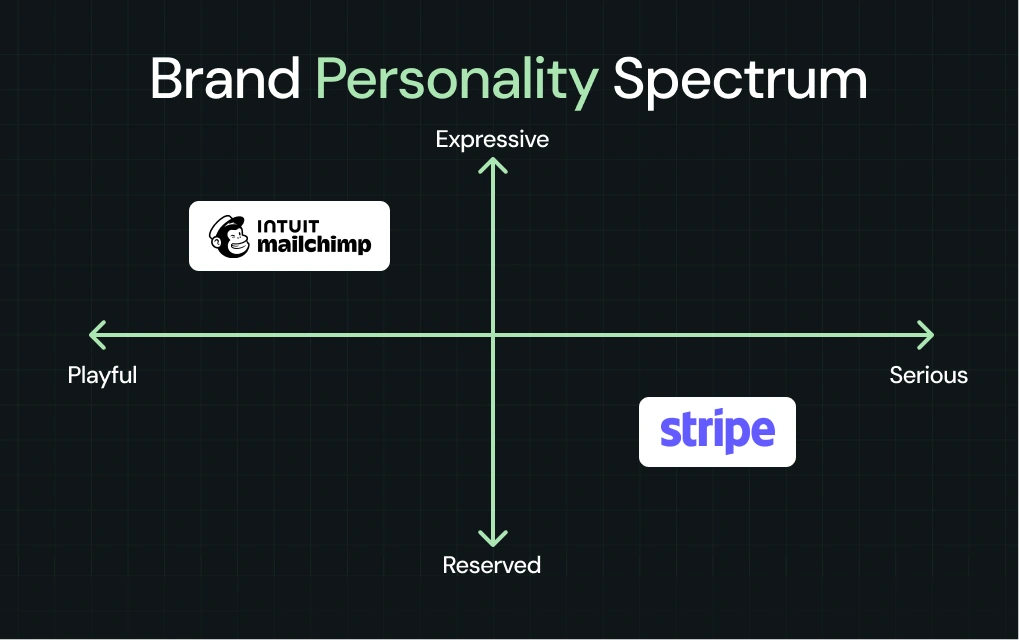
While both operate in the software space, Stripe is serious, reserved, and highly credible. Its minimalist visual system, technical precision, structured documentation, and understated brand voice build trust and competence.
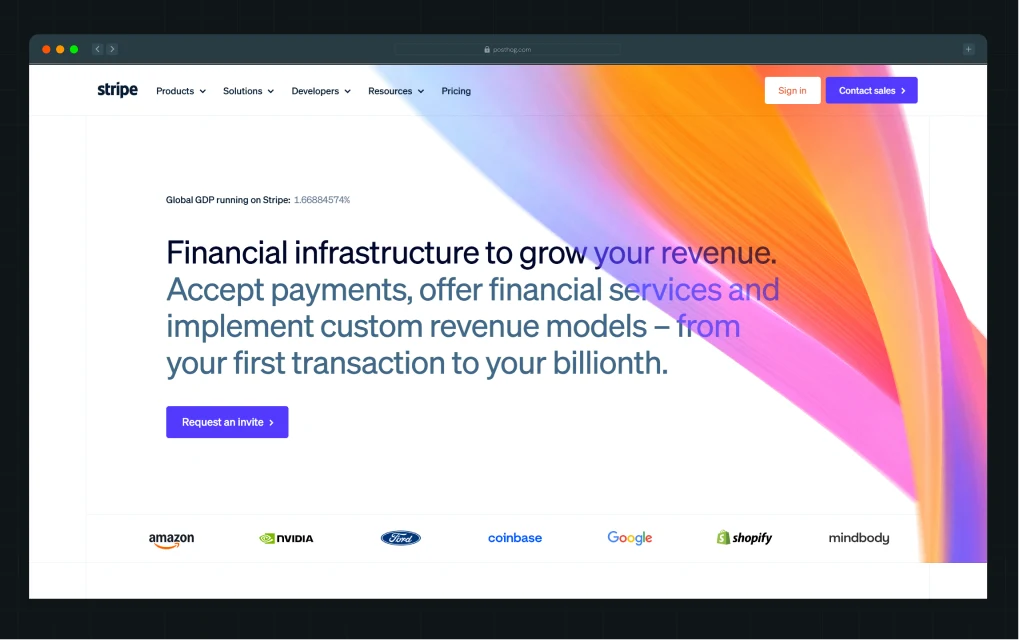

Neither approach is inherently better, but each is designed to create a specific emotional response from a specific audience.
This process creates alignment before a single visual asset is produced. Once the personality framework is defined, every team works from the same emotional brief, turning subjective discussions about "brand feel" into strategic decisions that shape a consistent brand experience.
As Sreeram Kayanadath, Senior Visual and Brand Designer at ThunderClap, explains:
"One thing we really believe in when it comes to B2B branding is that even enterprise decisions are emotional at first. People might compare features and capabilities later, but the first thing they respond to is perception. Does the brand feel trustworthy, clear, confident, modern and credible? That emotional reaction plays a huge role in how people remember and connect with a company."
In crowded B2B categories, functional differentiation rarely lasts. A competitor can match your feature set within a quarter. They cannot replicate how your brand makes buyers feel.
When ThunderClap partnered with WizCommerce, the company faced a deeper challenge than simple visual inconsistency. The brand identity had lagged behind the sophistication of the actual software. Both internal teams and external buyers felt a disconnect because the marketing did not match the product's power.
We built a fresh visual direction to support the new positioning goals. We also developed a structured system that streamlined internal workflows and enabled buyers to grasp the product's value instantly.
The deliverables included:
- Brand exploration assets, focusing on extensive moodboarding, typography, color palettes, and identity iterations
- A comprehensive design system, built with scalable UI components and clear style guides
- A full suite of marketing and sales assets, covering social media templates, pitch decks, video graphics, event banners, product cards, and virtual backdrops
During the LinkedIn launch, ThunderClap founder Ayush Barnwal noted in his LinkedIn post that this project marked the exact moment the brand finally caught up with the product.
Defining the emotional personality before starting the creative execution made every subsequent design choice fall naturally into place.
Step 3: Create positioning buyers can instantly understand
Strong positioning should answer three questions within the first ten seconds of any buyer interaction:
- Who is this for?
- What problem does it solve?
- Why is it genuinely different from every other option available?
If your homepage needs a paragraph to explain what you do, your positioning is working too hard and doing too little, something many SaaS companies discover before pursuing a full rebranding agency engagement.
Weak positioning forces buyers to interpret, while strong positioning makes interpretation unnecessary. In a market where the average buyer evaluates multiple vendors simultaneously, comparing landing pages in browser tabs and scanning decks between meetings, the brand that communicates with the most clarity wins the cognitive shortlist.
Here’s the difference between generic messaging and the kind of positioning used by high-performing leading B2B branding agencies:
A strong USP needs to survive comparison. If a competitor can say the exact same thing, it is a category description.
Real positioning is ownable and specific, creating recall without requiring explanation. It should feel like it could only describe one company in the world, yours.
When Zamp, a sales tax compliance platform, partnered with us, they were competing in a crowded market dominated by massive, well-funded incumbents like Avalara and TaxJar. Zamp possessed a genuinely excellent product with 99.9% filing accuracy, a two-hour onboarding process, and lightning-fast support response times.
However, the existing brand lacked the confidence to communicate those strengths effectively.
We rebuilt the brand from scratch to reflect the software's true quality. In fact, we focused on several core updates:
- A complete positioning overhaul anchored around three distinct pillars, which highlighted Zamp's owned data, elite accuracy, and in-house tax experts
- Targeted messaging built specifically to resonate with corporate finance leaders and key decision-makers
- A reorganized website architecture featuring persona-driven user paths that naturally guided visitors toward booking a demo
- A premium visual identity utilizing clean typography hierarchy and balanced visual elements
- Transparent pricing and managed-service highlights placed directly on the front page to establish trust early
The strategy succeeded because Zamp now looks and sounds like a legitimate category leader. Backed by more than $30 million in funding and top G2 rankings, the updated brand gives buyers a clear reason to trust the company before they ever jump on a sales call.
Step 4: Build a storytelling system people actually remember
Strong B2B brands stand out from forgettable ones during this phase of the process, and the shift has very little to do with simply writing better copy.
Powerful B2B brand storytelling brings together metaphors, visual language, illustration styles, motion design, imagery, and interaction patterns. All of these elements tie back to a single central idea that buyers associate with your brand alone.
The strongest B2B brands usually build their identity around a central metaphor. This concept should naturally describe what the product does while capturing how the buyer feels about the future of their business.
As Sreeram explains:
"A lot of ideas can actually be communicated metaphorically through illustrations, visual systems, imagery, motion, and overall brand language that the company can uniquely own. Those elements create a much stronger sense of recall and help the brand stand out in a market where most competitors visually and verbally communicate in the exact same way."
This approach highlights the structural difference between a brand people remember and one they scroll past. Buyers do not lack information. They lack meaning. A comprehensive storytelling system gives your brand meaning that sticks.
Factors.ai provides a great example of this narrative shift in action. Before partnering with us, the Factors.ai website described the product in generic software terms like dashboards, integrations, buyer signals, and attribution. The copy was technically accurate but emotionally flat. The brand felt like one of dozens of analytics platforms, giving buyers no compelling reason to remember it.
We anchored the entire rebrand around a single central concept, the Marketing Compass. This metaphor acted as a watchtower, giving marketing teams clarity, direction, and visibility in a world where buyer data is fragmented and campaign attribution is incredibly difficult.
That central idea expanded into the full visual system through several key updates:
- Watchtower-inspired architectural elements and directional visual motifs integrated across the website
- A sharp, emotionally resonant homepage headline that read, "Know how your buyers move. Run campaigns that win."
- Connected design touchpoints that appeared consistently across all brand language and marketing collateral
As Kiran Kulkarni, Partner & Head of Growth at ThunderClap, shared on LinkedIn, the Factors rebrand was a full-circle moment:
The project delivered much more than a simple aesthetic upgrade. Factors.ai now commands a brand narrative that buyers connect with, a visual identity they remember, and a positioning story that makes the product feel like the obvious choice in its category.
Step 5: Make the brand feel consistent across every touchpoint
True consistency has very little to do with simply slapping the same logo on every slide. Instead, it creates the same emotional perception every single time a buyer encounters your company.
Strong brands feel intentional everywhere. Weak brands look like they were built by different teams over several years without a shared plan. This fragmentation forces buyers to work harder to trust you because your company feels internally disorganized.
Data highlights the financial impact of this disconnect. In fact, a Deloitte survey found that consistent brand experiences reduce customer acquisition costs by 27%.
Your core metaphor and emotional positioning must shape every layer of execution:
- Website copy, structure, and information hierarchy
- Sales decks and marketing collateral
- Motion design, animations, and visual interactions
- Social content, campaign messaging, and paid ads
- Product UI language and user onboarding
- Customer success communications and email sequences
When buyers encounter the same personality across your website, emails, and product interface, they stop questioning your credibility. Repeated, coherent exposure helps trust grow from a fleeting impression into a deep conviction. In long B2B sales cycles involving multiple stakeholders, that accumulated trust becomes your biggest commercial advantage.
{{specficBlog}}
Step 6: Turn brand strategy into GTM leverage
A brand framework that sits in a Notion document without touching your pipeline is just expensive documentation. The real value of brand strategy appears when it changes how buyers move through your go-to-market funnel, from initial awareness to final purchase.
For example, strong positioning reduces the effort required to explain what your company does and why it matters. Clear messaging helps prospects understand their fit faster, allowing sales conversations to focus on solving problems rather than establishing credibility. Consistent brand experiences across campaigns, websites, and sales materials strengthen trust at every stage of the buyer journey.
When a prospect sees the same message reflected in an ad, a landing page, a product demo, and a sales presentation, confidence builds faster because the brand feels coherent and reliable.
As Sreeram puts it:
"Branding is not just about making things look good visually; it directly affects how people perceive, trust, and remember a company across the entire funnel. When the storytelling, visuals, and positioning become memorable and emotionally distinctive, people tend to connect with the brand faster and remember it much longer."
Brand Strategy vs. Branding: What Is the Actual Difference?
These two terms often get used interchangeably, but treating them as equivalent frequently causes B2B brand projects to fail.
Think of it this way: strategy is the brief, and branding is the execution. If the brief is wrong, even the most polished execution misses the mark. Strategy defines what your brand means, who it is for, and why it matters in its category. Branding gives that meaning a face, a voice, and a visual system.
The table below breaks down how these two disciplines divide the work:
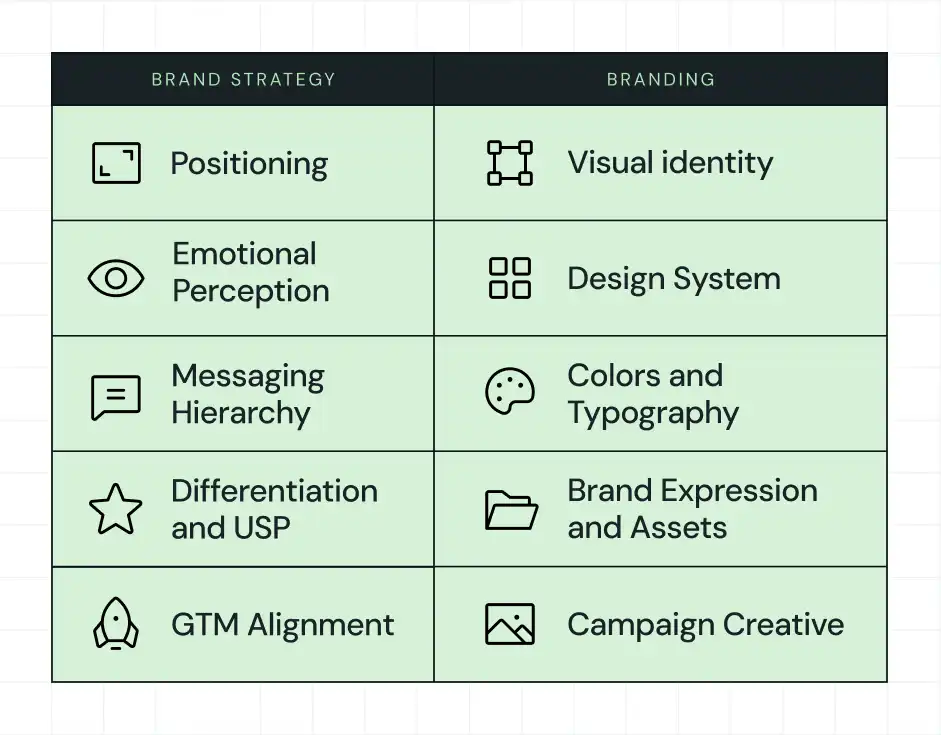
Both disciplines are necessary, but they must happen in the right order. Beautiful designs built on a weak strategy will fail with buyers. The visuals might catch their eye, but a lack of real substance will make them leave.
Conversely, starting with a strong strategy and weaker visuals is much easier to fix. The foundation is already there, so the look just needs to catch up. That is a much simpler fix than starting over because you built the brand backward.
Also read: 11 Most Asked B2B Brand Strategy Questions Answered
How ThunderClap Operationalizes This Framework
ThunderClap views brand strategy as a connected system where each decision shapes the next. The framework above reflects how we build brands across client projects.
1. We start with emotional perception before visual execution
We establish trust, recall, and emotional connection before anyone opens a design file. Our team maps the brand personality, analyzes competitor perception, and defines the core positioning well before launching creative execution.
This specific order separates a deeply memorable brand from a polished look that lacks surface-level differentiation.
2. We build brands around central narrative systems
The most memorable brands we have built, from Factors.ai's Marketing Compass to Zamp's precision-first positioning to WizCommerce's scalable brand system, share one structural characteristic: a central metaphor or narrative idea that holds the entire identity together.
This central idea guides everything from messaging to motion design. It creates a conceptual anchor that competitors cannot copy simply by updating a color palette.
3. We treat storytelling, positioning, and GTM as one connected system
Finally, we treat brand strategy, storytelling, and go-to-market execution as the exact same conversation. Every brand decision considers downstream GTM results. Our team tracks how a positioning shift impacts sales calls, how storytelling affects ad campaigns, and how consistency speeds up conversions across the funnel.
The companies that win in crowded B2B markets rarely differentiate through feature volume alone. They win through recall, trust, and positioning. In B2B sales, earning that initial recall secures the meeting, the shortlist, and the deal.
Ready to build a brand buyers remember?
If your brand identity is lagging behind the sophistication of your product, let's fix it.
{{ctaBlock}}
FAQs
1. What is a B2B brand strategy framework?
A B2B brand strategy framework is a structured system that outlines how a company positions, differentiates, and communicates itself to the market. This structured system builds directly from initial market perception to pipeline impact, organizing messaging and growth goals into a clear sequence.
2. What is brand positioning in a B2B strategy?
Brand positioning dictates how buyers view your company compared to your competitors. Effective B2B positioning clearly states who you serve, what problem you solve, and why buyers should choose you over anyone else. If a competitor can copy your statement, you have a category description instead of unique positioning.
3. What are the key features of a good brand strategy framework?
A strong brand strategy framework combines positioning clarity, emotional differentiation, a central storytelling system, cross-touchpoint consistency, and direct alignment with GTM strategy. The process treats these elements as a single, unified system rather than as isolated files owned by different teams.
4. What is the difference between brand strategy and branding?
Brand strategy defines your company's meaning, perception, and market position. Branding builds the visual and verbal look based on that plan. Strategy must come first because beautiful designs without a strategic foundation fail to build emotional recall during a buying cycle.
5. How long does it take to build a B2B brand strategy?
It depends on the depth of your research, stakeholder alignment, GTM complexity, and the maturity of your current positioning. Most B2B brand strategy projects run for several weeks to a few months. Compressing the market research and emotional positioning phases often results in work that needs to be rebuilt once the company scales or enters a new market segment.
6. How does brand strategy connect to GTM and revenue growth?
When brand positioning is clear and emotionally resonant, sales conversations start from a position of trust rather than explanation. Demand generation performs better because the brand behind the campaign already carries weight. A strong strategy accelerates every commercial metric, lowering customer acquisition costs and driving higher conversion rates across the funnel.



.webp)
Browse Similar Articles




Leading 5 SaaS Branding Agencies in Florida (That Actually Understand SaaS Growth)

.svg)

How to Turn Your B2B Website into a Self-Serve Growth Engine? (PLG Ready in 2026)

9-Step Website Copy Audit Checklist to Improve Conversions (Examples from Top B2B Brands)

.webp)

How to Choose the Right Fintech Web Development Company for Your Business
Top B2B Website Design Principles That Turn Visitors into Qualified Leads
%20Audit%20That%20Actually%20Improves%20Revenue.webp)
How to Do a Conversion Rate Optimization (CRO) Audit That Actually Improves Revenue
Web Design Agency vs. Freelancer vs. In-House: What Actually Works in 2026
5 CRO Agencies in London and How to Choose the Best CRO Agency for Your Business
The Ultimate Fintech B2B Positioning Guide for 2026 (That Actually Drives Conversions)
Mapping the B2B Buyer Journey to Improve Conversions Across Every Touchpoint
.webp)
7 Best Website Maintenance Companies in India for Growth-Led B2B Teams (2026)


8 Best Healthcare Website Design Agencies for HIPAA-Compliant Sites in 2026


How to Find the Best Web Design Company in Houston, Texas for B2B Brands (6 Best Picks)

Positioning That Wins: How to Make Complex B2B Products Clear and Compelling
The Step-by-Step Website Redesign Process B2B Teams Use to Increase Conversions (Without Killing SEO and Pipeline)

7 Best Video Production Agencies for SaaS Product Walkthroughs and Feature Videos

How to Choose the Best B2B Website Maintenance Company: 9 Questions to Ask Before You Hire One


How to Choose a Web Design Company in San Francisco in 2026 (with Examples)

10 Best Web Design Companies in Florida in 2026 and How to Choose the Right One
How to Use Brand Storytelling on Your Website to Close More B2B Deals and Build Buyer Trust

SaaS CRO Best Practices: What High-Growth Brands Do Differently to Win Conversions

How a Rebranding Agency Can Redefine Your B2B SaaS Identity and Boost Pipeline
B2B Marketing Trends in 2026 That Directly Influence Pipeline and Revenue

Top 7 Video Marketing Agencies Driving B2B SaaS Brand Awareness in 2026
Why Partnering with a B2B Brand Positioning Agency Accelerates Market Differentiation

The Complete Website Redesign Checklist for B2B SaaS Teams Ready to Scale
.avif)
10 Best Webflow Development Agencies in India for 2026 (In-Depth Review)

10 Product Marketing Companies Powering the Fastest-Growing SaaS Brands in 2026
Website Copywriting Services vs In-House: What's Right for Your Business?


How to Choose a Marketing Agency That Understands B2B SaaS Growth Metrics


How to Choose a Video Marketing Agency That Understands B2B Storytelling

Outsourcing Web Design: Cost-Benefit Analysis for Mid-Market & Enterprise Brands

From Leads to Lifetime Value: How Growth Marketing Agencies Scale SaaS Revenue
Build a B2B Website Strategy That Aligns with Sales and Marketing Goals

Webflow vs WordPress: Which Platform Is Better for Your Business Website in 2026?
Fintech Web Design That Builds Trust: 8 UX Principles Every Fintech Site Needs

Optimizing for Intent: How B2B Website Messaging and UX Changes Help Capture Top-Funnel Buyers


12 Best B2B Web Development Agencies in the US to Build Scalable Websites

From Audit to Action: 8-Step Process to Optimize Your B2B Website Strategy for 2026 Buyers
How to Design a High-Converting Landing Page from Scratch (2026 Edition)

From Click to Customer: Proven Landing Page Conversion Optimization Techniques

How to Write Website Copy That Converts: A Step-by-Step Guide for 2026


How to Optimize a Landing Page for Maximum ROI: A Step-by-Step Breakdown


AI Landing Pages That Convert: 7 Design Principles Every AI Platform Should Follow
From Traffic to Pipeline: B2B Website Growth Strategy for Scaling Teams


B2B Website Optimization Strategy: Speed, UX, SEO, and CRO in One Playbook




Interested in seeing what we can do for your website?



.webp)
