














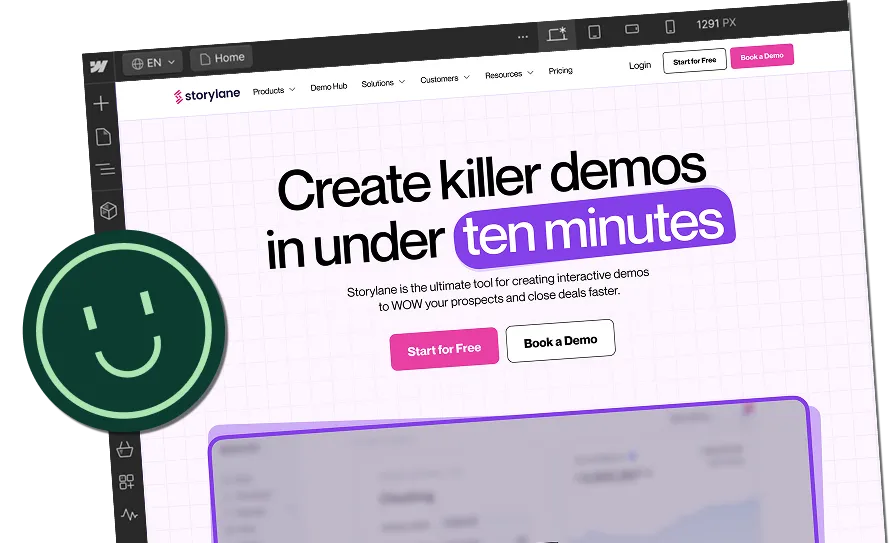

8 Best Web Development Companies in Texas for a B2B SaaS Brand


TL;DR
- SaaS websites fail when they can’t scale, adapt, or convert. Users leave confusing sites, slow pages, or unclear messaging.
- ThunderClap builds B2B SaaS websites that handle growth, CMS updates, integrations, and performance without slowing your team down.
- We combine scalable architecture, maintainable code, and SEO-ready performance to create websites that retain users and drive demos.
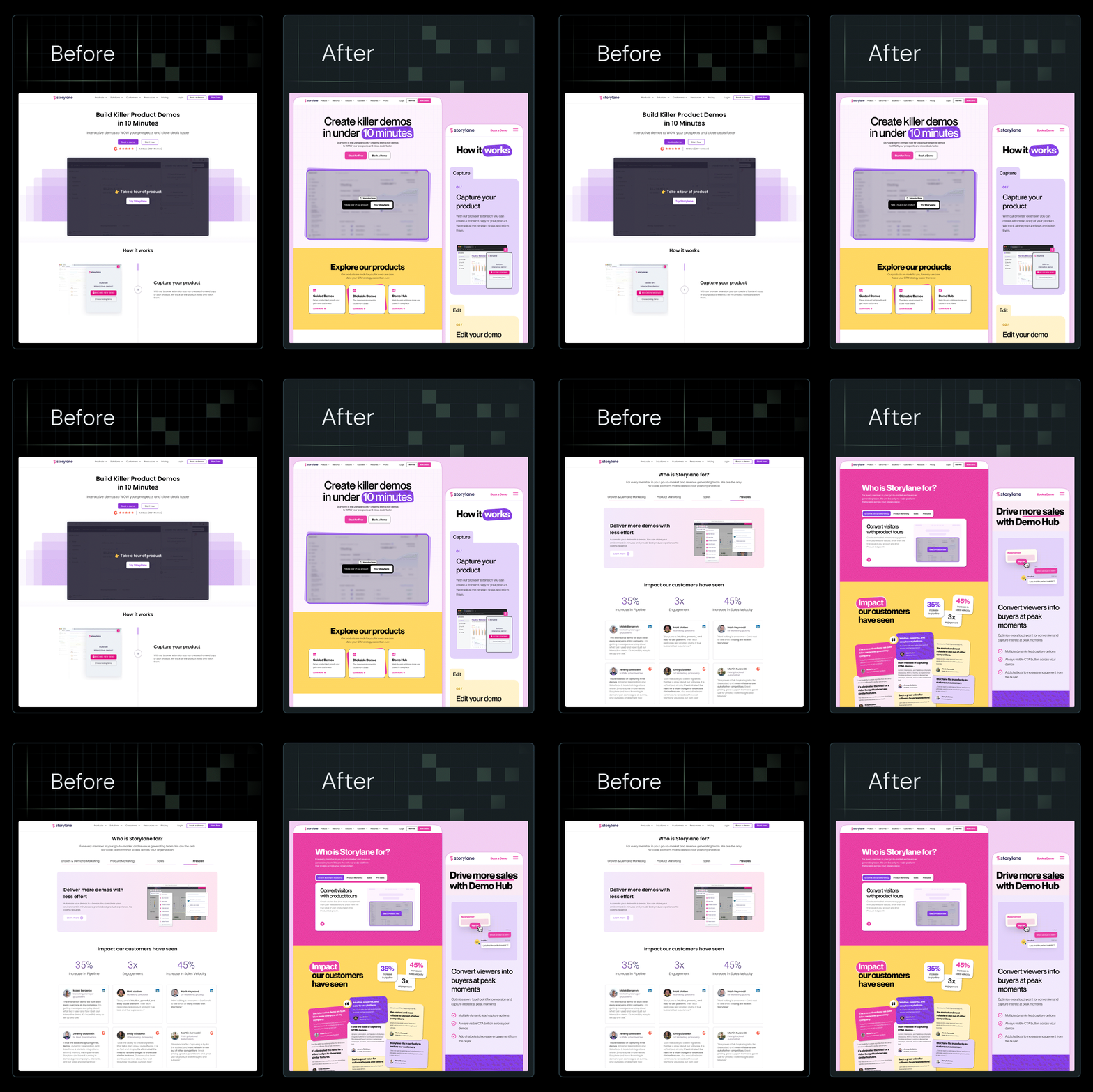
- Our work with Amazon, Storylane, Factors, Roommaster, ClearlyRated, Z47, Zenda, Zamp, Dropit, Wizcommerce, DPDZero and other SaaS brands shows that technical depth plus thoughtful UX drives measurable business growth.
- Plenty of agencies can make a site look pretty. ThunderClap builds websites that act like your most reliable growth engine.
If you’ve seen The Social Network, you know how fast things can go sideways when the wrong people are involved. Not the lawsuits part, hopefully, but the part where building something good suddenly gets complicated. Yes, we’re talking about when Eduardo realizes the Winklevoss deal isn’t going to pan out, and Mark is already five steps ahead!
That’s pretty much what picking a dev partner feels like for a SaaS brand. On paper, a lot of teams look great. Scalability, clean code, user-first design, all of that. Then the work starts, and things get slow, messy, or just… off. Which is why more founders are quietly looking at web development companies in Texas.
Over the past couple of years, Texas has become one of the fastest-growing tech ecosystems in the U.S. Cities like Austin, Dallas, and Houston are no longer “emerging” but are actively competing with traditional hubs. In fact, Austin alone accounted for nearly half of Texas companies on Deloitte’s 2025 high-growth tech list, driven largely by software and SaaS innovation.
At the infrastructure level, the shift is even bigger. Texas is now leading a massive wave of AI and cloud infrastructure expansion, with the state expected to host a significant share of new hyperscale data center capacity in the coming years.
If you’d rather skip the trial-and-error phase, here are 8 web development companies in Texas that are actually worth a look.
What B2B SaaS Companies Actually Need From a Web Development Agency
Most web projects still start with the wrong question: “How should this site look?”
But high-performing SaaS teams ask something else entirely: “How will this site scale, adapt, and convert over time?”
See the difference? One focuses on colors and fonts; the other focuses on results, growth, and keeping your users coming back. This means teams build websites that actually scale, adapt, and convert.
There are a few reasons SaaS founders are paying attention to web development companies in Texas.
- Deep SaaS & cloud expertise: Texas firms are building for cloud-native, API-first, and AI-assisted products by default, aligning with modern SaaS needs.
- Builder mindset over buzzwords: Especially in hubs like Austin, teams are known for practical, product-focused execution. Less theory, more shipping.
- Strong talent pipeline (without Bay Area costs): Developers in Texas report high satisfaction despite lower salary benchmarks, largely due to cost-of-living advantages, which directly impact agency pricing and retention. For example, Texas web designers earn about $84,453 annually, with 88% satisfaction, compared with $102,067 in New York (69% satisfaction) and $106,346 in California (85% satisfaction).
Here’s a quick snapshot of what they actually need from a web development agency:
Now, let’s break each one down with examples, stats, and real-world case studies.
Scalable website architecture
Most SaaS websites do not fail because they cannot handle traffic. They fail because they cannot handle change.
As new features roll out, messaging shifts, and integrations expand, what started as a simple structure quickly becomes difficult to navigate. This is where user experience starts to break down, and the impact is immediate. According to Clutch, 49% of consumers will leave a website if the navigation feels confusing.
High-performing SaaS teams approach architecture as a long-term system rather than a collection of pages. They design structures that can support multiple product lines, evolving positioning, and integrations with tools like CRM platforms, analytics systems, and marketing automation software, without forcing constant rebuilds.
You can see the difference when comparing modern SaaS websites to older enterprise platforms, where users often have to click through multiple layers just to understand what the product actually does.
Clean, maintainable code
Texas is increasingly seen as an entry point for emerging design and development talent, with a large share of early-career web designers and a rapidly expanding ecosystem in cities like Dallas–Fort Worth and Austin (which has earned the nickname 'Silicon Hills,' rivaling California's Silicon Valley).
In fast-growing markets like this, strong engineering systems become especially important to ensure consistency as teams scale. A beautiful frontend means nothing if the backend is fragile.
Messy code slows down updates, creates dependency on developers, and builds technical debt that increases over time. And it directly impacts perception. In fact, 28% of users judge a website’s credibility almost immediately. Plus, broken interactions or inconsistent behavior break trust faster than bad design.
Hence, a strong web development agency in Texas should focus on:
- Structured, readable codebases
- Systems that marketing teams can update without friction
- Long-term stability instead of quick fixes
Our work with Wizcommerce illustrates how this approach translates into real impact. Wizcommerce offers AI-assisted sales tools, B2B storefronts, and ERP integrations. When we started, their platform suffered from fragmented systems, outdated tools, and messaging that did not align across teams.
We worked closely with leadership, marketing, and product teams to map buyer journeys and identify operational gaps. Then, we rebuilt the platform to clearly communicate their value to audiences such as business owners, sales leaders, and operations teams.
Ultimately, we delivered a structured, scalable system that reduced friction for internal teams and made the product easier to understand and adopt.
Ayush Barnwal from ThunderClap shares the launch video of the revamped WizCommerce website in his latest LinkedIn post.
CMS and flexibility for marketing teams
Your marketing team should never feel chained to a developer. That means a modern SaaS site needs easy content updates, the ability to create landing pages, and fast iteration cycles.
This is why SaaS companies are increasingly moving toward headless and composable CMS platforms, a shift driven by the need for speed, flexibility, and simpler workflows. According to recent research, 61% of teams still use multiple CMSs to manage content across platforms or regions, but last year also saw a 20% rise in companies consolidating into a single CMS to reduce maintenance overhead and streamline operations.
Modern CMS tools now allow marketers to build and update pages visually, reuse components across campaigns, and publish content across multiple channels without engineering support. Platforms like headless CMSs are designed specifically to reduce dependency on dev cycles and improve time-to-market for campaigns.
In practice, this means faster launches, quicker messaging testing, and greater control for marketing teams without slowing down product or engineering teams.
Performance and technical SEO readiness
A beautiful website is useless if no one can find it or if it frustrates visitors. Development should support fast load speeds, mobile responsiveness, and a clean site structure for SEO.
And this ties directly to credibility. For example, 32% won’t trust a site if they can’t tell who’s behind it, so your “About Us” page and mission statement aren’t optional.
Performance and SEO are part of trust. If your site loads quickly, works everywhere, and makes sense to both humans and search engines, users stick around. That’s the difference between a site that just exists and one that actually drives demos, trials, and revenue.
8 Best Web Development Companies in Texas for B2B SaaS Brands
We reviewed more than 50+ web development companies across Texas, analyzed their case studies, read client feedback, and studied how they handle architecture, integrations, and scalability.
After drawing our conclusions, these are the 8 web development companies we actually trust to build B2B SaaS websites that scale, perform, and drive growth in 2026.
1. ThunderClap
.webp)
Best for: B2B SaaS and enterprise companies seeking scalable websites with high conversions and maintainable systems
ThunderClap is a premium web development agency with offices in India and a reputation for award-winning work, including Webby and CSS Awards. The team has a proven track record of serving B2B brands such as Amazon, Storylane, Factors, Roommaster, ClearlyRated, Z47, Zenda, Zamp, Dropit, Wizcommerce, and DPDZero.
They provide end-to-end web design and development services, covering strategy, branding, UI/UX design, copywriting, conversion rate optimization (CRO), web development, website migrations, and ongoing maintenance.
What is it best for?
- Website design and development: ThunderClap has managed 129+ enterprise-grade projects and, as a certified WebFlow enterprise partner, has access to exclusive features and ongoing training to stay on top of the platform’s best practices.
- 30-day post-launch support: Clients receive 30 days of free post-launch support. During this period, ThunderClap implements CRO and SEO best practices to optimize site performance and conversions.
- Structured, senior-led oversight: Each project is personally managed through a dedicated account manager, supported by account directors, ensuring clear communication, reduced back-and-forth, and reliable execution throughout the lifecycle.
- 24/7 support: Clients get around-the-clock support via Slack, with full visibility into progress through tools like Notion for project management.
- Scalable designs and competitive timelines: ThunderClap delivers aesthetically pleasing, reusable design systems, with most projects completed in 8 to 12 weeks, balancing speed and quality.
Notable clients
With 144+ websites launched and 10+ industry awards, ThunderClap demonstrates both category expertise in SaaS, fintech, and AI, and cross-industry capability in consulting, commerce, and B2B services.
Their work has helped clients:
- Increase conversions by up to 50%
- Boost engagement by up to 60%
Some of its clients include Storylane (the 6th-fastest-growing SaaS on G2), ClearlyRated (top 500 U.S. SaaS per Inc.), and Deductive AI (raised a $10M seed round). ThunderClap’s projects consistently propel brand professionalism, engagement, and funding success.
2. Devox Software
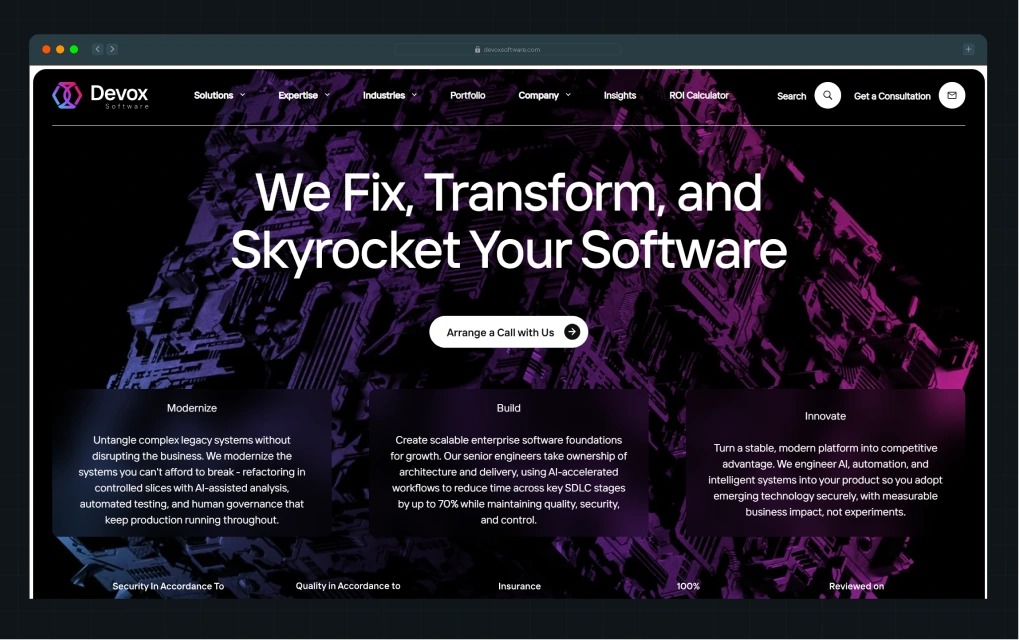
Best for: Startups and enterprises looking for full-cycle web development, custom solutions, and flexible team scaling
Devox Software is a web development company in Texas offering full-cycle development services, from discovery to deployment and maintenance.
They also provide outsourcing options, allowing companies to quickly scale teams or hire dedicated developers based on project needs.
What is it best for?
- Full-cycle development approach: Covers everything from discovery and architecture planning to testing, deployment, and long-term maintenance
- Flexible team scaling: Offers ready-to-go teams and hiring options within 2–4 weeks for faster project kickoff
- Diverse tech expertise: Works across multiple stacks, including MERN, LAMP, .NET, Python, Angular, React, and cloud platforms
- Strong QA and security focus: Uses comprehensive testing methods and follows strict data security, NDA, and compliance practices
Notable clients
CURE Media, Ferretly, Eurolinx, Active Place, Magma Trading, Optherium, Function4, Lexplore, Stromcore
3. Ariel Digital
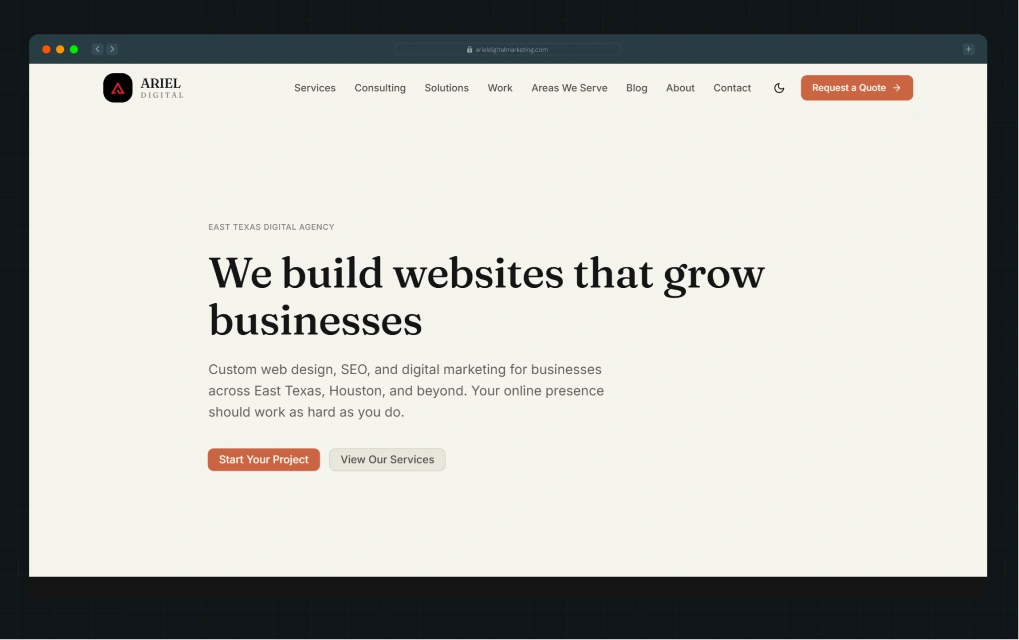
Best for: Businesses building custom web apps, SaaS products, or internal tools tailored to specific workflows
As a Texas-based web development company, Ariel Digital specializes in custom web applications, SaaS products, and mobile apps.
Their services include custom web apps, SaaS development, mobile applications, API development, and system integrations, as well as end-to-end support from discovery through post-launch scaling.
What is it best for?
- Custom-built solutions: Tailored apps designed around specific workflows and business needs
- SaaS product development: From MVP to full-scale platforms with billing, user management, and infrastructure
- Integration-focused builds: APIs and system integrations that connect tools and automate workflows
- Agile development approach: Iterative sprints with continuous feedback and faster time to market
Notable clients
Tyler County Hospital, JEDCO, Olympian Properties, Squeaky Clean Maid Service
4. Roars Technologies
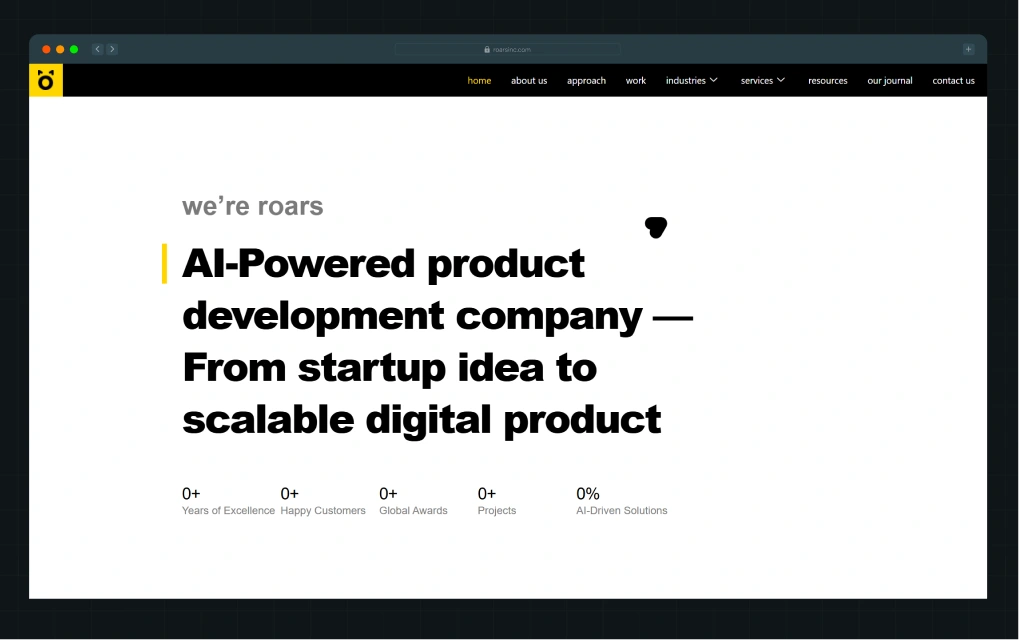
Best for:
With 19+ years of experience, Roars Technologies is a product development company known for building scalable digital products across SaaS, healthcare, eCommerce, and more.
They focus on AI-driven solutions, UX-led development, and end-to-end execution from idea to launch.
What is it best for?
- AI-powered product development: Builds intelligent, scalable digital products with AI-driven capabilities
- MVP to scale: Takes products from early-stage prototypes to full-scale platforms
- UX-led development: Uses research and user experience principles to guide product decisions
- End-to-end execution: Covers everything from strategy and design to development and deployment
Notable clients
GymBait.ai, Gypsy, Onus, Company Guru, Parqly
{{specficBlog}}
5. GLIDE Design
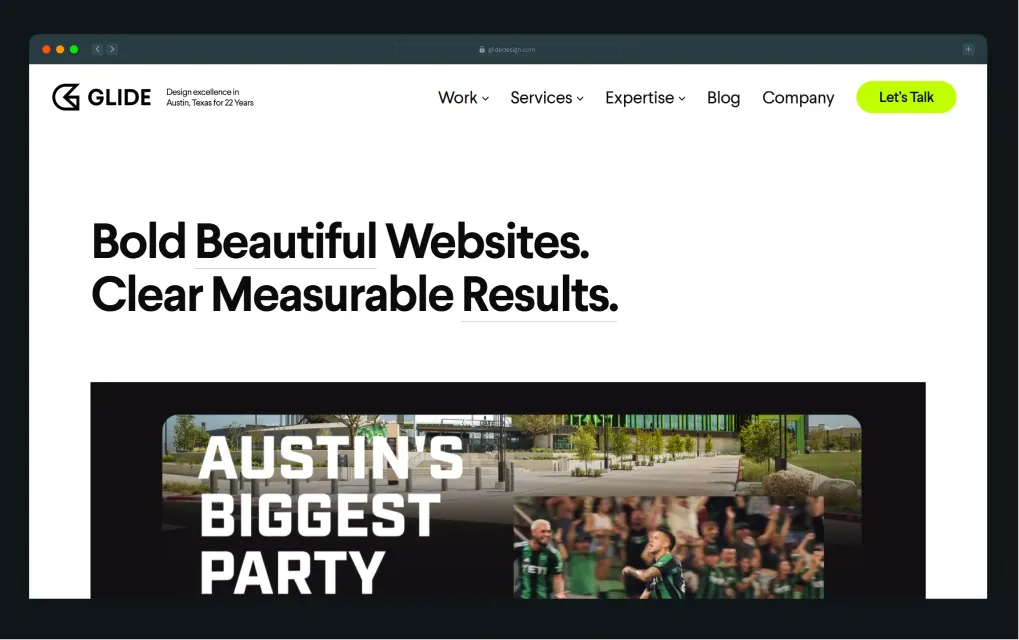
Best for: B2B organizations and enterprises looking for high-performing, content-driven websites with strong CMS flexibility
Known for building high-performing, easy-to-manage websites, GLIDE Design combines development, content, and SEO into a single workflow.
Their work often involves rebuilding outdated systems, streamlining content, and fixing navigation issues so users find what they need faster.
What is it best for?
- Performance-focused websites: Improves speed, SEO, and conversion metrics through structured development
- CMS-driven builds: Works across WordPress, Webflow, Shopify, and headless CMS setups
- Content integration: Aligns design, content, and development for consistent site experiences
- End-to-end execution: Covers discovery, development, testing, SEO, and post-launch optimization
Notable clients
WP Engine, Redis, Yeti
6. SaaS Consulting Group
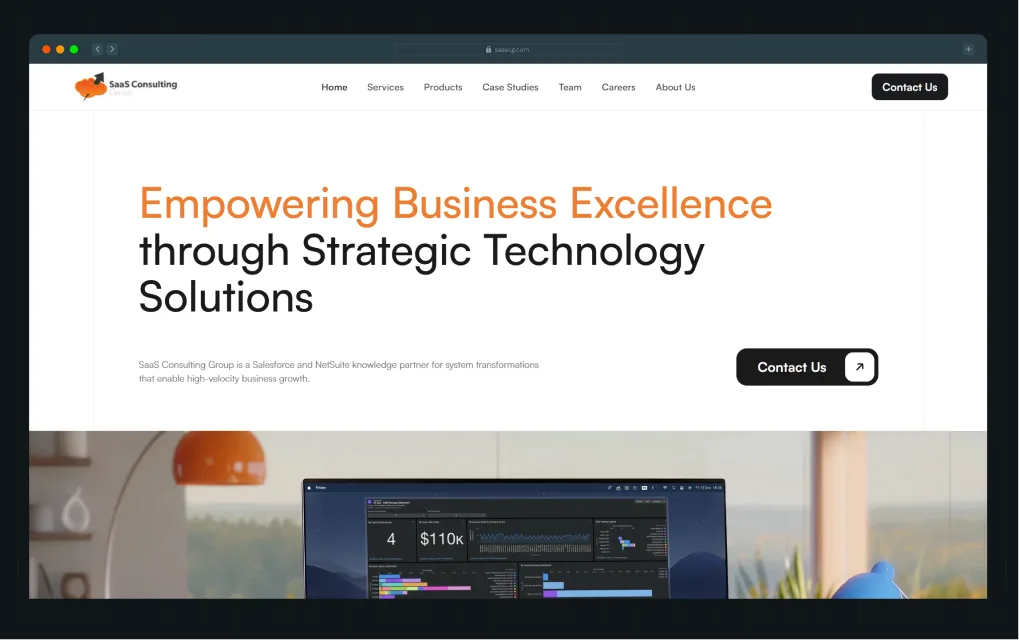
Best for: Mid-market and private-equity-backed businesses needing Salesforce and NetSuite transformations for faster, scalable growth
Recognized as a trusted partner for Salesforce and NetSuite transformations, SaaS Consulting Group helps mid-market and private-equity-backed companies streamline operations and scale efficiently.
They resolve system silos, slow post-merger integration, and revenue visibility gaps, building automated lead-to-cash workflows, real-time reporting, and custom integrations that empower finance, sales, and operations teams.
What is it best for?
- Salesforce & NetSuite optimization: Streamlines CRM and ERP operations for efficiency and growth
- System integration: Eliminates manual workflows with bi-directional platform connectivity
- Revenue visibility: Real-time reporting for ARR, churn, and renewals
- Rapid web deployments: Implements functional, best-practice environments quickly
Notable clients
Private-equity portfolio companies, SaaS businesses, manufacturing and service industry leaders
7. Thinkster
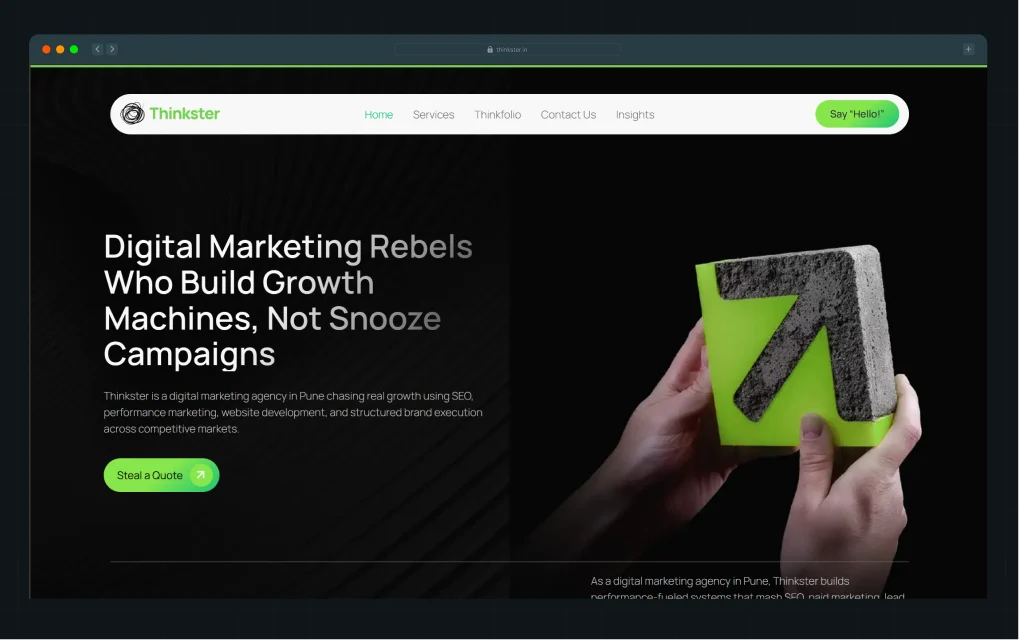
Best for: Texas businesses seeking reliable, high-performance websites that support growth and credibility
Thinkster combines design, development, and maintenance into consistent digital platforms. Their approach ensures fast load times, mobile responsiveness, and clear user navigation while supporting long-term business growth in competitive industries.
Their projects range from custom websites and e-commerce stores to landing pages and WordPress development.
What is it best for?
- Custom website design: Builds sites reflecting brand identity and usability
- WordPress development: Flexible, easy-to-manage platforms for content and scalability
- E-commerce solutions: Structured online stores for smooth transactions and visibility
- Landing pages & campaigns: Guides users toward specific actions efficiently
Notable clients
GWC, Saudamini, Ziva, Sunbridge, DAD, Radharaman Hospital
8. Phenomenon Studio
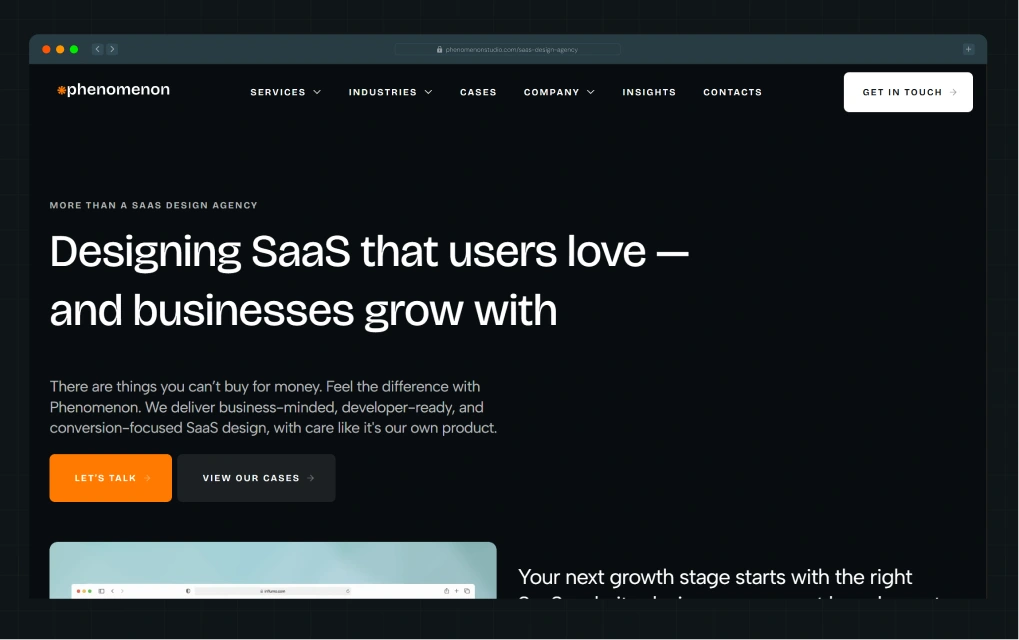
Best for: Businesses looking for robust, high-performing web solutions that enhance user engagement and drive measurable growth
Phenomenon Studio delivers end-to-end web experiences, from concept and design to development and ongoing support. They focus on building responsive, scalable, and reliable platforms that combine smooth functionality, fast performance, and intuitive navigation.
Their work spans custom websites, web applications, WordPress platforms, admin dashboards, and comprehensive product redesigns.
What is it best for?
- Custom web development: Creating tailored websites that match business goals and brand identity
- Web application development: Developing interactive, efficient, and scalable web apps
- WordPress development: Building flexible and easy-to-manage content platforms
- Admin panel development: Designing feature-rich dashboards for streamlined operations
Notable clients
KlickEx, Isora, Greenow, Nomupay, SaltyCloud
How to Choose the Right Web Development Company in Texas
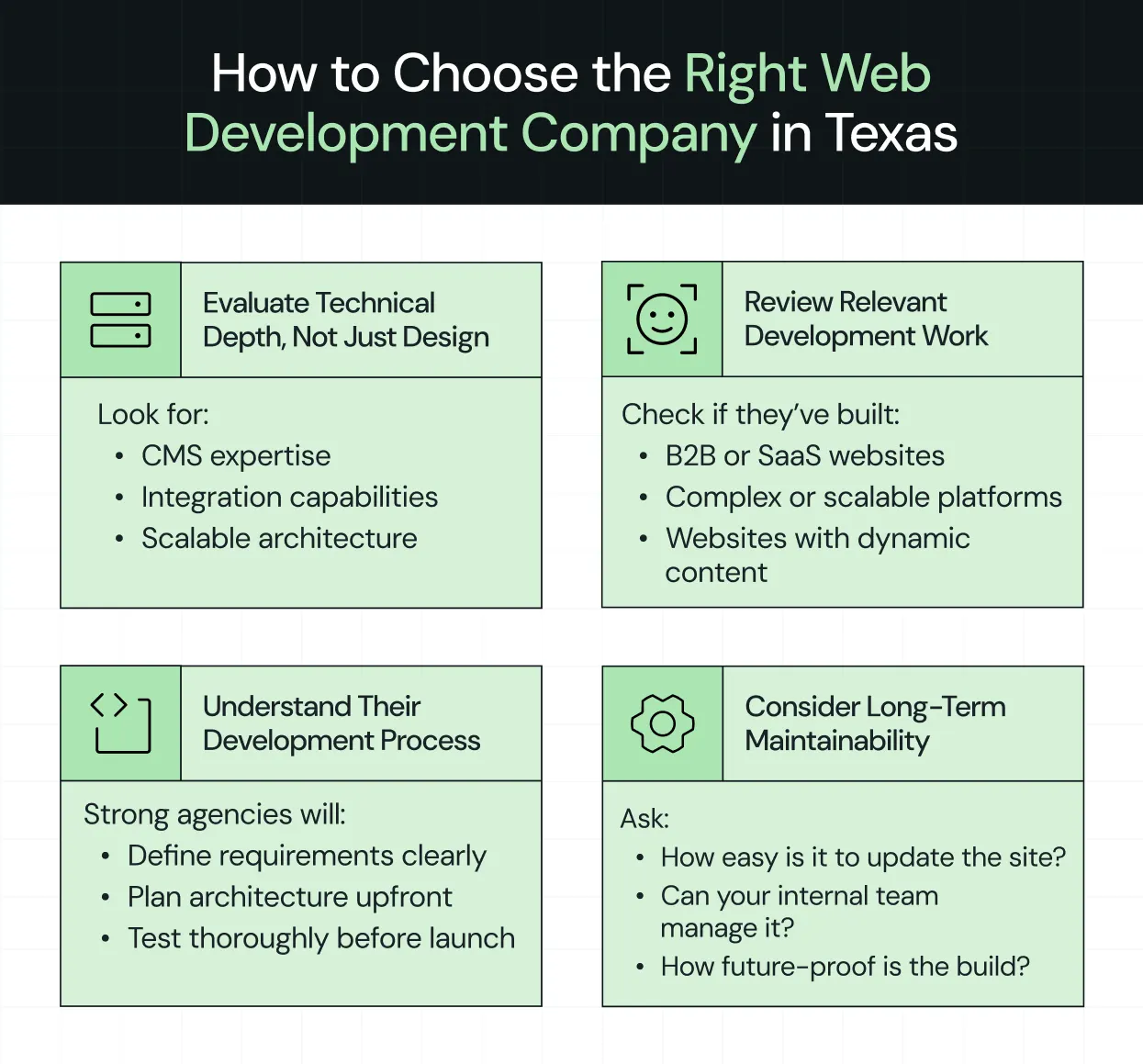
Most companies think they are choosing a web development partner. They’re actually choosing how their website will perform, scale, and evolve for the next few years.
This is why the decision cannot be based on visuals or surface-level impressions alone. Let’s break down what to look for.
{{specficService}}
Evaluate technical depth, not just design
It is easy to be drawn to good design. It is much harder to evaluate the systems behind it.
Many agencies present polished interfaces, but that does not always translate into strong development practices. What you need to understand is whether they can build a system that supports your business as it grows.
This means looking closely at their:
- Expertise with CMS platforms
- Ability to handle integrations with tools like CRM and analytics systems
- Approach to building scalable architectures that do not need to be rebuilt every time your product evolves
A visually appealing site might win attention in the short term, but without technical depth, it quickly becomes difficult to maintain and scale.
This is where Zenda’s transformation stands out. As a B2C fintech SaaS company, they needed a landing experience that balanced trust with clarity while still feeling engaging.
The final site guided users through a clear journey from the hero section to rewards, features, testimonials, and community. Each section was easy to scan, while visuals added personality without distracting from the message. Trust signals like partner badges and stats reinforced credibility, and consistent CTAs guided users toward action.
The experience felt simple and intuitive, and it earned recognition at Awwwards. More importantly, it gave Zenda’s team a structure they could build on without constant redesigns.
Aastha Shad, who leads Brand Design and Communications Marketing at Zenda, shared in a video testimonial how the revamp transformed their website and overall messaging. Ayush explained the project journey on LinkedIn, showing how they brought the site together step by step.
Review relevant development work
An agency that has built simple marketing websites may not be equipped to handle the complexity of a B2B SaaS platform, where multiple audiences, dynamic content, and evolving product narratives need to coexist seamlessly.
This is why it is important to look for work that reflects challenges similar to yours. For example:
- Have they built SaaS or B2B websites before?
- Have they handled platforms with multiple use cases, integrations, or dynamic content structures?
If their past projects don’t mirror the complexity of your SaaS, chances are they won’t be ready when your product scales.
Understand their development process
A strong outcome usually comes from a strong process. The difference between a smooth project and a frustrating one is that the agency clearly defines requirements, plans the architecture early, and tests thoroughly before launch.
Without a structured approach, projects tend to drift. Requirements change mid-way, technical decisions are made too late, and issues only surface after the site goes live, when they’re more expensive to fix. On the other hand, experienced development teams bring clarity early on. They align stakeholders, map out the architecture in advance, and ensure testing is an integral part of the process.
Here’s a quick way to think about where to focus and what to ignore:
Consider long-term maintainability
The launch is not the finish line. Is your website built to keep up after day one?
A site that looks great on day one but is hard to update quickly becomes a challenge for marketing and product teams. Even small changes can require developer intervention, slowing campaigns and limiting agility.
That’s why maintainability has to be part of your evaluation from the start. Ask yourself:
- How easily can your internal team manage the site?
- How flexible is the system for future updates?
- Can the underlying architecture support new features without a major rebuild?
The best development partners build with this in mind. They create systems that let your team move fast, experiment, and iterate without being stuck waiting for every tiny change.
What Does It Cost to Hire a Web Development Company in Texas?
Hiring a professional website development company in Texas is an investment in your SaaS business. Knowing what to expect can help you plan your budget and avoid surprises.
Typical pricing models
Unlike a poncho, web development pricing is rarely ‘one-size-fits-all’. Most agencies offer models like:
- Fixed project pricing: A set fee for a clearly defined project, often used for launches or redesigns
- Retainer-based development: Ongoing monthly support for continuous updates, new features, or iterative improvements
- Ongoing support plans: Includes maintenance, bug fixes, and minor enhancements to keep your site running smoothly
Understanding which model aligns with your goals helps you pay for value, not uncertainty.
Cost based on project complexity
Pricing depends heavily on the complexity of your project. Key factors include:
- Number of pages: More pages mean more design, development, and QA time
- CMS and integrations: Connecting with tools like CRM, analytics, or automation platforms adds engineering work
- Custom functionality: Advanced features like AI dashboards, user portals, or interactive product demos increase scope
In Texas, here’s what the cost of website development typically looks like:
Planning beyond the initial build
Modern SaaS websites evolve with your business, so plan for:
- Maintenance: Regular updates, security patches, and CMS management
- Content updates: New landing pages, product updates, or blog posts
- Performance optimization: Speed, SEO, and usability improvements to keep users happy and engaged
Planning for these ongoing costs keeps your site driving growth instead of becoming a one-time expense.
Ready to Build a Website That Scales With Your SaaS?
The insights we’ve shared here show how top B2B SaaS teams approach architecture, code, CMS, and performance to stay ahead of the curve.
You can use these ideas to evaluate agencies on your own. Or, if you want to move faster and minimize risk, that’s where partnering with the right team makes all the difference.
Why ThunderClap stands out:
- Proven SaaS expertise → We’ve built scalable platforms for B2B companies, handling complex workflows, multi-audience sites, and integrations with tools like CRM, analytics, and automation. We understand the differences that make SaaS websites work.
- Scalable, maintainable builds → We don’t just launch websites. We create systems that your marketing and product teams can update and iterate on without waiting for developers. Every site is built to grow with your business.
- Performance and results-focused → From fast load speeds and technical SEO to clean UX, we deliver websites that retain users and drive conversions. Many clients see 30–50% increases in demo requests or trial signups within months.
Plenty of agencies can hand you a website that looks nice. ThunderClap builds websites that become your most reliable growth engine.
{{ctaBlock}}
FAQs
1. How do I choose the right web development company in Texas for my business?
You should evaluate agencies based on their technical expertise, past experience with SaaS or B2B projects, and their development approach. Choose a team that communicates clearly, plans architecture thoughtfully, and can scale your platform as your business grows.
2. What is the average cost of hiring a web development company in Texas?
The cost depends on project complexity, the number of pages, integrations, and custom features. Simple websites typically start around $1,500–$5,000. Full redesigns range from $5,000 to $25,000, and complex SaaS platforms with multiple integrations can cost $20,000 to $50,000 or more.
3. Do Texas web development companies also provide website design services?
Many agencies offer both design and development services, including UX, visual branding, and front-end implementation. Some focus more on one area than the other, so it is important to review portfolios to confirm they can deliver a functional and visually polished website.



.webp)
Browse Similar Articles





Leading 5 SaaS Branding Agencies in Florida (That Actually Understand SaaS Growth)

.svg)

How to Turn Your B2B Website into a Self-Serve Growth Engine? (PLG Ready in 2026)

9-Step Website Copy Audit Checklist to Improve Conversions (Examples from Top B2B Brands)

.webp)

How to Choose the Right Fintech Web Development Company for Your Business
Top B2B Website Design Principles That Turn Visitors into Qualified Leads
%20Audit%20That%20Actually%20Improves%20Revenue.webp)
How to Do a Conversion Rate Optimization (CRO) Audit That Actually Improves Revenue
Web Design Agency vs. Freelancer vs. In-House: What Actually Works in 2026
5 CRO Agencies in London and How to Choose the Best CRO Agency for Your Business

The Ultimate Fintech B2B Positioning Guide for 2026 (That Actually Drives Conversions)
Mapping the B2B Buyer Journey to Improve Conversions Across Every Touchpoint
.webp)
7 Best Website Maintenance Companies in India for Growth-Led B2B Teams (2026)

.webp)
8 Best Healthcare Website Design Agencies for HIPAA-Compliant Sites in 2026
How to Find the Best Web Design Company in Houston, Texas for B2B Brands (6 Best Picks)
Positioning That Wins: How to Make Complex B2B Products Clear and Compelling
The Step-by-Step Website Redesign Process B2B Teams Use to Increase Conversions (Without Killing SEO and Pipeline)
7 Best Video Production Agencies for SaaS Product Walkthroughs and Feature Videos
How to Choose the Best B2B Website Maintenance Company: 9 Questions to Ask Before You Hire One


How to Choose a Web Design Company in San Francisco in 2026 (with Examples)

10 Best Web Design Companies in Florida in 2026 and How to Choose the Right One

How to Use Brand Storytelling on Your Website to Close More B2B Deals and Build Buyer Trust

SaaS CRO Best Practices: What High-Growth Brands Do Differently to Win Conversions

How a Rebranding Agency Can Redefine Your B2B SaaS Identity and Boost Pipeline
B2B Marketing Trends in 2026 That Directly Influence Pipeline and Revenue
Top 7 Video Marketing Agencies Driving B2B SaaS Brand Awareness in 2026

Why Partnering with a B2B Brand Positioning Agency Accelerates Market Differentiation

The Complete Website Redesign Checklist for B2B SaaS Teams Ready to Scale
.avif)
10 Best Webflow Development Agencies in India for 2026 (In-Depth Review)

10 Product Marketing Companies Powering the Fastest-Growing SaaS Brands in 2026
Website Copywriting Services vs In-House: What's Right for Your Business?

How to Choose a Marketing Agency That Understands B2B SaaS Growth Metrics


How to Choose a Video Marketing Agency That Understands B2B Storytelling
Outsourcing Web Design: Cost-Benefit Analysis for Mid-Market & Enterprise Brands

From Leads to Lifetime Value: How Growth Marketing Agencies Scale SaaS Revenue
Build a B2B Website Strategy That Aligns with Sales and Marketing Goals
Webflow vs WordPress: Which Platform Is Better for Your Business Website in 2026?
Fintech Web Design That Builds Trust: 8 UX Principles Every Fintech Site Needs
Optimizing for Intent: How B2B Website Messaging and UX Changes Help Capture Top-Funnel Buyers


12 Best B2B Web Development Agencies in the US to Build Scalable Websites

From Audit to Action: 8-Step Process to Optimize Your B2B Website Strategy for 2026 Buyers
How to Design a High-Converting Landing Page from Scratch (2026 Edition)
From Click to Customer: Proven Landing Page Conversion Optimization Techniques

How to Write Website Copy That Converts: A Step-by-Step Guide for 2026

How to Optimize a Landing Page for Maximum ROI: A Step-by-Step Breakdown


AI Landing Pages That Convert: 7 Design Principles Every AI Platform Should Follow




Interested in seeing what we can do for your website?



.webp)
