














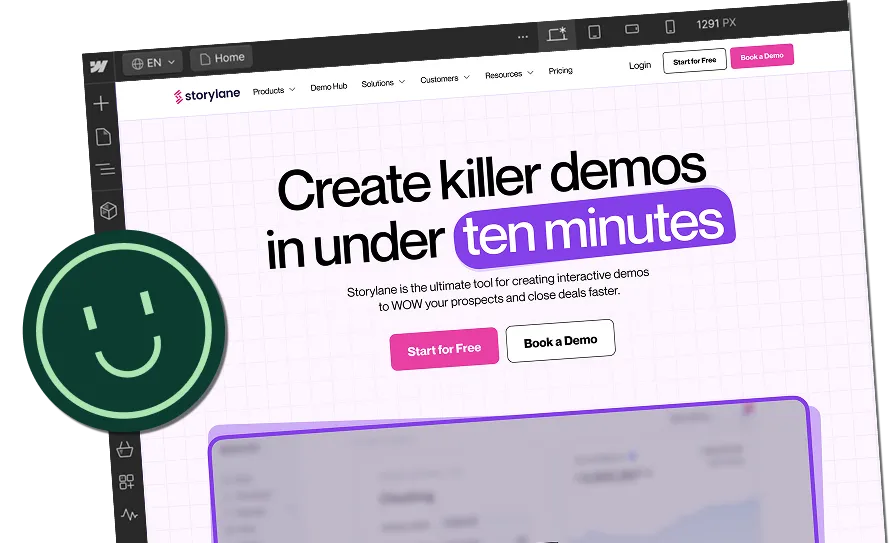

Top Video Marketing Trends Shaping B2B SaaS in 2026



You just watched a 45-second video on LinkedIn that explained a SaaS concept so clearly that you immediately thought, "We need to do this."
You stop scrolling, rewatch it, and notice something. It's neither flashy nor cinematic. It's just clear, focused, and it made you want to learn more.
If that moment felt familiar, you've just witnessed the future of B2B video marketing.
By 2026, video won't become more elaborate. It's becoming smarter. It's shorter. It's personalized. AI powers it. And it's converting at rates that text-based content can't touch.
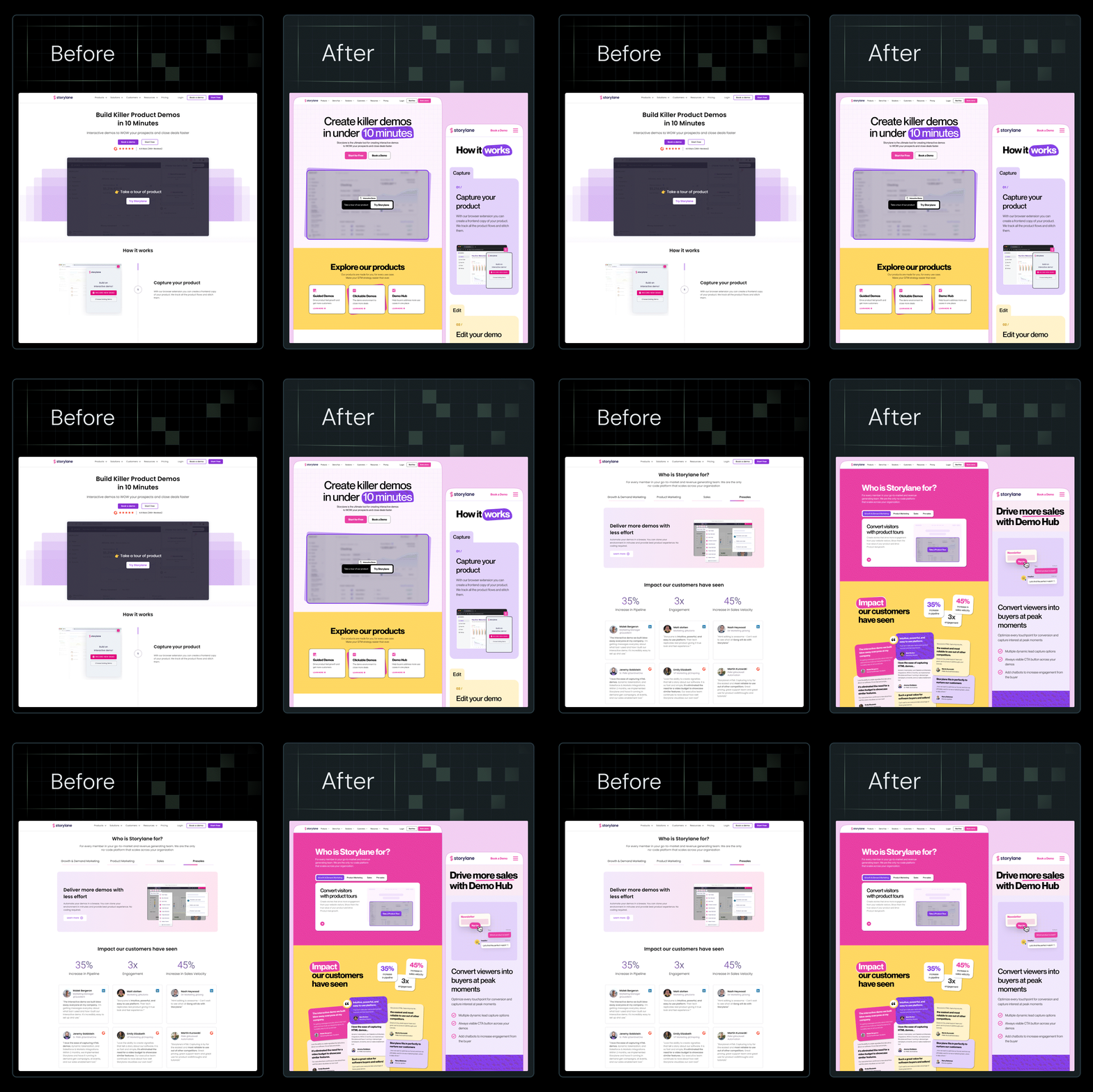
At ThunderClap, we've worked with over 129 B2B websites for SaaS, fintech, AI, and enterprise tech companies, including Factors AI, Amazon, Razorpay, Storylane, and Deductive AI, and one thing we've learned is this: the best-performing B2B videos aren't about production value. They're about clarity, strategy, and platform fit.
Video marketing is no longer optional for B2B companies. 87% of B2B marketers plan to invest in video in 2025, and the trends shaping 2026 reveal why. Landing pages with video convert 86% higher than those without, 90% of marketers report positive ROI from video (the highest ever recorded), and 49% revenue growth separates companies that invest in video from those that don't.
In this blog, we'll walk you through the 10 video marketing trends that will define 2026, show you what's changing in production and strategy, and help you avoid the mistakes competitors are still making.
TL;DR
- Short-form vertical video (under 60 seconds) is the #1 format driving ROI in 2026, replacing long-form as the default engagement play.
- AI-generated and AI-assisted video will power 75% of marketing videos by 2026, reducing production costs by 70% while enabling mass personalization.
- Personalized video is rising. 68% of marketers say it improves engagement and reply rates, with brands creating multiple versions per campaign.
- B2B video must integrate with CRM and analytics systems for real-time lead scoring, smarter follow-ups, and measurable ROI tracking.
- Interactive AI video generation is emerging, allowing real-time scene adjustment and dynamic storytelling based on viewer behavior.
- The V.I.D.E.O. Trend Framework (Vertical, Integrated, Data-Driven, Experienced, Outcome-Focused) separates high-performing video strategies from vanity projects.
- Video success in 2026 requires a scalable video content marketing system that is in sync with trends, too. Not isolated one-off productions.
Why 2026 Is a Turning Point for B2B Video Marketing
If you watched B2B video in 2025, you saw what traditional agencies produced: polished, long-form, cinematic content that looked impressive but often failed to convert.
2026 is different.
The video scene shifted in four fundamental ways:
- First, platforms have spoken. LinkedIn, YouTube Shorts, and TikTok now reward short-form vertical video with algorithmic reach.
75% of US adults watch up to 2 hours of short-form video daily, and B2B buyers are no exception. They're scrolling the same feeds, consuming the same content formats, and making decisions based on the videos they see in 30 seconds or less.
- Second, AI has democratized production. You no longer need a $50,000 budget and a six-week timeline to produce a professional video. AI reduces production costs by 70% and timelines to nearly instant. 87% of creative professionals now use AI tools for video creation, with 66% using them weekly. By 2026, 75% of marketing videos will be AI-generated or AI-assisted.
- Third, buyers demand personalization. Generic videos for all audiences no longer cut it. 68% of marketers say personalized video improves engagement and reply rates. In SaaS, that means different versions for product managers vs. CFOs vs. IT leaders, all from a single source asset.
- Fourth, video is no longer a marketing-only tool. 84% of B2B buyers rely on social media during their purchase journey, and 53% of businesses report that video has directly reduced support requests, saving internal resources. Video lives across sales decks, onboarding flows, product education, and customer success.
If your 2026 video strategy hasn't accounted for these shifts, you're already behind.
The 10 Video Marketing Trends Changing B2B SaaS in 2026
Video Marketing Trend #1: Short-Form Vertical Video is Now Your Baseline
By 2026, the question isn't "Should we make short-form video?" It's "Why aren't we producing short-form first?"
The data is unambiguous:
- Videos under 60 seconds have the highest completion rates
- Short-form videos (15-30 seconds) saw a 48% lift in click-through rate YoY
- 52% of B2B buyers prefer concise videos that "get to the point"
- Short-form is the #1 format marketers plan to invest more in for 2026
What does "short-form" mean? 30 to 90 seconds, vertical orientation, mobile-first design. This is the sweet spot for LinkedIn, YouTube Shorts, and TikTok, the platforms where 80% of B2B decision-makers are hanging out.
The shift away from 3-to-5-minute explainers isn't about dumbing down content. It's about respecting the buyer's attention. In a crowded feed, you have 3 seconds to prove the video is worth watching. Short-form forces clarity.
What to do now:
- Prioritize 30-90 second video productions in your video content marketing plans (try to include trends too)
- Optimize for vertical format (9:16 aspect ratio)
- Test captions and text overlays (50% of viewers watch without sound)
- Measure completion rates, not just views
Video Marketing Trend #2: AI-Generated and AI-Assisted Video is the Competitive Standard
Here's what's happening: AI video tools have moved beyond novelty. They're becoming table stakes. By 2026, 75% of marketing videos will be AI-generated or AI-assisted. Not because agencies want them to be. Because AI enables speed, scale, and personalization that manual production can't touch. The technology is advancing fast. Platforms like Google's Veo 3, OpenAI's Sora, and HeyGen now allow you to:
- Generate high-quality video from text prompts.
- Automate editing, voice-over, and motion graphics
- Create video variations for different audiences
- Produce, test, and optimize in days instead of weeks
The cost advantage is staggering: AI reduces production costs by up to 70% while cutting timelines to nearly instant. But here's the critical insight: AI isn't a replacement for strategy. It's a force multiplier. The brands winning with AI video aren't just hitting "generate." They're combining strategic direction, brand guidelines, and clear conversion goals with AI tools. They're using AI to produce variations and test which narrative hooks work best. They're repurposing assets across campaigns at scale. 87% of creative professionals now use AI tools for video creation. The question for your team isn't whether to use AI. It's how to use it without producing generic, homogenized content.
What to do now:
- Experiment with AI video tools (HeyGen, Synthesia, Runway)
- Build a brand prompt library so AI-generated videos stay on-brand
- Use AI for production speed, not creative direction
- Test AI-generated variations against human-produced content
- Never sacrifice clarity for efficiency
Video Marketing Trend #3: Personalized Video is Rising (And It's Getting Easier)
A single generic video for all audiences underperforms. Your CFO cares about ROI. Your product manager cares about workflows. Your IT security team cares about compliance.
One video can't speak to all three. 68% of marketers now say personalized video improves engagement and reply rates. In 2026, the barrier to creating personalized videos is collapsing. Emerging AI technologies like SoulID are making character consistency across multiple videos possible. Dynamic scripting tools allow dialogue and messaging to adapt based on viewer data. Some platforms now allow you to create branching video paths where viewer decisions alter the narrative flow.
What does this look like in practice?
Imagine a product demo where:
- The intro changes based on company size (5 employees vs. 500)
- The features highlighted match the viewer's role
- The CTA is personalized to their stage in the buying journey
- Follow-up messaging adapts based on video engagement
The challenge: Scale. Producing 50 video variations manually is impossible. But producing one master video and using AI to personalize dialogue, messaging, and imagery? That's viable today.
What to do now:
- Map your core audience segments (by role, company size, industry)
- Identify the 3-5 key messaging variations needed
- Use AI personalization tools to create multiple versions from one base asset
- Test which message variants drive higher engagement
- Automate follow-up based on video engagement signals
Video Marketing Trend #4: Video Analytics Integrate with CRM for Real-Time Lead Intelligence
For years, video was a black box. You'd produce great content, publish it, and wonder: "Did anyone actually watch this? Did it matter?"
2026 is different.
Video analytics are now integrating directly with CRM systems, offering real-time insights into viewer behavior. This changes everything about how you think about video ROI.
Instead of guessing, you now know:
- Which prospects watched your product demo (and for how long)
- Which competitors did they research before watching your video
- Whether they visited your pricing page after engaging with your content
- Which video hook drove the highest conversation rate
- Which B2B accounts are showing buying intent based on video engagement
This data enables smarter follow-ups. Instead of sending a generic email to everyone who watched, sales can prioritize prospects who watched 80% of your demo video. Marketing can score leads based on video engagement patterns. Product teams can see which features resonate most through video behavior.
What to do now:
- Implement video tracking in your CMS or marketing platform
- Integrate video analytics with your CRM (HubSpot, Salesforce, Pipedrive)
- Define what "high engagement" means for each video type
- Create lead scoring rules based on video engagement
- Share insights with sales so they can reference video engagement in outreach
Video Marketing Trend #5: Interactive and Real-Time AI Video Generation
This is where things get weird (in a good way). By late 2026, static AI video generation will feel outdated. The next evolution is interactive, real-time video generation, where creators direct AI like a live production.
Imagine being able to:
- Adjust lighting and camera angles in real-time
- Modify character expressions mid-scene
- Change backgrounds without re-rendering
- Experiment with different narrative directions instantly
Platforms with an AI video generator like Higgsfield are already moving in this direction. The implication is profound: video creation becomes closer to improv and real-time collaboration than traditional production.
For B2B marketers, this means:
- Faster creative iteration (test 10 narrative approaches in a day)
- More control without needing technical expertise
- Ability to respond to market feedback in weeks, not months
- Real-time personalization based on viewer data
This won't fully mature until 2027-2028, but the trends are clear. AI video is moving toward interactivity, not just automation.
What to do now:
- Stay informed on emerging AI video tools
- Run pilots with interactive video platforms
- Don't bet your entire 2026 strategy on tech (it will break)
- Focus on proven AI tools while experimenting with emerging ones
Video Marketing Trend #6: Product Videos and Animations Drive "Aha" Moments
Explaining software through written copy is exhausting. Your buyers are busy. They want to see how your product works, understand the value in seconds, and move on. Product videos are now ranked as the most impactful video type by Wistia. And 36% of marketers report that animated content has a measurable impact on their major KPIs.
What works in product video for 2026:
- Animated explainers simplify abstract concepts; instead of explaining how your API works, show it. Instead of describing your workflow automation, animate it.
- Live-action product demos build trust. When a real person uses your product to solve a real problem, buyers feel the credibility.
- Hybrid approaches (animation + live action) help you stand out. Pure animation can feel sterile. Pure live-action can feel slow. Blending them creates visual interest while maintaining clarity.
- Feature-led storytelling demonstrates how specific parts of your product fit into real workflows. This is where
See how ThunderClap redesigned the Factors AI website with cool product illustrations:
What to do now:
- Audit which product features are hardest to explain in copy
- Prioritize video for those features
- Mix animation, live-action, and UI screenshots (don't pick just one)
- Test different explanation styles to find what converts
- Place product videos near CTAs on your
Video Marketing Trend #7: Long-Form Thought Leadership Still Wins Bottom-Funnel
Short-form dominates. But don't kill long-form yet.
Long-form educational content still performs strongly on YouTube, particularly for bottom-funnel buyers, with viewers staying engaged for an average of 6 minutes.
Webinars continue to deliver exceptional ROI: 213% average ROI, with B2B SaaS seeing peaks of 430%.
Videocasts, podcasts, and in-depth interviews still drive thought leadership. The key difference in 2026 is repurposing.
You produce one long-form webinar. From that asset, you extract:
- 10 short-form clips for LinkedIn
- 3-4 quote videos for TikTok
- 1-2 highlight reels for YouTube Shorts
- 1-2 email-friendly animated clips
- Transcripts for blog content
One production, multiple formats, maximum reach.
What to do now:
- Keep producing long-form educational content (webinars, deep dives, interviews)
- Build a repurposing system to extract short-form clips
- Use AI-powered editing tools to speed up the process
- Track which short-form clips drive the highest engagement
- Double down on messaging from your best-performing clips
{{specficBlog}}
Video Marketing Trend #8: Vertical Video and Silent-First Production
Here's what's really happening: Mobile is no longer an afterthought. It's the primary format. Vertical video consumption continues to grow, especially on LinkedIn and TikTok. Your B2B buyers are watching videos on their phones while scrolling between meetings.
This changes everything about how you produce video:
No sound? No problem. Most viewers watch without audio. Your video must communicate without sound. Captions, text overlays, and visual clarity become critical. If your video only makes sense with audio, you're losing 50% of your audience.
What to do now:
- Shoot all B2B videos in a 9:16 vertical format
- Assume no sound (use captions for everything)
- Add text overlays for key points, not just transcripts
- Test mobile viewing before publishing
- Optimize thumb-stop rate (can you hook viewers in 3 seconds?)
Video Marketing Trend #9: Sales Teams are Adopting Short-Form Video
For years, video was a marketing department thing. In 2026, sales teams are doing it too. B2B companies are increasingly incorporating short-form video into sales processes, with customer-facing teams using bite-sized content to engage prospects throughout the sales cycle.
This is powerful because sales has objection-handling content. Instead of explaining a pricing model in an email (which gets ignored), a sales rep sends a 60-second video addressing the exact objection the prospect just raised.
Video accelerates deal velocity. Prospects understand product value faster. Sales reps spend less time on repetitive explanation calls. Sales can show prospect-specific ROI. A custom 2-minute video showing how your solution saves time for a prospect's specific workflow? That converts better than any generic demo.
The system becomes scalable. Marketing creates a library of short-form videos addressing common objections, features, and use cases. Sales reps use these as templates, customize as needed, and scale impact.
For this to work, video quality must be consistent but not overproduced. Sales reps don't need Spielberg-level production. They need clear, authentic, customizable content.
What to do now:
- Build a sales-focused video library (objections, features, ROI proofs)
- Make videos easy for sales reps to customize and share
- Train sales teams on when and how to use video effectively
- Track which sales videos drive engagement and follow-up meetings
- Create templates that sales can use to produce their own short-form content
Video Marketing Trend #10: AI-UGC Hybrid Content Balances Authenticity with Scale
Here's a challenge in 2026: How do you scale authentic user-generated content without losing the human touch that makes it credible? AI-UGC is the answer. A hybrid approach that combines the authenticity of user-generated content with the scalability of AI.
Here's how it works:
A customer creates an authentic testimonial video on their phone. It's genuine but rough. Instead of cleaning it up manually (which takes time), you use AI to:
- Add professional captions
- Improve audio fidelity
- Optimize for different platforms
- Translate into multiple languages
- Extract short-form clips
The result? Authentic, credible customer content at scale, without sacrificing quality. It usually shows that UGC and AI-generated content (AIGC) are competing, but AI-UGC brings the best of both.
What this means: By 2026, customer testimonial videos won't require a film crew. They'll be authentic, AI-enhanced, and deployed across your entire website, sales decks, and social channels.
What to do now:
- Encourage customers to create simple testimonial videos
- Invest in AI audio and caption tools to polish UGC
- Create a system for extracting and repurposing customer videos
- Build a library of AI-enhanced testimonials
- A/B test AI-UGC against professionally produced content
The V.I.D.E.O. Trend Framework
So far, we've covered 10 B2B video marketing trends. But how do you know which ones matter for your business?
At ThunderClap, we've seen teams invest heavily in video and see no results. And we've seen modest video budgets drive 50%+ conversion increases. The difference is rarely the production quality.
The difference is strategy.
We call it the V.I.D.E.O. Trend Framework, a way to evaluate whether your video strategy will convert in 2026.
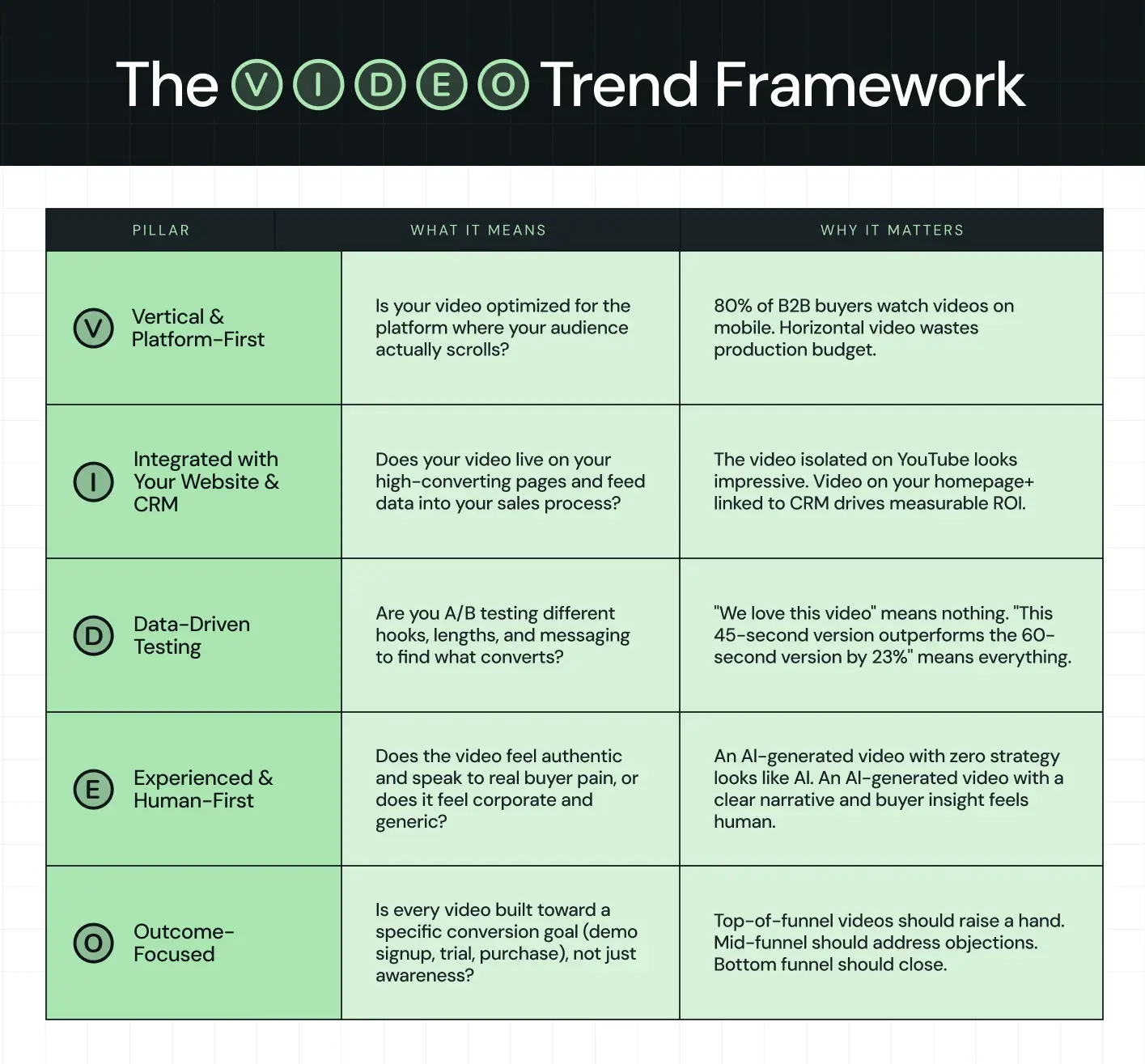
Use this framework when evaluating ANY video you're considering:
Does it check all five boxes? If yes, produce it.
Missing one? Reconsider. A beautiful AI-generated video that doesn't integrate with your CRM is a wasted production budget. A personalized video that isn't platform-optimized won't see engagement. A data-driven test without an authentic narrative will feel forced.
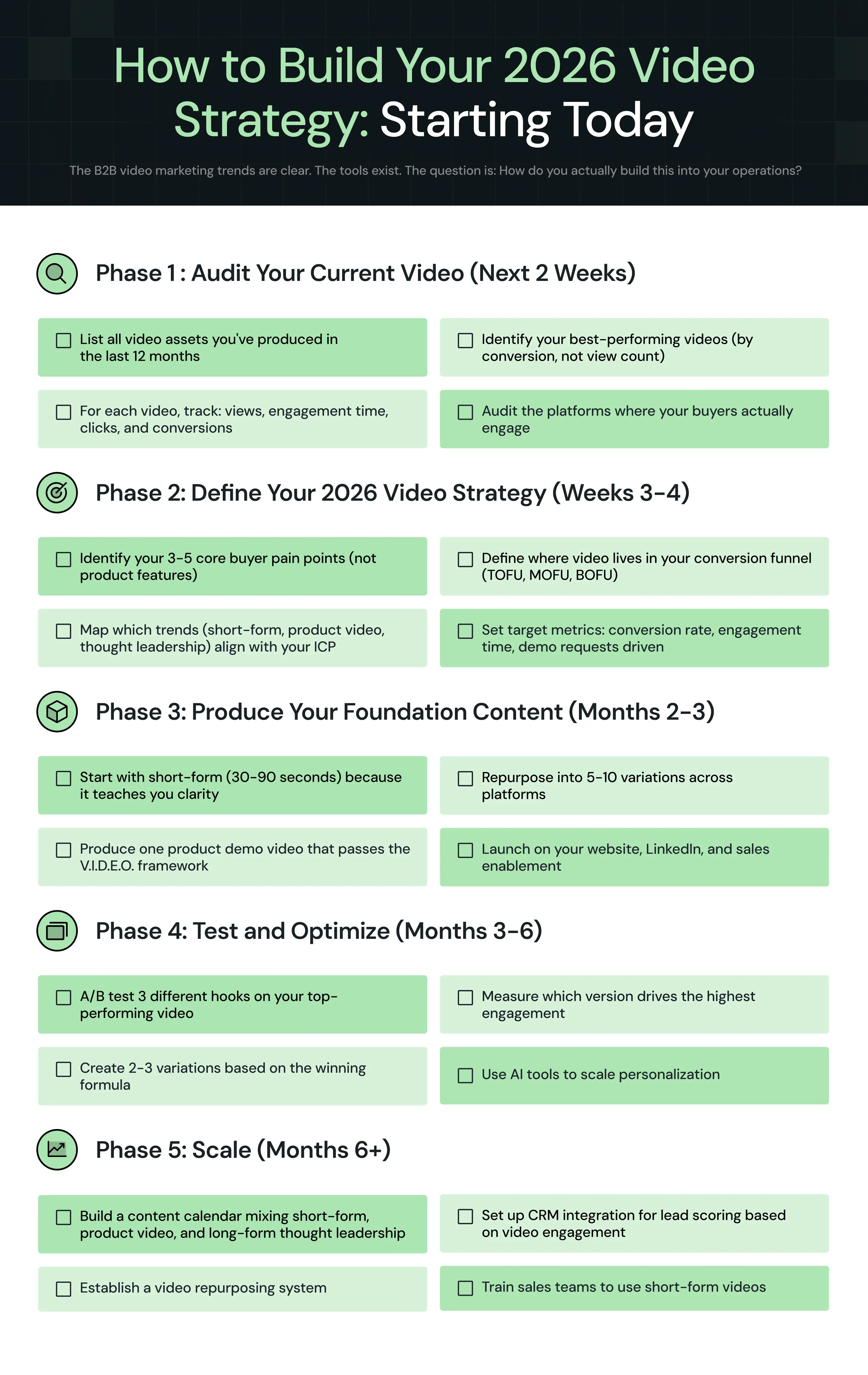
How to Build Your 2026 Video Strategy: Starting Today
The B2B video marketing trends are clear. The tools exist. The question is: How do you actually build this into your operations?
Here's a practical playbook:
Why Video + Website Strategy is the Winning Combo
A stunning explainer video doesn't convert if it's buried on page 3 of your website.
At ThunderClap, we've rebuilt 129+ B2B websites and produced dozens of video campaigns. The most successful clients are those who think of video and websites as an integrated system, not separate projects.
Your website is where your video lives. Your video is what clarifies your website's value prop. Together, they form the conversion engine.
This integrated approach requires:
- Website platform flexibility: Your CMS needs to handle video embeds, custom integrations, and dynamic personalization.
- Webflow is built for this.
- Consistent messaging: Your video narrative should mirror your website copy and positioning.
- Strategic placement: Don't just slap video on your homepage. Place videos contextually where they answer specific buyer questions.
- Performance data: Track how video engagement correlates with conversion rates, lead quality, and sales cycles.
If your video strategy doesn't account for where video lives and how it integrates with your digital presence, you're missing 70% of the opportunity.
Ready to evaluate your video and website strategy together?
{{ctaBlock}}



.webp)
Browse Similar Articles





Leading 5 SaaS Branding Agencies in Florida (That Actually Understand SaaS Growth)

.svg)


How to Turn Your B2B Website into a Self-Serve Growth Engine? (PLG Ready in 2026)


9-Step Website Copy Audit Checklist to Improve Conversions (Examples from Top B2B Brands)

.webp)

How to Choose the Right Fintech Web Development Company for Your Business


Top B2B Website Design Principles That Turn Visitors into Qualified Leads

%20Audit%20That%20Actually%20Improves%20Revenue.webp)
How to Do a Conversion Rate Optimization (CRO) Audit That Actually Improves Revenue
Web Design Agency vs. Freelancer vs. In-House: What Actually Works in 2026

5 CRO Agencies in London and How to Choose the Best CRO Agency for Your Business

The Ultimate Fintech B2B Positioning Guide for 2026 (That Actually Drives Conversions)


Mapping the B2B Buyer Journey to Improve Conversions Across Every Touchpoint
.webp)
7 Best Website Maintenance Companies in India for Growth-Led B2B Teams (2026)


.webp)

8 Best Healthcare Website Design Agencies for HIPAA-Compliant Sites in 2026




How to Find the Best Web Design Company in Houston, Texas for B2B Brands (6 Best Picks)

Positioning That Wins: How to Make Complex B2B Products Clear and Compelling

The Step-by-Step Website Redesign Process B2B Teams Use to Increase Conversions (Without Killing SEO and Pipeline)

7 Best Video Production Agencies for SaaS Product Walkthroughs and Feature Videos




How to Choose the Best B2B Website Maintenance Company: 9 Questions to Ask Before You Hire One





How to Choose a Web Design Company in San Francisco in 2026 (with Examples)


10 Best Web Design Companies in Florida in 2026 and How to Choose the Right One

How to Use Brand Storytelling on Your Website to Close More B2B Deals and Build Buyer Trust

SaaS CRO Best Practices: What High-Growth Brands Do Differently to Win Conversions


How a Rebranding Agency Can Redefine Your B2B SaaS Identity and Boost Pipeline

B2B Marketing Trends in 2026 That Directly Influence Pipeline and Revenue

Top 7 Video Marketing Agencies Driving B2B SaaS Brand Awareness in 2026

Why Partnering with a B2B Brand Positioning Agency Accelerates Market Differentiation

The Complete Website Redesign Checklist for B2B SaaS Teams Ready to Scale


.avif)
9 Best Webflow Development Agencies in India for 2026 (In-Depth Review)

10 Product Marketing Companies Powering the Fastest-Growing SaaS Brands in 2026
Website Copywriting Services vs In-House: What's Right for Your Business?


How to Choose a Marketing Agency That Understands B2B SaaS Growth Metrics


How to Choose a Video Marketing Agency That Understands B2B Storytelling

Outsourcing Web Design: Cost-Benefit Analysis for Mid-Market & Enterprise Brands

From Leads to Lifetime Value: How Growth Marketing Agencies Scale SaaS Revenue

Build a B2B Website Strategy That Aligns with Sales and Marketing Goals

Webflow vs WordPress: Which Platform Is Better for Your Business Website in 2026?

Fintech Web Design That Builds Trust: 8 UX Principles Every Fintech Site Needs



Optimizing for Intent: How B2B Website Messaging and UX Changes Help Capture Top-Funnel Buyers




12 Best B2B Web Development Agencies in the US to Build Scalable Websites


From Audit to Action: 8-Step Process to Optimize Your B2B Website Strategy for 2026 Buyers


How to Design a High-Converting Landing Page from Scratch (2026 Edition)

From Click to Customer: Proven Landing Page Conversion Optimization Techniques

How to Write Website Copy That Converts: A Step-by-Step Guide for 2026



How to Optimize a Landing Page for Maximum ROI: A Step-by-Step Breakdown


AI Landing Pages That Convert: 7 Design Principles Every AI Platform Should Follow

From Traffic to Pipeline: B2B Website Growth Strategy for Scaling Teams


B2B Website Optimization Strategy: Speed, UX, SEO, and CRO in One Playbook




Interested in seeing what we can do for your website?



.webp)
