













SaaS Messaging Framework: 7 Steps for B2B Positioning (2026)


A SaaS messaging framework helps you clearly define what your product says, who it is for, and why it matters, so your website, ads, sales decks, and onboarding all tell the same story. Most B2B SaaS companies get this wrong. They have a solid product, but their positioning is built for internal clarity instead of buyer clarity.
According to Gartner research, B2B buyers spend only 17% of their total purchasing time in direct contact with vendors. Your website does most of the convincing before a sales rep ever joins the conversation. A weak message does not just lose a click. It costs you deals before the conversation even starts, driving up your customer acquisition cost (CAC) while shrinking your pipeline.
The CLARITY Framework is ThunderClap's 7-step B2B SaaS messaging framework that helps you move from unclear messaging to a single, sharp message that converts. This guide walks you through each step with real examples and a validation method that most SaaS teams skip entirely.
TL;DR
- Most B2B SaaS messaging fails because it is built for internal alignment instead of buyer clarity.
- The solution requires a fundamental shift in process, meaning you should fix your strategy before you write a single line of copy.
- The biggest mistake companies make is publishing positioning without validating it with real buyers. The CLARITY Framework builds this validation directly into the process.
- Great messaging is never about clever wordplay. It succeeds by using the exact language your customers use to describe their own problems.
Why Do SaaS Companies That Skip Messaging Strategy End Up Redesigning Twice?
SaaS companies face harder messaging challenges than companies in almost any other category because customers cannot see your product until they use it.
Skipping messaging and jumping straight to design causes a predictable failure. Your first redesign looks polished, but fails to convert buyers. Your team built the creative brief around aesthetic goals instead of buyer clarity goals. Your metrics freeze. Three to six months later, you sit in a briefing room trying to diagnose the flat performance.
Multiple stakeholders make the challenge even harder. Forrester's State of Business Buying report shows that the average B2B purchase involves 13 stakeholders. Buying decisions cross multiple departments 89% of the time. Your homepage must convert the growth-stage CMO, the skeptical CFO, and the hands-on product manager simultaneously without diluting your core message. Unclear brand positioning fragments under that pressure, while clear product positioning holds.
The math behind skipping your messaging strategy is brutal. Launching a redesign based on vague positioning costs $50,000 to $150,000 and underperforms. Your second redesign costs the same amount and drains 12 months of pipeline from your sales team.
ThunderClap eliminates this loop. We launch every project with a messaging sprint before our designers draw a single wireframe.
We followed this approach when working with Tagalys. After refining their positioning and messaging, the team realized their website no longer reflected how they wanted the brand to be perceived. Instead of jumping straight into design, we started with a brand audit and competitor analysis, aligned the visual identity with the new messaging, and then redesigned the website.
Ayush Barnwal, Partner & CEO at ThunderClap, explained the challenge in a LinkedIn post:
A messaging strategy sprint costs a fraction of that amount. The sprint secures your redesign performance before you spend a single dollar on creative work. If your last redesign failed to move your metrics, the problem started with your brand messaging, long before anyone wrote the design brief.
What is the CLARITY Framework? ThunderClap's 7-Step B2B SaaS Messaging Framework Explained
The CLARITY Framework is ThunderClap's proprietary product messaging framework for SaaS companies. We named the system after the single biggest failure in B2B SaaS positioning: a lack of clarity.
Each letter maps directly to an active step in our process.
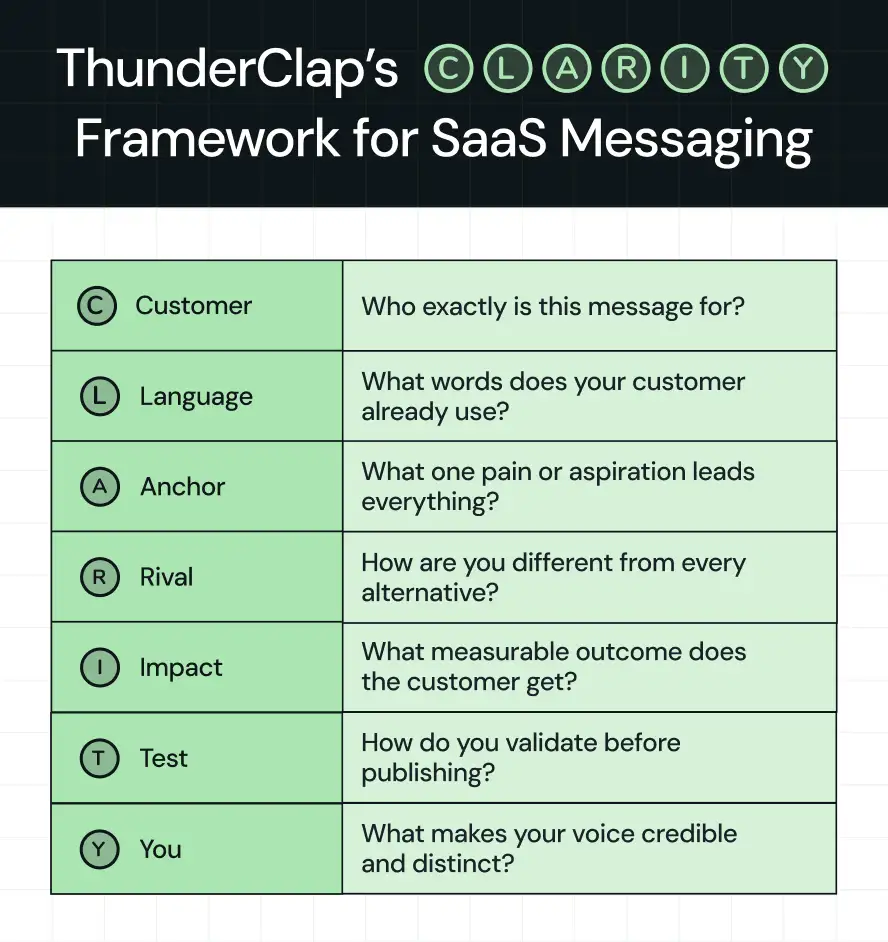
Step 1 (C). Customer: Who exactly is your SaaS product messaging for?
The first step in any SaaS product messaging framework is identifying the exact buyer persona you're trying to reach. Strong messaging starts with understanding the customer's job to be done, the progress they want to make, and the customer’s pain point standing in their way.
A simple market segmentation test: if this message reached only your ideal buyer, would they immediately recognize themselves in it? If not, your audience is probably too broad.
Many SaaS companies get this wrong by building messaging around features rather than customer problems. Buyers do not care about your roadmap. They care about solving a specific pain point.
LaunchBay's landing page demonstrates this principle well with the headline:
"Customer onboarding software built for B2B SaaS teams."
Instead of trying to appeal to every business, LaunchBay explicitly identifies its target audience: B2B SaaS teams.
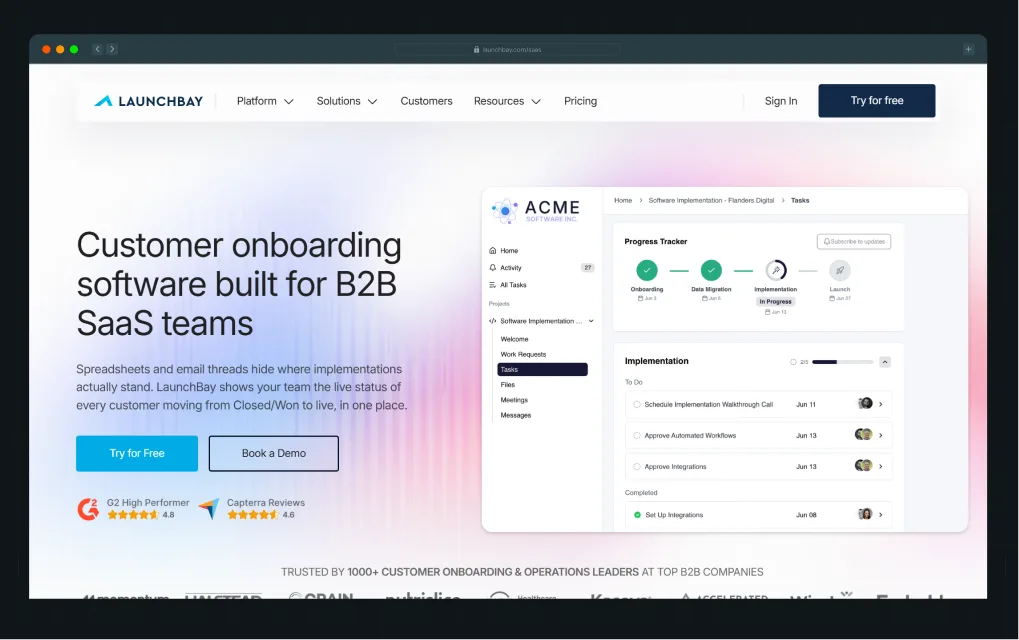
The message immediately tells visitors who the product is for and what problem category it solves. A SaaS founder, Head of Customer Success, or onboarding manager can instantly determine whether the product is relevant to them.
The supporting copy reinforces the pain point by highlighting slow onboarding processes caused by spreadsheets and email-based workflows. Together, the headline and subheading create a clear connection between the target customer and the outcome they want to achieve.
At ThunderClap, we choose the focus customer from closed deals. Our team reviews a client’s last 10 closed-won deals to find the problem those buyers needed solved, then runs stakeholder interviews and buyer persona mapping. We define the ICP by the workflow buyers want to fix, and company size comes second. The segment with the most urgent, repeatable problem becomes the audience the homepage speaks to first.
Step 2 (L). Language: How do you use your customer's own words in B2B SaaS messaging?
Customer language works better than polished copy because people recognize their own words faster than they interpret new ones. When buyers see their own frustrations reflected back at them, the page feels as if it were written specifically for them.
The best sources for customer language are G2 and Clutch reviews, sales calls, onboarding interviews, and Reddit discussions. During customer interviews, we repeatedly hear comments such as "Our website doesn't reflect who we are now" and "We're losing leads because our value isn't clear up front." Those insights shaped ThunderClap’s own brand messaging and B2B website strategy.
ThunderClap’s homepage skips agency jargon and speaks directly to buyer concerns:
"Build a 10X better B2B website that makes your product unforgettable."
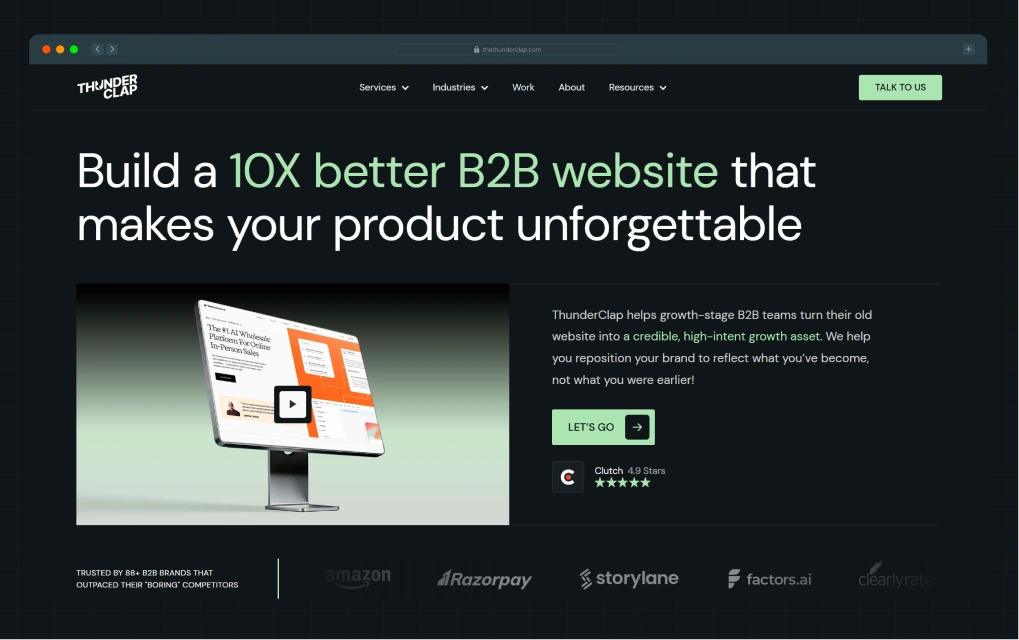
The supporting copy reinforces familiar challenges around outdated positioning and weak differentiation:
"Turn your old website into a credible, high-intent growth asset."
"Reposition your brand to reflect what you've become, not what you were earlier."
At ThunderClap, we capture customer language before anyone writes copy. During discovery, our team shadows sales calls, interviews stakeholders, and reads the client’s and competitors’ G2, Capterra, and Trustpilot reviews. We log every phrase buyers repeat and build the messaging hierarchy around those phrases. Headlines and subheads come straight from that list.
Step 3 (A), Anchor: What is the one pain or aspiration your SaaS messaging leads with?
Strong messaging in SaaS starts with the customer's problem, not the product. Most SaaS companies lead with features or categories instead of the pain point or outcome that buyers care about.
To figure out whether your messaging is actually working, you need a quick way to test it.
A simple anchor test is to read your headline and ask what it leads with. If it starts with a feature ("AI-powered analytics") or a category ("the leading platform for X"), it is not anchored. Effective messaging connects directly to a problem the buyer wants solved or an outcome they want to achieve.
Pain anchors work best when buyers are actively looking for a solution. Aspiration anchors work when buyers already understand the category and want better results.
At ThunderClap, we choose the anchor from the buyer journey map built during discovery. We list the fears and goals buyers raise at each stage, from problem awareness to final approval. The one that shows up at every stage becomes the anchor. Everything else, features included, turns into supporting proof.
ThunderClap’s recent website project for FillHQ, a HIPAA-compliant eSignature platform for healthcare, finance, and legal teams, shows how a strong anchor works. Our team built FillHQ’s core message around trust, security, and workflow speed, with features in a supporting role.
We mapped the buyer journey from problem awareness to decision-making and used it as an anchor to shape the entire narrative. The messaging highlighted outcomes like faster approvals, automated workflows, and secure data handling, while compliance signals like HIPAA, ESIGN, and eIDAS reduced buyer hesitation.
The result was a message that stayed anchored to the buyer’s primary concern: “Can I trust this with sensitive documents?”
Step 4 (R). Rival: How does your SaaS positioning make differentiation impossible to ignore?
There are three types of differentiation in B2B SaaS:
- Category (what you are)
- Feature (what you have)
- Experience (how you work)
Most companies try all three and achieve none. Strong brand positioning picks one and drives it deep enough to be ownable.
Most differentiation claims sound unique internally but become interchangeable the moment buyers compare vendors. A quick test can reveal whether your positioning is genuinely distinctive or simply marketing fluff.
Replace your differentiator claim with a competitor's name. If the statement still sounds true, it is not specific enough. "We're passionate about your success" passes the substitution test for almost every company in the category. That is exactly the problem.
Another factor many teams overlook is that the biggest competitor is often the status quo. Spreadsheets, Slack threads, and email chains frequently create more friction than competing software. Positioning against the default way of working can be more effective than positioning against a named competitor because it validates the buyer's existing frustration before introducing a solution.
At ThunderClap, our competitor audit goes past rival homepages. We read competitors’ G2, Capterra, and Trustpilot reviews and log the complaints buyers repeat. Each recurring complaint marks a gap the client can own, and the strongest gap becomes the differentiator we build the positioning around.
ampliphi offers a strong real-world example of this principle. The company does not rely on vague claims about innovation or customer support. Its comparison pages evaluate ampliphi against competitors such as Duetto, Atomize, and RoomPriceGenie using specific criteria.
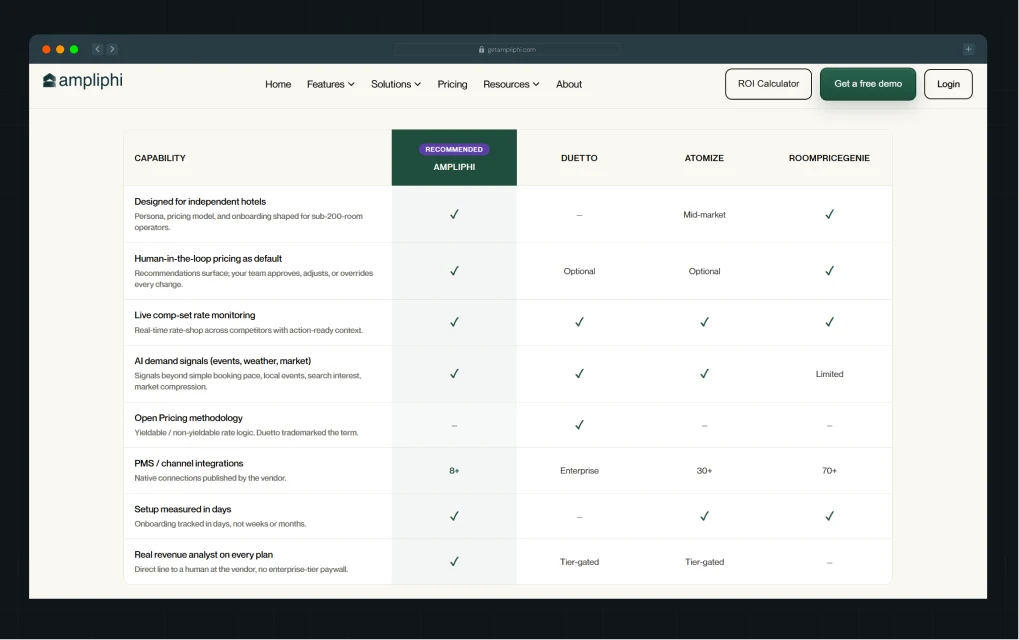
Those differences are concrete, verifiable, and directly tied to buyer priorities. A hotel operator can immediately understand how ampliphi differs from competing solutions and decide whether those differences matter.
Step 5 (I). Impact: What measurable outcome does your B2B SaaS messaging promise?
Vague metrics like "improved conversion rates" mean nothing to a buyer. Specific promises, such as "increase qualified demo requests by 40% within 60 days," trigger an immediate calculation. Your buyer multiplies that percentage against their current numbers to build a real business case. This specific validation separates an empty aspiration from a unique value proposition a CFO will approve.
Impact statements usually fall into three types:
- Time-to-value (How fast does value arrive?)
- Performance outcome (What metric works?)
- Risk reduction (What does the buyer stop losing?)
Early-stage buyers respond to performance outcomes. Late-stage procurement buyers prioritize risk reduction. Your sales enablement content should carry all three, but your homepage leads with the one that matches where most of your traffic arrives.
You can source real numbers from case studies, onboarding data, customer interviews, or G2 and Clutch reviews. Your strongest impact claim should sit near the primary CTA, not buried in a case study.
For example, NativeMSG’s platform was strong, but the original website focused on features instead of outcomes. Visitors understood what the product did, but not why it mattered commercially.
ThunderClap rebuilt the messaging around measurable impact, such as engagement, conversions, and ROI. The homepage now surfaces proof immediately: 500M+ messages sent, 2M+ conversations managed, and 45%+ higher CTR versus SMS, placed above the fold with a direct “Book a Demo” CTA.
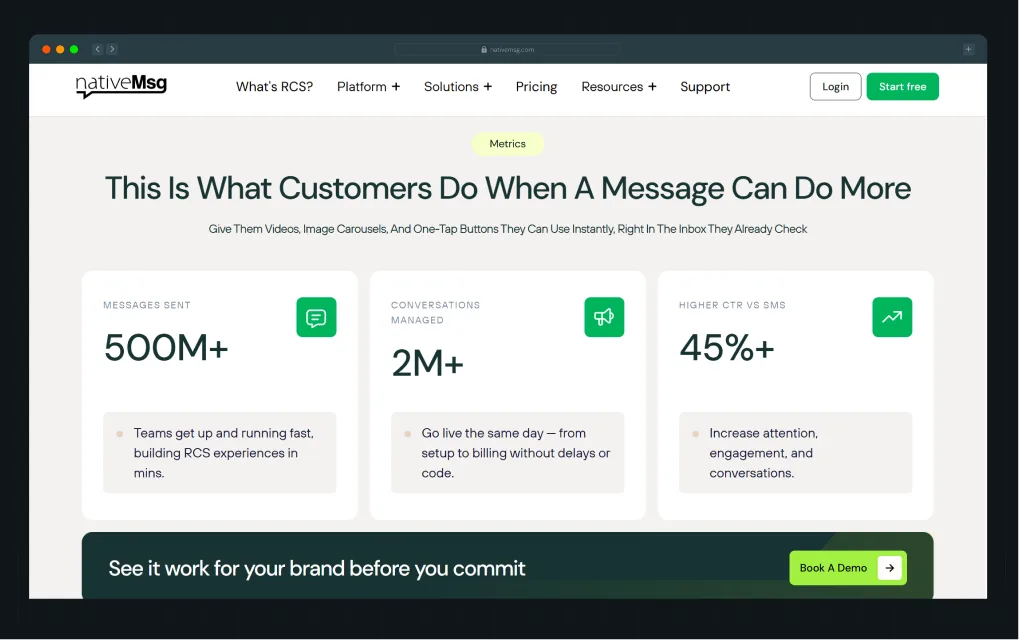
The subtext answers time-to-value upfront: “Go live the same day, from setup to billing without delays or code.”
Feature explanations describe the product. Impact statements sell the outcome. The redesigned nativeMsg homepage leads with outcomes first, and the metrics reinforce it.
As Ayush Barnwal, Partner at ThunderClap, put it: “They wanted to own RCS, not just be another messaging vendor. The visual-first approach helped people understand the product in minutes.”
Step 6 (T). Test: How do you validate your SaaS brand messaging with target customers before publishing?
This is the step most B2B SaaS teams skip and the one that determines whether the other six steps worked. Publishing unvalidated positioning is one of the most expensive messaging mistakes because the consequences appear months later as higher bounce rates, lower conversion rates, and confused sales conversations.
A simple 5-second test can reveal most messaging problems. Show your homepage to someone unfamiliar with the company. After five seconds, ask three questions:
- What does this company do?
- Who is it for?
- Why would someone choose it?
If they cannot answer all three, your messaging is not as clear as you think it is.
The most effective validation methods involve real buyers. Platforms like Wynter recruit your exact ICP to review messaging and identify what resonates, what feels confusing, and what information is missing. A faster alternative is reviewing discovery call recordings. The questions and objections prospects raise before the sales pitch often reveal gaps that your messaging should have addressed up front.
Testing at ThunderClap happens before and after launch. First, we show the positioning statement and current site to 5 to 10 people from the client’s ICP and ask four questions. What type of company is this for? What problem does it solve? Why choose it over alternatives? What questions remain? The positioning passes when at least 7 of 10 correctly name the ICP, the problem, and the differentiator. We then stress-test wireframes before visual design starts, and after launch, heatmaps and A/B tests show which messages hold up with live traffic.
ThunderClap revamped the Factors.ai website and rebuilt its homepage messaging. Our team benchmarked Factors.ai against 6sense, Demandbase, and Dreamdata, then anchored the homepage on one headline: “Know how your buyers move. Run campaigns that win.”
Below the headline, we structured the page as a step-by-step narrative. It names the challenge of fragmented buyer signals, shows how the platform solves it, and closes with customer proof points and security credentials. Each section answers one of the 5-second test questions: what Factors.ai does, who it serves, and the outcome it delivers.
Step 7 (Y). You: How do brand voice and proof make your SaaS messaging credible and distinct?
Two companies can make the same claim and get very different results. The difference comes down to proof and voice. Named clients, real metrics, and a clear point of view will always outperform anonymous testimonials and generic positioning.
In B2B SaaS, social proof follows a clear hierarchy:
- Specific metrics from named clients
- Testimonials with measurable outcomes
- Client logos, awards, and finally, generic claims
Many companies lead with logos and hide the numbers. Reversing that order is one of the fastest wins in B2B branding strategies for conversion.
ThunderClap’s voice work starts with a brand personality audit and an internal alignment exercise. We ask each stakeholder to describe the brand in their own words, and the gaps between their answers show where the voice has drifted. We then pair the agreed voice with the client’s strongest named proof and attach a metric or customer name to every bold claim on the page.
Ramp shows how voice and proof work together. Its homepage headline, “Time is money. Save both.”, sounds like no other line in finance software. The page backs that confident tone with named proof: a “$1M+ saved on global spend” result next to Notion’s logo, plus quotes from finance leaders at Shopify, Notion, and Eight Sleep, each with a name and title attached.
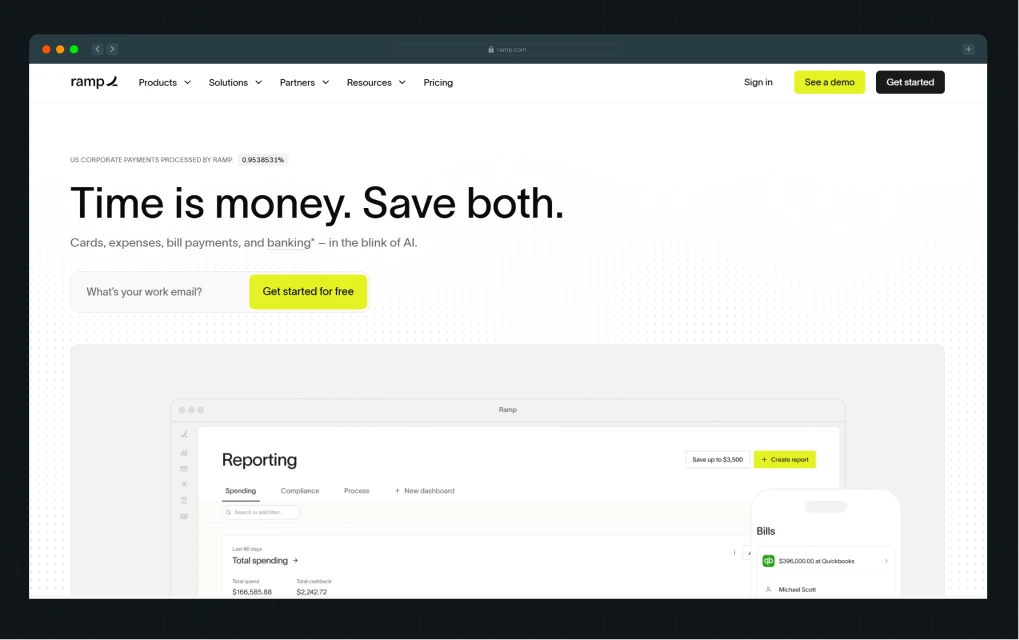
The claim feels credible because named customers and a specific number stand behind it. The four-word headline makes it memorable because it sounds like a company with a clear point of view.
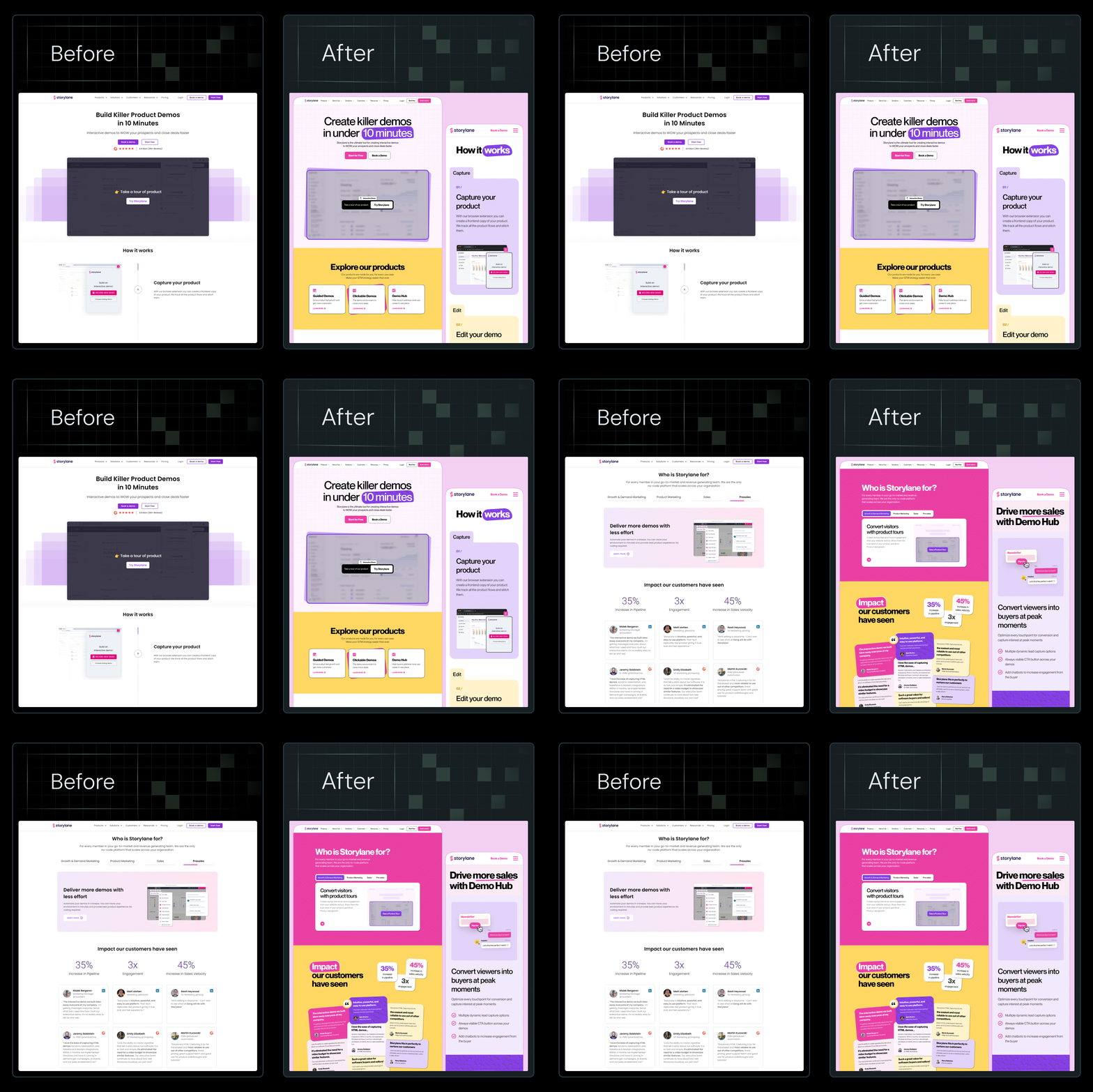
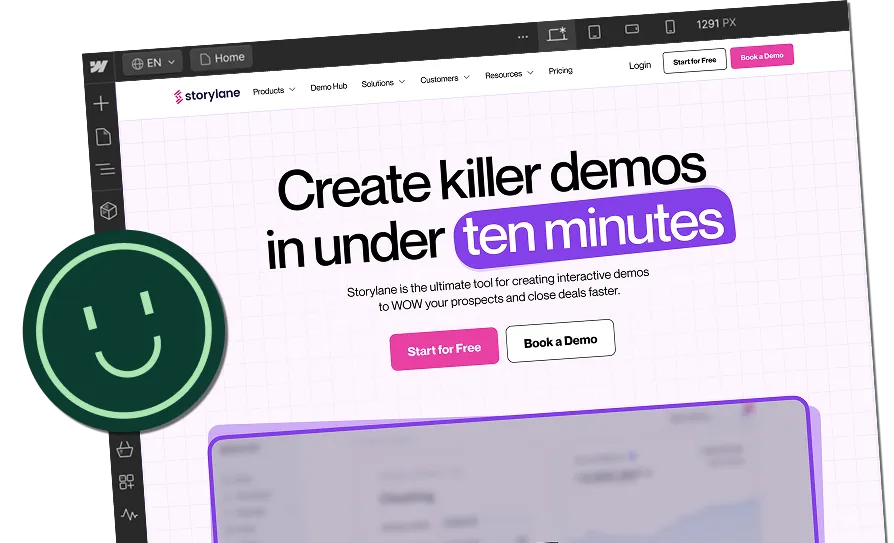
Storylane came to ThunderClap with a copy that already worked. Madhav Bhandari, Head of Marketing at Storylane, asked our team to keep the words intact, and our audit backed his call. The gap sat in the design. An early-stage look, inconsistent visuals, and hidden USPs kept strong messaging from reaching buyers.
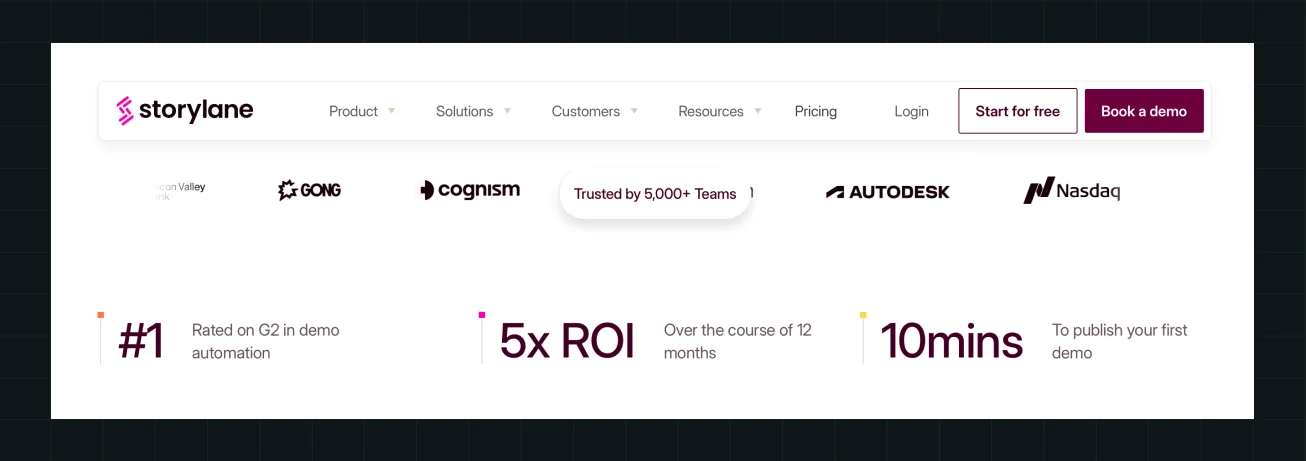
After the redesign, Storylane saw a 30% increase in demo requests and a 36% increase in website impressions, as Ayush mentioned in his LinkedIn post. Strong messaging helped create demand. Better execution helped unlock it.
How Do You Apply the CLARITY Framework? Download the Free SaaS Messaging Worksheet
The table below turns the CLARITY Framework into a one-page template your team can fill in for any B2B SaaS product.
Why Does SaaS Messaging Break Down at Scale?
Most messaging failures do not happen when companies are small. They happen when growth outpaces positioning, audience changes, and product complexity.
1. Messaging that worked at Series A stops converting at Series B
Messaging that worked for a founder-led startup often struggles at scale. As teams grow, the website must communicate the value proposition without context from the founder. Conversion rates fall, and sales teams spend more time explaining what the company does.
Rezolv faced a version of this challenge early in its growth. The founders had deep fintech expertise and a strong product vision, but no clear way to communicate the platform's value to prospective customers.
ThunderClap developed a new messaging framework, positioning strategy, and brand identity that translated complex workflows into simpler, trust-building narratives. Following launch, Rezolv reported a 39% increase in prospect engagement.
Kiran Kulkarni, Partner and Head of Growth at ThunderClap, later described this as a recurring pattern in early-stage fintech, where simplifying complex products into trust-building narratives is often what determines whether buyers move forward or lose interest.
2. Product expansion without messaging architecture
Many SaaS companies add features, use cases, and products without updating their messaging architecture. The homepage tries to speak to everyone and ends up resonating with no one.
This challenge often appears when a website built for a single use case must suddenly represent a broader platform. New features accumulate, new audiences emerge, and the original positioning no longer reflects the product's scope. The solution is rarely a copy refresh. More often, it requires a complete messaging rebuild designed to redefine your B2B SaaS identity and boost pipeline.
3. Expanding to a new ICP without updating positioning
Growth often means serving new audiences. A company that starts with SMBs may move upmarket, enter new industries, or target different stakeholders.
When market segmentation changes but positioning stays the same, ideal buyers stop recognizing themselves in the message.
4. Messaging drifts across teams and channels
As organizations scale, messaging spreads across websites, ads, sales decks, and onboarding flows. Without a shared framework, each team creates its own version of the positioning.
This is why learning how to test SaaS brand messaging with target customers is critical. Regular validation keeps teams aligned and prevents messaging drift before it impacts pipeline performance.
{{specficBlog}}
When Should You Build Your SaaS Messaging Framework Yourself vs. Partner With a Specialist?
In-house works when you have a single ICP, a simple product, and direct access to customers. Early teams benefit from interviews, sales call reviews, and structured frameworks to refine messaging as they learn.
As you grow, internal messaging becomes harder to manage. Multiple ICPs, new products, and changing market segmentation often lead to fragmented positioning. If sales, marketing, and leadership describe your product differently, the issue is no longer copy.
At this stage, you need more than rewriting. You need a system that aligns positioning, messaging, and outcomes. The CLARITY Framework does this and helps teams use brand storytelling on their websites to close more B2B deals by turning product value into a clear, scalable narrative.
At ThunderClap, we apply this across branding, websites, and messaging in SaaS to help companies clearly communicate their value as they grow. We also offer post-launch retainer engagements where your account manager and PMM team continue to iterate on messaging, test new positioning variants, and update the website as your strategy evolves.
{{ctaBlock}}
FAQs
1. What is a SaaS messaging framework?
A SaaS messaging framework is a step-by-step process for defining what your product says, who it speaks to, and why that message should drive a specific buyer to act. It gives your team a reusable document that keeps positioning consistent across your website, ads, and sales conversations.
2. Why do SaaS companies struggle with positioning?
SaaS companies struggle with positioning because they write for internal alignment instead of buyer clarity. The product team knows the product deeply, which makes it hard to see it from a buyer's perspective. If you add in multiple stakeholders with different priorities, you’ll get messaging that conveys everything and lands with no one.
3. How does messaging differ from positioning?
Positioning is the strategic decision about who you are, who you serve, and how you differ. Messaging is how you express that decision for a specific audience on a specific channel. You fix positioning first. Then, you write messaging. If the foundation is wrong, rewriting the homepage copy will not fix the output.
4. How do you identify customer pain points for messaging?
Start with G2 and Clutch reviews, sales call recordings, and customer interviews. Then, look for the language buyers use to describe their situation before they found your product. That exact phrasing belongs in your homepage copy, not your internal product description.




Browse Similar Articles






Leading 5 SaaS Branding Agencies in Florida (That Actually Understand SaaS Growth)



How to Turn Your B2B Website into a Self-Serve Growth Engine? (PLG Ready in 2026)

9-Step Website Copy Audit Checklist to Improve Conversions (Examples from Top B2B Brands)



How to Choose the Right Fintech Web Development Company for Your Business
Top B2B Website Design Principles That Turn Visitors into Qualified Leads
How to Do a Conversion Rate Optimization (CRO) Audit That Actually Improves Revenue
Web Design Agency vs. Freelancer vs. In-House: What Actually Works in 2026
5 CRO Agencies in London and How to Choose the Best CRO Agency for Your Business
The Ultimate Fintech B2B Positioning Guide for 2026 (That Actually Drives Conversions)
Mapping the B2B Buyer Journey to Improve Conversions Across Every Touchpoint

7 Best Website Maintenance Companies in India for Growth-Led B2B Teams (2026)


8 Best Healthcare Website Design Agencies for HIPAA-Compliant Sites in 2026


How to Find the Best Web Design Company in Houston, Texas for B2B Brands (6 Best Picks)

Positioning That Wins: How to Make Complex B2B Products Clear and Compelling
The Step-by-Step Website Redesign Process B2B Teams Use to Increase Conversions (Without Killing SEO and Pipeline)

7 Best Video Production Agencies for SaaS Product Walkthroughs and Feature Videos
How to Choose the Best B2B Website Maintenance Company: 9 Questions to Ask Before You Hire One



How to Choose a Web Design Company in San Francisco in 2026 (with Examples)

10 Best Web Design Companies in Florida in 2026 and How to Choose the Right One
How to Use Brand Storytelling on Your Website to Close More B2B Deals and Build Buyer Trust
SaaS CRO Best Practices: What High-Growth Brands Do Differently to Win Conversions

How a Rebranding Agency Can Redefine Your B2B SaaS Identity and Boost Pipeline
B2B Marketing Trends in 2026 That Directly Influence Pipeline and Revenue

Top 7 Video Marketing Agencies Driving B2B SaaS Brand Awareness in 2026

Why Partnering with a B2B Brand Positioning Agency Accelerates Market Differentiation

The Complete Website Redesign Checklist for B2B SaaS Teams Ready to Scale

10 Best Webflow Development Agencies in India for 2026 (In-Depth Review)

10 Product Marketing Companies Powering the Fastest-Growing SaaS Brands in 2026
Website Copywriting Services vs In-House: What's Right for Your Business?


How to Choose a Marketing Agency That Understands B2B SaaS Growth Metrics


How to Choose a Video Marketing Agency That Understands B2B Storytelling

Outsourcing Web Design: Cost-Benefit Analysis for Mid-Market & Enterprise Brands

From Leads to Lifetime Value: How Growth Marketing Agencies Scale SaaS Revenue
Build a B2B Website Strategy That Aligns with Sales and Marketing Goals

Webflow vs WordPress: Which Platform Is Better for Your Business Website in 2026?
Fintech Web Design That Builds Trust: 8 UX Principles Every Fintech Site Needs

Optimizing for Intent: How B2B Website Messaging and UX Changes Help Capture Top-Funnel Buyers


12 Best B2B Web Development Agencies in the US to Build Scalable Websites

From Audit to Action: 8-Step Process to Optimize Your B2B Website Strategy for 2026 Buyers
How to Design a High-Converting Landing Page from Scratch (2026 Edition)

From Click to Customer: Proven Landing Page Conversion Optimization Techniques

How to Write Website Copy That Converts: A Step-by-Step Guide for 2026


Interested in seeing what we can do for your website?