















Website Design and Maintenance: One Partner or Two?


Should you hire one partner for website design and maintenance, or two?
Many teams separate the two because they appear to be different kinds of work. Website design shapes how a site looks and feels. Maintenance keeps it stable and functional.
In practice, website maintenance goes beyond basic upkeep. It includes reviewing site structure, improving performance, cleaning up CMS logic, maintaining layout consistency, and making sure new pages don't break the design system. That means it often includes both design-led and technical work.
When you see maintenance this way, the decision changes. You're not choosing between creative and technical specialists; you're choosing between one team that handles both, or two teams coordinating around it. In this guide, we discuss both models to help you decide based on how you define maintenance and how often your site changes.
But, What Does Website Maintenance Actually Include?
Don't let the word confuse you. Maintaining a website isn't about bug fixes and security patches. Here's what real website maintenance includes:
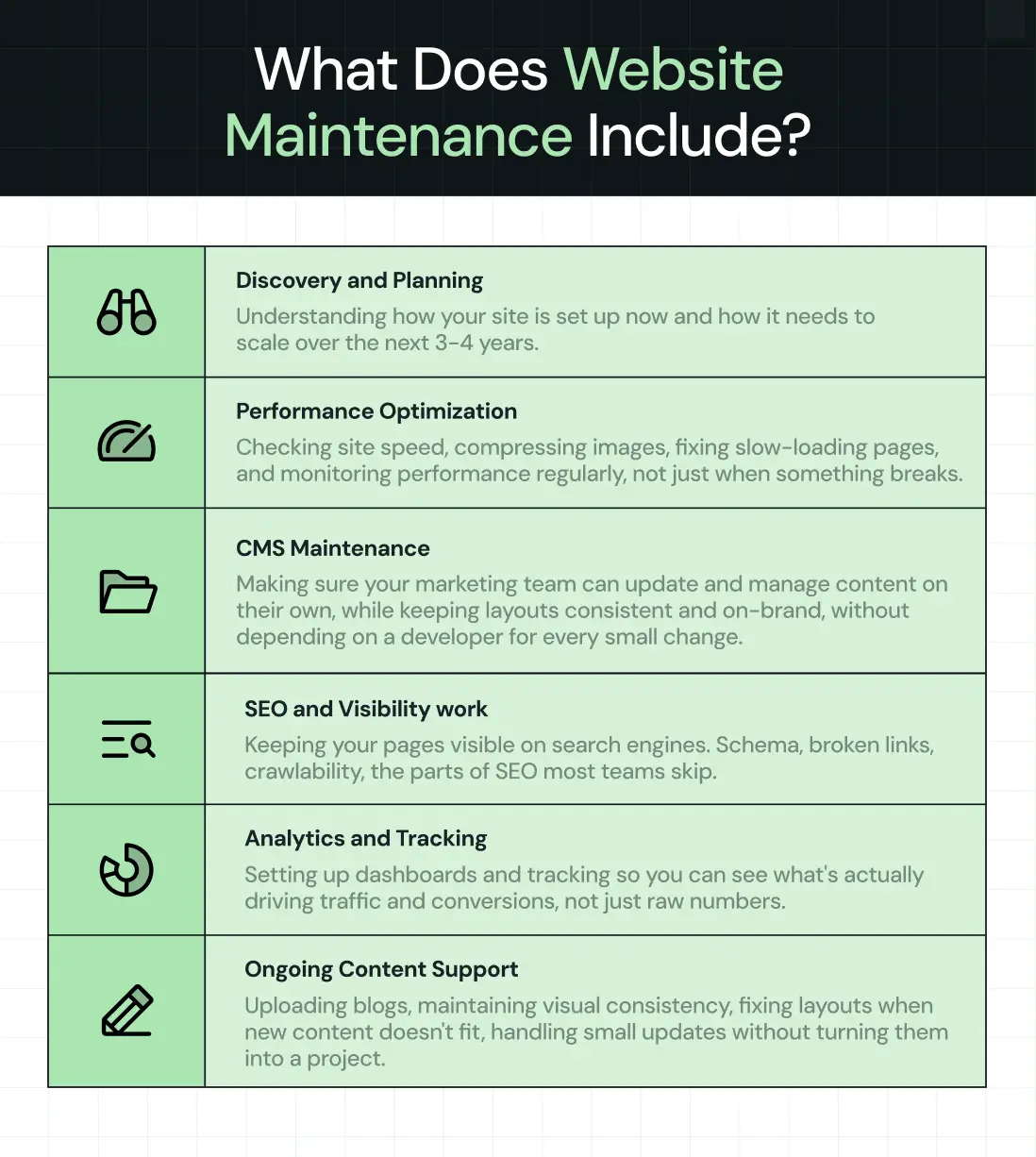
- Discovery and planning: Understanding how your site is set up now and how it needs to scale over the next 3-4 years.
- Performance optimization: Checking site speed, compressing images, fixing slow-loading pages, and monitoring performance regularly, not just when something breaks.
- CMS maintenance: Making sure your marketing team can update and manage content on their own, while keeping layouts consistent and on-brand, without depending on a developer for every small change.
- SEO and visibility work: Keeping your pages visible on search engines. Schema, broken links, crawlability, the parts of SEO most teams skip.
- Analytics and tracking: Setting up dashboards and tracking so you can see what's actually driving traffic and conversions, not just raw numbers.
- Ongoing content support: Uploading blogs, maintaining visual consistency, fixing layouts when new content doesn't fit, handling small updates without turning them into a project.
When Should You Choose One Partner for Website Design and Maintenance
Choosing one partner for website design and maintenance services makes sense if:
1. Your website changes frequently
A single partner managing your website end-to-end means they know your product inside out. This rules out the chance of "why was this built this way?" questions before every update. Since they know the reasoning behind every design, messaging, and conversion decision, things get shipped faster with less chance of breaking.
Case in Point: After revamping the website for Z47, one of India's top VCs backing companies like Ola and Razorpay, we handled ongoing page updates and new additions. Because we built the site, there was no learning curve.
They sent content, we turned around UI design in two days, got approval, and shipped dev in another two with feedback built in. Even UI assets like graphics and visuals moved just as quickly because the design system was set. We just needed direction. No re-onboarding calls or "why should we do this?" discussions.
Here’s a LinkedIn post from Ayush Barnwal, Partner and Head of Design at ThunderClap, about results we delivered for Z47 post revamp:
2. You're planning for growth, not just maintaining what’s there
When the same team handles development and maintenance, it's not a one-time project for them. They make decisions with future growth in mind.
ThunderClap's WebFlow development associate, Jazz Michael, confirms this:
"We ask how they see themselves in the next three or four years, so we develop and maintain the site in such a way that it's very scalable and future-proof."
Case in Point: Unbound came to us for maintenance with five separate sites, one main site, and four event pages. Their team needed two people just to manage updates. We spotted the real issue: the structure itself wasn't built to scale.
We consolidated everything into one site, cutting hosting costs and reducing their internal workload. That kind of structural decision only happens when maintenance is focused on growth rather than just keeping the site running.
3. You need maintenance that drives results, not just fixes issues
Website maintenance that actually moves the needle isn't about patching bugs or updating content. It's about making changes that improve performance, conversions, traffic, and user behavior. When one team owns both design and development, strategic decisions that require both design thinking and technical execution happen without coordination overhead.
Case in Point: roommaster needed forms updated across 30+ pages to track user behavior and improve conversions. Because we handled both sides, we repositioned forms from separate pages to in-page pop-ups (design decision) and set up page-level tracking in their CRM (technical implementation).
The site saw an 80% increase in demo requests and organic traffic. That kind of change happens fast when the team knows the reasoning behind the work, not just what needs to be done.
Here’s a LinkedIn post from Ayush Barnwal, Partner and Head of Design at ThunderClap, where he breaks down roommaster’s website revamp strategy:
4. You want clear ownership and accountability
One team takes complete ownership. There's no "is this a dev or design issue?" discussion. They see the problem, own it, and work to resolve it as fast as possible. With two vendors, this level of clarity is nearly impossible and usually involves a lot of blame game that slows everything down.
For instance, here’s how Aditi Sharma, Director at Zluri, describes working with us:
“ThunderClap team is a delight to work with! They don't feel like vendors but an extension of our team itself. The work quality is top-notch and all deliverables are completed within time.”
Case in Point: After their revamp, we handle ongoing design and development requests for ClearlyRated, including landing pages, reports, guides, and templates. Since the site and design system were built during the revamp, new work doesn’t need much ramp-up.
This means even if the designer working on a request isn’t available the next day, someone else on the team can pick it up and complete it. The design system is documented well enough that they can continue exactly where the other person left off. That continuity only works when the same team owns both design and development.
{{specficBlog}}
When Should You Choose Two Partners for Website Design and Maintenance
Choosing two partners for website design and maintenance services makes sense if:
1. Your website doesn't require ongoing design updates
You can outsource website maintenance to a different vendor if your website only requires occasional updates with minimal to no design changes. Changes of this sort include quarterly content refreshes, security audits and checks, minor bug fixes, or annual compliance updates. Since these are largely dev-led and don’t require deep product context, most teams can handle them.
But most B2B sites don't work this way. They need regular content updates, new pages, layout adjustments, the kind of work that touches design even when it seems purely technical.
A separate maintenance team can still run things if the web design agency provides a proper handoff: CMS walkthroughs, documented components, field notes, and basic version control. If that’s missing, the new team ends up reverse-engineering design decisions every single time they touch the site.
2. You have an internal project manager
With someone to coordinate between teams, outsourcing website design and maintenance to different partners can work. This person serves as the middle layer, passing context between teams, managing timelines, translating design intent into technical requirements, and ensuring nothing gets lost in handoffs.
The project manager needs to understand both design and development well enough to ask the right questions and catch misalignments early. Without that, updates stall and even simple changes stretch from days into weeks. The maintenance team waits for design clarification while the design team waits for technical feedback.
3. Budget is a concern for you
If the budget's tight, it makes sense to hire a premium design partner to build the site, then shift to a lower-cost maintenance team after launch. It lightens the load financially, especially if updates are occasional.
But this only works if the handoff is solid with clear design documentation, component guidelines, and walkthrough videos. Without that, the maintenance team is left guessing. Anything beyond basic edits slows down. Small changes start breaking consistency. Design work gets avoided because no one wants to “mess it up.”
What feels like savings upfront can quietly turn into rework, fixes, and patch jobs later, the kind that cost more time and money than you planned for.
How to Choose the Right Website Design and Maintenance Partner
Once you shortlist web design and development agencies based on their expertise and social proof, get on discovery calls with each of them. During the calls, ask the following questions to understand if they're just vendors or strategic partners that work as an extension of your team, not just until the website goes live, but beyond that as well.
1. What does their maintenance actually include?
Don't just ask if they do maintenance, ask what's in it. Real maintenance goes beyond bug fixes and security patches. It should include performance monitoring, CRO optimization, analytics dashboards, SEO implementation, and ongoing optimization.
Ask them to break down what happens month by month. Are they actively checking site speed? Setting up conversion tracking? Building dashboards so you can see what's actually working? Compressing images and cleaning up backend structure? Or are they just waiting for you to report problems?
If their answer is vague or focuses only on "keeping things running," that's upkeep, not maintenance. Look for website maintenance agencies that actively improve your site over time, not just maintain its current state. The difference shows up in results; one keeps your site stable, the other makes it perform better.
2. Do they think strategically or just execute?
Most agencies do what you ask. Better ones pause to question whether it’s the right move first.
One way to gauge this is through how they respond to your requests. For example, when you describe a feature, page, or change you want made, pay attention to the questions they ask. Do they ask why you need it? Do they try to understand the problem behind the request? Or do they simply move straight to execution?
You can also ask about situations where they’ve pushed back on a client request. What was the context? What alternative did they suggest? Their answer usually reveals whether they think beyond deliverables.
It helps to test long-term thinking too. Do they ask where your site needs to be in the next 3–4 years? Do they consider scalability early, or only solve for what’s in front of them?
If they're not asking these questions during discovery, they're treating your site like a task list, not a growth engine. Strategic partners help you avoid expensive rebuilds by thinking ahead.
3. What's their operational setup?
Good maintenance agencies have clear workflows and processes. They offer everything to ensure seamless collaboration. This includes:
- Dedicated point of contact - One person assigned to your account, not getting passed around.
- Shared task tracker - You can see what's being worked on in real-time without emailing for updates.
- Regular syncs - Weekly or bi-weekly calls, even when there's no active work, so nothing goes silent.

For example, at ThunderClap, we begin the maintenance process by getting on onboarding calls to understand the current setup, then set up dedicated task boards for both teams to access, schedule weekly sync calls, and run internal QA before the client sees anything.
If the agency can't clearly explain how you'll work together day to day, coordination will be messy.
{{specficService}}
4. What kind of results have they driven for past clients?
Ask for a rundown of maintenance projects where they've driven strategic results. If their maintenance work is limited to "uploaded 5 blogs" and "fixed broken link," that tells you something.
Look for specific details that move the conversion needle, like building custom dashboards, optimizing conversion flows, restructuring sites for better scalability, and implementing tracking systems. The kind of work that shows they're thinking about growth, not just keeping the lights on.
For example, a specific result we recently achieved for roommaster was introducing a custom integration not natively supported by HubSpot during their migration from Salesforce to HubSpot, like auto-selecting country fields based on IP address and adding custom form logic to improve data accuracy and user experience.
Finding the Right Website Design and Maintenance Partner
Whether you choose one partner or two, one thing is non-negotiable: find a team that thinks strategically, not just executes tasks.
If your maintenance partner isn't curious enough to ask why you need a change, they'll never think long-term. They'll keep your site running, but they won't make it better. And if your site needs regular updates and strategic improvements, including conversion optimization and performance monitoring, it makes sense to work with the team that designed it. They already know the product, design system, and website strategy behind it.
If you're considering ThunderClap for website design and maintenance services, here's why 88+ B2B brands across SaaS, VC, AI, HR tech, and fintech, including Storylane, Factors, Zamp, FillHQ, and Razorpay, chose us:
1. Proven B2B expertise. We design for the B2B buyer journey, meaning every decision from messaging, website copy, layout, to CTA placement is tied to conversions. We've helped brands reposition for upmarket segments and new geographies.
For instance, Factors came to us when they needed to attract enterprise buyers in the US. We repositioned their messaging, redesigned key conversion paths, and helped them look the part for that audience.
- In-house PMM team + international design talent. We combine strategic product marketing expertise with world-class design standards. Our in-house PMMs ensure messaging clarity while our international designers deliver premium, conversion-focused visuals that stand out in crowded markets.
- 30 days of free post-launch support. To ensure your website achieves the results you wanted, we stay on for a month after launch to make tweaks, optimize for performance, and fine-tune conversions based on real user data.
{{ctaBlock}}
FAQs
1. What is website design and maintenance?
Website design and maintenance covers both building the website and keeping it updated after launch.
This includes UX/UI design, development, CMS setup, and ongoing work like content updates, performance improvements, SEO fixes, and security checks so the site stays relevant and conversion-ready over time.
2. Why is ongoing website maintenance important after launch?
Most B2B websites need regular updates after launch, new pages, content additions, and performance improvements. Behavioral analytics also starts coming in, showing what’s working and what’s not. That’s what guides future changes, so tracking and refining the site becomes essential.
3. Can the same agency handle both website design and maintenance?
Yes, and it’s often the most efficient option. The same team already understands the design system, site structure, and product context, so there’s no second-guessing why something was designed a certain way. This way, they can focus on improving performance and conversions, not just handling upkeep.
4. Does a Webflow website require maintenance?
Yes. Webflow websites still require maintenance. While the platform reduces heavy development work, you still need to keep the site functional and growth-ready by updating the CMS, improving SEO, monitoring performance, integrating with other systems, and making design tweaks. Many businesses bundle website design, hosting, and maintenance with a single partner to simplify ownership and ongoing updates.
5. Is website maintenance only technical work?
No. Website maintenance goes beyond technical upkeep. It includes design updates, CRO improvements, content expansion, analytics tracking, UX enhancements, and SEO work, especially for B2B websites that evolve as the business grows.
6. In-house vs outsourced website design and maintenance: Which is better?
It depends on scale and internal bandwidth. In-house teams work well when updates are frequent and closely tied to product or marketing. Outsourced website design and maintenance services make more sense when you need specialized design, development, and CRO expertise without building a full internal team. Many companies also run a hybrid setup, internal teams handling day-to-day updates while external partners support larger initiatives.
7. What is website design and maintenance?
Website design and maintenance is the process of building a website and keeping it updated after launch. It typically includes UI/UX design, CMS setup, content updates, CRO and SEO improvements, and performance tracking to ensure the website stays optimized for performance and conversions.
8. How much do agencies charge for website design and maintenance?
Agencies usually charge $10,000–$20,000 per website design. Ongoing maintenance is often billed hourly, starting at around $50 per hour. Pricing still varies based on requirements, CMS setup, integrations, and content needs.



.webp)
Browse Similar Articles

Leading 5 SaaS Branding Agencies in Florida (That Actually Understand SaaS Growth)

.svg)

How to Turn Your B2B Website into a Self-Serve Growth Engine? (PLG Ready in 2026)

9-Step Website Copy Audit Checklist to Improve Conversions (Examples from Top B2B Brands)

.webp)
How to Choose the Right Fintech Web Development Company for Your Business

Top B2B Website Design Principles That Turn Visitors into Qualified Leads

%20Audit%20That%20Actually%20Improves%20Revenue.webp)
How to Do a Conversion Rate Optimization (CRO) Audit That Actually Improves Revenue
Web Design Agency vs. Freelancer vs. In-House: What Actually Works in 2026
5 CRO Agencies in London and How to Choose the Best CRO Agency for Your Business


The Ultimate Fintech B2B Positioning Guide for 2026 (That Actually Drives Conversions)
Mapping the B2B Buyer Journey to Improve Conversions Across Every Touchpoint
.webp)
7 Best Website Maintenance Companies in India for Growth-Led B2B Teams (2026)

.webp)


8 Best Healthcare Website Design Agencies for HIPAA-Compliant Sites in 2026

How to Find the Best Web Design Company in Houston, Texas for B2B Brands (6 Best Picks)

Positioning That Wins: How to Make Complex B2B Products Clear and Compelling
The Step-by-Step Website Redesign Process B2B Teams Use to Increase Conversions (Without Killing SEO and Pipeline)
7 Best Video Production Agencies for SaaS Product Walkthroughs and Feature Videos

How to Choose the Best B2B Website Maintenance Company: 9 Questions to Ask Before You Hire One


How to Choose a Web Design Company in San Francisco in 2026 (with Examples)

10 Best Web Design Companies in Florida in 2026 and How to Choose the Right One
How to Use Brand Storytelling on Your Website to Close More B2B Deals and Build Buyer Trust
SaaS CRO Best Practices: What High-Growth Brands Do Differently to Win Conversions

How a Rebranding Agency Can Redefine Your B2B SaaS Identity and Boost Pipeline
B2B Marketing Trends in 2026 That Directly Influence Pipeline and Revenue

Top 7 Video Marketing Agencies Driving B2B SaaS Brand Awareness in 2026
Why Partnering with a B2B Brand Positioning Agency Accelerates Market Differentiation

The Complete Website Redesign Checklist for B2B SaaS Teams Ready to Scale
.avif)
10 Best Webflow Development Agencies in India for 2026 (In-Depth Review)

10 Product Marketing Companies Powering the Fastest-Growing SaaS Brands in 2026
Website Copywriting Services vs In-House: What's Right for Your Business?

How to Choose a Marketing Agency That Understands B2B SaaS Growth Metrics

How to Choose a Video Marketing Agency That Understands B2B Storytelling
Outsourcing Web Design: Cost-Benefit Analysis for Mid-Market & Enterprise Brands

From Leads to Lifetime Value: How Growth Marketing Agencies Scale SaaS Revenue
Build a B2B Website Strategy That Aligns with Sales and Marketing Goals
Webflow vs WordPress: Which Platform Is Better for Your Business Website in 2026?
Fintech Web Design That Builds Trust: 8 UX Principles Every Fintech Site Needs
Optimizing for Intent: How B2B Website Messaging and UX Changes Help Capture Top-Funnel Buyers

12 Best B2B Web Development Agencies in the US to Build Scalable Websites

From Audit to Action: 8-Step Process to Optimize Your B2B Website Strategy for 2026 Buyers
How to Design a High-Converting Landing Page from Scratch (2026 Edition)

From Click to Customer: Proven Landing Page Conversion Optimization Techniques

How to Write Website Copy That Converts: A Step-by-Step Guide for 2026

How to Optimize a Landing Page for Maximum ROI: A Step-by-Step Breakdown

AI Landing Pages That Convert: 7 Design Principles Every AI Platform Should Follow
From Traffic to Pipeline: B2B Website Growth Strategy for Scaling Teams




Interested in seeing what we can do for your website?



.webp)
